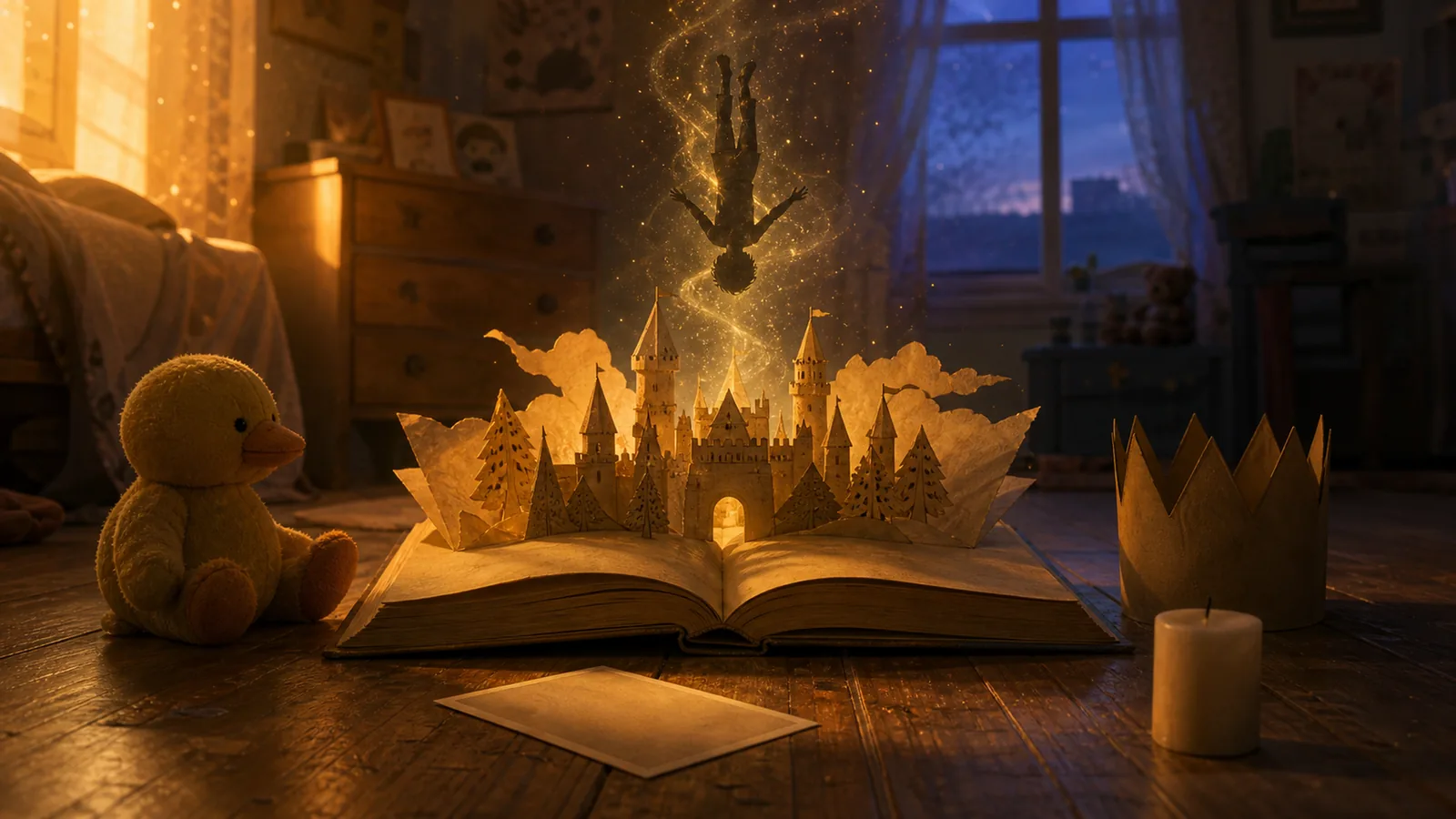
The WONDERfools Episode 4 Review: A Fairy Tale Without a Happy Ending Cracks Open Ju-ran's Origin
What happens — the short version (spoilers)
- A storybook cold open shows deaf orphan Ju-ran hearing for the first time, then the orphanage burns and Dr. Ha Won-do tells four kids to hide as men drag him away.
- Kim Jeon-bok meets the paroled Dr. Ha, who reveals the Child of Eternity can't die but feels every death as adults in lab coats kill a small boy on repeat.
- Chae-ni, Son Gyeong-hun, and Kang Ro-bin corner Lee Un-jeong and draft him as their reluctant Sensei; he warns that being known for powers means losing everyone you love.
- Powers surface clumsily during training: Chae-ni teleports into a bar's koi pond instead of Norway, and Gyeong-hun ends up stuck to a ceiling.
- The Church of Eternal Salvation walks into City Hall, then corners and helps kill variant 3972 in a quarry while chanting hymns.
- During a bus ambush by Ju-ran's Wunderkinder siblings, panic for Ro-bin finally triggers Chae-ni's teleport and lands her under the real aurora.
- Chae-ni meets the grown Ju-ran in the snow, who greets her flatly: 'A defective product?'
Telekinesis announces itself by sticking a magician to the ceiling, a deaf girl hears warmth for the first time before everything burns, and Eun Chae-ni sees the aurora at last — not from Norway, but from the side of a moving bus.
For three episodes The WONDERfools has been quietly building a question it refuses to answer directly: what was done to the children of Haeseong-si twenty years ago, and which of them grew up to be looking for Chae-ni. Episode 4 opens with the answer in the most disarming form possible — a fairy tale, told in a child’s storybook register, that breaks before the second commercial.
The cold open puts a face on the season’s buried trauma
A little girl who can’t hear is asked, gently, “Ju-ran. Can you hear my voice now?” And then she does. The flashback narrates itself: it was the first warm sound I’d ever heard in my life. The framing is pure children’s-book, all soft light and tender close-ups.
Then the title card lands: But the fairy tale did not have a happy ending.
The orphanage is on fire. Father — Dr. Ha Won-do, the scientist of the year from those clippings Lee Un-jeong was staring at in Episode 1 — tells the four surviving kids to run, hide their identities, and wait for him to find them. Then men in suits drag him out of the inferno, and the kids start their lives in the kind of hiding the show has been hinting at since Lee Un-jeong’s deadpan recital of disappearances. The whole thing lands in under five minutes. Episode 1 spent ninety minutes earning the question; Episode 4 rolls back the curtain and shows the answer was a Christmas-storybook tragedy all along.
The Child of Eternity is the cruellest piece of lore this show has dropped
The mid-flashback adult sequence resets the chessboard. Kim Jeon-bok — Chae-ni’s grandmother, given a back-room of her own at last — meets a paroled Dr. Ha Won-do and refuses to flinch when he asks where the Child of Eternity is. She tells him that child is dead. He tells her, calmly, the Child of Eternity cannot die. Then we see what he means: a small boy being killed, over and over, by adults in lab coats taking notes. Just because you can’t die doesn’t mean you can’t feel pain — each and every time, each and every moment of death.
Episode 1 made the WONDERfool premise feel like grace given to the wrong person. Episode 4 says: for at least one of these children, the gift was a torture chair with no exit. Ha Won-do calls Kim Jeon-bok’s sheltering of orphans playing make-believe. She calls his immortality project what it was.
Lee Un-jeong’s training session is one of the funniest things the show has done
After the cold open, you’d expect the rest of the hour to sit in that minor key. Instead we cut to Chae-ni, Son Gyeong-hun the Sap King, and Kang Ro-bin (a.k.a. Train Wreck, the mayor’s son) ambushing Lee Un-jeong on his Friday off and demanding that he be their Sensei. They have decided he is now the leader of their “fantastic contingency.” (He patiently corrects: contingency is an unpredictable future event. She meant contingent.)
What makes the bit work is that Un-jeong does not soften. His pitch, given inside a shipping container at the dump, is grim: the idea that anyone likes people with special abilities is a fantasy. If anyone finds out — friends, family, the people you love — you might not ever be able to see them again. He says it while looking at three adults who treated his powers as a party trick five minutes ago, and the show lets the line do its work without scoring it. The trio’s response is to ask if they get a uniform with red Superman underwear. He says yes if Ro-bin designs it himself.
Un-jeong has been the clearest figure in this show from the start, and Episode 4 puts him in scenes that match that gravity. Repetition. The only way is to practice and pay attention. The methodology of someone who figured out his own ability the hard way.
The teleportation comedy keeps undercutting the horror, on purpose
Chae-ni’s first solo attempt to teleport to Norway lands her instead inside an Aurora-brand bar in Haeseong-si, sticking her face into a stranger’s koi pond. The Sap King laughs that he isn’t surprised — it’s named Aurora — and the show keeps doing this all hour, letting power-discovery be small and embarrassing instead of cinematic.
The Sap King’s rule reveals itself under the same training session: he sticks to things only when his heart is calm. The faster he runs, the more his body becomes a normal body again. The proof of concept is brutal — Ro-bin throws him into a ceiling beam and walks away with the line I threw you up there by accident, but you got yourself stuck up there.
And then Ro-bin’s power surfaces, visibly, during a magic-trick session — and Son Gyeong-hun, performing the bit, ends up stuck against the ceiling himself, asked moments later whether he’d noticed he was up there. The fairy tale is leaking into civilian life, and somebody who shouldn’t is going to notice. Un-jeong’s earlier warning is doing real plot work here — the show set up the cost before charging us for it.
The Church arrives at City Hall and the apocalypse stops being theoretical
The quietest dread of the hour belongs to the Church of Eternal Salvation, last seen on a flyer in Episode 1, walking into City Hall in matching uniforms and volunteering for the Friday street-cleanup campaign. Kim Pal-ho’s representative tells Un-jeong, with a small smile, that belief is nothing, and knowledge is all. The Church does not believe the apocalypse is coming. They know when, where and how the end will happen, through our shepherd.
Episode 1’s apocalypse-on-a-flyer joke becomes, in Episode 4, an organized faction with municipal sign-off. And then the Church does the thing the show has been telegraphing since Episode 3: they corner number 3972, the variant introduced last episode, and Wunderkinder pursuers cut him down in a quarry while the Church chants hymns over the violence. Number 3972, your apocalypse is here, without any mercy or salvation. The hymn is in major key. The kill is matter-of-fact. The church and the missing-children plot are the same plot, and here is the proof.
Chae-ni finally sees the aurora — and the trap is already closing
Chae-ni and Ro-bin run to help Un-jeong, ambushed by Ju-ran’s older Wunderkinder siblings on a city bus. Mid-rescue, sheer panic cracks open Chae-ni’s pattern: when she’s terrified for someone she loves, she goes. She teleports out of the chase entirely and lands, of all places, under the actual aurora borealis. Park Eun-bin plays the moment like a child seeing snow. Can you believe it? It’s my first time outside of Haeseong-si. The promise of Episode 1 — that this dying woman would never get her bucket-list trip — gets paid off with one line: It’s the real aurora.
And then the show pulls the rug. Chae-ni meets a small Wunderkinder girl in the snow — the same girl the cold open opened on, grown up. Ju-ran’s first words to her, deadpan: A defective product? The fairy-tale framing returns, only this time Chae-ni is in it, and the storybook-narrator voice has been retired.
The episode title, Boon the King Duck vs Wunderkinder, looked like nonsense in the cold open. By the end it’s the whole show in five words. Boon the King Duck is the story Dr. Ha told his children to make them feel chosen. The Wunderkinder are what those children became while they grew up hunting the one of them who can’t die. Chae-ni walked into both books without knowing she was a character.
Tiny details worth clocking
- Number 3972 is the boy Kim Jeon-bok unlocked the door for during the orphanage fire — the show’s earliest act of mercy and its biggest current liability. Dr. Ha’s surviving kids treat him as competition for Father’s favor; the Church treats him as prey.
- Mr. Choi told me everything before he died. Dr. Ha drops this in passing to Kim Jeon-bok. Choi Yeong-jun was the man she called at the end of Episode 2. The show is quietly burning through her allies.
- Ho-ran is the one of Dr. Ha’s surviving kids losing faith. Everything Father does, he does for a reason — yes, but what I don’t know is if it’s for our benefit. Watch her in the back half.
- The bus chase ends with Chae-ni teleporting Ro-bin away from a knife to the throat. These characters are heroes in increments, not montages.
Verdict
“Boon the King Duck vs Wunderkinder” is the hour where The WONDERfools lets the season’s lore step out from behind the curtain — and then trusts its comic register enough to keep three of its leads inside a shipping container arguing about Uri Geller and Joseon Dynasty scapegoats while the world’s worst church kills a man in a quarry. The Ju-ran cold open is the most affecting four minutes the show has put on screen, and the Chae-ni-under-the-aurora payoff is the warmest. That both happen in the same episode tells you how confidently Yoo In-shik is calibrating the tonal swings.
What matters here is that the WONDERfools never get a heroic register. Chae-ni discovers her pattern by panicking. The Sap King discovers his by running. Ro-bin discovers his by being a brat. None of them get a costume montage. They get a stranger in the snow asking if they’re defective, and the answer is almost yes.
Rating: 8.6/10
More episodes from The WONDERfools — Defective superpowers in 1999 Haeseong, episode by episode. Jump to any episode in the season:
Where to go next
Reviewed by Mira Vance · QuizFandom Editor & Lead Reviewer. Every rating is an honest per-watch assessment from the desk that also writes the quizzes — not a press release rehash.