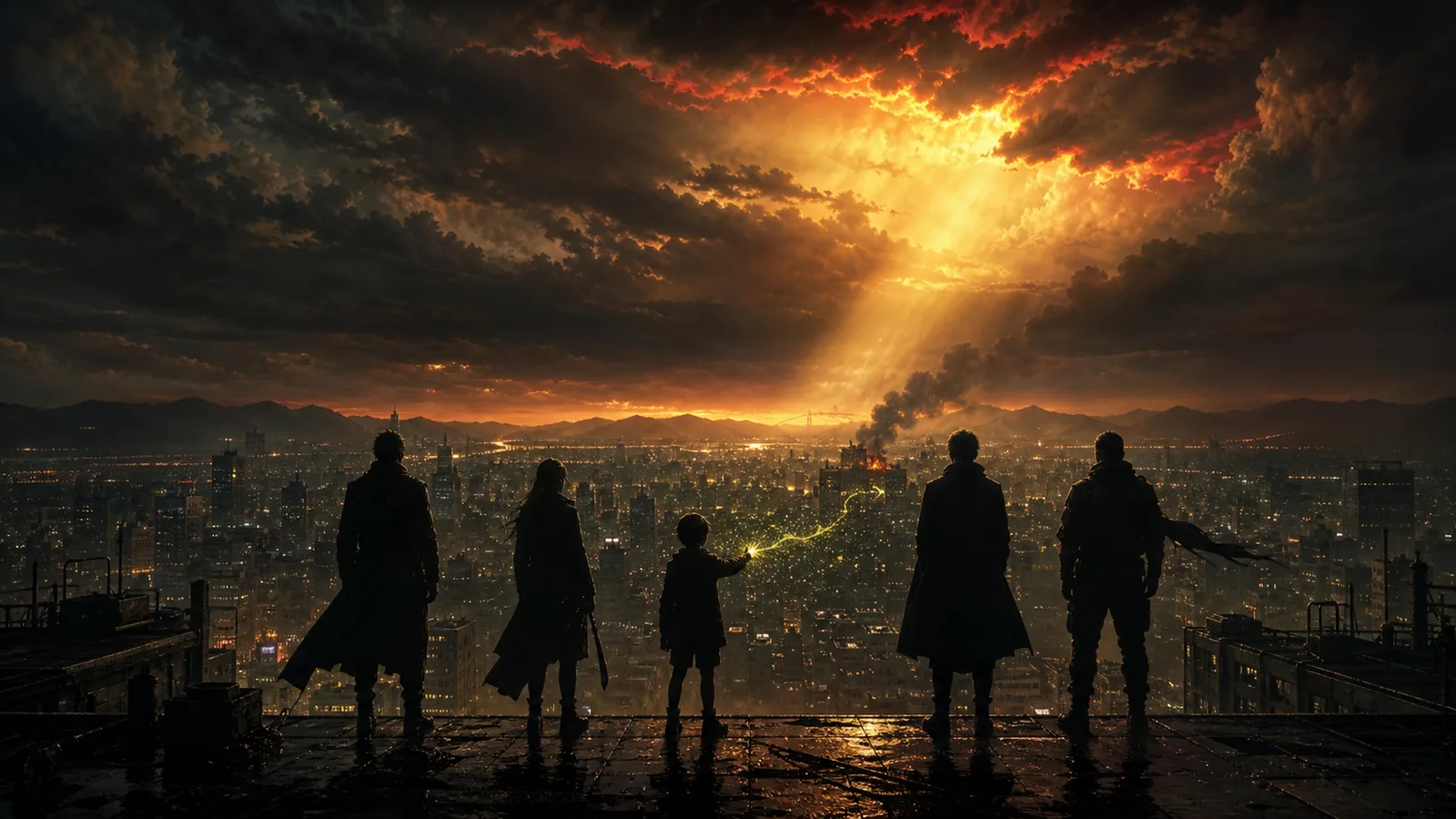
The WONDERfools Episode 8 Review: The Apocalypse Comes for Haeseong on a Mascot Float
What happens — the short version (spoilers)
- Right after Pal-ho's death, the family-pressure speeches take over: the Nightmare (now calling himself Train Wreck) grieves over his daughter, and Chae-ni snaps back that he should just tell his wife the truth.
- Dr. Ha Won-do finally confesses to Lee Un-jeong that the orphanage experiments had no real reason beyond a chemist's desire to live longer, and that of 72 children, Chae-ni is the one Child of Eternity. Un-jeong stabs him.
- The Church's midnight fireworks turn out to be a cover; the real apocalypse is phenol rigged to the giant inflatable Yang-soon mascot floating over the parade. Ho-ran uses mind control to send it flying, and the WONDERfools battle on top of it.
- Ho-ran's dying sister Ju-ran hands her a revenge order before she dies; Ho-ran's grief drives the chaos, until grandmother Kim Jeon-bok (the woman who unlocked the orphanage door 20 years ago) reaches her, and Ho-ran wishes things had been different.
- Ro-bin tosses Chae-ni and the Sap King onto the phenol-rigged float; the Sap King locks himself to it and Chae-ni teleports the whole thing far away, sacrificing herself to save the city.
- On January 1, 2000, the whole town remembers only a freak weather event. No one knows Chae-ni saved them, and the Nightmare's family treats him like a delusional man again. Chae-ni returns weeks later to her own 49-day funeral, and Sensei catches her, complaining she smells.
- A post-credits tag at the Church of Eternal Salvation shows blood on the floor and someone ordering a search, the lone Season 2 hook with Ho-ran ambiguously alive.
The Church gets its end-times, the family-pressure speeches hit harder than the powers, and a season that started with a dying woman screaming at a flyer-pusher ends with a town that forgets she ever saved it.
A finale earns its title or it doesn’t, and “The Guardians of Haeseong City Part 2” spends most of its 80 minutes on a question the show has been quietly daring its leads to answer since Episode 4. Lee Un-jeong told three adults inside a shipping container that the world hates people with abilities and that being a hero gets you disappeared. Eight hours later, those same three adults are standing in front of a flying mascot float at midnight on December 31, 1999, deciding whether the city they grew up resenting is worth a death they may not come back from. The episode’s answer to its own title is small and unsentimental: a guardian is whoever shows up when no one will believe what they’re showing up for.
The opening minutes are a thesis in three voices
Kim Pal-ho’s body has been on the floor for less than a scene, and the show goes straight to the family-pressure beats that have carried the whole season. The Nightmare — Train Wreck now, by his own announcement — sits on the floor of the Church and recites the line that turns out to be the episode’s center of gravity: I might be a broke loser, but I’m also a husband, and a father. The head of my family. Cheong is so young. Park Eun-bin’s Chae-ni does her sharpest counter all season — Tell her. — and the script lets it sit, because none of these people can tell anyone the truth and they all know it.
The parallel with Episode 1’s premiere monologue is the load-bearing structure here. Chae-ni was the one who took the apocalypse personally when nobody else would. Now every WONDERfool around her gets that monologue in turn — the Nightmare grieving a CD player he never bought his daughter, the Sap King refusing to keep score, Chae-ni herself slipping into the same nervous chatter she used to do her seven-times tables to prove her brain still worked. The premiere’s tirade against a faceless street preacher has finally split into four separate panic attacks, all delivered to each other.
The Ha Won-do confession is the lore reveal the show needed to land
For seven episodes The WONDERfools has been holding back its origin scientist. The flashback in Episode 4 told us the orphanage tragedy was real. The Episode 2 newspaper clippings told us Dr. Ha was the man behind it. Episode 8 finally lets him speak, and the speech is, by design, the most banal villain monologue Kang Eun-kyung and Heo Da-joong could have written.
Why these children, Lee Un-jeong asks. No particular reason, to be honest. Why the experiments. The trivial human desire to live longer and longer lives. Why the eternal heart drug. Life is governed by coincidence and trivial, insignificant desires until we return to the void. The numbers are deliberate cruelty — out of 72 children, half died without manifesting, half of the manifesters died from their mutations, and exactly one carried the Heart of Eternity. The Child of Eternity is, of course, Chae-ni. The man who tortured a small boy to death on repeat to prove that point — Episode 4’s worst image — is the same man now offering Lee Un-jeong a partnership in the next stage of evolution.
Un-jeong plays the scene like a man who has waited twenty years to be told it was for nothing, and then has to live with being told it was for nothing. So all of our suffering doesn’t matter to you? The line could read flat. He delivers it like a final answer he was hoping to be talked out of. When he stabs Ha Won-do, the catharsis is withheld. What a shame. I was always very fond of you. Even the death is processed as a transaction.
The parade sequence is the show’s strongest staging
Yang-soon, Haeseong-si’s piggy mascot, has been a background gag since Episode 5. The finale builds the entire apocalypse around her. The Church has sponsored a 100 million won fireworks show at midnight. The mayor, Ro-bin’s father, has agreed to it because the donation also bought a giant inflatable Yang-soon to float above the parade. The Nightmare runs through the rehearsal screaming the truth — we’re all gonna die, when the clock strikes 12:00 everyone here is gonna vanish in an instant — and the mayor’s response is one flat sentence: whatever floats your boat, but not here. The angry old man from Episode 1, the one who reported sideways-blinking crows and winking carp, gets thrown back in the Nightmare’s face. Haeseong-si has been refusing to believe him for an entire season. The finale gives him one chance to be heard and the town turns its mascot to face the sun.
Once the float starts flying — courtesy of Ho-ran’s mind control, slipping mid-festival from the puppeteered Yang-soon driver into the WONDERfools themselves — the biggest action sequence of the season unfolds on the most embarrassing prop in Haeseong-si. Train Wreck takes the side with more people. Ro-bin learns to throw his power without an insult. The Sap King King-of-the-Saps-es himself onto the side of a tank rigged to detonate phenol over the town. The way the apocalypse actually arrives here is exactly as undignified as the residents of Haeseong-si have been treating it for an entire season. Pal-ho’s vision of the non-believers thrown into the fires of hell when they die, and those who believe gain eternal life as Wunderkinder gets delivered through a 30-foot pig face. That’s a bit, and it’s also the season’s last argument: the apocalypse you ignore is the one that flies right over your head.
Ho-ran’s last scene is the season’s quietest tragedy
The Pal-ho-Ho-ran-Ju-ran sibling thread has been the most painful corner of the season since Episode 4’s cold open, and the finale resolves it without raising its voice. Ju-ran, after every adult around her has died, finally tells Ho-ran the truth: let’s stop this, then, sister. And then, in the most unforgivable beat of writing the season produces, Ju-ran is the one who says it to Ho-ran — Avenge us. Kill them all. Take everything they love. It is the dying sister, not the living one, who hands over the revenge order, and the living one has to carry it. Then she dies anyway.
Staging the New Year’s chaos around Ho-ran’s grief means her powers stop being a plot device and start being a feeling. The car flipping over the wall and onto Mi-hui. The crowd’s eyes glazing as she walks them out of the record store. The stabbing of Chae-ni by Sensei’s hijacked body — Cha Eun-woo gets his first scene with real menace, then Park Eun-bin shakes him out of it on the floor of an alleyway. Ho-ran’s grief is the apocalypse. The phenol is just the delivery mechanism.
When Ho-ran whispers her last wish — I wish we’d been on the same side. I wish it was all different — two of the season’s quietest setups pay off. Kim Jeon-bok, who unlocked the door for 3972 inside the burning orphanage twenty years ago, has been the woman who saved them all. You always took care of us. Me and all the other kids in there too. The finale’s last act of mercy from a Wunderkinder belongs to a girl who learned generosity from a grandmother she only barely knew.
Chae-ni saves Haeseong-si and Haeseong-si forgets her
The big stunt — Ro-bin tossing Chae-ni and the Sap King onto a phenol-rigged Yang-soon, the Sap King King-of-the-Saps locking himself to the metal, Chae-ni teleporting the whole airship away on a one-way coordinate — works as both a comic set piece and a death scene the show genuinely commits to. I said I wanted to live to see the end of the world, and it happened. But unfortunately for you, I’ve changed my mind. The apocalypse sucks. The Episode 1 monologue inverted. The dying woman who screamed at God for not letting her see the end finally sees it, decides it isn’t worth seeing, and disposes of it by hand.
The brutal twist is what comes after. The morning of January 1, 2000, the news anchors call it a powerful squall. The Nightmare’s wife and daughter remember a strange weather event. Ro-bin’s father doesn’t remember his son fighting on a flying pig. The only person who remembers the whole night — the Nightmare himself — is treated by his family exactly the way they treated him in Episode 1: as a man who hallucinates carp and crows. Why not just say you flew around wearing tights? So pathetic.
Lee Un-jeong’s Episode 4 warning has finally been collected. The idea that anyone likes people with special abilities is a fantasy. If anyone finds out, you might not ever be able to see them again. The finale’s hardest joke: the people you save can’t ever know you saved them. The WONDERfools earn their plural name in the only way the season was ever going to let them — by being the only fools in town who remember it was real.
Tiny details worth clocking
- Pal-ho’s death in Episode 7 frames the cold open as a martyrdom. The Church’s words land flat almost immediately, because the Nightmare’s broke loser, but a husband and a father speech is doing actual mourning the religious framing can’t compete with. Scoring the apocalypse with family pressure instead of liturgy is the season’s whole rhetorical move.
- The Yang-soon piggy mascot has been planted in the background since Episode 5. It’s the Episode 1 carp-and-crow joke matured into a weapon of mass destruction. Of course Haeseong-si’s apocalypse arrives inflated and adorable.
- 3972 is finally a person in this episode — Kim Jeon-bok, in the flashback of the orphanage door, tells the small boy his number and that he is free to live a long life. The four-digit-number motif from Episode 2 closes by becoming an act of grace.
- The fireworks were a misdirect. We were meant to assume for half the episode that the phenol would be in the pyrotechnic shells. The actual delivery system was Yang-soon all along, which is funnier and crueler.
- Mi-hui’s Pay your own way gift in Episode 2 pays off as a gravestone — MEMORIAL TABLET: EUN CHAE-NI — and then resurrects itself as a hot meal at the 49-day service Chae-ni walks into smelling like the desert. The grandmother who could not say the word die in Episode 1 now performs Chae-ni’s funeral and lives to take it back.
- Florala — the cosmetics brand of Episode 5 — appears on a billboard during Chae-ni’s long walk back. Small joke, but it tells us she’s been on the road for weeks.
- The closing tag — the entrances are blocked off, search every inch of this place — at the Church of Eternal Salvation is the only Season 2 hook the finale plants. There’s blood on the floor. Someone is still in there.
Verdict
The WONDERfools is two shows running in parallel. One is an apocalyptic-cult thriller about a chemist who tortured children into superpowers so he could find the immortal one. The other is a small-town K-drama about a granddaughter who couldn’t tell her grandmother she was dying. Yoo In-shik has been merging these two registers for eight hours, and the finale’s biggest argument is that the K-drama half was always the one carrying the show. The cult is dispatched with a banal monologue and a knife. The apocalypse is dispatched with a teleporter and a sticky guy. The grief Ju-ran feels when Ho-ran refuses to forgive Ha Won-do is the only thing in the finale the script treats with the silence it earns.
What “The Guardians of Haeseong City Part 2” actually answers — the question its own two-part title has been pushing on for eight hours — is what a guardian looks like in a town that won’t notice it has one. The answer: three middle-aged unemployed people, one mayor’s son, one civil servant with a battery problem, and a grandmother who unlocked a door twenty years ago. None of them get a costume. None of them get a memorial anyone but they will read. The Nightmare goes home to a family that tells him to shut up about the apocalypse. The Sap King goes back to the dump site. Ro-bin returns to the City Hall where his father bullies him. Chae-ni eats rice cakes at her own funeral and gets called freaking disgusting by her sensei in the best possible spirit. No one remembered what happened on New Year’s Eve. The town is intact because four people who never asked to be heroic chose to be anyway, and the town’s only thanks is to keep them small.
Denying the WONDERfools the public-recognition payoff every superhero finale tells you to expect separates this show from the genre it borrows from. The Wunderkinder who survived Dr. Ha became weapons because no one ever apologized for what was done to them. The WONDERfools became guardians because someone — a grandmother, a teacher with a battery, a teleporter who couldn’t get to Norway — kept showing up for them anyway. Episode 1 asked how you live a second life in a town where the first wave of people like you was made to disappear. The finale’s answer: badly, with the people who already know you’re disgusting, and you don’t tell anyone what you did.
Does this earn a Season 2 ask? Yes, but the ask is sharper than the cult plot deserved. The Church of Eternal Salvation with blood on its floor and Ho-ran ambiguously alive is a hook, sure. The real question is whether The WONDERfools can sustain its register without an apocalypse to push against. Yoo In-shik’s track record on Extraordinary Attorney Woo says the warmth is durable. The finale’s refusal to give Chae-ni any public credit for saving the city is the most generous ground a Season 2 could grow from. The world doesn’t know. The Nightmare’s wife doesn’t believe him. The grandmother who lost her granddaughter for three weeks will spend the next phase of her life pretending nothing happened. That’s the show worth coming back to.
Park Eun-bin’s Chae-ni walked into the finale a dying woman who had decided to enjoy her resurrection and walked out an extraordinarily tired one who had been to a desert and back. The post-credits beat — Sensei catching her in the middle of his work shift, telling her she’s a little late — is the only quietly romantic moment of the season, and it lands because every second of restraint leading up to it has been earned. He was a man who threw her into a truck to confirm her ability in Episode 2. Eight hours later, he’s the only person whose memory of her is intact, and he’s complaining she smells. That’s a love story this show can keep telling.
Rating: 9.0/10
More episodes from The WONDERfools — Defective superpowers in 1999 Haeseong, episode by episode. Jump to any episode in the season:
Where to go next
Reviewed by Mira Vance · QuizFandom Editor & Lead Reviewer. Every rating is an honest per-watch assessment from the desk that also writes the quizzes — not a press release rehash.