Avatar: The Last Airbender S2 Episode 3 Review: "City of Walls and Secrets" — Joo Dee seals the war away, Aang trusts Long Feng, and Lake Laogai opens under Sai
What happens — the short version (spoilers)
- Toph drills Aang in earthbending while Iroh teaches Zuko how lightning can pass through the body.
- The Boulder and Xin Fu chase Toph, and Aang wins a fight without mastering the lesson he needs.
- Ba Sing Se imprisons the Omashu refugees in comfort, and Joo Dee insists there is no war in the city.
- Long Feng offers gifts, shelter, and a royal path that quietly keeps the Avatar contained.
- Sokka learns Suki has left while Katara searches for golden nettle to help a sick child.
- Cactus juice sends Sokka back to Yue, Aang finally earthbends after a "half-atar" insult, and Sai is taken to Lake Laogai.
Avatar: The Last Airbender* Season 2 reaches Ba Sing Se, the safest city in the Earth Kingdom, and safety quickly starts feeling like a softer kind of prison. "City of Walls and Secrets" splits its pressure three ways: Aang cannot make earth move until Toph finally makes him stand still, Sokka cannot move past Suki until he says Yue's name, and Ba Sing Se cannot protect refugees without hiding the war that made them refugees. Instead of one big battle, the story follows systems that smile while closing doors. Everyone gets inside the walls, and the walls keep answering for them.
Toph drills Aang into failure, while Iroh teaches Zuko how to let lightning pass through him
Aang’s earthbending education opens with him begging Momo to save himself, which tells you roughly how well the lesson is going. Toph calls him less stalwart than a possum chicken, assigns hop squats, and hears Katara’s plea for positive reinforcement only long enough to save it for the day Aang does something positive.
The joke has a point. Toph keeps asking Aang to hold his ground, and everything in his body wants escape: glider, air, motion, distance. That makes the cut to Iroh and Zuko sharper than a simple parallel lesson. Iroh names earth as strength and air as freedom, then teaches Zuko a technique he built by watching Waterbenders. Lightning cannot be made safe by meeting it head-on. It has to enter one side, move through the stomach, and leave through the other arm. If it passes through the heart, it kills you.
Zuko hears defense as insult. He wanted to create lightning so he could defeat Azula; Iroh gives him redirection, then says lightning is too dangerous until Zuko resolves the turmoil inside. Zuko’s answer is the most Zuko possible: “What turmoil?” The technique is useful. The diagnosis is unbearable.
The Boulder and Xin Fu chase Toph down, and Aang wins the fight without learning the lesson
The thing following Team Avatar is not Azula, at least not yet. It is Toph’s old life wearing two very loud faces: The Boulder and Xin Fu, sent to collect the little Beifong her mother still thinks can be retrieved. Toph turns the ambush into a lesson, shoves Aang forward, and tells him to handle it with earthbending.
He cannot. The Boulder throws rocks, Xin Fu corrects fundamentals, Toph screams counter-instructions, and Aang stands in the middle of three people explaining earth to a boy whose instincts keep leaving the ground. He wins only when he gives up on the lesson and airbends his way out.
Toph sees that clearly. “Bravo. You didn’t learn a thing.” It is funny, but it also keeps the new teacher honest. She can beat The Boulder. She can shame Aang. She cannot make the element click by yelling at him, even when yelling is the only teaching language she trusts.
Ba Sing Se imprisons the Omashu refugees, and Joo Dee welcomes the Avatar into a city with no war
The arrival at Ba Sing Se is supposed to be relief: the Outer Wall, Appa’s tracks, the destination finally under their feet. Instead, Katara is shouting from behind stone. The soldiers have locked the Omashu refugees into separate cells along the wall, covered Appa and Momo in stone, and treated the people seeking help as a problem to be contained.
Toph can feel the cells, but someone fights her bending from the other side. The scene turns the city’s famous wall from symbol into method. Ba Sing Se does not only keep enemies out. It separates, files, delays, and seals.
Toph gets the core four released by spending the family name she never wanted to use again. Everyone else stays behind, and then Joo Dee arrives with perfect posture and a sentence that changes the whole season’s temperature: “There is no war in Ba Sing Se.” The smile matters. This is not Ozai’s throne room or Azula’s blue fire. This is denial with an itinerary.
Long Feng brings perfect gifts, a royal invitation, and the first version of his lie
The city tour is all polish over pressure. Joo Dee shows them the Agrarian Zone, the Lower Ring, the Middle Ring, and the Upper Ring while Appa is pushed along instead of allowed to fly because the city is a no-fly zone. Aang keeps asking for the Earth King. Joo Dee keeps promising procedure.
Toph recognizes the machinery first. A city, she says, runs on bureaucracy, and bureaucracy is people standing between you and what you want. That sounds cynical until Long Feng enters and proves her right with gifts chosen so precisely they feel intimate: sea prunes for the Water Tribe, mineral salts for Toph’s feet, a stone from the Eastern Air Temple for Aang. He knows the roster, the pressure points, and the exact size of the kindness required.
Then he gives them everything they asked for in a way that makes asking again feel rude. The Omashu refugees have asylum, food vouchers, necessities, stipends. The Kyoshi Warriors and Suki are on the list. The Earth King is hosting a palace party that night. Aang hears help. Toph hears handling.
Sokka learns Suki left the city, while Katara finds a wound golden nettle could heal
The Lower Ring visit starts as proof that Long Feng kept his word and ends as a map of who Ba Sing Se has already pushed out. Sai is safe enough to talk, but Teo has left to find resistance fighters and build more gliders because the city that shelters his father forbids flight. Sokka asks after Suki and gets the answer he spent the road avoiding: the Kyoshi Warriors left too. There was no need for warriors in a city with no war.
Sai offers him a place to come back, not only for work but to talk. Sokka cannot take it yet. He has not apologized to Suki, and now the wall has done what fear already started doing.
Katara’s Lower Ring thread is quieter and more damning. Amita is thinking about opening a flower shop again; a child named Diya has a spider bite from the holding room. Katara tries to bend the venom out because venom is liquid, but she cannot make it work. The missing cure is golden nettle, rare enough to be impossible for the Lower Ring and ordinary enough to sit in the king’s private garden at the party.
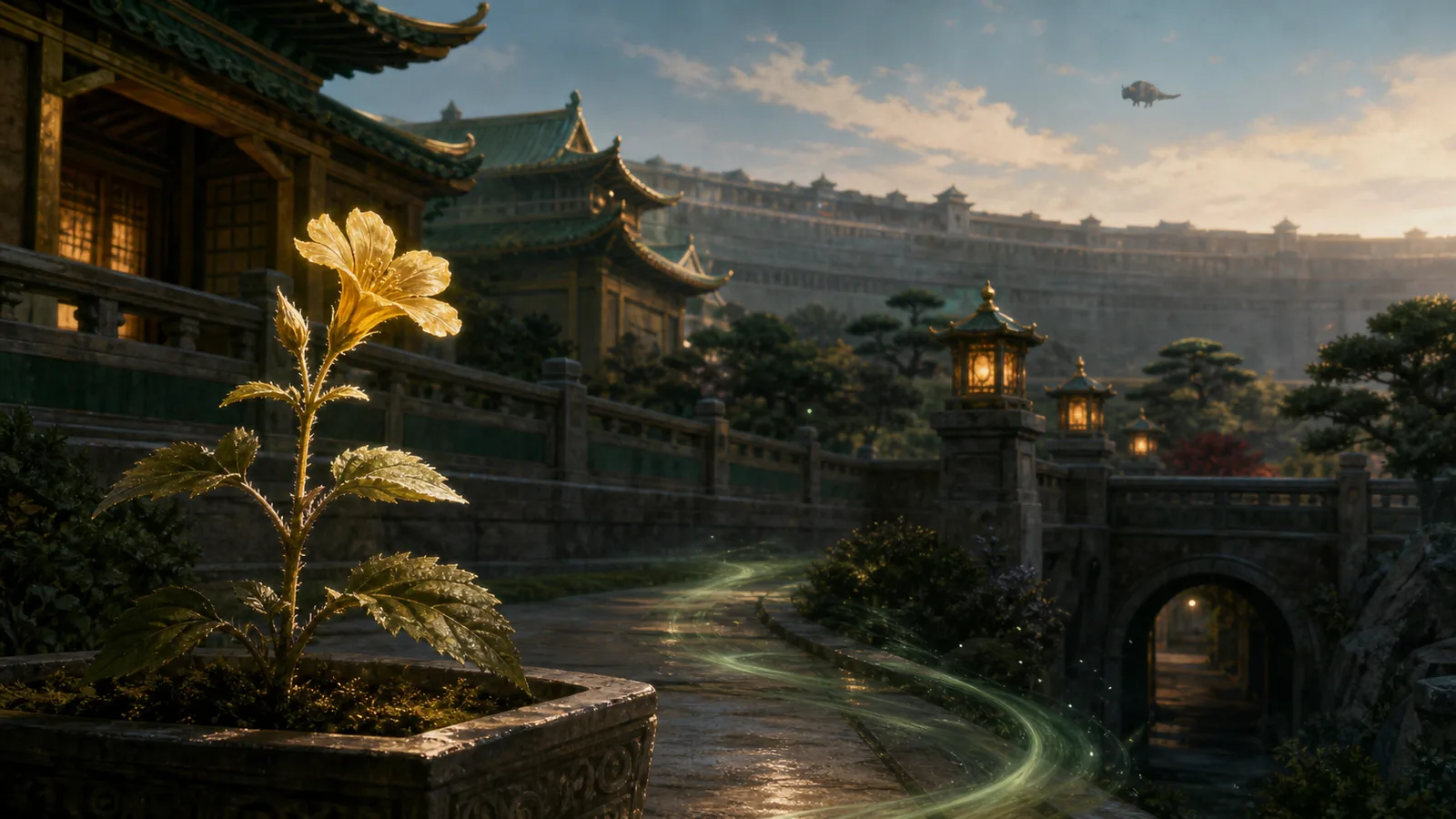
The palace denies the war, and cactus juice sends Sokka back to Yue
Toph treats the palace party like combat training: bow correctly, say yes when you mean no, smile without teeth, and answer everything with “Huh, perhaps.” It is one of the hour’s best uses of her. She hates the room, but she knows its rules better than anyone.
Aang does not. He tells a noblewoman the refugees came because Omashu was taken by the Fire Nation, and the room answers with practiced impossibility. One woman says the line again. General Sung, commander of the Outer Wall, admits the city was once besieged and then insists the wall will remain impenetrable for centuries. Out there, Aang says, the Fire Nation is growing in power. The general’s answer is the city’s sickness in one question: what does out there have to do with us?
Sokka finds a different kind of ambush in Professor Zei. At first, the scholar is the one person at the party who seems curious instead of polished, warning Sokka off cactus juice and asking about Southern Water Tribe architecture. Then his questions turn toward the North, spiritual leadership, the moon and ocean spirits, and Sokka’s mind does what Sokka has been trying not to do all episode. It goes to Yue. The cactus juice is funny later; the reason he reaches for anything that can knock his brain sideways is not.
Katara defends Toph with a drink, and Aang finally earthbends after a “half-atar” insult
Toph gets cornered by the version of Beifong life she ran from: marriage proposals, family friends, social climbers, and women whispering that if only the Beifongs had a son. Toph tells Katara not to make a scene. Katara makes one anyway, bending the women’s drinks into their faces when they mock Toph’s makeup.
Katara says the plain thing, and the scene has room to breathe: Toph is her friend. Toph hears it, absorbs it for half a second, and then takes exactly the wrong lesson. Maybe she has been too nice. Maybe the problem is that she crossed half the Earth Kingdom, used her name, entered a city she hates, and still has an Avatar who cannot kick a rock.
The fight with Aang is mean enough to work. Toph says she quits. Aang says she cannot. She calls him a “half-atar,” and the word hits the one place all his patience has been hiding. He yells, holds his ground, and the floor answers. Toph immediately claims the victory for her teaching, which is both ridiculous and not entirely wrong. She did not make him calm down. She made him stop running.
Sokka names Yue, Long Feng sells Aang a gentler cage, and Sai is taken to Lake Laogai
The episode’s softest sibling scene belongs to Sokka and Katara after the party breaks him open. Sokka says he messed everything up with Suki, that she was right there and then a wall came up between them. Katara keeps asking until the real name comes out: Yue. He did not want to lose Suki the same way. He pushed her away and lost her anyway.
Katara does not offer a fix. She says grief does not work like that, then names their mother too. There will never be a day she does not think about her. That is why she has Sokka, and Sokka has her. The cactus juice joke sits beside that without undercutting it; Sokka can be grieving, sorry, and absolutely destroyed by a desert beverage in the same night.
Zuko gets a quieter mirror on the ferry. Jet and Smellerbee’s food raid becomes medicine for Iroh, and Iroh receives willow bark tea from strangers Zuko did not trust. Earlier, by Iroh’s side, Zuko insisted his uncle did not get to abandon him. By the time the tea reaches him, Zuko is watching other exiles choose care in a place that gives them none.
Aang, meanwhile, walks straight into Long Feng’s gentler cage. Long Feng tells him the king forbids talk of war, that the Dai Li are the king’s eyes and ears, and that Aang must show he cares about Ba Sing Se before the king will listen. He even makes room for Aang’s loneliness, enough for Aang to offer the one comfort he trusts: when it gets too much, he talks to Appa.
By morning, Aang believes Long Feng will help. Toph is not sure. Sai the mechanist receives the last word from the city itself: the king has invited him to Lake Laogai. Now. The doors close politely, which is worse.
Tiny details worth clocking
- Iroh’s lightning-redirection lesson rhymes with Aang’s earthbending failure: both boys want a power to beat someone, and both teachers hand them a way to survive force instead.
- Appa being pushed through the no-fly-zone tour is such a clean Ba Sing Se image: even Aang’s oldest friend is allowed inside only as long as he moves the approved way.
- Long Feng’s Eastern Air Temple stone works because it is not generic flattery. It touches Aang through Appa, airbending, and the home he lost.
- Katara tries to heal Diya with the same logic she used on the serpent: liquid in the body can be moved. The failure makes the golden nettle in the palace garden feel uglier.
- Toph saying “No, I don’t” after Aang says “See, Toph?” keeps the show from sanding down her blindness into a phrase everyone else can forget.
Final verdict
“City of Walls and Secrets” trades the road-adventure shape for a political trap, and the shift works because Ba Sing Se is allowed to be beautiful, useful, funny, and rotten at the same time. The villa is real comfort. The Lower Ring aid is real aid. Long Feng’s gifts are real gifts. That is why the cage is convincing. Aang wants so badly to find a grown-up with power who will help him carry the comet warning, and Long Feng gives him exactly enough warmth to make obedience look like strategy.
The palace sequence wobbles under too many jobs: war denial, Sokka’s Yue wound, Katara’s golden nettle, Toph’s social panic, Aang’s king access, and the earthbending breakthrough all compete for space in the same room. A few turns arrive fast. Still, the crowdedness holds: the wall between Sokka and Suki, the wall around the refugees, the wall Aang finally stops backing away from, and the polite wall Long Feng builds around the truth all belong to the same trap.
Ba Sing Se was supposed to be somewhere safe. By the end, it is somewhere comfortable enough to make danger easy to explain away.
Rating: 8.6/10 — A sharp Ba Sing Se arrival that finds suspense in bureaucracy, even when the palace sequence has to carry more plot than it can elegantly hide.
More episodes from Avatar: The Last Airbender S2 — Aang, Toph, Zuko, and Ba Sing Se, episode by episode. Jump to any episode in the season:
Where to go next
Reviewed by Mira Vance · QuizFandom Editor & Lead Reviewer. Every rating is an honest per-watch assessment from the desk that also writes the quizzes — not a press release rehash.