Avatar: The Last Airbender S2 Episode 6 Review: "The Parable of the Two Dragons" — Aang breaks before the Earth King, Azula names Zuko as prey, and Iroh enters the White Lotus
What happens — the short version (spoilers)
- Aang enters the Avatar State over Appa while Zuko's fever turns Ursa, Ozai, and the Blue Spirit into one nightmare.
- Azula gives Long Feng the names of conspirators and threatens him with 20,000 Firebenders outside the wall.
- Zuko asks Iroh for tea-shop work, and Dragon Well tea becomes a lesson in bitterness.
- Team Avatar rides into the palace in wine casks, and Katara gets King Kuei to hear the war through his garden.
- Azula tells Mai and Ty Lee the parable of the two dragons, then decides she will not miss her chance to kill Zuko.
- Long Feng turns the team's good deeds into evidence, Toph walks out after the villa fight, and the White Lotus welcomes Iroh.
Avatar: The Last Airbender* Season 2 turns Appa's disappearance into the loss that makes every plan wobble. "The Parable of the Two Dragons" gives Team Avatar the audience they have been chasing for weeks, but the truth reaches King Kuei through a room already poisoned by Long Feng, General Sung's fear, and Aang's grief. Around that palace fight, Zuko wakes from a fever into something almost ordinary, Azula finds the shape of her real mission, and Iroh asks the White Lotus to judge the Dragon of the West without letting the old name disappear. The hour keeps placing power beside accountability. Some characters reach for control; a few finally admit what control has cost.
Aang explodes in the Avatar State over Appa, while Zuko’s fever drags Ursa, Ozai, and the Blue Spirit into one nightmare
The episode starts exactly where “Ten Thousand Things” left its wound. Aang comes out of the Spirit Library loss in the Avatar State, and the first person his grief finds is Toph. She tried to hold the library open. She saved the others. He can only hear the other half of the sentence: Appa is gone.
That is ugly, and the hour lets it be ugly. Aang says there is only one plan now: “Find Appa. I don’t care about anything else.” Katara and Sokka keep trying to steer him back toward the Earth King because that is still their best chance of finding Appa, but grief has made even strategy sound like betrayal. When Aang flies off, Toph is left repeating the math everyone else is too kind to say out loud: Jet did not make it out, and she still thinks she should have held the door longer.
Zuko’s fever is the same kind of rupture from the opposite direction. The Blue Spirit mask sits like evidence beside him, and the voices in his head turn childhood into prosecution. Ursa tells him to remember who he is. A voice calls compassion weakness. Old taunts and his mother’s pleas collapse into one burning room until Zuko is begging for it to stop. The fever does what Iroh’s language says a fever can do: it burns at the old self. The question is what survives.
Sokka keeps inventing palace plans, and Azula corners Long Feng with one that actually scares him
Back at the villa, Appa’s absence ruins even Sokka’s nonsense rhythm. He tries blizzards, pillar costumes, Kyoshi Warrior uniforms, and a Momo earthbending distraction so confusing that it almost deserves a field test. The jokes are doing real work. Without Appa, the team’s usual movement through the world has turned into walls, guards, Dai Li, and bad sketches on paper.
Azula’s plan has none of that panic. She walks into a prison room with Long Feng and starts by giving away names: General Sung, General Situ, Lieutenants Khettry, Kim, and Zhang. It looks like bad leverage until she adds the army outside the city. Twenty thousand Firebenders are close enough to level the wall unless she tells them to stand down.
Long Feng tries to make class do what information cannot. He calls her a privileged girl desperate to prove she deserves anything. Azula answers with bloodline and threat, but the best part of the scene is that both of them are right about the other’s hunger. Long Feng has built a kingdom out of lies and an absent monarch. Azula has been sent away from court and still talks like inheritance is a weapon she can sharpen.
The deal does not close. Long Feng says he does not make deals with the Fire Nation. Azula leaves him the better line anyway: “Everyone deals with the Fire Nation one way or another.” In Ba Sing Se, that already sounds less like a threat than a weather report.
Zuko asks Iroh for tea-shop work, and Dragon Well tea turns bitterness into a lesson he can actually hear
Zuko wakes quietly, which is almost stranger than the fever. He thanks Iroh for taking care of him, admits he missed three shifts and got fired, then asks whether Iroh can still get him a job at the tea shop. It is a small request, but for Zuko it plays like a door opening. No throne. No Avatar hunt. No heroic speech. Just work.
The city immediately tests how ordinary he can stand to be. A customer notices him staring at a baby and asks if he is afraid of babies. Zuko’s answer is perfect because it is not charming on purpose: babies are afraid of him. When she offers to show him the better sights of Ba Sing Se, he barely knows what to do with the offer. A date is harder for him to process than a duel.
Iroh’s tea lesson is doing the deeper version of that scene. Zuko overheats Dragon Well tea, and Iroh tells him a lower temperature keeps it from turning bitter. Then he refuses to throw it away. “Bitterness has its own lessons,” he says, and once the tea is right, you can savor how far you have come. It is the kind of Iroh line the show earns by making him face his own bitterness later. He is not handing Zuko a greeting-card truth. He is preparing both of them for the work of living after the person you were.
Team Avatar rides into the palace in wine casks, and Katara gets King Kuei to hear the war through his garden
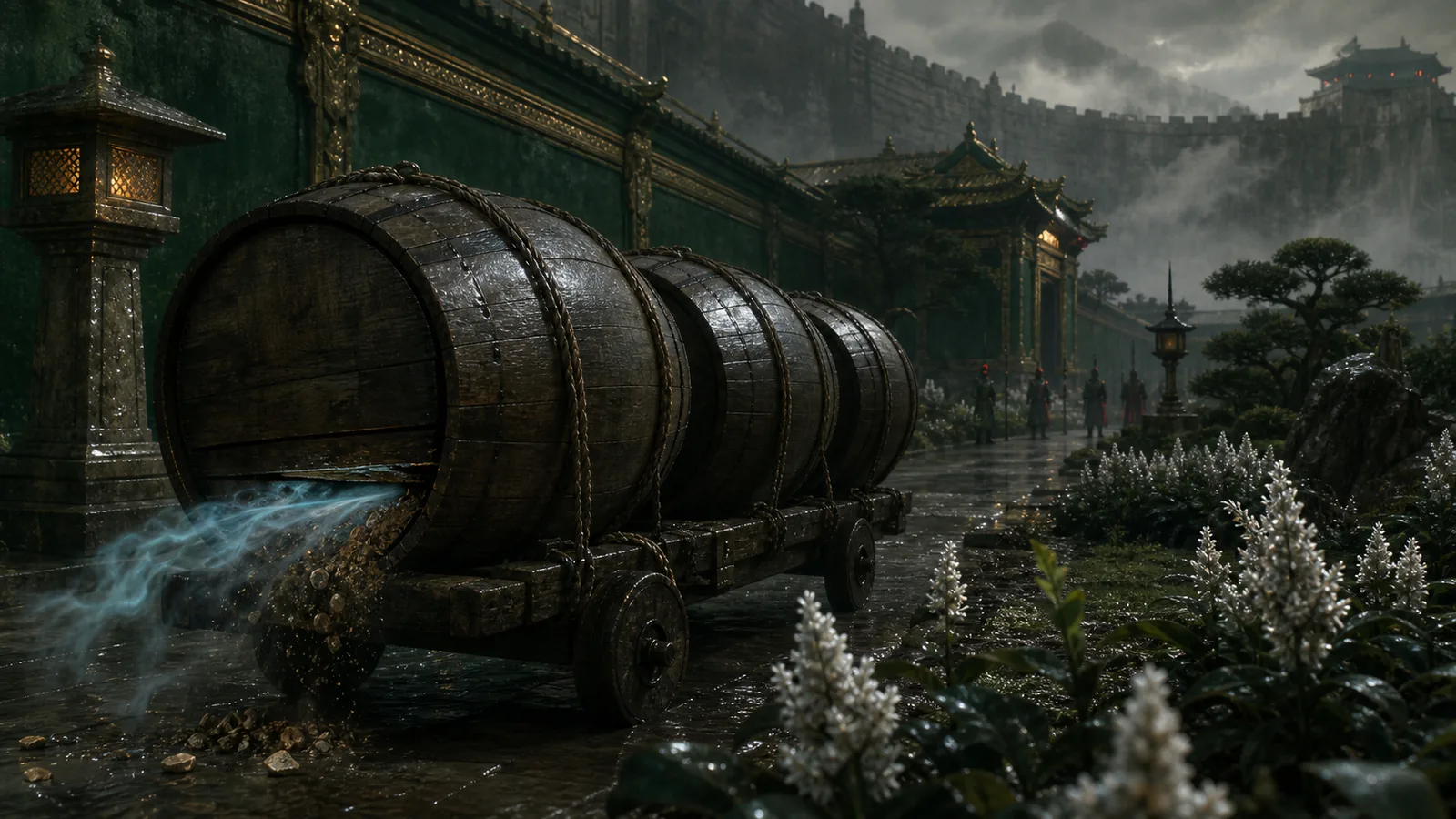
Sokka’s real palace plan is ridiculous enough to work. General Sung brings wine casks from the Agrarian Zone, the Dai Li intercept the party at the gate, and Team Avatar hides under false floors while the casks are carted inside. The execution is messy, because of course it is. One cask ends up somewhere else, Sokka still insists his plans are foolproof, and Toph gets the credit for finding the study.
Aang almost breaks the plan before it begins. He is tired of waiting. Appa needs him as much as he needs Appa. Katara has to stop him in the hallway and say the part he does not want to hear: if he talks to the Earth King like this, the king will not listen, Jet will have died for nothing, and Appa will not be any closer. Aang finally says it plainly: he misses him. The breath Katara coaches him through is tiny compared with the storm around it, but it is the only reason they make it into the room.
King Kuei is not cruel. That almost makes him more frustrating. He knows flowers, wants to talk about the silver amaranth at the Western Air Temple, and says politics turns his stomach. Aang’s facts bounce off his gentleness until Katara finds the language of the garden. The walls cannot keep weeds out. Everything is connected. Flowers thrive only when someone pays attention and takes action. For once, the king hears a metaphor before Long Feng can turn it into policy.
Azula tells Mai and Ty Lee the two-dragons story, and the lesson becomes her order to kill Zuko
The title lands in Azula’s mouth, which is exactly where it should be. She tells Mai and Ty Lee the parable of Hageshi and Nho Xiu, two dragons born from the same egg. One grows large by stealing what the smaller one hunts. The smaller dragon hesitates when revenge finally becomes possible, and the stronger brother wakes up in time to kill him.
Ty Lee remembers a softer version, one her mother used to teach sharing. Azula’s correction is the whole character in one turn. Nho Xiu’s regret was not hatred. It was hesitation. The lesson is to strike completely when the chance comes.
That story would already be sharp if it only described Azula’s politics. Then she names the target. Ozai has sent her far from court to hunt her brother, and she has decided that Zuko’s weakness still makes him dangerous. “I will not miss my chance to kill Zuko.” The hour does not need her to know about his fever, the tea shop, or the girl asking him to see the city. The cut does the cruelty for her. Zuko is trying to become a person. Azula is deciding he is prey.
Long Feng turns Katara, Toph, Sokka, and Sai into evidence, and Aang loses the room by demanding Appa
For a moment, the plan works. Team Avatar lays out the comet, the Day of Black Sun, and the chance to save the world. King Kuei understands enough to call it the most important decision he has ever had to make. Then General Sung walks in and says no.
That betrayal has a blade behind it. Long Feng has already threatened Sung through his daughter and Lake Laogai, and now the general reduces everything to a manageable palace story. Ba Sing Se is strong. The Fire Nation forces outside the wall will be handled. The Kyoshi scouts have captured their general. The Avatar and his friends want to feel important in a city that does not need them.
Long Feng’s attack works like paperwork with teeth. He has collected the group’s good deeds and filed them as crimes. Katara stole golden nettles and stirred tension in the Lower Ring. Toph is tied to Beifong war machines. Sokka was last seen with Professor Zei before the scholar vanished. Sai becomes the spy who supposedly invented the whole story. By the end, Long Feng has a phrase clean enough for the king to hold: the Avatar is in league with a thief, a spy, and a traitor.
Aang still almost pulls the room back to the point. The city is in danger. The world needs help. Then King Kuei asks Long Feng what to do, and Aang’s grief breaks through the diplomatic shell. He demands to know where Appa is, enters the Avatar State, and proves Azula’s prison argument against him in front of the one man he needed to convince. Long Feng survives the scene, but not untouched. Kuei asks for reports from the wall and orders future threats sent directly to him. Whatever Long Feng’s hold on the city is, even Azula can see it slipping.
Team Avatar breaks apart in the villa, and Toph leaves after telling them they do not see her
The villa argument is the hour’s harshest scene because everyone has a real wound and chooses the worst possible target. Aang blames Katara for the nettles. Katara says she was helping a sick child. Sokka and Toph defend her, which only makes Aang feel more excluded from decisions that shaped the king’s judgment.
Then Katara turns on Toph with the thing Long Feng placed in the room. The Beifong contracts are not abstract to her. She asks whether Toph’s family built the ships that came to Wolf Cove, the ships that brought Firebenders who burned the village and killed her mother. It is a terrible question to ask a child who just left that family, and it is also exactly the kind of question war teaches people to ask when grief wants a body in front of it.
Toph keeps insisting she is not her family. Aang keeps circling Appa. Sokka tries to protect the plan and finally names what happened with rare precision: his plan worked; they got beat. That is not on him. It is on Aang.
The line that lands hardest belongs to Toph. “I may be blind, but you guys don’t see me at all.” The show has spent the season making her blindness part of how she knows the world more clearly than anyone expects. Here, her friends become the people who miss what is right in front of them. She walks out, Sokka follows his own anger out the door, and Katara finally cuts the carrying metaphor loose. If Aang thinks nobody has been with him, he can carry himself from now on.
Zuko brings Iroh to the ancient-ways meeting, and the White Lotus asks the Dragon of the West what he will do
Zuko’s choice is quiet enough that Azula’s parable makes it feel endangered before it fully arrives. He tells Iroh he is not acting out of anger or vengeance. He wants to help people, and he is doing it for himself. Iroh calls him a good man, which would have sounded impossible to Zuko not long ago. Now it sounds like something he might spend the rest of the season trying to deserve.
Then the hour turns the judgment onto Iroh. He comes to a hidden room as the Dragon of the West and offers his services, but the man waiting for him refuses to let the title become legend without memory. The Dragon ordered the burning of innocents. The Dragon ordered slaughter. The old man facing Iroh served under that Dragon, deserted him, and left a regiment leaderless. One of the men who died was Lu Ten.
That is the episode’s strongest answer to Azula. Her parable says hesitation is failure and mercy is weakness. Iroh stands in front of someone who has every reason to hate him and asks forgiveness for the things he ordered others to do. The old soldier forgives him. The others second it. Iroh is welcomed into the White Lotus, and the welcome is not absolution by erasure. It is work. The Dragon remains part of him. What matters now is what the old man does with the fire.
Tiny details worth clocking
- Sokka saying the plan “isn’t planning like usual” turns Appa’s absence into a practical problem before the hour lets it become a full emotional collapse.
- Toph’s instant verdict on Sokka’s cask drawing – “I can’t even see it, and I already know it’s bad” – is the right joke for a scene where everyone is seconds from panic.
- Long Feng inviting General Sung’s daughter to Lake Laogai gives the betrayal its pressure point: no speech, just a family member turned into leverage.
- Katara’s garden argument works on King Kuei because she stops trying to make politics sound urgent and makes neglect visible in the dirt.
- Iroh’s Dragon Well lesson only becomes fully honest after the White Lotus scene forces him to drink his own bitterness.
- The final run of silent arrivals – Toph meeting her mother, the hunt for Zuko reaching him, Aang alone with Momo, and Appa’s name in the dark – keeps the episode from pretending the palace loss is the only cliff edge.
Final verdict
“The Parable of the Two Dragons” is a bruising penultimate chapter, and its best choice is refusing to isolate the Appa loss from the war plot. Aang does not fail before the Earth King because he lacks facts. He has the facts, the plan, the comet, the eclipse, and enough truth to shake King Kuei awake. He fails because Long Feng has spent weeks turning every act of compassion into a liability, and because Appa’s absence has taken away the part of Aang that could still breathe before speaking.
The episode does lean on a few hinge moves that could use more daylight. General Sung’s reversal is emotionally legible once Long Feng mentions his daughter, but the palace scene has to do a lot of work off that one threat. The last-act pileup also leaves some transitions feeling more like chess moves than lived scenes: Toph reaches her mother, Zuko’s hiding place stops feeling hidden, and Appa returns to the frame almost as a sequence of trapdoors.
Still, the braid is strong. Azula turns a family parable into permission to kill. Iroh turns a war title into a request for judgment. Zuko tries to choose ordinary decency while his sister decides ordinary decency makes him weak. And Team Avatar, the found family that usually survives by arguing in motion, finally stands still long enough to hurt each other with every secret Ba Sing Se has been collecting. The Day of Black Sun still matters. The Earth King may finally be awake. But the hour’s real cliffhanger is simpler and meaner: the team that has to save the world cannot currently stay in the same room.
Rating: 8.7/10 — A tense, emotionally sharp palace chapter that makes Appa’s loss infect every alliance, even if a few late setup beats land more like trapdoors than fully played turns.
More episodes from Avatar: The Last Airbender S2 — Aang, Toph, Zuko, and Ba Sing Se, episode by episode. Jump to any episode in the season:
Where to go next
Reviewed by Mira Vance · QuizFandom Editor & Lead Reviewer. Every rating is an honest per-watch assessment from the desk that also writes the quizzes — not a press release rehash.