Bridgerton S03E2 Recap: "How Bright the Moon" — Hope Leaves a Mark
What happens — the short version (spoilers)
- Queen Charlotte refuses to name a diamond and decides she wants a young lady who truly sparkles.
- Colin turns Bridgerton House into a practice ball, where Penelope's praise of his eyes unsettles them both.
- Penelope reads Colin's journal, then bandages his cut hand and tells him his writing is good.
- Francesca slips away to play the piano, and Queen Charlotte praises her as sparkling when she stops performing for approval.
- Eloise says too much about Colin helping Penelope, and the secret spreads through the celestial ball.
- After Whistledown prints the scandal, Penelope asks Colin to kiss her, and the kiss leaves him changed.
A private lesson in confidence gives Penelope one bright night before the ton remembers how fast a whisper travels.
Bridgerton, Season 3, Episode 2 — “How Bright the Moon” Netflix
Penelope Featherington wants a husband for one clean reason: freedom.
That is the ache under all the moonlit sparkle in “How Bright the Moon.” Marriage means a door out of her mother’s house. It means a place in the world that does not depend on Portia’s moods, her sisters’ noise, or the pity of people who have already decided she is beyond rescue.
Colin Bridgerton thinks the answer is confidence. He came home from abroad believing that a person can step outside the shape society has assigned them. No one knew him overseas. No one expected him to be the Colin Bridgerton the ton already knew. He calls that freedom.
Penelope hears him. She wants to believe him.
But London is not Paris. A secret cannot stretch its legs here without someone spotting the hem.
Queen Charlotte searches for a sparkler as Penelope tries Colin’s lesson
Queen Charlotte starts in open defiance of Lady Whistledown. The gossip sheet has suggested she is afraid to choose a diamond, and Her Majesty refuses to reward the provocation. If she is going to grant favor, the young lady must do more than arrive polished and anxious.
She wants someone who sparkles.
That word sends every ambitious mama and debutante into fresh motion. Lady Danbury quietly lets Violet know that the queen is still watching. Francesca may not be chasing the role, but Violet cannot help wondering whether her daughter should be brought forward before some other girl catches the royal eye.
Penelope has a smaller, more urgent problem. Colin has agreed to help her find a husband, and his first instruction is not exactly gentle. No more hiding in books. No more theory. She has to try conversation with actual gentlemen.
It goes badly.
Penelope opens with the weather, loses her nerve, and retreats almost at once. The failure is funny because it is so painful. She knows how to observe a room. She knows how to puncture one in print. Put a lord in front of her, though, and all that private cleverness gets trapped somewhere between her heart and her mouth.
Colin does not laugh at her. That matters.
He remembers the girl who once knocked him into the mud with a yellow head covering and teased him afterward. He insists that girl is still there, before self-consciousness and public judgment taught her to shrink. Penelope answers with the plain truth: society is made of other people’s judgment. For her, that is not a philosophy. It is the weather she has lived in for years.
Colin turns Bridgerton House into a practice ball
Colin listens when Penelope tells him where she used to feel at ease. Sunday teas at Bridgerton House were one of the few places where she could be herself, before the rupture with Eloise made that comfort impossible.
So Colin brings her back there.
It is reckless, sweet, and very Colin. The family is playing cards outside, Eloise is out with Violet and Francesca, and Penelope’s maid can wait nearby. Colin decides the drawing room will become a ball. The sofa becomes a row of mamas. The pianoforte waits for the Parisian quadrille. The lemonade table becomes the place where Penelope must flirt with a dashing suitor.
Him.
Penelope is mortified because she knows him. Colin thinks that is why he is safe. The mistake is delicious. He is safe enough for honesty, which is precisely what makes the moment dangerous.
When Penelope finally lets herself speak without guarding every word, she compliments his blue eyes and the way they brighten when he is kind. It is direct enough to unsettle them both. For one second, the lesson stops looking like practice.
Then Eloise comes home.
Penelope hides in the study and finds Colin’s journal. She should not read it, and she knows that. But she does, and the page she lands on is intimate in a way Colin has clearly not offered the room at large. He writes about beautiful women abroad, about touch, about feeling closeness and distance at the same time.
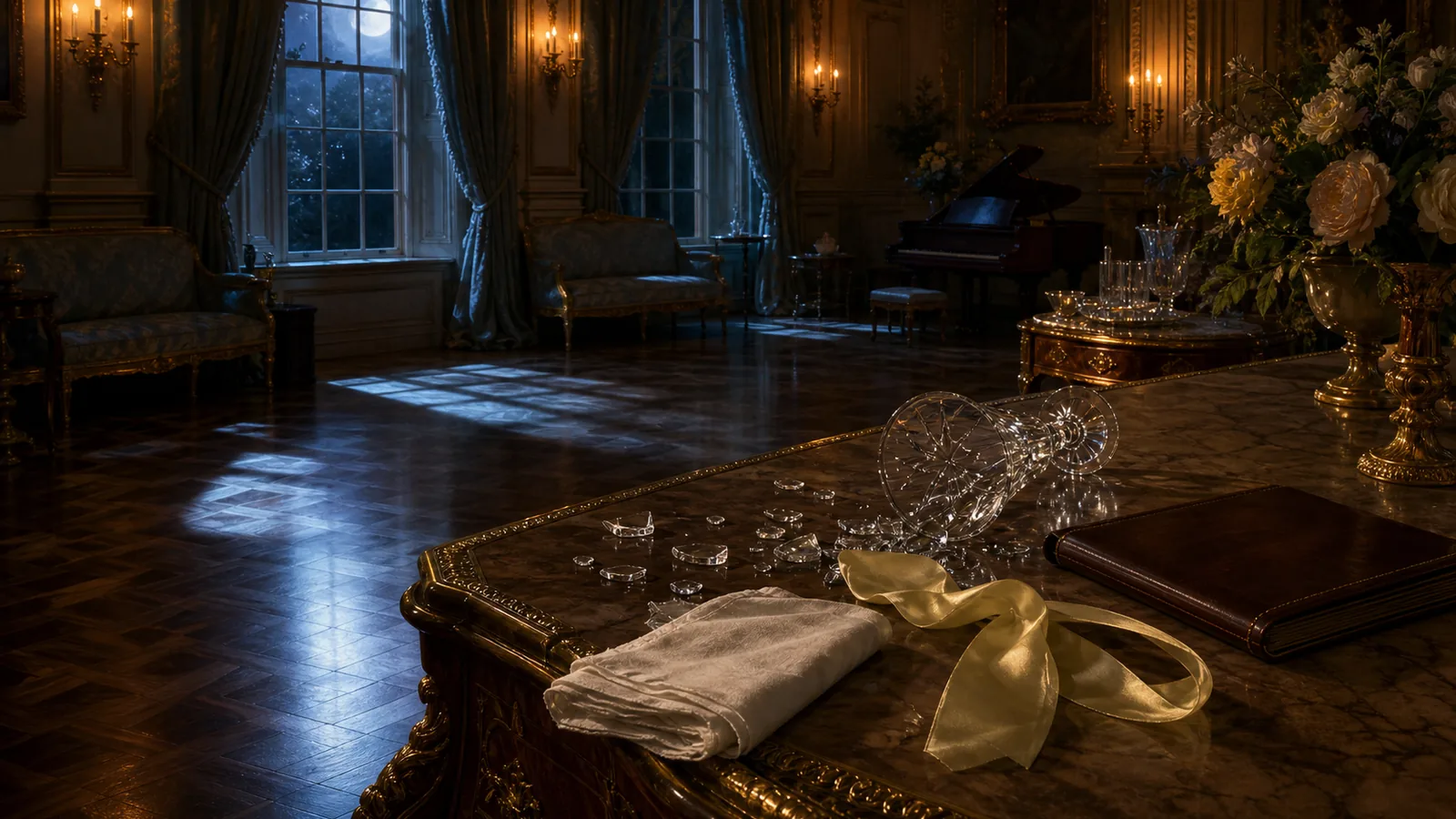
Colin catches her, and his hurt is immediate. When the broken glass cuts his hand, Penelope’s apology becomes action. She bandages him gently. She tells him his writing is good. The praise lands because it is not flirtation for a lesson. It is Penelope seeing him.
Neither of them knows what to do with that yet.
Francesca plays alone and catches Queen Charlotte’s attention
Francesca wants marriage, but not spectacle. That makes her difficult for Violet to steer. She is willing to meet suitable men, and she would very much like to be done before her mother can turn the season into a campaign.
At the modiste, Eloise tries to use Francesca’s debut as cover for her own delay. Francesca refuses the favor. She welcomes marriage more than Eloise expected, just not the pressure that comes with being paraded in front of the queen.
Violet means well. She keeps naming music-loving suitors: Lord Courtenay, Lord Petri, Lord Godwin. At the celestial ball, she guides Francesca toward Lord Petri, a man with a declared fondness for the cello. It should be a neat match on paper.
The conversation curdles anyway.
Francesca talks about Ries, Beethoven, and the feeling inside the music. Lord Petri talks about chord progressions. He is not cruel. He is not foolish. He simply answers from a different room of the heart.
Lady Danbury sees Violet worrying from the sidelines and gives her the advice Violet needs, even if it is hard to take. Let Francesca be in her natural sphere.
So Francesca slips away to the piano.
She is not performing for a prize. She is taking a small pause from the ball, playing because the music gives her room to breathe. That is when Queen Charlotte hears her. Her Majesty calls it splendid, praises Francesca for delighting in her own endeavor, and gives the word everyone has been chasing all night: “Sparkling.”
Francesca earns attention the moment she stops reaching for it.
Portia pushes the Featherington husbands while Will steadies Alice
The Featherington plot stays bawdy in exactly the right way. Portia wants an heir, and she has two married daughters who keep misunderstanding the assignment.
Prudence would rather be out showing off Mr. Dankworth than flattening her hair in bed. Philippa cheerfully reports that she and Albion have been visiting upholsterers, silk mercers, and even a potential new housekeeper. Portia is horrified to learn how little progress either marriage has made, then more horrified when Philippa reveals that she and Mr. Finch have not actually grasped the mechanics.
It is broad comedy, but it is also Portia in pure survival mode. The Featherington title is still a prize that can slip away. Her daughters may talk nonsense, but Portia knows reputation, inheritance, and security are tied together. Romance is charming. An heir is paperwork with a pulse.
Across town, Alice and Will Mondrich face a different version of the same question: how does a family inhabit a life it never expected?
Their new estate is absurdly large. Alice is shown separate bedchambers, a library, a music room, a private drawing room, a writing room, and twenty-seven rooms in all. She tries to move carefully. She keeps Lady Kent’s old clothes. Even at Madame Delacroix’s shop, she worries that too much change will make the ton bristle.
Will has less patience for borrowed shame. He comes to Alice’s room instead of sleeping alone because he does not want a cold, lonely version of nobility. When Alice admits she is afraid they will do something wrong and have it all taken away, Will answers with bracing common sense: they have done nothing to earn it, same as every viscount, earl, and baron outside.
So they will enjoy it.
No more tiptoeing. No more separate rooms. No more old Lady Kent clothes.
Alice keeps the jewelry, naturally. A woman must have standards.
Eloise lets Penelope’s secret slip at the celestial ball
Eloise keeps insisting she has altered, while everyone around her keeps testing what that alteration actually means.
Violet gently encourages her to widen her circle beyond Cressida. Eloise does try. She joins other young ladies, makes them laugh with a story about accidentally calling a French tutor an owl, and discovers that her talent may be speaking before she has sanded down the edge.
The trouble is that edge cuts Penelope first.
Eloise is not indifferent to her former friend. She asks Colin how Penelope is. She says she does not want Penelope to be friendless. She even tells Colin not to cast Penelope out, only to keep the visits away from Bridgerton House. There is care there, bruised and badly handled.
Then Cressida asks about Penelope at the ball, and Eloise says too much. Colin is helping Penelope look for a husband. It is a private fact with public consequences, and Miss Livingston is close enough to carry it around the room.
The cruelty spreads fast. The young ladies call Penelope pitiable and beyond hope. Colin tries to defend her, but the damage is already done. Penelope hears enough to flee, and the room is already hungry for Whistledown’s version before the night has even ended.
Colin turns on Eloise because he thinks she gave the secret away. Eloise insists she only confided in Cressida. Cressida, for once, may not be the direct culprit, but her reply still cuts: if Eloise were more decided about her former friendship, maybe she would not have needed to gossip.
That is the part Eloise cannot laugh off.
Colin visits Penelope after Whistledown prints the scandal
Lady Whistledown prints what everyone is talking about: Penelope was so certain she could not find a husband on her own that she enlisted Colin Bridgerton’s help.
Portia’s reaction is worse than the column. She is not shocked that Penelope tried. She is shocked that Penelope believed she could succeed. The dresses, in Portia’s mind, were amusement. The hope was the embarrassing part.
That is crueler than any ballroom whisper.
Penelope returns to the familiar shadows Whistledown names for her, and then Colin comes through the door. He has bribed Rae for a moment alone because he needed to see how Penelope was. He calls Whistledown beastly. Penelope, even wounded, defends the logic of the gossip sheet: it would have been suspicious not to report what everyone was saying.
She blames herself. A sad, stupid girl who believed she might have a chance at love.
Colin tells her not to say that, but Penelope is past comfort. Hope has made her reckless, and she asks the question her despair finally lets out: would he kiss her?
She says it does not have to mean anything. She will not expect anything. She is nearly on the shelf and has never been kissed, and she cannot bear the thought of dying without knowing what that feels like.
The request hurts because she believes she is asking for a kindness, not receiving a confession.
Colin kisses her.
Then he kisses her again.
Penelope thanks him, which is somehow more painful than the tears. She still thinks the moment belongs to pity. Colin’s face says he has crossed into something else entirely.
The moon may be bright, but this is not safety. This is the first mark hope leaves when it touches skin.
Verdict
Penelope’s second chapter lands because romance and reputation move together. Her confidence lessons are not a makeover trick. They are a risk. Every time she steps toward the light, someone else gains the power to describe what they saw.
Francesca’s quiet musical self-possession, the Mondriches’ refusal to apologize for their new life, and Portia’s frantic heir campaign sit neatly beside that central thread. They all circle the same question from different rooms: what does freedom cost in a society that keeps score out loud? Penelope and Colin carry the emotional center, and the final kiss gives the season its first real swoon without pretending the scandal around it has vanished.
Rating: 8.6/10
More episodes from Bridgerton — Season 3 — Penelope and Colin, and Whistledown unmasked, episode by episode. Jump to any episode in the season:
Where to go next
Reviewed by Mira Vance · QuizFandom Editor & Lead Reviewer. Every rating is an honest per-watch assessment from the desk that also writes the quizzes — not a press release rehash.