For All Mankind S5E4 Review: A Mars Built for Workers Quietly Plans to Replace Them
What happens — the short version (spoilers)
- Alex starts at Helios, where Dev recruits him into the Meru city vision, but Alex hacks a terminal and finds a Russian-Helios plan to replace nearly all workers with machines and ship them home.
- Alex shows the files to his reporter friend Lily, hesitating only over Dev, and the documents go public just as Sojourner-T launches for Titan.
- Avery Jarrett fails her first OPEF polygraph by refusing to claim her astronaut father Daniel Stevens; Danielle Poole tells her chasing a legacy she doesn't want will make her fail too.
- Avery passes the second polygraph by telling the truth about her father and her real reasons for serving, and her Marine unit gives her the callsign 'Tabasco.'
- Aleida arrives on Mars and confronts Dev over Helios funding Meru while staying solvent; their tense truce holds with her line, 'I'll stab you in the front.'
- The launch celebration is interrupted as the automation leak hits every phone in the room.
Apple TV+'s alt-history sci-fi crashes a launch-day pep rally with a leak, and lets Avery Jarrett finally claim a father she never knew.
For All Mankind has always run on the gap between a stated mission and its true cost, and “Open Source” widens that gap by handing it to a teenager with a copied password and a Cyrillic dictionary. Ed Baldwin’s funeral box is still open in Kelly Baldwin’s hab when his grandson Alex finds, on a Helios server, the most cynical thing the show has done with its own utopian premise: a Russian-Helios plan to automate 98% of Happy Valley and ship every worker home. “Open Source” runs on three first days — Aleida Rosales’s first day on Mars, Alex’s first day at Helios, and Avery Jarrett’s first honest interview with the OPEF board — and each one ends with someone deciding whether to keep a lie running or expose it. The launch of Sojourner-T to Titan is the public event. The leak that lands on every phone in the room as the rockets clear the tower is the real episode.
Alex’s first day at Helios ends with the season’s biggest betrayal
Cynthy Wu’s Kelly walks Alex through his nerves about being a Helios hire under his mom’s boss, asking him to give the job “a few weeks, see if you like it.” He does the opposite. Edi Gathegi’s Dev Ayesa hijacks the first morning, pulling Alex out of his data-entry assignment with Ms. Joshi and showing him Meru renderings: a self-sustaining Martian city with a baseball field and a beach powered by incinerator waste. Alex, autistic and used to closed spaces, says it looks “almost too perfect.” When he suggests modular living so people can shape their own pods — the way his mother tore the cabinet doors off their hab so she could fill it with toys from Earth — Dev does something terrifying. He listens. He offers to fund the redesign. He tells Alex that Meru “will be your home too one day.”
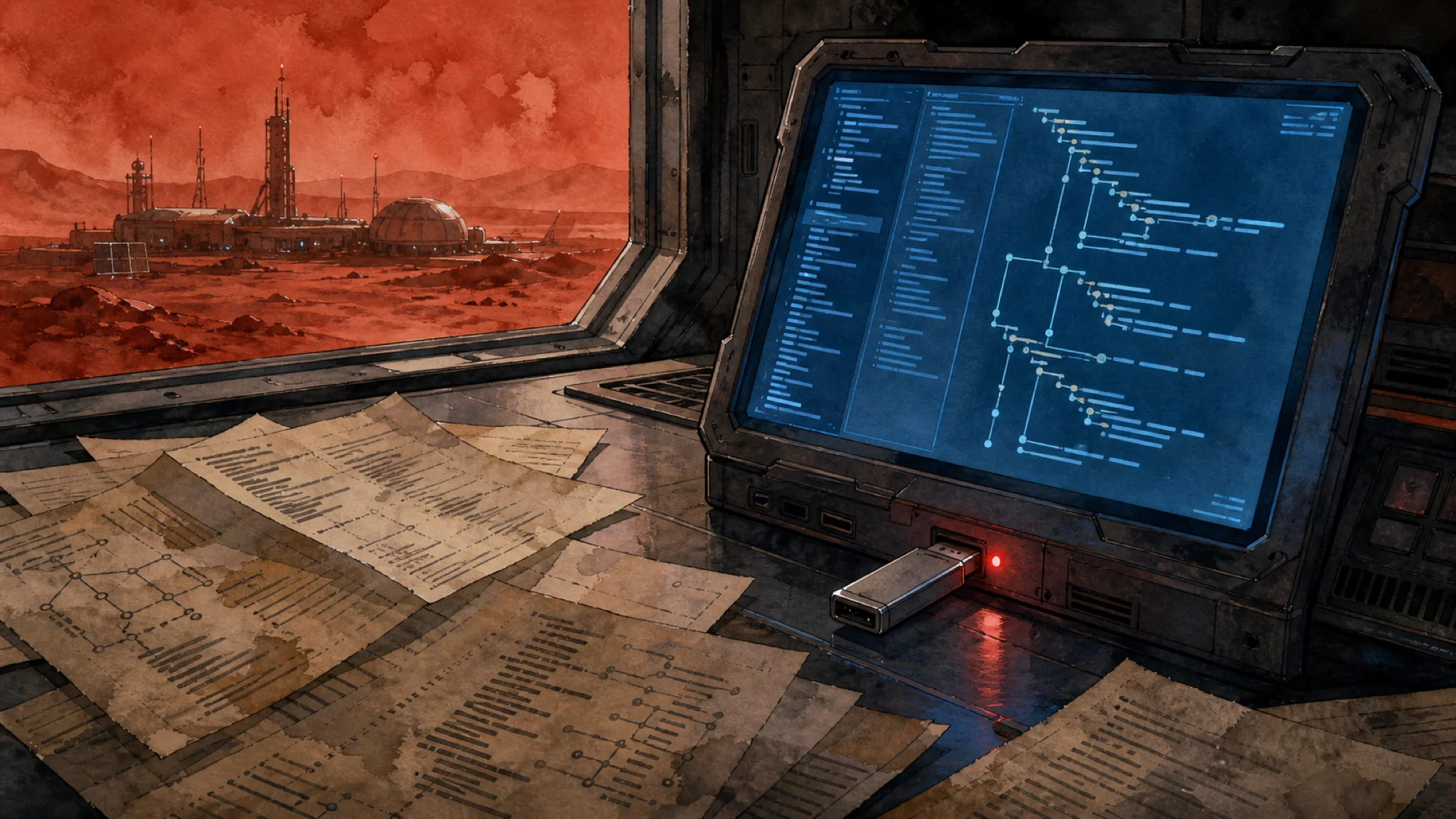
The show has been here before with Ed Baldwin and Dev — the older mentor seeing in the younger man a son-shaped vessel for an unfinished mission — and the rhyme is intentional. Alex is being recruited into a vision before he understands what owning it costs. So when the data-entry assignment turns into an access problem on Server 36 (the Axl Rose server, in Giorgi’s joke about why all of his references stop in the ’80s), Alex types Ms. Joshi’s own name backwards into her terminal and finds the Cyrillic folder labeled “automation.” What he reads inside is the deal Dev signed: replace personnel with machines, then send the workers home “within a few years.” Asteroid mining, iridium refinery, the hopper, even Phoenix. The Mars utopia is being designed to need no people.
The scene where Alex shows the files to Lily Dale, his NNC-reporter friend, is one of the strongest pieces of writing this season. They are still kids who used to hack vending machines for free soda. Now they are looking at a plan that will collapse a planetary economy. Alex hesitates only on Dev — “He believes in Mars more than anybody” — and Lily, who has been told she only makes coffee at NNC, presses the obvious question: then why is this on Helios servers? Alex asks for time to think. He does not get it. By the end of the hour, the files are out, and the launch celebration is interrupted by every phone in the room going off at once.
Avery’s polygraph cuts the show’s father-son inheritance from a new angle
Avery Jarrett carries a Marine’s clenched-shoulder discipline and a kid’s untreated wound, and her arc this hour is the episode’s other thesis. Avery is the daughter of Daniel Stevens, the astronaut who lied his way through his career and died for it, and she has spent her life burying him under her stepfather Tom Jarrett’s surname. Her first OPEF polygraph blows up because she refuses to claim him: “He’s not my father.” The Marines call this poisoning the well. The episode treats it as the same lie her father told the system that killed him.
Krys Marshall’s Danielle Poole gets the scene the show has been saving for her. Avery comes in hot, accusing Danielle of sabotaging her by telling OPEF the truth about Stevens. Danielle answers without flinching: she told them Avery’s father was talented and had “serious psychological issues,” that the burden of his shadow was never Avery’s to carry. Then she sits Avery down and delivers the verdict the show has been circling since season three. Daniel Stevens died because he chased a legacy he did not actually want — he lied to his superiors, to Joel Kinnaman’s Ed Baldwin, to Danielle, to himself. “If you’re doing all this just to prove you aren’t him, you’ll fail too.”
What makes the second polygraph land is that Avery does not flip into denial about her father. She tells the board the truth she has been refusing all season: as a kid she lay in bed at night looking out the window at the stars, thinking maybe someone had made a mistake and her father was still alive up there, that he would land his spaceship in the backyard and tell her how much he missed her. Then she names her motive plainly. She did not join the Corps to prove the bullies wrong. She joined to serve her country, “same as my dad and his dad before him.” The board passes her. Her unit gives her a callsign — “Tabasco” — and chants it across the bar. The chant is warm and dumb and completely transactional. Avery has bought a place in the club by telling the truth her father never could.
Aleida and Dev’s “stab you in the front” meeting recasts the season’s central fight
Wrenn Schmidt’s Margo Madison is offscreen this week, but her absence is felt in how much weight the Aleida/Dev confrontation is asked to carry. Aleida lands on Mars after a month in zero-G, gets drunk with Kelly on Ed’s bourbon, then marches into Dev’s office to deliver an ultimatum: Helios cannot subsidize Meru and stay solvent at the same time. Dev’s confession — that he has lost trust in people who stabbed him in the back — is met with Aleida’s cleanest line of the season: “The difference with me is I’ll stab you in the front.” Their truce is the episode’s only handshake that holds.
What follows is the engineering problem the rest of the hour pivots on. Sojourner-T’s plasma engines are not making rated power. The aerobraking maneuver at Titan needs accurate atmospheric scale-height calculations or the ship either skips off into Saturn or burns on entry. The Russian Kuragin mission has those numbers and will not share them. Aleida promises to find a way. The way turns out to be the same way the show’s plot has been working all season — through Alex’s stolen credentials — except the data she actually receives at the launch console is not the scale-height file. It is the same automation memo Alex pulled.
What this episode argues
“Open Source” argues that the alt-history Space Race is reaching the moment every real corporate-utopian project reaches, which is the moment the workers who built it become a line item. The Russian leader at Happy Valley, Lenya Polivanov, is being pushed by Moscow to expedite iridium shipments “no matter the cost.” His wife suggests turning the Titan launch into a rally — a “shared sense of purpose” to bind the base together while management quietly automates them out of jobs. The launch speech he delivers is genuinely stirring. It is also a cover story for a plan that has already been signed. Both run at once, and we feel the lift of the rocket and the drop of the leak in the same minute.
The episode also keeps insisting that inheritance is a choice you make under polygraph conditions. Alex inherits Ed Baldwin through a children’s book Kelly carries to Titan to name a methane lake. Avery inherits Daniel Stevens by saying out loud, for the first time, that he was her father and that she is here for her own reasons anyway. Both kids decide what to do with their fathers in the same hour, and the show treats those decisions as the spine of everything Mars is about to do next.
Verdict
The pacing in the middle stretch sags. Aleida’s hangover scene with a grown Alex is charming but plot-light, and Lenya’s “shared sense of purpose” monologue with his wife lays the launch-as-distraction reading on too thickly when the leak in the final act would have made it on its own. The Dev/Alex office scene also leans on a line — “Meru will be your home too one day” — that the show has already telegraphed three times.
What works is the structural rhyme. Three young people are recruited into systems they are told to trust. One — Avery — survives by telling a hard truth about a parent. One — Alex — survives by stealing the truth a corporation has hidden. One — Kelly’s Sojourner crew — is launched into space by a speech that the leak is about to make a lie. The episode trusts the audience to hold all three at once, and the final shot of phones buzzing across a celebration crowd is the cleanest expression this season has found of what “Open Source” actually means: when the source goes open, everyone has to decide which version of the mission they have been working for.
Rating: 8.4/10
More episodes from For All Mankind — Season 5 — The alt-history NASA race enters its final season, episode by episode. Jump to any episode in the season:
Where to go next
Reviewed by Mira Vance · QuizFandom Editor & Lead Reviewer. Every rating is an honest per-watch assessment from the desk that also writes the quizzes — not a press release rehash.