For All Mankind S5E8 Review: A Finale That Blows Up Its Own Idealism on a Mining Platform
What happens — the short version (spoilers)
- Kelly reads 'We came in peace for all mankind' on Titan, but Soviet intelligence uses the broadcast to schedule an invasion of a starving, allyless Mars.
- To stop a landing force, Celia, Miles, and Lee improvise a fertilizer-and-hydrazine bomb in a hopper aimed at the Kuznetsov docking platform through a dust storm.
- Celia volunteers because she has no one; Lenya Polivanov copilots because his wife was forced to denounce him and his son is missing, while Aleida calls the plan insane.
- Lenya restarts the thrusters mid-storm and tells Celia she's ready to be a cosmonaut, just before the platform blows up with Marines already on it.
- Avery Jarrett asks Sergeant Ruiz to bench her, afraid she's inherited her father's violence; Ruiz tells her 'we're better than them, and this is how we show it.'
- Avery dies on the platform Celia and Miles bombed, the inheritance she tried to refuse catching up to her, while on Titan Kelly orders a guilt-ridden Walt onto the EVA roster.
The Happy Valley experiment ends the only way Ron Moore's alt-history ever ends — with a body count the people who chose it have to keep walking past.
For five seasons this show has staged the next giant leap as a choice between rival kinds of progress, and “Brave New World” finally asks what happens when the leap itself becomes the bomb. A Titan landing opens the hour with Kelly Baldwin (Cynthy Wu) reading the Apollo 11 peace plaque over a hostile moon, and the rest of the episode dismantles every word of it. By the time Celia Boyd broadcasts a warning to the Soviet troops her own bomb is about to kill, the finale has stopped pretending Happy Valley’s independence movement and Earth’s empires are different things wearing different uniforms. The episode plays as both a season closer and a possible series ender, and Ronald D. Moore’s team writes it that way — narrative knots tied, thematic ones left raw.
Kelly’s speech is the promise the rest of the hour breaks
The cold open is a sucker punch in dress uniform. Kelly stands on Titan reciting “We came in peace for all mankind” from a plaque her father Ed Baldwin (Joel Kinnaman) carried until he died, framing the moment as the next link in a chain that runs from Apollo through Mars to the outer solar system. It is the speech the show has been writing since the pilot — Ed’s daughter on a moon Ed never reached, naming the dead of Kosmos-1 alongside the engineers who saved their ship.
The staging is brutal because of what follows. The same broadcast that lifts Happy Valley’s spirits and halves the number of people requesting transport home is also the broadcast Soviet intelligence uses to schedule an invasion. Irina Morozova, exiled and watching from prison, tells Miles Dale (Toby Kebbell) that the Titan landing was beautiful and irrelevant — Mars still has two weeks of food, no allies, and a Soviet strike force already in transit. The show lets the peace plaque hang in the air just long enough for the next scene to make it sound like advertising copy.
That gap between Kelly’s words and Miles’s situation room is the finale’s organizing principle. Every later beat — Celia swearing in the Happy Valley Corps with a speech about leading with kindness, Walt Griebel breaking down because his code might have killed everyone, AJ Jarrett admitting to Sergeant Ruiz that she is afraid of inheriting her father’s violence — gets read against an opening that promised this generation would do it differently. By the closing shot, the finale has answered: they didn’t.
Celia and Lenya volunteer for the bomb, and the show does the math out loud
The plan to blow up the Kuznetsov docking platform is engineered as a moral arithmetic problem. Lee suggests destroying the runway because you cannot fight a force you cannot stop from landing. Miles Dale runs through what they have — Palmer stole the explosives, the food got blown up with them, no industrial-scale charge sits in the armory. Celia Boyd and Miles improvise: ammonium nitrate from fertilizer, hydrazine, a blast cap, a hopper aimed at a docking platform in the middle of a dust storm thick enough to mask a Soviet stealth ship.
What lifts the sequence above standard sci-fi heist material is who volunteers and why. Frank Halloran offers first; he has a family. Celia overrides him with one of her flattest lines of the season: “I don’t have anyone. I’m doing it. End of discussion.” Lenya — the Soviet operative Miles has been suspicious of for half a season — adds himself as copilot because his wife was forced to publicly denounce him and his son has been missing for a month. Celia’s solitude and Lenya’s hostage family arrive at the same destination. Both of them are choosing the mission for reasons that look like idealism only from the outside.
Aleida Rosales is the conscience seat in MOCC. She points out that the plan is insane — unstable explosives in a hopper, flown through a dust storm with rising lightning, to detonate a docking platform whose Soviet crew has already been evacuated. She is right. Nobody in the room pretends the cleverness of the engineering cancels that out. When Celia later picks up scrambled M-6 radio traffic on the station and realizes the Soviet troops arrived early, the mission has already passed the point where its math still works.
The dust storm sequence is the best action the show has built in years
The flight to Kuznetsov is the most physical action setpiece the show has built since the season three Mars landing. The hopper hits the densest part of the storm. Lightning strikes the airframe, the electrical attitude control jams into a feedback loop, vibrations climb into the warning zone. Aleida tells them to cycle the thruster bus to aux and restart the engines mid-storm. Lenya says, in Russian and then in English, that this is the kind of thing he used to do for a living, then proves it.
When Lenya brings the thrusters back online and says “you are ready to be a cosmonaut,” it is the closest the season gets to the old For All Mankind register — the one where competence and grief and politics happen in the same cockpit and nobody narrates it. The serene piano that takes over when Hopper 1 reaches Kuznetsov is a deliberate trick. The show has been telling you for forty minutes that this is a peace plaque hour, and the score finally agrees, just before the platform blows up with Marines on it.
AJ Jarrett’s confession is the season’s quiet center
Tucked inside the asteroid-recon storyline is the scene the finale will be remembered for once the explosions cool. Avery “AJ” Jarrett — Daniel Stevens’s daughter, the recruit who spent S5E04 refusing to claim her father at the polygraph — asks Sergeant Ruiz to bench her. The reason is not nerves. She read her file. She knows about her father and his record. She has been trying to bury the suspicion that the violence is in her, and the closer they get to the operation, the less she trusts that the burial holds.
Ruiz does not lecture her out of it. He tells AJ his own father was a drunk who beat him every time the Padres lost, and the Padres lost a lot. The line is funny and bleak in equal measure. Then he gives AJ the only verdict that matters: “We’re better than them, and this is how we show it.” It is Celia’s HVC speech stripped of pageantry and delivered between two people who actually mean it.
The cruelty of the episode’s structure is that this scene is rhymed with AJ’s death. She goes on the recon because Ruiz convinced her she was not her father. She dies on the platform because a plan dreamed up by Celia and Miles — people she might have called her side — failed to account for Soviet stealth ships and a stealth schedule. The show does not need to spell out that the very inheritance AJ was trying to refuse is the one that catches up to her. It just lets Celia say “I don’t think there are any survivors” and lets the music do what the script will not.
Kelly puts Walt back together by refusing to let him sit out
The Titan storyline runs parallel to the platform plot and argues for a different model of leadership. Walt Griebel — the engineer whose corrected delta-v burn appeared to malfunction earlier in the season — has dug himself into the ship’s logs trying to find the error that nearly killed everyone. He cannot find it. The mission has landed, the seeker is 20 kilometers outside safe EVA range, and Walt is paralyzed.
Kelly’s solution is twofold and very Baldwin. First she makes him formally hand command to her, which lets the team work. Then she uses that command to drag him out of his bunk and onto the EVA roster — he is the foremost expert on Titan, and Kelly refuses to let his guilt become a place to hide. “That’s an order, Griebel.” The line lands because Cynthy Wu has been playing Kelly as a leader without a podium all season, and she delivers it the way Ed used to give orders in season one — kindly and without an inch of give. The Titan thread is also where the finale gestures at hope. The seeker that picked up signs of life is within reach. Whatever has broken on Mars, the search continues, and the show keeps that possibility alive without sentimentalizing it.
What this episode argues
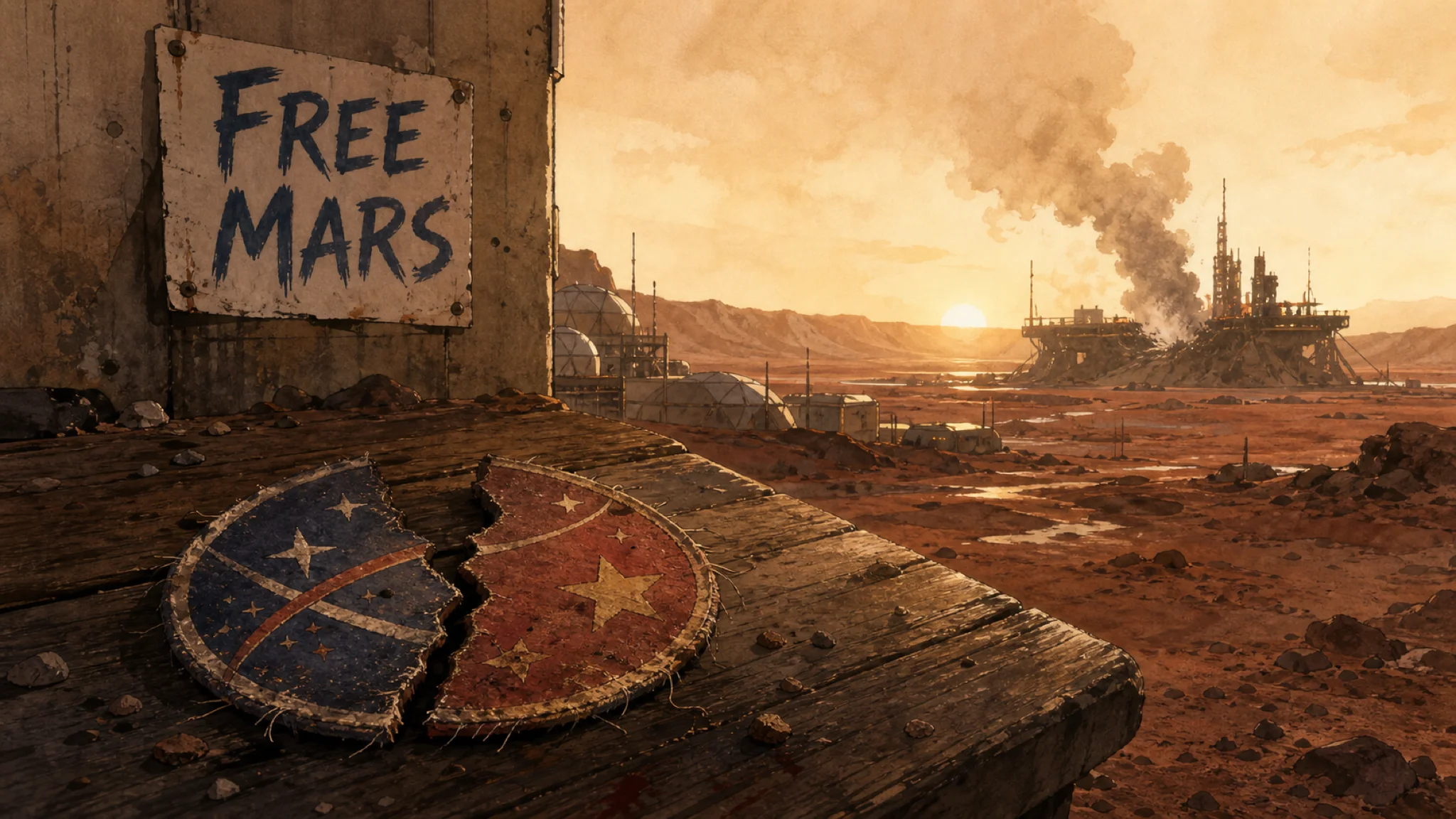
Five seasons in, For All Mankind has been telling a story about how every new frontier becomes the old one wearing different uniforms. Apollo’s peace plaque gives way to Mars’s labor camps gives way to a Soviet invasion force aimed at a mining station. “Brave New World” stops treating that drift as accident and starts treating it as the recipe. Celia’s HVC swearing-in promised authority without abuse. Within hours, that same Corps detonates a platform full of Marines who arrived early because the dust storm hid them. The lead-with-kindness speech and the warning broadcast — “M-6 units in the vicinity of Kuznetsov, clear off now” — were both sincere. Neither stopped the explosion.
The finale’s argument is that idealism on Mars dies the same way idealism died on the moon and on Earth. Not because the ideals are wrong, but because the people holding them keep making exceptions for the next bomb, the next concession, the next dead crew. Kelly’s plaque was always about who gets to write the next sentence. The episode closes on the people on Mars discovering they have written one they will have to live inside.
Verdict
This is a finale that does the hardest version of what a Ron Moore season ender can do — it lands its plot beats, kills characters the show built five seasons of equity in, and refuses to let the survivors call the result a win. The dust-storm hopper sequence is the action centerpiece the season has been holding back. The AJ Jarrett arc is the most disciplined piece of grief writing the show has done since Karen Baldwin. The cold open is one of the best opening minutes the series has ever filmed, precisely because the episode spends the next hour betraying it on purpose.
What keeps it from a higher rating is the same structural problem that nagged at the back half of the season: the M-6 occupation force, Korzhenko’s politics, and Lenya’s family in the USSR are all driving the plot from offscreen. The finale handles them with one Lenya monologue and Irina’s prison-cell exposition, and they hold, but they hold the way a brace holds — you can see the joinery. If this turns out to be the series finale, those threads will read as truncated. If there is a season six, the finale has paid for them honestly.
Rating: 8.7/10
More episodes from For All Mankind — Season 5 — The alt-history NASA race enters its final season, episode by episode. Jump to any episode in the season:
Where to go next
Reviewed by Mira Vance · QuizFandom Editor & Lead Reviewer. Every rating is an honest per-watch assessment from the desk that also writes the quizzes — not a press release rehash.