Goblin Episode 01 Recap: A Sword, a Birthday, and a Door to Canada
Guardian: The Lonely and Great God (Goblin), Season 1, Episode 01 tvN · Written by Kim Eun-sook · 2016-2017
Kim Shin receives immortality as punishment, while Ji Eun-tak grows up carrying the miracle he was never supposed to give.
Episode 01 of Goblin begins with a curse that sounds romantic until the cost becomes visible. Kim Shin is not looking for love because he is lonely in a glamorous way. He is looking for the one person who can pull the sword from his chest and end 939 years of memory. Before that girl arrives, he has already collected death, divinity, wealth, grief, a roommate war, and a door that opens into another country.
That is a lot of mythology for one first hour.
It lands because the fantasy keeps returning to bodies: a general walking toward his king while his family dies around him, a mother begging for her baby in a wrecked street, a child cooking seaweed soup on the birthday that is also her mother’s death day.
The romance can wait. The wound arrives first.
Kim Shin dies with the king’s sword in his chest
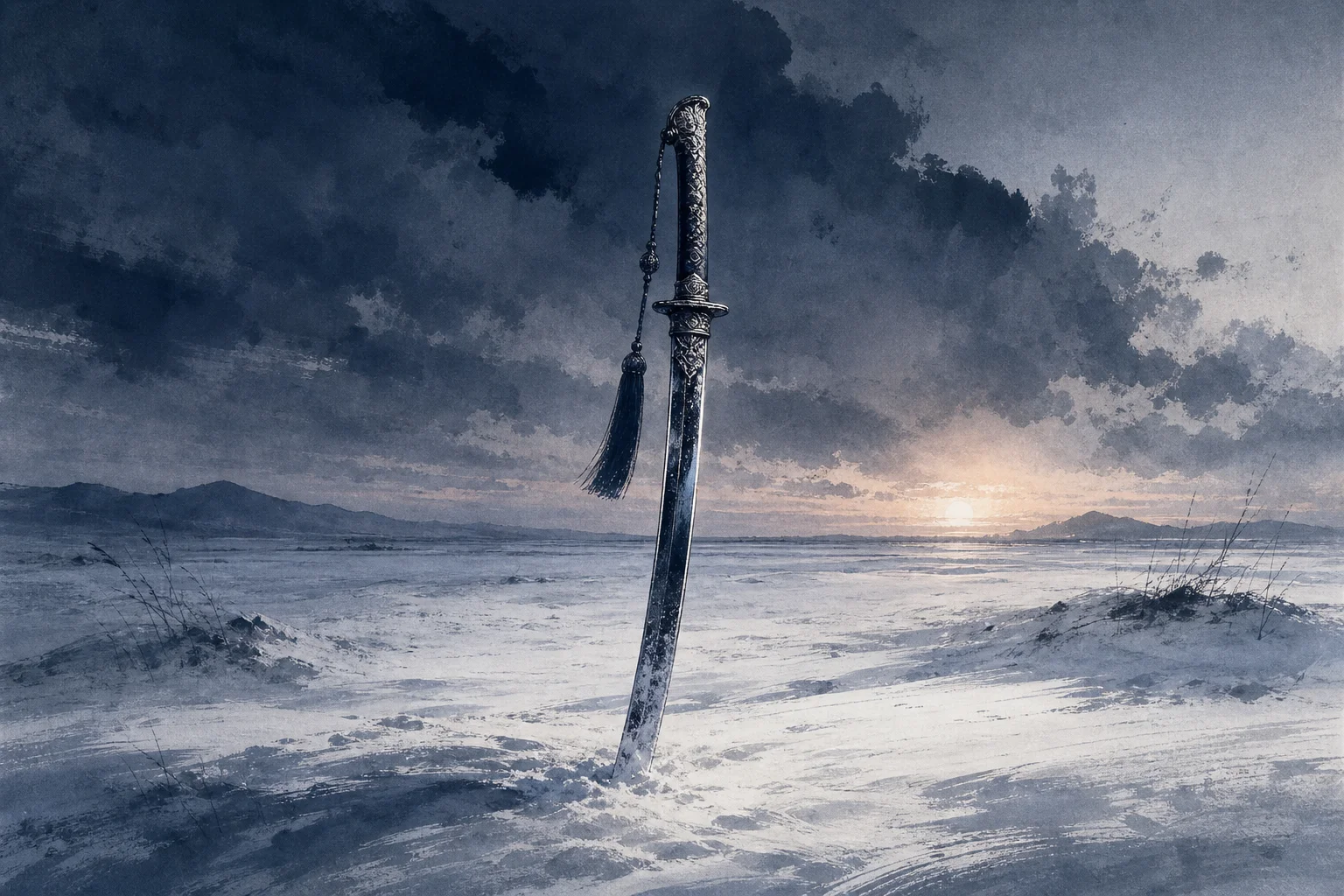
Kim Shin (Gong Yoo) enters the story first as legend, then as a man covered in blood. The opening myth gives the rules: a sword touched by blood and desire can make a goblin, and only the goblin’s bride can pull that sword free. Once it is drawn, he will cease to exist and be at peace.
Then Goryeo puts flesh on the fairy tale.
Kim Shin returns from battle as a victorious general, but the palace greets him like a rebel. The young king listens to the older court official who feeds his fear: Kim Shin’s victories dazzle the people, his power threatens the royal family, and his name has become too close to godhood. By the time Shin reaches the palace gates, loyalty has already been rewritten as treason.
Shin keeps walking because stopping would mean accepting the lie. With each step, the king orders another death. His sister tells him to go. His soldiers fall. The friend who loves him receives the terrible request to end him properly.
Shin does not get a heroic death in the way songs would prefer. He dies betrayed, displayed, and forbidden a burial. His body is left in the field so animals can feed on it. The people pray over him anyway.
The answer to those prayers is not mercy in any clean sense.
He wakes with the sword still inside him, told that the people’s desire saved him while the blood on his weapon condemned him. Immortality becomes both reward and sentence. He will live. He will remember every death. He will watch the people who love him grow old and leave.
That is why the sword matters before it becomes a romance device. It is his execution, still happening.
The Grim Reaper misses a mother and meets a child who should not exist
The Grim Reaper (Lee Dong-wook) enters cold because he is not evil. He is procedural.
In 1998, Hwang Mi-young dies after a crash, and the Reaper appears with her name, death time, and cause of death. He offers the tea that removes memories from this life. She asks what happens if she refuses it. He gives the answer like someone who has said it too many times: regrets should be left behind.
That teahouse exchange gives him shape before the mansion comedy arrives. He is precise, detached, and tired in a way that does not yet know itself as grief. He has no memory of who he was, but he knows the paperwork of death down to the minute.
Then he loses a case.
Ji Yeon-hui should die with her unborn baby after the accident. Kim Shin hears her prayer and intervenes, even while insisting he does not meddle with mortal life and death. He saves her and the child because she asks for the baby, not herself. The Reaper’s death card still says “No Name, 0 years old,” but the baby lives long enough to receive a name.
Eight years later, he finds Ji Eun-tak at the worst possible moment: her mother has just died, and the child can see the spirit saying goodbye to her. The Reaper recognizes the error immediately. Eun-tak was not supposed to be born. She has a name now, but he has no proper card with that name on it.
That failure matters as much as Kim Shin’s miracle. The supernatural world has rules, forms, deadlines, and missing records. Eun-tak survives inside that gap.
The old grocery woman protects her, tells her to move, and gives her a birthday gift. It is not a soft rescue. She warns Eun-tak that suffering is coming, then helps her survive anyway. Blessings can arrive with cabbage, spinach, and instructions to pack within three days.
Eun-tak grows up cooking her own birthday soup
Ji Eun-tak (Kim Go-eun) could have been a miracle child in a glowing bubble. Instead, her life stays hard.
At nine, she celebrates a birthday with cake because she thinks wishes might work better with candles than rice cakes. Then she realizes the woman lighting those candles is not her living mother, but her mother’s soul. The goodbye is small and devastating: put on your scarf, go to the grocery lady, wait for the hospital call, never look spirits in the eye.
Eun-tak apologizes for being able to see things.
Her mother answers by thanking her for seeing her.
Ten years later, Eun-tak is still living with the consequence of that night. Her classmates gossip that she sees ghosts. A dead girl bothers her in the cafeteria and calls her the goblin’s bride. At home, her aunt and cousins treat her birthday as an inconvenience while eating the seaweed soup she cooked herself. They want her mother’s insurance money, her bank book, and her silence.
The poverty here is not decorative. It shapes every wish Eun-tak makes. She needs a job because money is pressure. She wants her aunt’s family gone because the house is unsafe. She wants a boyfriend because loneliness has started to sound embarrassing.
So when she blows out a flame and summons Kim Shin, the joke has real ache under it. She has spent years refusing to make wishes because nobody grants them. Now the wrong man keeps appearing with buckwheat flowers in his hand.
The first meeting is prickly in exactly the right way. She thinks he is a ghost. He insists he is not. She asks for money, lottery numbers, a job, and romantic assistance with the efficiency of someone who cannot waste a supernatural contact.
Then she asks what buckwheat flowers mean.
“Lover,” he says.
Neither of them is ready for that word. That is why it works.
There is room for ridiculousness too, especially once Deok-hwa rents the mansion to the Grim Reaper.
Kim Shin’s immortal melancholy could sink the mansion plot, so Yoo Deok-hwa (Yook Sung-jae) arrives as a rich heir with more nerve than judgment. As a child, he asks why this strange man speaks informally to his grandfather. As an adult, he gets his credit card cut off and accidentally turns his uncle’s house into a supernatural shared rental.
The tenant is the Grim Reaper.
That reveal sets up two death-adjacent men with old business, different manners, and no desire to share a kitchen. Kim Shin calls him a thing. The Reaper has a lease. Kim Shin burns the copy. The Reaper says the original is with the realtor. One threatens the house. The other mentions Deok-hwa as an alternative payment.
The immortal goblin has a roommate because Deok-hwa wanted twenty years of rent.
The dinner scene keeps that tension light without making it empty. The Reaper recoils at meat like it is barbaric. Kim Shin peppers him on purpose. The Reaper returns the favor because they have apparently agreed on rudeness as a house rule.
Kim Shin’s curse began with a king, a court official, and a sword. The Reaper’s world runs through death cards and memory tea. These two do not know yet how deeply their pasts are tangled, but they are already across the table from each other, irritated and trapped in the same house.
The bromance starts as a property dispute. Good.
Eun-tak follows Kim Shin through the door
The final movement belongs to Eun-tak because she solves the mystery before Kim Shin wants her to.
After summoning him once by accident, then again by blowing out flames, she begins treating him like a stubborn contact who refuses to save his number. He is baffled. She is delighted by the leverage. She calls him into a church, learns there are places where his disappearing trick will not work, and keeps pushing for the boyfriend portion of her wish list.
He tries to test her. If she is truly the goblin’s bride, what can she see?
Eun-tak can see ghosts. She can see his shadow. She can identify him as a goblin because the ghosts have been calling her his bride since birth. But she cannot see the sword in his chest. For Shin, that seems to close the question. If she cannot see the wound, then she cannot be the person who ends it.
His cruelty in that exchange is sharp because it comes from fear. He tells her she has no value to the goblin. He calls her survival a side effect of a rule being broken. He tells her to live in reality, not rumors.
Eun-tak hears something worse than rejection. She hears another adult deciding whether her life counts.
Then she follows him through the door.
Kim Shin can cross from Seoul to Canada through an ordinary doorway. Eun-tak should not be able to follow. Yet there she is, standing in a foreign country, thrilled by maple leaves and red carpet, suddenly very sure of herself.
If he is the goblin, and she can cross his impossible threshold, then she makes the only romantic leap a lonely nineteen-year-old with no safety net would make.
She tells him she will marry him.
Then she says she loves him.
It is absurd. It is too fast. It is also completely legible. Eun-tak has been treated like a burden, a freak, an error, and a bank account. Kim Shin is the first impossible thing in years that might belong to her future.
What works
Every supernatural rule has an emotional cost. Kim Shin’s sword is tied to betrayal and memory, Eun-tak’s ghost sight is tied to losing her mother, and the Reaper’s missing card turns bureaucracy into danger. The fantasy feels large because the details stay personal.
Kim Shin and Eun-tak’s first dynamic is stronger than a simple fated-couple reveal. He is exhausted and defensive. She is broke, funny, lonely, and unafraid to ask for practical miracles. The buckwheat flowers could have been pure romance, but the birthday context makes them feel like the first gift she did not have to cook for herself.
The Reaper material is not filler. His teahouse work, his failed claim on Eun-tak, and his deadpan lease war with Kim Shin give him a full lane from the start.
What stumbles
There is a huge amount of setup, and some of it arrives in blunt exposition. The opening mythology, the Goryeo betrayal, the 1998 accident, Eun-tak’s childhood, Kim Shin’s departure plans, Deok-hwa’s rental mess, and the Canada cliffhanger all compete for space.
The age gap framing will also be a hurdle for some viewers. Eun-tak is nineteen, and her line about marriage is played with fairy-tale excitement, but romance, destiny, and a teenager’s desperation now sit in the same hand. The later episodes need care there.
What this sets up for Episode 02
Episode 02 has three immediate problems to answer. First: why can Eun-tak pass through Kim Shin’s door if she cannot see the sword? Second: what happens when the Reaper, who already knows she was supposed to die, lives under the same roof as the man who saved her before birth? Third: can Kim Shin keep pretending Eun-tak is not his bride now that she has followed him somewhere no ordinary person should reach?
Kim Shin is left with the worst possible combination: a curse he wants ended, a girl he wants to dismiss, and proof that the universe may have already chosen her.
Rating: 8.6/10
More episodes from Goblin: The Lonely and Great God — Kim Eun-sook's 939-year-old goblin and his bride, episode by episode. Jump to any episode in the season:
Where to go next
Reviewed by Mira Vance · QuizFandom Editor & Lead Reviewer. Every rating is an honest per-watch assessment from the desk that also writes the quizzes — not a press release rehash.