Tom Clancy's Jack Ryan S3E1 Review: The Old War Finds a New Fuse in Athens
Falcon opens the Russia arc with buried Cold War doctrine, public diplomacy, and a CIA operation that curdles into betrayal.
Tom Clancy’s Jack Ryan returns for Season 3 with an episode that treats history as unfinished business rather than background color. “Falcon” opens on the Sokol Project as both technical problem and political wound, then jumps to Jack Ryan chasing a Russian warning nobody in power can trust cleanly. The premiere is built around a blunt anxiety: a Cold War remnant has found people willing to make it useful again. By the final call from Athens, Jack is no longer the analyst pushing an uncomfortable thesis through channels; he is the man those channels are preparing to discard.
A buried program begins with a purge
The cold open gives the season its moral weather before Jack appears. A group of scientists explains that a launch vehicle test failed because of a manufacturing defect and asks for six weeks to fix it. The response is polite on the surface, almost paternal, until the conversation shifts to national humiliation, dying “old ways,” and the need for sacrifices. Sokol is named as a noose around Russian necks, too dangerous to continue, and Luka is ordered to take care of it.
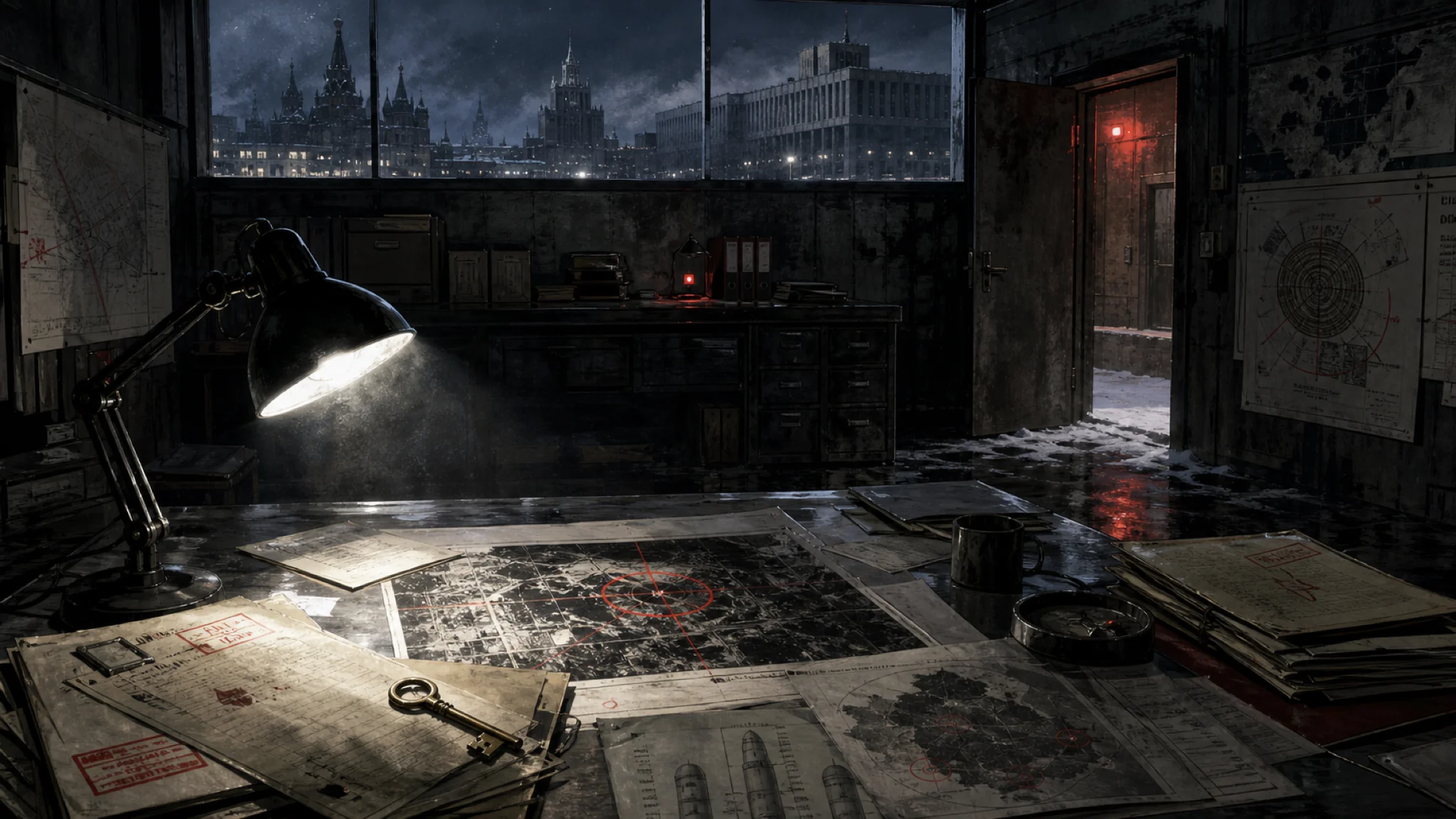
That phrase could have meant a shutdown. The episode makes it a massacre. Luka tells Egorov and Lebedev that the general has ordered Sokol closed “completely,” then soldiers move through the facility and open fire on the workers inside. “Falcon” does not introduce Sokol as a sleek villain device. It introduces Sokol as a state secret already soaked in coercion, fear, and deniability.
That history gives Jack’s Rome operation more charge than the usual embassy-party meet. Zoya Ivanova approaches Jack at a crowded reception and tells him Sokol was designed as a small-yield battlefield nuclear weapon that would be invisible to radar and undetectable. She also says the program has been reactivated, the weapon has been built, and it is being moved. The scene is short, cramped, and risky. Jack leaves with a card and a bruise to his pride after being thrown out by security, while James Greer waits outside with the kind of grin that says he came early specifically to watch Jack suffer.
Their banter keeps the premiere from locking itself into solemnity too soon. Greer asks whether getting kicked out was part of the plan; Jack says it was the fastest way out. The joke matters because the next line is all dread: the project is active, and the weapon exists. Season 3’s first clean Jack-Greer beat is not triumph but shared recognition. They know enough to be frightened and not enough to know who is using whom.
Wright sees the danger in Jack’s certainty
Director Wright gets one of the episode’s sharpest early scenes because she understands Jack’s value and his danger at the same time. She notices that Jack did not file an action report for the Zoya meet and frames the reprimand through her own first job reading cables and after-action reports. Wright tells Jack she has never liked heroes because heroes tend to think more about their actions than the repercussions. The line lands because Jack has already acted outside the clean paper trail.
The briefing that follows is heavy with exposition, but it is some of the premiere’s most important work. Jack lays out Sokol’s link to Seven Days to the Rhine, a war-game logic built around assassinations, misinformation, destabilized Eastern Bloc neighbors, and a limited nuclear strike that could create the chaos needed for land invasion. The episode makes Jack’s analysis procedural rather than mystical. Zoya’s SIM card is not treated as proof by itself; it is a mapping program that may locate the nuclear material for the missile, and even Greer admits Zoya is a self-serving liar when she is not giving good intel.
That skepticism is where the episode is at its most adult. Wright does not dismiss the threat, but she refuses to let Jack convert fear into permission. Crimea is politically radioactive, Russia is already accusing NATO of aggression, and Jack’s thesis has not fully proven out. When the SIM card points toward a refrigerated cargo ship leaving Sevastopol, Jack and Wright push Director Miller for a sheep-dipped SOG recon team, but the approval is narrow: see it, confirm it, get off the ship.
The ship sequence works because the object of the mission changes under Jack’s feet. The team boards expecting nuclear material and finds Yuri Bashkin hidden in a container. Yuri says he is a scientist, asks for U.S. asylum, and tells Jack he helped build Sokol. A recon mission becomes an extraction, and Jack again asks Wright to make a decision faster than the institution can comfortably absorb it.
Wright authorizes the extraction, but the permission already carries blame inside it. Jack argues that if Miller gets the question, Miller will either blow the operation open or wait until the trail goes cold. Wright sends coordinates for a drop on the coast of Greece and tells Jack to play it by the book. The cruel pressure of “Falcon” is that the book has no page for what is happening. Yuri confirms there is a small, low-yield weapon, says his work was payload, and acknowledges the radar-invisibility research. He also refuses to reveal who helped him leave Russia until he has asylum. Jack has enough to know the conspiracy is real, but not enough to protect the man who can prove it.
The beach ambush is the episode’s operational collapse point. The entire team is killed, Jack gets Yuri into a car, and the chase through Athens becomes panic. Yuri keeps repeating “asylum” while Jack presses him for the source, for who wants him dead, and for how high Sokol reaches. Jack needs a name because he sees the larger pattern. Yuri needs a legal promise because he knows information without protection is a death sentence.
Kovac makes diplomacy a trap
The Czech storyline gives “Falcon” its stronger political counterweight. President Alena Kovac is introduced as a leader caught between NATO’s missile offer, Russian pressure, rural suspicion, and the practical threat of energy dependence. Her conversation with her father is quieter than the CIA material but just as loaded. He tells her half the country sees her as deep in NATO’s pocket and the other half sees her as a Russian puppet gone soft. She answers pressure with strategy: she counts on being underestimated.
Kovac proves that in the meeting with Russian defense minister Dmitry Popov. She deliberately fills the castle with reporters after the Russians requested no media, then uses the cameras to make her offer public. Kovac says she will refuse or postpone NATO’s surface-to-air missiles if Russia agrees to cease further incursions into Ukraine. It is a clever ambush because it forces Popov to respond in front of witnesses, but the episode does not pretend cleverness removes danger. Popov warns her to tread lightly. Later, Kovac sends him a bottle of Soyuznik, Russian for “ally,” as both apology and truce.
The soccer match then breaks that fragile truce into the season’s first visible domino. Popov and Kovac speak in the language of national pride, old hockey wounds, Czech vulnerability, and the usefulness of staying close between two larger powers. Popov says he has decided to bring Kovac’s proposal to the Kremlin, with no promises. Then a silenced shot kills him in the arena.
The assassination is staged with brutal economy. It lands at the precise moment diplomacy seems to have found a channel, which makes it feel less like random escalation than engineered sabotage. Kovac is left with blood on her and calls pouring in from foreign leaders. Jack, meanwhile, learns from Wright that Popov is dead only after Yuri has been killed by the men pursuing him. The two plots snap together through Jack’s conclusion: Seven Days has started, the assassination is the first domino, and the Sokol weapon will be the last.
That connection also exposes how quickly the system moves to self-protection. The official Greek line says Jack entered the country illegally to eliminate a Russian national and killed one of their own in the process. Jack hears the shape of the decision before Wright can soften it: they are looking for a fall guy. Wright warns that if Jack does not come in, his embassy cover will be withdrawn and he will lose diplomatic immunity. Jack refuses because someone reached out to him directly, which means someone knows he is right. Greer’s Arabic message, “Shelter in paradise,” tells Jack where to go even as Wright admits she made the choice to burn him. Jack was a resource; now he is a liability.
What this episode argues
“Falcon” argues that spy work becomes most dangerous when accurate intelligence threatens institutional survival. Jack is right about Sokol, right that Yuri matters, and right that Popov’s assassination fits the Seven Days pattern. The episode still refuses to make correctness glamorous. Jack’s instincts produce movement, but movement also produces dead operators, a murdered scientist, an international accusation, and a CIA directorate ready to separate itself from its own man.
The politics are framed with the same caution. Kovac is smart and brave, but her public pressure play also helps create a stage on which an assassin can alter history. Wright is not a coward, but her job requires converting moral risk into paperwork, deniability, and hard choices. Greer is retired from field life in theory, quoting Aeschylus and joking about meditation, yet the moment Jack is burned he becomes the only person willing to speak to him in code. The hour’s best idea is that nobody here controls the consequences as completely as they think.
Verdict
“Falcon” is a sturdy, tense premiere with a few stretches of heavy briefing-room explanation, but its architecture is strong. The cold open gives Sokol a bloody origin, the Rome material restores Jack and Greer’s prickly rhythm, and the Czech scenes keep the season from becoming only an American chase story. Jack is most effective when he is pushing too hard because he knows the shape of the threat but not the trap around it, while Wright’s caution carries real force rather than simple obstruction.
The final movement is its best. Yuri’s death, Popov’s assassination, and Jack’s burned status arrive close together without feeling arbitrary because each event has been prepared by the episode’s concern with deniability. “Falcon” gives Season 3 a clean engine: the old Cold War plan is moving again, and Jack Ryan has become easier to blame than to believe.
Rating: 8.0/10
More episodes from Jack Ryan — Season 3 — The Russia arc — Jack on the run after a rogue Sokol plot is uncovered. Jump to any episode in the season:
Where to go next
Reviewed by Mira Vance · QuizFandom Editor & Lead Reviewer. Every rating is an honest per-watch assessment from the desk that also writes the quizzes — not a press release rehash.