Tom Clancy's Jack Ryan S3E3 Review: Running With Wolves Sends Jack Into the War's Blind Spots
Jack follows a suspect ally into Vienna while Greer tests Czech trust, and the hour makes every institution look compromised.
“Running With Wolves” pushes Jack Ryan deeper into the season’s Russia crisis by making flight look almost indistinguishable from investigation. Jack is still a fugitive after the failed operation around Sokol, wound tight rather than triumphant, but the episode refuses to treat his outlaw status as a clean badge of honor. By the final scene, the danger is no longer only that Jack has been framed; it is that every side is moving toward exactly the confrontation the Sokol faction wants.
Vienna makes trust a moving target
The episode opens with Jack going to Zoya Ivanova because the regular chain of command has become part of the threat. Zoya spots Mike November’s tail before Jack can pretend the meeting is clean, and that early detail tells us how little room this hour has for romantic fieldcraft. Jack needs her to arrange a meeting because Sokol, if real, means mass death; Zoya agrees only after making it clear that self-preservation comes first.
Mike November, with the right mix of contempt and loyalty, gives the Vienna thread its necessary resistance. Mike believes Jack about Sokol, but he also keeps naming the cost Jack refuses to slow down and weigh. He tells Jack he is about to cross a line with no guaranteed return, and that warning hangs over the rest of the hour. Jack frames his choice as doing the right thing; Mike’s answer is more adult than cynical: believing Jack does not mean Jack is the only person who can stop this. The scene keeps Jack from becoming an inspirational renegade.
The Washington response makes that narrowing worse. At the CIA office, FBI agents arrive under a warrant that charges Jack under the Espionage Act, and Director Wright has to watch another piece of the machinery move without her full control. Once Jack becomes a traitor on paper, everyone who helps him becomes vulnerable, and every useful fact he finds becomes easier for Miller’s side to discard. Wright still tries to limit access and track Zoya because she understands Jack’s next move, but she is trapped inside the optics of bringing him in.
That is why James Greer’s phone call to Jack lands with such dry ache. Greer’s tone can sound casual while carrying real fear, especially when he tells Jack the FBI is coming to Vienna on a treason charge. Greer admits the Popov assassination has too many gaps: no definitive money trail, no footage of the shooter, a missing witness. Jack, working from Popov’s record as a Chernobyl liquidator and nuclear treaty advocate, pushes the bigger possibility that the murder served someone inside Russia who needed a more aggressive policy.
Kovac learns that pressure can come from allies too
Greer’s Prague material is the episode’s strongest political writing because it puts President Alena Kovac in a position where every helpful fact is also an accusation. Alena listens like someone trained to hear the angle inside every courtesy, and the walk with Greer gives her reason to distrust even the man trying to help. Greer brings NSA transcripts showing that Dmitry Popov had been advising President Surikov not to alienate the Czech Republic by pushing farther into Eastern Europe. Popov looked like a hardliner, but the evidence suggests he was aligned with Alena’s attempt to keep the region from becoming a trigger point.
The revelation cuts two ways. It tells Alena that Popov may have been killed because he was preventing escalation, but it also tells her that the CIA had been sitting on intelligence with direct consequences for Czech security. Her anger at Greer is not performative. When she says the CIA treats allies too much like enemies, the show lets the criticism stand. Greer is not wrong to bring the information, and he is not using swagger to sell it. He says he is arming her with information and leaving the decision to her. Still, the damage is already baked into the delivery. Allies who learn the truth late are being managed, not trusted.
That trust problem sharpens at the stadium. Greer brings Alena back to the scene of Popov’s assassination because the official story around Tibor Kasal no longer holds. Security was too tight for Kasal to carry in a weapon; Kasal had no clear motive or operational capacity; the footage leaves blank spaces exactly where the plot would need them. Alena resists because Radek is her head of security and a longtime friend. Greer asks her to remember the movement before the shot, and the physical space does the rest.
Alena’s memory that Radek had left her before Popov was hit gives the episode one of its better procedural turns. The missing man is suddenly not only absent; he is positioned. Greer adds that Radek was upstairs where Kasal was later killed, and the personal betrayal becomes a national-security problem. When Petr Kovac arrives, Greer says he believes Radek is part of a larger conspiracy, and Petr immediately understands what that means for Alena’s options. By then, she has already approved NATO missile installations on Czech ground, refusing to let Russia make her country a playground. It is a decisive act, but the episode has just spent forty minutes showing how easily decisive acts can be baited.
The wolves are not only in the forest
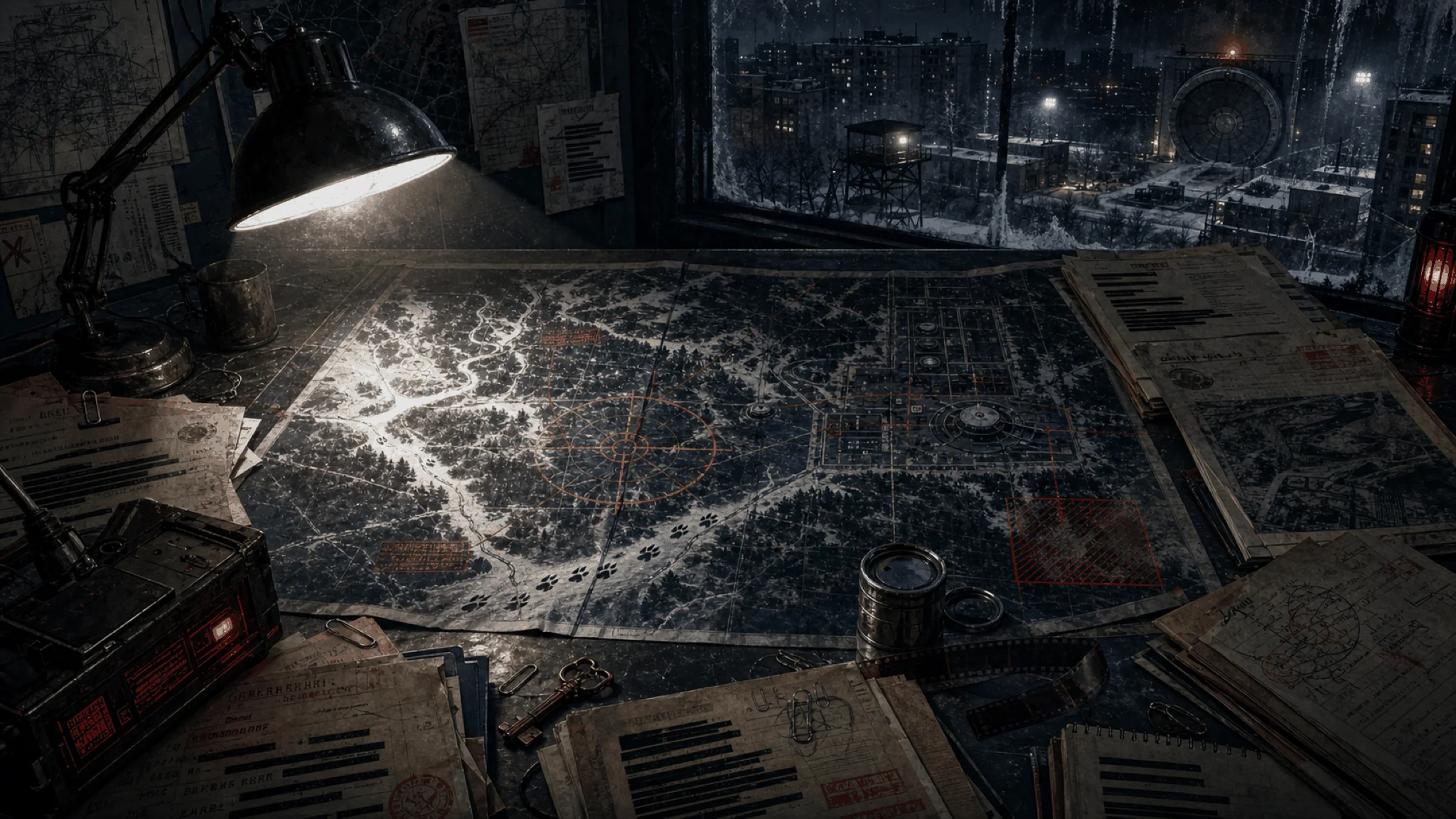
The hunting-party thread gives the title its most direct image and its bluntest ideological statement. Petr hosts Levan Zubkov, Sarhan, and Alexei Petrov at a remote wolf hunt where the business of restoring an old order happens under the manners of leisure. Zubkov says the item they agreed upon has been acquired and is moving, with a twenty-million-dollar cost attached. The later Luka conversation makes the implication clear enough: Sokol still needs uranium, and Zubkov is positioned near the supply line.
Petr’s authority in that gathering is chilling because he never has to raise his voice. When Sarhan complains about the CIA officer and about Petr’s limited influence over Alena, Petr allows the insult to hang, then absorbs it as a manageable concern. In the private exchange with Alexei, he tells the story of a father who cried when the Berlin Wall fell because Russia had stopped being the monster that frightened the world. The speech is not subtle, but it is clarifying. These men want to manufacture a cost large enough to make Russia feel like itself again.
That is where “Running With Wolves” finds a cleaner villainy than the season’s fugitive mechanics. The episode is not claiming Russia as one mind, and Luka Gocharov’s later explanation matters for that reason. The threat is a rogue faction that is Russian but not synonymous with the Russian state. Petr’s faction wants NATO missiles in Czech territory because the provocation helps the project succeed. Alena’s sovereign decision and the CIA’s pursuit of its own agent become pieces on a board someone else arranged.
Luka’s entrance on the train is the hour’s best reversal because it begins like a capture and becomes something stranger. Jack is beaten, Mike is held nearby, and Luka demands to know what Yuri told him and who his source is. Then Luka kills the assassin and reveals that the syringe contained only water. The trick is brutal, but it creates a new channel of information. Luka says Yuri knew the Sokol disaster was not Russia but a Russian faction, and he wants to expose it because he has no one left to trust, not even inside his own government.
The explanation reorients the season without wiping away the dirt on anyone’s hands. Luka admits he lied about a nuke on a ship to make the CIA react. He names Zubkov as the arms dealer most likely to have enough uranium, and Mike’s connection to Zubkov becomes the reason the train is heading to Budapest. Jack then calls Wright and asks for trust based on intelligence from a man she knows has done terrible things. Wright’s skepticism is the right response, even when Jack is probably right. Miller will not authorize action from Luka’s word, and Jack uses that limit as another reason to keep moving outside the system.
What this episode argues
“Running With Wolves” argues that escalation is often built out of partial truths rather than simple lies. Popov really is dead. Russian troops really are near the Slovakian border. Jack really has gone rogue. Alena really has reason to accept NATO missiles. Each fact can be defended in isolation, which is exactly why the conspiracy can use them. The episode’s politics are strongest when it treats institutions as reactive systems full of people with incomplete sightlines.
The hour also resists making Jack’s defiance purely aspirational. Jack’s instincts are valuable because he keeps noticing the details others want to simplify: Popov’s anti-nuclear record, the convenience of his death, the danger of assuming official Russia and Petr’s faction are the same thing. But the show keeps putting cost around that clarity. Mike risks his station and freedom. Greer gets pushed farther into unofficial work. Wright has to choose between procedure and a man who may be the only moving piece close enough to stop Sokol.
Verdict
“Running With Wolves” is a strong third hour because it makes the season’s conspiracy feel less like a puzzle box and more like a pressure system. The Vienna train material gives Jack and Mike a tight field-thriller engine, while Greer’s Prague scenes add the diplomatic weight the Russia arc needs. The hunting-party scenes are broader than the episode’s best conversations, but they give the Sokol faction a coherent emotional motive: the desire to recover fear as national identity.
The episode occasionally leans hard on explanatory dialogue, especially when characters spell out Popov, NATO, and the rogue faction in quick succession. Even so, the structure holds because each exposition scene changes someone’s position. Alena acts. Wright follows. Luka reveals himself. Jack crosses the line Mike warned him about. That makes “Running With Wolves” a careful, tense installment in a season about how easily intelligence can become provocation when every government is braced for betrayal.
Rating: 8.0/10
More episodes from Jack Ryan — Season 3 — The Russia arc — Jack on the run after a rogue Sokol plot is uncovered. Jump to any episode in the season:
Where to go next
Reviewed by Mira Vance · QuizFandom Editor & Lead Reviewer. Every rating is an honest per-watch assessment from the desk that also writes the quizzes — not a press release rehash.