Monarch S2E9 Review: A Finale That Trades Vengeance for a Love Letter in the Rift
What happens — the short version (spoilers)
- Isabel Simmons reveals she funded the egg theft to hold a rift open and use Axis Mundi's time dilation as a back door to the future — to visit the dead.
- Cate punctures the pitch by noting the Apollo astronauts came home to living families, while Kentaro sits silent as the one Randa still pullable either way.
- Lee Shaw's tactical team lands on Skull Island and loses half its number to Skullcrawlers within minutes; Tim pulls May from a creature's mouth.
- Shaw refuses to fall back to the beach, rallying the survivors to keep going for the people they came to rescue.
- Cate escapes her escort, finds a Monarch radio frequency, and reaches May to point the rescue at the bunker.
- Keiko and Lee find a row of Billy's field probes dropped into rifts worldwide over six years, all surfacing on the island where she vanished.
- One probe holds Billy's letter and vow to love her in this world or any other; Keiko realizes he spent his life looking for her, treating the rift as a mailbox not a time machine.
- Titan X wakes inside the bunker as the implants fire; Cate asks Kentaro to help her give the mother her egg and undo the damage, finally deciding which Randa he'll be — a season-three cliffhanger.
Skull Island becomes a tomb, a launchpad, and a mailbox in the same hour, and the season's quietest revelation comes wrapped in Billy Randa's handwriting.
For a season that has spent eight episodes arguing about whether the Randas are explorers, criminals, or the unwitting middle managers of an interspecies disaster, the finale finally stops asking and starts paying. “Skull Island” puts every surviving Randa on the same rock for the first time in fifty years, and then makes the rock itself the point. Isabel Simmons runs her time-machine pitch in a dripping concrete bunker. Cate Randa (Anna Sawai) jailbreaks herself onto a Monarch radio frequency mid-dust-storm. Lee Shaw (Wyatt Russell) leads a tactical team that loses half its number to Skullcrawlers in the first twenty minutes. And Keiko Miura (Mari Yamamoto), exhumed from Axis Mundi and walking the island with her grown husband’s friend, finds a row of metal probes that turn the finale from sci-fi caper into something closer to a Victorian ghost story.
Isabel’s pitch is the Skull Island episode in miniature
Showrunners Chris Black and Matt Fraction have spent the season letting Isabel Simmons accumulate menace through reasonableness, and the finale finally lets her say the quiet part out loud. The pitch is delivered to Kentaro (Ren Watabe) and Cate inside a recycled Monarch outpost: Apex didn’t bankroll the egg theft, she did, with a trust fund and a “group of extremely smart people.” The plan is not weaponization. It is, in her telling, a stable rift held open by Titan X’s distress so a private expedition can step into Axis Mundi and use its time-dilation as a back door to the future. Visit a cure. Visit a dead parent. Visit the day before the mistake.
The writing is careful with the moral framing. Cate calls it exploiting Axis Mundi as a personal time machine, and Isabel doesn’t deny it. She reframes it as the same flinch every NASA skeptic had in 1962. The script lets her have the analogy and then lets Cate puncture it with a science-teacher’s correction — the Apollo astronauts came home to find their families alive. The exchange is the finale’s thesis condensed into ninety seconds. The Randas have been arguing all season about whether the dead get a vote in what the living risk; Isabel’s pitch is the version of that argument that uses the dead as the reason.
What lands hardest is Kentaro’s silence. He’s the one Isabel built this for — Bill and Keiko’s grandson, Hiroshi’s son, the heir to the lineage Apex wants to harvest. She tells him outright that NASA picked Armstrong not because he was the best pilot but because he was the right name. The line is meant to flatter. Kentaro plays it like a slap. He spends the rest of the hour as the one Randa who can still be pulled either way, and the finale is built around the two scenes that pull him.
Lee Shaw runs the rescue, and the show does the casualty math on screen
Once the Monarch ship punches through the storm wall, the finale splits into three theaters and refuses to flinch at any of them. Lee Shaw’s tactical team lands on the beach, follows Titan X’s signal into a tree line, and gets ambushed by Skullcrawlers within minutes. Hadley dies first, off-camera in the way the show has learned is more unsettling than the kill itself. By the time Lee orders a scatter, half the team is gone. Tim catches May before she goes under and pulls her out of a creature’s mouth. The sequence runs roughly four minutes and burns through more named operatives than the show has killed in two seasons combined.
What lifts the action above standard Apple TV+ creature-feature material is what Lee does after. He gathers the survivors, gets one of them on the radio asking to fall back to the beach, and refuses. The speech is a Wyatt Russell special — not loud, not rallying, just the old colonel reminding a team that the people they came for might still be alive, and that this is the deal. He apologizes for being a dick on the way out. The line is funny and it is also the closest the finale gets to admitting that Lee enjoys being in command of something that isn’t waiting for him to die.
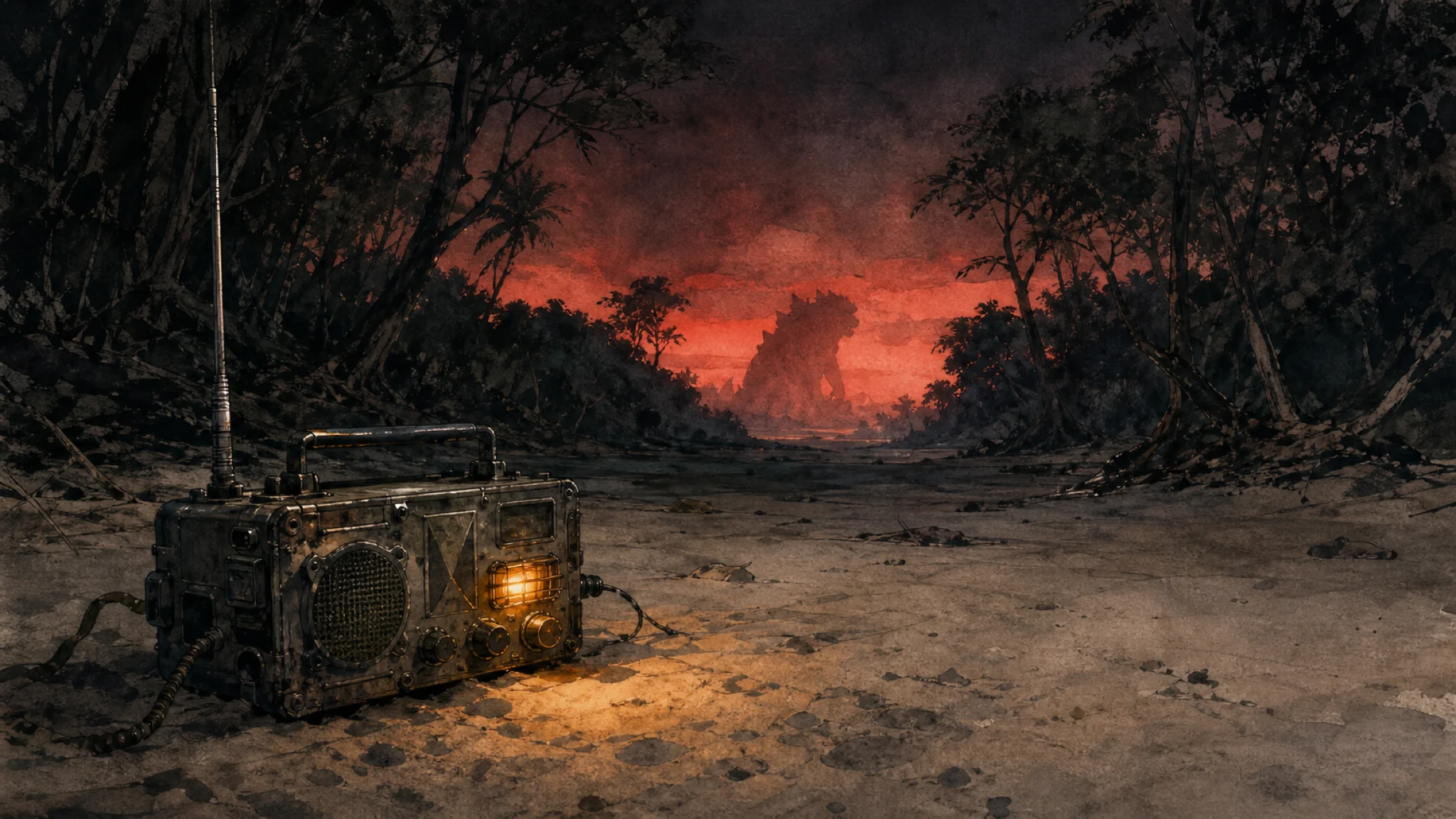
The scene matters because it sets up the radio bridge. Cate, escaped from her chopper escort and loose on the base, finds a Monarch frequency and gets May on the other end. The exchange — “old Monarch base,” “she’s luring the Titan here,” “find the valley” — is delivered through static and door-pounding, and May’s recognition of Cate’s voice carries the kind of relief the show usually keeps off-screen. It’s the first concrete piece of intelligence Lee’s team has had since they landed, and it points the rescue at the bunker just as Isabel triggers Phase Two.
Keiko finds Billy’s probes, and the season finally lets her grieve
Drop everything else, because this is the finale’s center. Keiko Miura — the woman the season pulled out of Axis Mundi after fifty subjective minutes and a half-century of geological time — has spent eight episodes acclimating to a world where her husband is dead, her son grew old without her, and a granddaughter she never met carries her last name. The show has handled it gently. The finale is the first time it lets her break.
The route in is Suzuki-sensei’s old field probes — the same multiband transmitters Billy improvised on his wedding day, when Keiko was newly his wife and the rift theory was a sketch on a napkin. She and Lee find one in the underbrush near the last site on Billy’s map. Then another. Then a row of them, dropped from Madagascar 1966, Loch Ness 1968, New Guinea 1971, Kazakhstan 1972. Billy spent six years chucking probes into every rift he could find, and every one of them came out here, on the island where she vanished.
Keiko plays the recognition in two stages. The first is the cold furious version — kneeling in the slaughterhouse where Billy died, screaming “Goddamn you, Billy” at the bones. The flashbacks the script intercuts are doing real work: the Brisbane registrar marrying them mid-storm, the lecture hall where Billy demoed his subway-of-rifts theory to bored students, the fight with Hiroshi about chasing the family he lost over the family he had. The second stage is the letter. One of the probes carries a folded note. “I didn’t have the words when it mattered, but I hope you hear them now.” She reads the first line. Billy’s voice — John Goodman, used sparingly all season — picks up the rest. “That you could possibly be in love with me lies beyond all logic. I vow to love you in this world or any other.”
It is the line the finale was built around, and the staging is correct. The show could have ended on the explosion, on Cate’s gambit, on Kong cresting the ridge. Instead it stays in a clearing with a widow reading a vow her husband sealed into a steel cylinder and threw into a hole in physics, hoping it would surface where she did. Yamamoto’s “he was looking for me the whole time” is delivered without a swell — the score retreats to a single piano figure — and the episode pivots there. Keiko isn’t grieving the man who left her on a cliff face. She’s grieving the man who spent the rest of his life building a postal system to a wife he refused to call dead.
What this episode argues
Monarch’s first season asked whether the family business — keeping Titans secret — was worth the lies it cost. Season two has been asking the harder version: whether the lies were just a way of refusing to grieve in public. The finale answers by lining up four versions of the same refusal. Isabel wants the rift so she can visit her dead. Cate wants the rift closed because she’s seen what reopening it costs the living. Kentaro is being asked to choose which Randa he is — the one who pushed the button in season one, or the one who could push a bigger one now. Keiko, who actually came back from the dead, is the only character the script trusts to tell us what the return is worth.
The answer is uncompromising. Keiko’s reunion with Billy is a probe in a clearing. She gets the words. She does not get the man. The vow survives the trip; the marriage does not. The show is arguing that Axis Mundi is not a time machine and never was — it is a mailbox, and the only thing it can deliver is what someone took the time to write down before the rift closed. Isabel’s pitch fails on contact with this. You cannot visit the cure. You can leave a note for the person who outlives you, and hope the probe surfaces.
That argument hardens by the closing minutes. Titan X wakes up inside the bunker. The synaptic implants come online. Cate, having found her brother, doesn’t pitch ideology — she pitches restoration. Give the mother her egg, send her home, undo the interference. When Kentaro hears her say “I did this. I let the genie out of the bottle. Help me put it back,” the finale finally tells us which Randa he is going to be.
Verdict
This is the finale Apple should have been holding out for. The Skull Island staging is the most expensive the show has ever looked, and the action math is honest — half the rescue team dies in the first sortie, and the survivors don’t get a triumph, they get a radio call. Wyatt Russell’s command beat in the tree line is the best stretch of pure Shaw the season has given him. Anna Sawai’s escape sequence and Kiersey Clemons’s radio reaction do more with restraint than any of the show’s set pieces. And the Keiko/Billy probe sequence is one of the best ten-minute stretches Apple TV+ has aired this year — a love letter delivered by satellite imaging, scored by silence, played by an actress the show has been undersupplying all season and finally lets carry the weight.
What keeps it short of a higher rating is the structural cost of the cliffhanger. The Phase Two payoff — Titan X waking up, the implants firing, Kong on approach — is the kind of finale-energy ladder the show usually pays off in the same hour. “Skull Island” leaves it dangling for a season three that may or may not arrive. Isabel’s expedition is staged as a pivot, not a resolution. If the renewal lands, the finale will read as patient setup. If it doesn’t, the bunker door will close on a story the show was just about to start telling.
Rating: 8.4/10
More episodes from Monarch: Legacy of Monsters — Season 2 — The MonsterVerse expands — Randa family secrets and new titans, episode by episode. Jump to any episode in the season:
Where to go next
Reviewed by Mira Vance · QuizFandom Editor & Lead Reviewer. Every rating is an honest per-watch assessment from the desk that also writes the quizzes — not a press release rehash.