Outlast: The Jungle Episode 1 Review: "Welcome to the Jungle" — Mary gets cut, Charlie claims the tarp kit, and Delta turns the beach into a leverage contest
What happens — the short version (spoilers)
- The first camp choices are framed as bets on scarcity, not personality.
- Mary gets squeezed off the first team despite real survival skills.
- Charlie's tarp kit gives the camp an early advantage and a visible status boost.
- Delta arrives with a much richer supply set and forces loyalty tests.
- The bow-for-fire trade stalls out, showing how fragile trust already is.
- The episode keeps tying strategy back to food, rain, bugs, and sleep.
The first hour does the hard work of explaining the game without ever pretending it is fair. Team choice is supposed to be about survival, but the show makes it clear right away that it is also about who gets cut, who gets fed, and who gets to act like a leader before anyone has even built a wall. Charlie lands the best shelter package, Bravo gets fire, Alpha gets hunting, and then Delta shows up with enough comfort to make the whole board feel rigged. By the end, the question is not whether anybody can survive the jungle. It is whether they can survive each other long enough to keep the advantage.
The camps split on shelter, fire, and hunting, and the first choice already tells you who is thinking like a scavenger
The premiere starts with the rulebook and then immediately breaks the cast into a choice that has consequences before anyone has unpacked a bag. Blue means shelter, green means fire, yellow means hunting, and every one of those options is less a job than a bet on how the season will go. Some players go straight for the practical answer, some talk themselves into the hardest job, and some are already measuring who on the beach looks useful.
What matters is that the show never treats the decision like a personality quiz. It is an argument about scarcity. Shelter looks smart until the bugs show up. Fire looks smart until everybody needs a place to sleep. Hunting looks heroic until the jungle turns into a calorie graveyard. The premiere keeps pressing on that point: the camp you choose is the version of survival you think you can actually hold together.
Mary gets squeezed off the first team, and the jungle starts as a popularity contest
Mary is the first casualty of the season’s math. She walks into the selection process with real outdoor experience, but the team she lands with has only five slots and no patience for sentimental choices. The decision gets made quickly, and then she is out in the open trying to sell herself to another camp with the clock already ticking.
That is a harsh way to start a reality season, but it fits the show. The premise says you have to finish as a team, and the premiere immediately proves that being useful is not the same thing as being wanted. Mary keeps talking up foraging, weaving, and survival skills, but the camp conversation keeps drifting back to fit, size, and who can still be cut without upsetting the group. She is stranded by a rule that is supposed to reward teamwork, which is a pretty clean way for the show to say that teamwork is already a lie.
Charlie gets the tarp kit, and the shelter advantage starts to look like social power
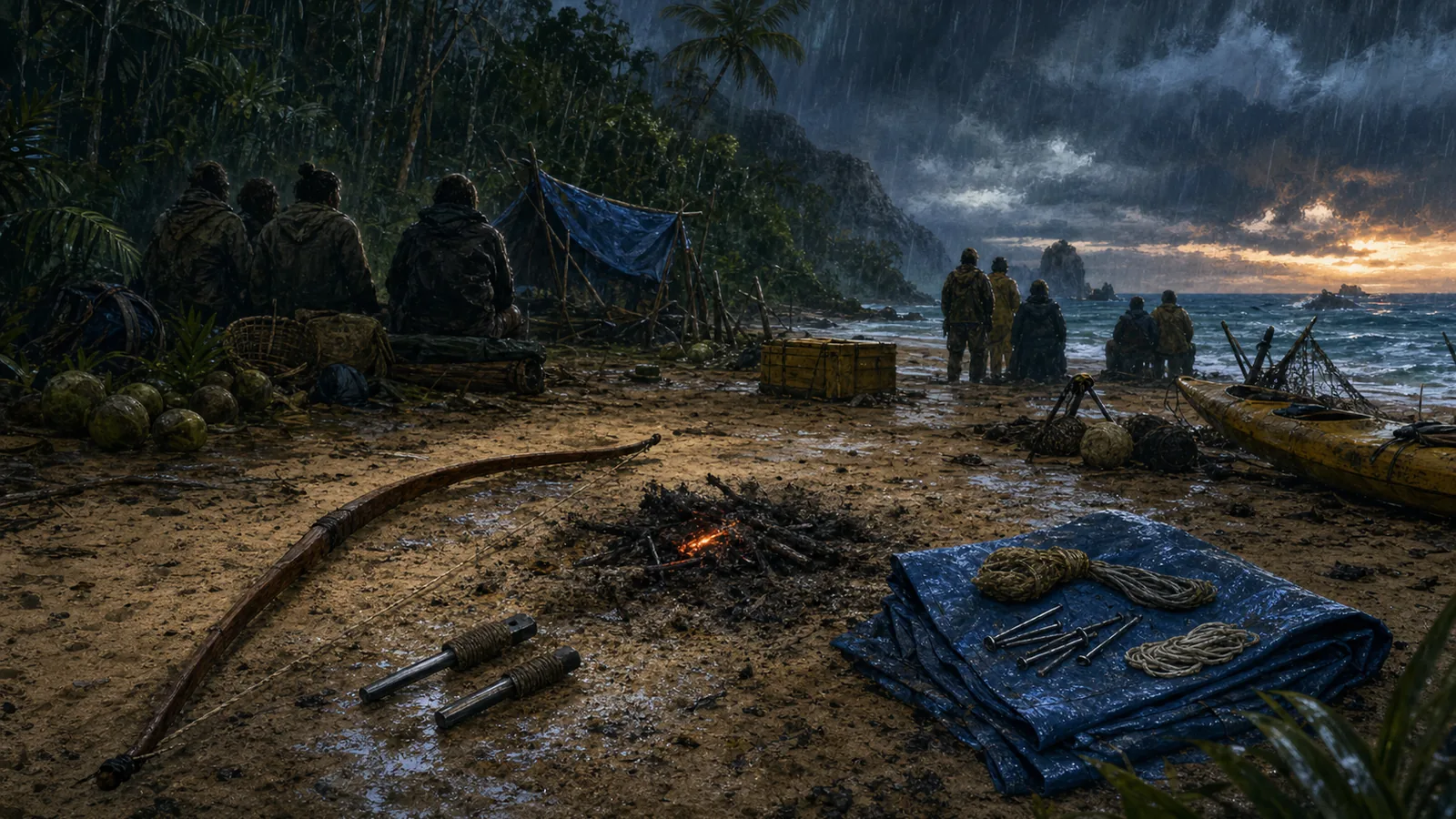
Charlie is the team that gets to look smartest and most smug at the same time. The shelter package gives them tarps, cord, nails, and rope, which is the kind of kit that makes everyone else stare a little harder at their own empty hands. That matters because the show does not just present the resource as gear. It presents it as proof that Charlie already has an edge in the game board’s invisible hierarchy.
The team spends the rest of the hour trying to turn that advantage into an actual home, and the effort is as much about group chemistry as it is about construction. They argue over where to set up, where the ground is too wet, and who is actually doing the work. Even when the shelter starts taking shape, you can feel the other edge of the advantage: if Charlie gets comfortable too early, they become the camp everybody else wants to strip later.
Delta arrives with a camp full of supplies, and the beach turns into a negotiation table
The episode’s biggest escalation comes when the teams are sent to Delta, where the game stops pretending it is about equality. Delta has the goods: fire tools, shelter materials, a pig, a boat, fishing gear, even the kind of raised bed setup nobody else can dream about yet. The catch is the one that matters. If you want to join, you have to leave your original team, and if you stay, you have to wait for recruits while the rest of the board keeps moving.
That turns the whole hour into a loyalty test with a price tag attached. People look at the pig and the fire and the gear and then have to decide whether the promise of comfort is worth ditching the camp they just picked. The show is smart here because it never frames the choice as abstract morality. It is hunger. It is bugs. It is rainwater. It is the awful knowledge that “clean game” sounds noble when you are still dry and makes less sense when you are hungry enough to count calories in a glance.
The bow-for-fire trade goes nowhere, and the first beach deal dies in plain sight
The final stretch is a bargaining scene that never stops being a power play. One side wants a bow for fire starter, the other side wants to keep the ferro rods, and nobody is really talking about the object in front of them. They are talking about whether they can be trusted to honor a deal once the night gets long and the camp gets cold.
That is the right way to end the premiere because it puts the thesis on the table without spelling it out. Everyone says they want a fair game. Nobody acts like a fair game exists. The show lets the deal stall out, then leaves the camps staring at what they have and what they still do not. It is not subtle, but it does not need to be. The whole season is already about to be a fight over who can call leverage a principle.
Tiny details worth clocking
- The episode keeps returning to the same practical facts: fire makes water safer, tarps keep the rain off, and food gets way more valuable once the bugs and wet ground start winning.
- Mary’s “lost puppy” language matters because the show immediately turns survival into a social home search, not just a physical one.
- Delta’s pig is not just a reward; it is a visual insult to every camp still eating coconuts and waiting on weather.
- Charlie’s shelter kit includes nails and rope, which makes the team look more organized than it feels in conversation.
Final verdict
This premiere knows exactly what kind of show it is. The jungle is real, but the real pressure is social: who gets voted out, who gets tempted, who gets left without a place to sleep, and who starts acting like the board belongs to them. Mary getting cut before the game even settles is brutal, but it is also the cleanest possible statement of the season’s rules. Useful does not always mean safe. Cooperative does not always mean protected.
What gives the hour its bite is that it keeps tying every strategic choice back to something physical. Fire is not an abstract advantage when your clothes are wet and the bugs are swarming. Shelter is not a minor perk when the rain starts. The premiere understands that the game is really about whether people can keep calling themselves a team after the first chance to be greedy. That is enough to make the setup feel sharp instead of generic.
Rating: 8.2/10 — A strong launch that treats resources like pressure points and makes the first social cuts feel immediate.
More episodes from Outlast: The Jungle — Panama survival game, team politics, and million-dollar pressure. Jump to any episode in the season:
Where to go next
Reviewed by Mira Vance · QuizFandom Editor & Lead Reviewer. Every rating is an honest per-watch assessment from the desk that also writes the quizzes — not a press release rehash.