Outlast: The Jungle Episode 5 Review: "Staying Afloat" — Leiya offers the kayak, Ben clamps down on the team math, and Charlie grabs the boat before the surf can swallow the board
What happens — the short version (spoilers)
- Leiya's kayak instantly changes how the camps value her.
- Ben pushes hard to keep the original team frozen in place.
- A white-versus-red note forces the board to choose between supply and elimination.
- Charlie gets the kayak while the others end up improvising with oars and rafts.
- The raft race turns the resource gap into visible embarrassment.
- The episode keeps asking whether more hands are worth the cost.
The hour keeps circling the same ugly question from different angles: is Leiya a teammate, or just the best piece of leverage on the beach? Alpha keeps weighing her kayak against the risk of another mouth, while Ben keeps dragging the conversation back to loyalty and four-person math. Then the game makes the answer literal by turning the title into a raft race, with Charlie getting the real boat and everybody else improvising in the tide. The episode is about survival, but it is really about who gets to keep making the rules when the water gets rough.
Leiya puts the kayak on the table, and Alpha starts arguing with itself about whether the boat is worth the body
Leiya comes in with the one thing nobody can ignore: a whole kayak. That instantly changes her from a person into a possibility, and the team spends the early part of the hour deciding whether that possibility is worth the risk of adding her. Some of them clearly like her. Some of them like the boat more. And some of them are mostly worried about what Charlie gets if Alpha hesitates too long.
Alpha is not deciding whether Leiya is decent. It is deciding whether another set of hands is worth the kayak. The whole conversation keeps drifting back to the same place: would we be stupid to turn her away? The show does not answer with a speech. It answers with hunger and caution.
Ben keeps pushing the team to stay frozen in place, while the camp keeps reminding itself how expensive every extra person can be
Ben is the loudest voice against changing the shape of the group, and the hour lets that stance read as both practical and boxed-in. He wants to keep the original team intact, ride it to the end, and split the money with as few people as possible. That sounds disciplined until you hear how often it is really just fear of cracking the thing he already controls.
The food run at low tide is the cleanest counterweight to that fear. People are checking rocks for oysters and fish and trying to act like a couple of small wins can carry five mouths. The line about five’s a lot of mouths to feed is not a throwaway. It is the whole survival problem in one sentence.
The white-and-red note turns the beach into a blunt choice between comfort and damage
When the new instruction drops, the game gets simpler and meaner at the same time. White means a supply. Red means an elimination. There is no way to pretend those are equivalent. If you go white, you are choosing gear. If you go red, you are choosing to remove a person from the board.
That split gives the episode its engine. The teams immediately stop talking in abstract survival language and start talking like gamblers. Charlie wants to move first, Alpha wants to beat them to the punch, and Bravo is already seeing how fast a practical note can become a moral trap. The show keeps pressing on the same idea: every advantage now comes with a body count or a shortage attached to it.
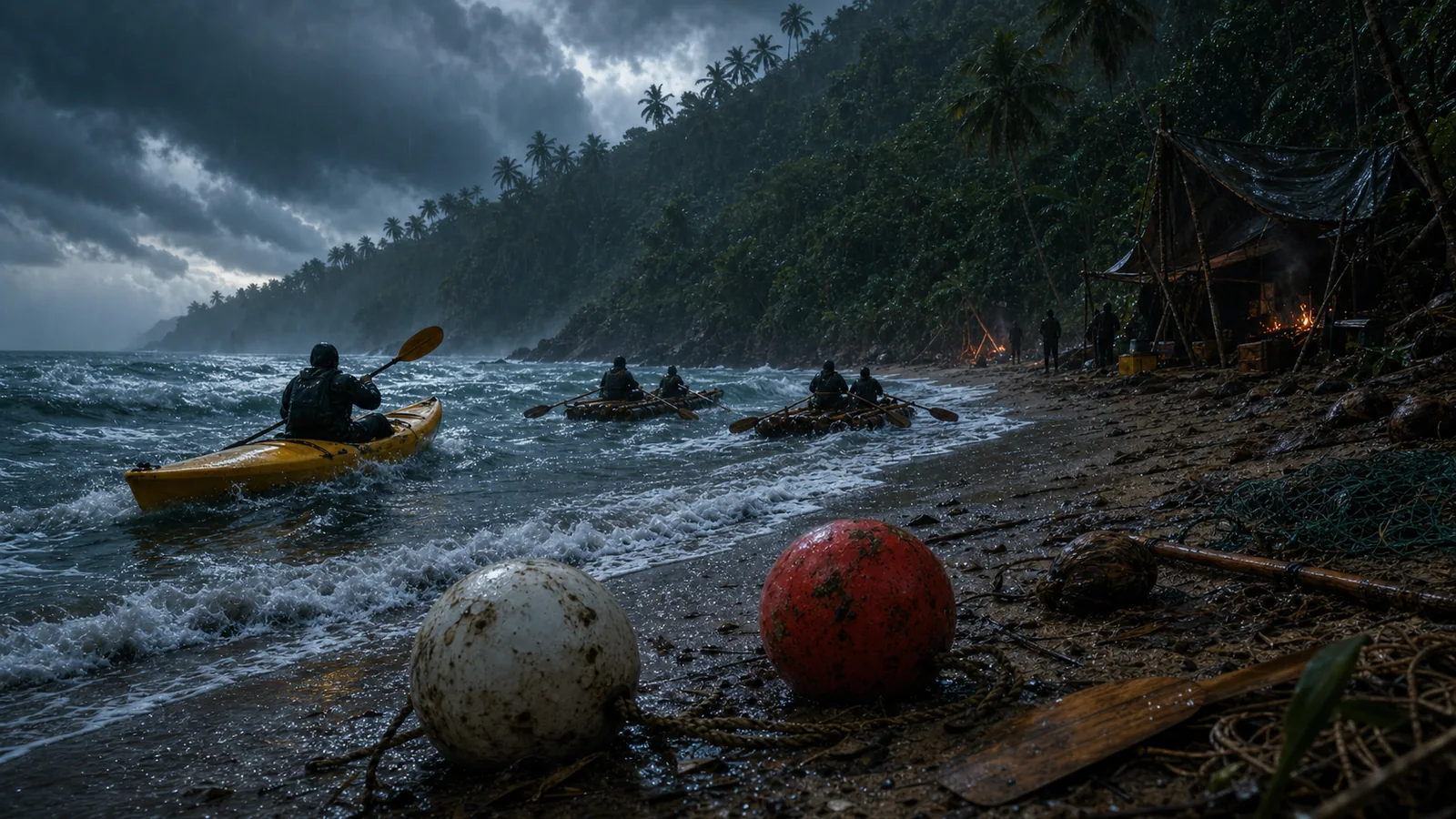
Charlie gets the kayak, Alpha and Bravo end up with the oars, and the board instantly learns who brought the real boat
Once the race starts, the board’s imbalance becomes obvious. Charlie secures the kayak, which means Charlie gets the one piece of gear that actually looks built for this game. Alpha and Bravo claim the oars, which is useful, but only in the way a wrench is useful when the engine already belongs to somebody else.
That is what makes the raft-build so grimly funny. Everyone is working hard, everybody is improvising, and nobody can ignore the fact that Charlie simply has a better answer to the water. The episode never needs to say the better-equipped team is favored. It just lets the surf prove it.
The raft run turns staying alive into a math problem, and the current makes the answer feel embarrassing
By the time everybody is out in the water, the challenge has become less about willpower and more about whether the handmade rafts can keep up with a real boat. Charlie has the kayak. Alpha and Bravo are trying to make bamboo look like engineering. The current punishes every stroke, and the distance keeps expanding in exactly the way survival reality loves to make humiliation visible.
What lands is not just the physical mismatch but the emotional one. Nobody wants to admit that the boat was the thing that mattered most. Nobody wants to confess they spent too long talking instead of building. But the surf has a way of settling the argument. Charlie’s advantage is not symbolic anymore. It is a lead.
Tiny details worth clocking
- Ben talking about a four-person finish is the clearest sign that the game has already shrunk his idea of success down to arithmetic.
- The rocks-for-food stretch keeps reminding you that every strategy conversation is still happening inside a body that needs oysters, water, and a dry place to sit.
- Charlie getting the kayak and the others getting oars is a perfect Outlast image: one team gets mobility, everyone else gets effort.
- The episode’s best little sting is how fast Leiya’s kayak becomes everyone else’s problem once the challenge starts.
Final verdict
This hour works because it never lets the social conversation get away from the physical one. Leiya’s kayak, Ben’s resistance to change, and the red/white buoy split all keep circling the same point: on this board, the thing that looks like teamwork can turn into a liability the second the tide shifts. The episode is not subtle about that, and it does not need to be.
The raft race is the right payoff because it turns all that talk into something visible. Charlie looks better equipped because Charlie is better equipped, and the rest of the board has to chase that fact across the water. That is a blunt kind of suspense, but it fits the show.
Rating: 8.1/10 — A sharp resource episode that makes the kayak feel like the season’s most expensive piece of advice.
More episodes from Outlast: The Jungle — Panama survival game, team politics, and million-dollar pressure. Jump to any episode in the season:
Where to go next
Reviewed by Mira Vance · QuizFandom Editor & Lead Reviewer. Every rating is an honest per-watch assessment from the desk that also writes the quizzes — not a press release rehash.