Star City S1E3 Review: Luna 17 Takes a Spy Signal to the Moon
What happens — the short version (spoilers)
- Tanya plays a contraband bone-record and Valya hears a security risk before he hears his wife ('you might as well be on the fucking moon!'), exposing a marriage hollowed out by the state.
- Luna 17 is rushed toward the surface with inflatable hardware and no spacesuits; Valya drills Sasha and Arseni on the detach step Sasha keeps skipping ('practically naked in a balloon').
- The Chief Designer smuggles a deep-sea bathysphere past Raskova's level-one security to seed his secret Venus mission — he needs 'someone with nothing to lose.'
- Before launch the crew writes death letters; Sasha brings his to Tanya, not the officials, asking her to hold it 'just to have.'
- Irina is drawn into Tanya's life through her daughter Zoya's piano lesson, then the episode replays the intimacy as material — trust turned into a report.
- Ground Control finds an American transceiver on the flight computer; Raskova's risky reboot scrambles the landing, so Sasha switches to manual and docks while Arseni depressurizes the hab by hand and then goes silent; a coerced source admits planting the device.
Luna 17 launches with an unfinished lunar base, a hidden American transmitter, and one household already cracking under the sound of its own walls.
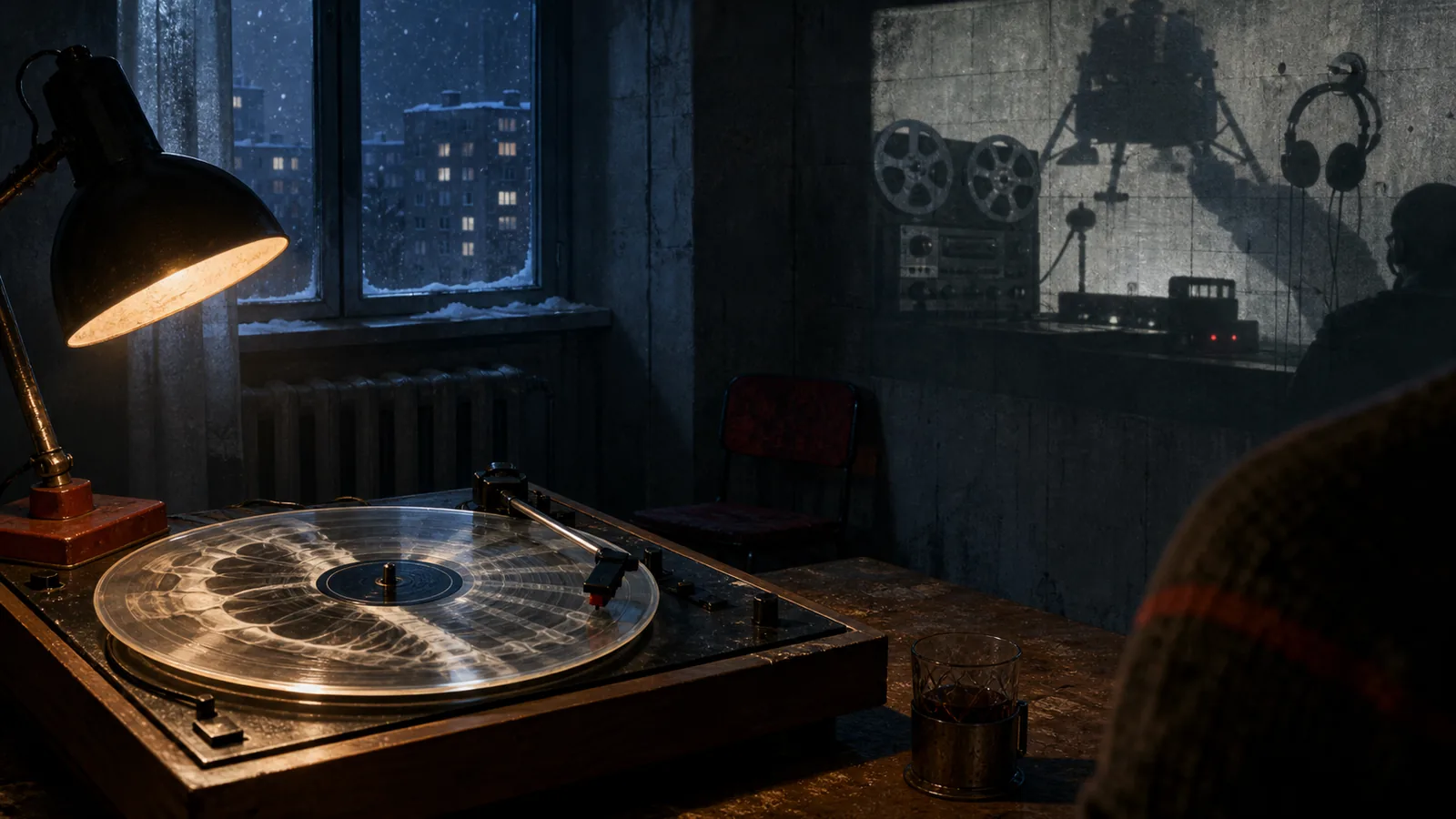
The hour opens with contraband that can only survive a few more plays. Someone hands over an X-ray record under a warning that everyone is being searched, and the object itself says almost everything about Star City right now: music has become something fragile, rationed, and dangerous enough to hide.
That sound lands in Tanya and Valya’s apartment before it reaches the moon. Tanya wants one small piece of her old life. Valya hears evidence. He is not wrong about the danger, which makes the scene worse. The state has trained him so well that he can no longer hear his wife’s loneliness before he hears the report someone else could write about it.
Outside that apartment, Luna 17 is being hurried toward the surface with inflatable hardware, no room for spacesuits, and a crew still drilling the emergency steps. The Chief Designer is smuggling his Venus dream through the same gates Raskova is trying to seal. Irina is drawn into Tanya’s life through a piano lesson that feels gentle until the episode begins replaying it like material.
By the end, the threat Raskova has been naming since Berlin is no longer theoretical. There is an American device on a Soviet craft, and the cost of removing it falls on the people in the machine.
Tanya plays a bone record, and Valya hears contraband before he hears her
Valya comes home looking for a stopwatch and finds Western music. Tanya has put on one of the bone records the opening warned us about, and the old intimacy between them appears for about half a second. She reminds him that he used to love it when she found music in Moscow. He answers with geography: they do not live in Moscow anymore.
That is where the fight really starts. Tanya is stuck in Star City while Valya disappears into training, security, and whatever else he cannot tell her. He shushes her. She catches it. He tells her to behave. The word lands like a door closing.
Tanya’s line is blunt because it has been waiting a long time: “Music’s the one thing that I have from my old life.” Valya cannot stay in the room with it. He says he has heard it all before, that it is all his fault, that he understands. He understands nothing in that moment. Tanya tells him he is not really there at all: “You might as well be on the fucking moon!”
Star City has used distance as romance before, especially with Belikova’s longing for lunar silence. Here the moon is not freedom. It is the name Tanya gives to marriage with a man whose body comes home while the rest of him remains under orders.
Sasha keeps missing the Luna 17 drill, while Belikova watches danger from the ground
The Luna 17 training sequence has the shape of a joke until Valya refuses to laugh. Sasha and Arseni run through the landing and ascent procedures for the new lunar habitat, with Sasha doing his broadcast voice and skipping the step that matters most. If the hab stays attached, he cannot fly straight back to Pavel in the orbital module. Valya stops him, makes him see the problem, then makes him start over.
Sasha takes it as insult before he takes it as instruction. He is the one going up, he says, and if anyone should be nervous, it is him. Valya’s answer is sharper: Sasha is going to the moon “practically naked in a balloon.” The mission remains unfinished. The crew will land without spacesuits because two men have to fit inside the lander. The inflatable base has to deploy, detach, and leave them enough control to return. Sasha’s childishness would be irritating in a simulator. Moscow is sending it into a machine that cannot forgive it.
After the blowup, Valya is allowed a little shame. He knows he has been too hard on Sasha and too hard on Tanya. He says the stress is getting to him: the mission, security, everyone afraid of their own shadows. Sasha is the wrong person for tenderness, which is why his obscene advice almost works. It is idiotic, and then it is funny, and for a moment the two men find a little air.
Belikova’s position is crueler because she has already proved herself in the place Sasha is trying to reach. At home, she hears him say there will be no spacesuits, then tries to turn fear into a joke: she is too young for a second husband. Later, Ground Control turns her into a headline before the mission has even landed: first woman on the moon coaching her devoted husband through his first moon mission. Someone asks for a smile. Then the story stops being useful and becomes real work.
The Chief Designer gets a Venus bathysphere through Raskova’s new gate
The Chief Designer’s secret mission begins with pressure. A deep-sea vessel can withstand one kind of crushing force; an older bathysphere can withstand more. The atmosphere on Venus, he later explains, is more than ninety atmospheres, like being nine hundred meters under the ocean. So the Soviet Union’s hidden path to Venus will begin with a machine built for the sea.
That is a lovely piece of engineering logic and a reckless piece of politics. Security is at level one because the Americans wanted a route into Star City. Raskova is stopping vehicles at the gate. The Chief Designer arrives with a covered load and insists that sensitive lunar equipment cannot be manhandled. Raskova does not buy the performance. She knows the Americans’ only hope is sabotage, and she knows this mission cannot afford another breach.
He tells her the mission cannot afford holdups. Both of them are right, which is the show’s favorite kind of trap. Raskova is looking for the enemy. The Chief Designer is hiding from his own side. When she notes that nothing that size appears in the manifest, the scene tightens beautifully. A guard calls her away, and the truck passes through.
Inside, the bathysphere becomes an altar to the mission he actually wants. Sergei sees the plan. Valya is brought into the secret because the Chief Designer trusts him with his life, though not enough to let him vanish for nine months. Valya will train the people who go instead.
The question is who can disappear. The Chief Designer lays it out without poetry: they need someone who will not be missed for a few days, then someone who will not be missed for nine months. Preferably someone with very little family. “Someone with nothing to lose.” The lunar base is the public lie. Venus is the private dream. Both require bodies the state can spare.
Sasha gives Tanya his death letter, and Luna 17 launches without Valya
Before launch, the Luna 17 crew receives paper for letters to their wives in case they die. Arseni looks at the ritual plainly. Sasha jokes less than usual. The officials can draft something heartfelt, strong, and patriotic for him if he wants, but he does not read what they have given him.
He takes the letter to Tanya instead.
The scene is small and awkward in exactly the right way. Valya is not home. Sasha does not ask Tanya to read it. He asks her to hold it, “just to have,” in case he does not come back. Their affair from the premiere still sits under the moment, but the episode does not play the visit as romance. It plays it as fear looking for the person who will understand the wrong part of it.
That is the sting. Sasha has a wife now, and Belikova is the one who has to smile in public while he climbs into a machine she knows too well. But the death letter goes to Tanya, the woman who already feels abandoned by the cosmonaut life. Sasha’s worst habit has always been treating danger like a game until it touches him. Here, for once, he knows exactly what can happen.
Valya tries to repair his own marriage after launch. He offers Tanya a night in Moscow, a concert, something from before Star City narrowed their lives into passes and permissions. Tanya does not believe they can get there with everything locked down. Valya says security should loosen now that the mission has launched. In three more days, he says, they will have a base on the moon.
Then he gives her the line she needed in the morning and could not get: he told them he could not go. His part is done. He has a date with his wife. It is the warmest beat of the episode, which makes the later cut back to the mission feel even colder.
Irina follows Tanya into a piano lesson and hears private hurt become material
Irina meets Tanya through Zoya at the market, in a scene built from ordinary shortages and ordinary politeness. There is no honey again because the guards took the shipments. Zoya’s teacher recognizes her student and introduces herself to Zoya’s mother. She sees talent in the child and offers a piano lesson at her apartment.
For a few minutes, the visit almost feels like the life Irina might want. Tanya talks about being a rehearsal pianist for the Moscow City Ballet before Star City. She asks what Irina does. Irina calls herself a glorified secretary, which is both a lie and the closest polite version of the truth. Tanya catches the class signal anyway: Zoya’s school requires importance, or proximity to someone important.
The conversation turns warmer when Tanya realizes Irina does not know Valya as a hero. Tanya gets to be herself before she has to be the wife of a cosmonaut. She describes him as good, solid, hardworking, too hardworking, serious. Then, softer, that he was not always serious.
Irina’s confession about Zoya’s father is broken, and the brokenness is the point. She says he is not a good man. She starts to say what happened between them, then stops at the edge of blame: “It is my…” Tanya hears enough to know she has been trusted with something. Irina apologizes and tries to leave.
But Star City does not let intimacy stay clean. The episode repeats the visit in fragments: Tanya’s argument with Valya, Irina asking to use the toilet, the unfinished line about Zoya’s father. The piano lesson becomes sound that can be handled, replayed, studied. Irina is no longer only the person being watched by her own child and neighbors. She is back inside the machinery that turns a room into a report.
An American transmitter forces a reboot, and Sasha brings Luna 17 home without an answer from Arseni
Luna 17 reaches the moon with jokes still moving through the cabin. Arseni worries about his broadcast voice. Pavel teases him from the orbital module. Sasha asks about his hair before television. The danger has not made them solemn, which is why the interruption lands so hard.
Ground Control catches a signal that does not dip with the others. It uses an American frequency. The device is no bomb. It is a transceiver linked to the onboard flight computer, apparently meant to help the Americans reverse engineer the automated systems. Raskova hears that and orders it disabled anyway.
The Chief Designer resists because the timing is terrible. They are about to land. A full reboot could stop the automated systems from returning in time. Raskova’s answer is pure Building 12: his measure of risk is misguided. The mission is important. The state secret is more important.
The reboot works until it does not. The lander separates, begins descent, and then takes a massive jolt. The hab has deployed early. Thrusters fire randomly. Control starts to vanish because the system reset the wrong thing at the worst possible moment. The only clean option is to jettison the hab and abort the landing, but the button fails.
Sasha does what Valya kept trying to train into him. He switches to manual and tries to fly the wounded craft back to the orbital module. Arseni goes into the hab to depressurize it by hand, stripping away the dead weight while Sasha fights the wobble. Voices from Earth talk him through degrees of alignment. The pilot who kept treating procedures as theater now has nothing left but procedure.
It works. Sasha docks. The room exhales. He calls Arseni a brilliant bastard, then calls his name again when no answer comes back.
The final scene turns the spy plot inward. A coerced Star City source says they planted the transmitter on Luna 17 and were promised that would be the end of it. It is not. The broadcast failed an hour ago. They are far from done. The Americans got their device onto the craft, but the person who carried it is still inside the cage.
Verdict
Star City’s third episode is the season’s strongest hour so far because it lets the domestic and engineering plots damage each other. Tanya’s bone record, Sasha’s death letter, the Venus bathysphere, Irina’s piano-lesson confession, and the Luna 17 abort all turn on the same pressure: people keep trying to preserve one private thing, and every system around them converts that private thing into leverage.
The lunar setpiece is excellent, especially because it pays off Sasha’s earlier training without pretending he has suddenly become noble. He is still vain, reckless, and cruelly careless with other people’s feelings. He is also the only person who can fly the lander back once the state has made the safer choice impossible. The episode gives him competence without washing him clean.
The Irina material is the trickiest piece. On first pass, the piano-lesson thread drifts almost too quietly beside the Luna 17 mechanics, and the repeated audio fragments ask the viewer to do some stitching. But the discomfort is productive. Irina wants to be seen as a mother, a wounded woman, a person with a past. Building 12 keeps making her useful as an ear. The hour’s clearest thesis is in Tanya’s apartment: under this state, even trust arrives with the threat that someone may play it back later.
The final reveal lands less as a clean clue than as another pressure report. The transmitter’s planter did what they were told and still did not get free. Like Belikova, Valya, Tanya, Irina, Sasha, and the Chief Designer, the mole obeyed the demand in front of them and found the chain still attached.
Rating: 8.8/10
More episodes from Star City — The Soviet space program's hidden cost, told from inside the cosmonaut city — episode by episode. Jump to any episode in the season:
Where to go next
Reviewed by Mira Vance · QuizFandom Editor & Lead Reviewer. Every rating is an honest per-watch assessment from the desk that also writes the quizzes — not a press release rehash.