Star City S1E4 Review: Valya Becomes Nikolay, Belikova Runs for the Lake, and Venus Picks Its Crew
What happens — the short version (spoilers)
- A field-report cold open exposes that Valya Mironov was cultivated through Tanya's dissident music circle into a Soviet asset, code name Nikolay — the marriage sits atop an operation it cannot name.
- Sergei traces the Luna 17 device to a Soviet shell hiding foreign parts; the Chief Designer turns Arseni's death into an indictment of Raskova's reboot order.
- Lakshmi Chadha and her husband Manu arrive to surveillance and a flyswatter in the walls; Raskova promotes Irina to fieldwork with a pistol to trace the transmitter's foreign alloy.
- Sasha takes Arseni's death letter to his widow Mila ('it should've been me'); Belikova learns Gagarin was grounded right after his world tour — Paris was the pattern, not a pause.
- The Chief Designer reveals the Venus hangar to Lakshmi ('we are going to Venus') and conscripts the crew — Valya accepts at once, Lakshmi is drafted, Sasha refuses until his recklessness is sold back to him as a qualification; Moscow installs Petrovsky as Raskova's watcher ('sounds like an obituary').
- Belikova escapes to a lake with the physics department ('my every word is given to me by someone else!'); Sergei is arrested over forbidden Fyodorov; Tanya confides in Irina, who turns it into collection.
The Luna 17 failure leaves Arseni's widow with a letter, Raskova with a career threat, Belikova with a stolen afternoon, and the Chief Designer with three people he can still send toward Venus.
The hour begins before Star City had a name for Tanya and Valya as a married couple. A stack of field reports follows Tanya Danilova from dissident music circles to romance, engagement, and relocation, as if love were only another way to acquire access. By the end of that file, Valya Mironov has become an asset with a code name: Nikolay.
That cold opening changes the shape of everything that follows. Tanya’s loneliness, Valya’s secrecy, the bone record, the Moscow concert, even Irina’s careful friendliness all sit under a history the marriage does not know how to speak aloud. Star City has been turning private feeling into usable material for years. This week, the machinery simply admits it has records.
Luna 17’s wreckage keeps moving through the episode too. Arseni is dead. Sasha is alive and cannot bear the distinction. Raskova still has a mole to find. The Chief Designer still has Venus to protect. Belikova is still being paraded as a national promise while the promise she wants most has been quietly revoked.
The result is quieter than the Luna 17 abort, but crueler in some ways. Nobody is exploding on the lunar surface now. They are being folded back into rooms, reports, marriages, and missions that already know where to put them.
Valya’s old file names him Nikolay, and Sergei traces the Luna 17 device to a Soviet transmitter
The opening reports are brutally efficient. Zeta begins as a dissident music group moving banned works out of the USSR through instrument cases. Tanya is part of that world. Then Valya appears as a possible route into the Soviet military, then the space program, then Star City. A stranger congratulates him on the wedding before he understands he has been watched closely enough for the greeting to land as threat.
The next report makes it official: new asset, cosmonaut Valya Mironov, code name Nikolay.
The show does not explain the whole arrangement yet, and that restraint helps. Valya has spent three episodes acting like a man frightened by walls. This hour gives that fear an older source without draining it of present tension. He is hiding something from Tanya. He may also be hiding from the first version of himself who agreed to survive by cooperating.
At Star City, the Luna 17 device gives Raskova and the Chief Designer a different kind of secret. Sergei takes the transmitter apart and finds Soviet craft inside it: common circuitry, a GT-104 transistor, a power draw made to look like interference. The useful answer is worse than the simple one. The device was not a bomb. It was espionage built from familiar parts and altered later.
The Chief Designer turns that discovery into an indictment. Another one of his Eagles is dead, and Raskova’s reboot order now looks like panic with a body attached. He says the quiet part to her face: his cosmonauts did their jobs, his systems would have functioned, and she failed at the one thing she was supposed to do. Raskova does not fold. She tells him to say it to Moscow.
That is the episode’s first clean transfer of pressure. The transmitter came from somewhere. The death has to belong to someone. In Star City, failure never stays a fact for long. It becomes an assignment.
Lakshmi Chadha finds microphones in the walls, and Raskova sends Irina into the field with a gun
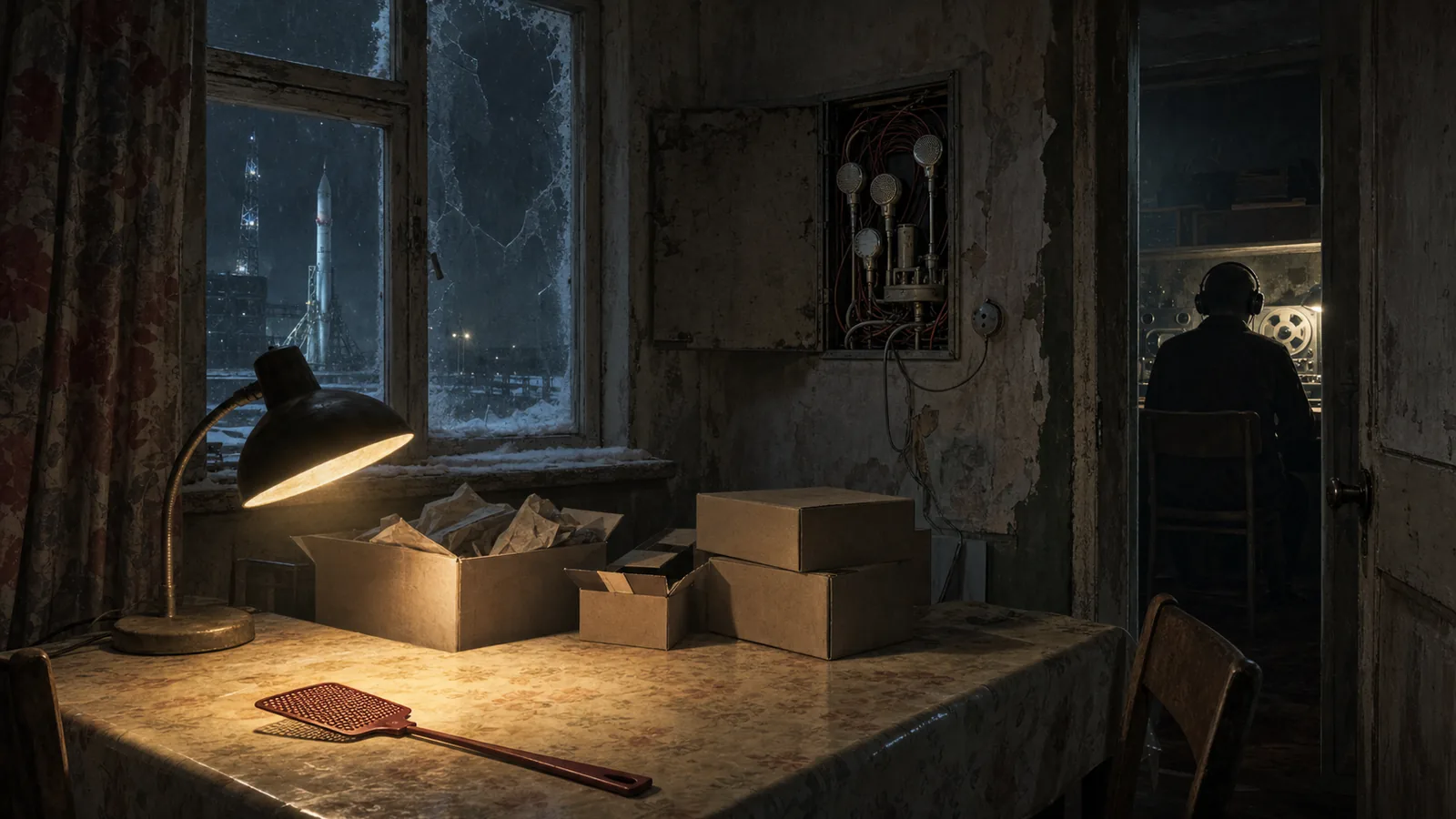
Lakshmi Chadha arrives with boxes, a brilliant life-support system, and almost no idea why anyone brought her to Star City. A colleague identifies her because her name is on the boxes. Nobody tells her what she will be working on. Her husband Manu discovers the more intimate welcome package: after he complains about flies, a flyswatter appears in the apartment.
Manu goes from joking about flies to sweeping the room for microphones. “Hearing about Soviet surveillance is very different than living it,” he says. Lakshmi is angry in another direction. She thought this was her chance to do real work. Star City has given her a room on the fringe and a husband swatting at proof that they are already being heard.
That domestic scene pairs neatly with Irina’s promotion from paperwork to fieldwork. Raskova catches her combing through suspicious notations after the breach and asks whether she wants to document petty speculation for the rest of her life. Irina says no. The answer costs her. She is handed the transmitter, ordered to trace it quickly and quietly, and given a pistol she says she does not need.
At the factory, Irina is good because she knows how to sound small until she needs to sound official. The technician recognizes the transmitter, then points to the modified part: an unusual alloy, unavailable in the Soviet Union, four times the thermal conductivity of copper. That tiny addition lets the transmitter handle far more energy than it should.
The clue opens the case outward again. A Soviet shell, foreign material, an unknown power source, purchasing records waiting somewhere. Raskova asked for a path to the mole. Irina finds one, with the pistol now part of the assignment.
Sasha takes Arseni’s letter to Mila, while Belikova asks when Gagarin knew he would never fly again
The visit to Arseni’s widow is one of the episode’s hardest scenes because everyone arrives with the wrong thing. Officials can bring process. Valya can bring the version of comfort trained into cosmonauts. Sasha can bring the letter Arseni wrote in case he died. None of it answers Mila’s question.
When she asks what happened, Sasha tries not to lie and almost collapses into confession. “I didn’t do enough,” he tells her. “It should’ve been me.” Valya cuts him off because Mila does not need Sasha’s guilt placed in her lap, and because Valya knows the other rule of that world. Up there, he says, no one is responsible for anything besides their own survival.
It is a terrible kindness. Sasha did send Arseni into the compartment. Sasha also flew the damaged lander home because there was no clean option left. The scene refuses to make either fact cancel the other, which is why Sasha’s grief works better here than his fear did in smaller doses last week.
Belikova is trapped in the public version of the same machinery. She stands before the Committee for Soviet Women of Leningrad and recites the proper lesson: the cosmos was never hers to conquer; it had always been theirs. The speech is perfect because someone else has sanded every private edge off it.
Then she gets the question that cuts through the tour. She asks someone who was with Gagarin when he knew he would never go back up again. The answer is almost casual: not long after his world tour.
Belikova absorbs the answer. Paris was no pause before the next flight. It was the pattern. A hero can be honored all the way out of the sky.
The Chief Designer shows Lakshmi the Venus hangar, and Moscow gives Raskova a new watcher
Lakshmi’s exile to the fringe turns out to be an audition she did not know she was passing. She finds the Chief Designer working in the hidden Venus space, though she does not recognize him at first. He lets her talk herself into the center of the room. Her BIOS system, self-sustaining breathable air, the weight it could have saved on Luna 17: she has been carrying the missing piece of his forbidden mission.
The reveal is practical before it is grand. The Chief Designer did not bring her to Star City for the moon. Venus needs a way to make air last, and he needs someone whose expertise is specific enough that no one else can fake it. When she realizes who he is, he gives her the real invitation: “We are going to Venus.”
Raskova’s Moscow meeting has the opposite shape. She arrives prepared to contain the breach and finds the containment already being applied to her. The director brings in Radimir Sergeievich Petrovsky, a new first deputy with an engineering background, a personal memory of Raskova’s old bullpen, and the smooth manners of a man placed in the room to make her smaller.
The language around her is all respect. Decades of service. Hero of the Soviet Union. A testament to what she has done. Raskova hears the coffin under it. “Sounds like an obituary,” she says.
She is right to hear it. Petrovsky wants reports, explanations, and a documented route from breach to death. Raskova wants time and authority. The state that made her useful is now testing whether she can still be useful under supervision. The Night Witch is not removed from the board. She is assigned a watcher, which in this world is often the first step toward being rewritten.
Valya accepts the secret mission at once, and Sasha has to be argued back into a cockpit
The Chief Designer does not let the Luna 17 disaster slow Venus. Sergei gently raises the idea of postponing the unmanned probe, and the answer is immediate: it has to be now or it will never happen. That line tells you exactly how desperate the conspiracy has become. The official program is wounded, security is tightening, and Moscow is circling Raskova. Delay would give reality time to catch up.
So he calls in Valya, Sasha, and Lakshmi. The craft launches in three days. The crew will be gone for nine months. They cannot tell their spouses. They cannot even know the destination until they agree.
Valya does not need the night. That choice lands differently after the cold open. He has spent the episode with Tanya’s suspicion closing around him and an old code name hanging over the marriage. Now he is offered a mission that will require another lie, longer and deeper than the last. He steps into it anyway.
Lakshmi is drafted with even less ceremony. She protests that she has never trained as a cosmonaut. The Chief Designer answers like a man for whom categories have become obstacles: she is one now. The life-support system cannot be taught quickly enough, so the person who made it has to become part of the payload.
Sasha is the one who finally says no. He is still hearing Arseni’s name in the silence after docking. He tells the Chief Designer he should never be let near another ship. He will resign if that makes things easier.
The Chief Designer refuses to let grief become the end of Sasha’s usefulness. He reminds him why he was pulled from the Air Force in the first place: not because he was controllable, but because he was not. “There’s no map to this mission. We’re drawing it.” For once, Sasha’s worst trait is being sold back to him as a qualification.
It is manipulative, and it may also be true. Star City keeps finding ways to make the same sentence do both jobs.
Belikova escapes with the physics department, Sergei is arrested for Fyodorov, and Tanya lets Irina back inside
Belikova’s best afternoon begins with a bad schoolroom speech. She talks to girls about collective achievement, silver medals in mathematics, and never giving up, then escapes into hunger with a young physicist who looks at her like an icon. She pushes back softly. He does not know anything about her. He says she is a promise of something better.
What she wants is much smaller and more painful: somewhere nobody knows who she is, fresh tomatoes, constellations, and the memory of being a farm girl before anyone thought she could do anything except milk a cow. He offers a dacha, possibly a cow, possibly a goat, and for one afternoon the national symbol makes the irresponsible choice.
The lake sequence is loose, bright, and slightly ridiculous: homemade rockets, water, laughter, Belikova letting a room of physicists become a crowd of accomplices instead of handlers. Then Sasha arrives because someone called him, and the afternoon hardens into marriage again. He has been playing dutiful husband all night while she dragged half the physics department into the water. She hears only the prison in that. If they will not let her fly again, why can she not enjoy herself?
Their fight is messy in the way arranged intimacy would be messy. Sasha resents the attention around her. Belikova explodes at the lie inside it: “My every word is given to me by someone else!” He thinks she is cherished. She knows she is managed. The episode lets them be cruel to each other without pretending either complaint is invented.
Elsewhere, the walls close faster. Security finds Sergei’s copy of The Philosophy of a Common Task and asks him to name other engineers who have read forbidden Fyodorov. Sergei says half of them have. He does not name them. He is taken in, which means the Venus mission loses one of the few people who understood its secret shape just as it is preparing to launch.
And Tanya, still trying to read Valya’s lie as an affair because an affair would at least be human, tells Irina what she saw at the Philharmonic. Irina reassures her too quickly for a woman who claims never to have met him. Tanya catches the gap. Then Irina asks the question that turns friendship into collection: has Tanya ever been unfaithful to him?
Tanya says no. Irina asks to use the toilet.
It is a small ending, and a nasty one. Last week, that gesture made Tanya’s apartment feel like evidence. This week, after the cold open has shown exactly how long Tanya has been evidence, the gesture feels like the room recognizing its old function.
Verdict
Star City’s fourth episode has the difficult job of following a lunar disaster without trying to out-shout it, and it makes the right choice. “Nikolay” turns aftermath into architecture. Arseni’s death becomes Sasha’s guilt, Raskova’s vulnerability, and the Chief Designer’s excuse to force the Venus crew into being. Valya’s hidden past pulls Tanya’s present loneliness into a much older operation. Belikova’s tour keeps proving that the state can take a living person and replace her with a usable image.
The Lakshmi material is the cleanest new addition because it lets the show refresh its engineering imagination without leaving its surveillance register. Her apartment scene plays as domestic comedy until the flyswatter proves Manu right; her hidden-hangar scene plays as professional rescue until the Chief Designer turns expertise into conscription. She is not swallowed by Star City yet, but the jaws are visible.
Its weakness is crowding. Petrovsky’s introduction, the transmitter investigation, Sergei’s arrest, Lakshmi’s recruitment, Valya’s asset history, Sasha’s grief, Tanya’s suspicion, and Belikova’s lakeside rebellion all compete for space, and a few transitions feel more functional than elegant. But the sprawl has purpose. The hour follows a system widening its grip after a breach, and the strongest scenes keep that pressure personal: Mila asking what happened, Belikova asking when Gagarin knew, Tanya mistaking espionage for infidelity because the alternative is harder to imagine.
The thesis lands in that final apartment. Tanya thinks she is telling a friend that her husband may be unfaithful. Irina thinks she is following a trail. The state has already written both women into older files. Trust is still possible in Star City, but the room always seems to know where to place the microphone.
Rating: 8.7/10
More episodes from Star City — The Soviet space program's hidden cost, told from inside the cosmonaut city — episode by episode. Jump to any episode in the season:
Where to go next
Reviewed by Mira Vance · QuizFandom Editor & Lead Reviewer. Every rating is an honest per-watch assessment from the desk that also writes the quizzes — not a press release rehash.