The East Palace Episode 1 Review: "Episode 1" — A Crown Prince Dies at the Pond, Gu-cheon Is Dragged into Court, and Peach Wood Enters the World of Gwi
What happens — the short version (spoilers)
- A Crown Prince dies near the palace pond, and the Queen Dowager connects the death to earlier losses in the royal line while the King forbids talk of spirits.
- Prince Yeongan is struck by another attack, pushing the court to find Gu-cheon, the son of a shaman who survived underwater as a child and can see spirits.
- The King forces Gu-cheon into the palace as a supposed feng shui master, threatening mutilation and death if he flees, speaks openly, or fails to save Prince Yeongan.
- The King also summons Saeng-gang, the daughter he thought dead, and orders her to assist Gu-cheon while secretly judging whether he should live or die.
- Gu-cheon explains that the palace has both gwi-mae, formed from sinister natural energy, and a likely won-gwi, a resentful dead soul tied to the pond.
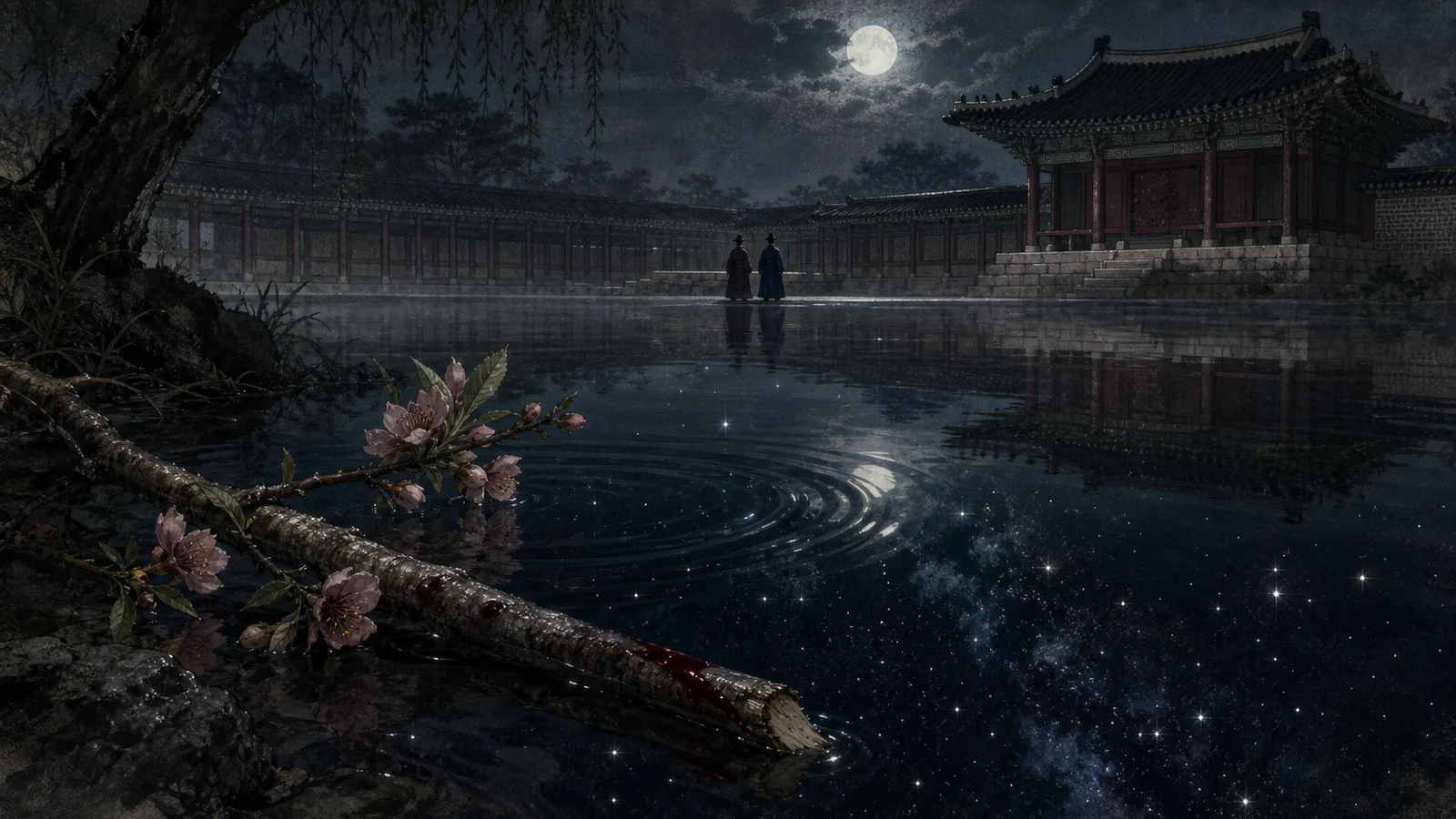
- Saeng-gang brings an eastward peach branch; Gu-cheon marks it with blood and enters the World of Gwi, where he can only ask the unseen spirit why it is killing the royal bloodline.
A Crown Prince dies beside the palace pond, and the King answers by forbidding the court to call the thing that killed him a spirit. That denial cannot survive Prince Yeongan's seizure, so Gu-cheon is dragged from a temple, disguised as a feng shui master, and ordered to hunt what the King refuses to name. Saeng-gang enters the bargain as both his assistant and her father's spy. The hour builds its palace out of that contradiction: everyone needs the truth about the dead, while royal power keeps threatening anyone who gets close enough to speak it.
A Crown Prince dies by the pond, and the King orders the court to stop speaking of spirits
The first death arrives before the palace has finished explaining the old ones. A mother begs her son to wake. The King orders funeral rites. The Queen Dowager counts Crown Princes Jangpyeong and Yunpyeong among the royal sons already lost, then reaches back 30 years to another run of deaths that looked much the same. Her son has a clean answer ready for every body: two princes died of illness, a third took his own life, and spirits have no place in a royal house of Neo-Confucian ideals.
His certainty sounds less like belief than policy. At the funeral, he stops the wailing and asks whether his subjects think a mere spirit could make their king a coward. His declaration is absolute: “Anyone who threatens royal authority, be it human or spirit… will exist no more.” It is a magnificent threat to make against something he has just insisted cannot exist.
The spirit answers anyway. The renowned shaman brought to restrain it is overwhelmed, and the voice at the pond promises, “I will dry out the seed of the royal bloodline.” Prince Yeongan is seized by a fit soon after. He sees something the adults around him cannot, hears that it will take him as well, and folds in pain before the King. The palace can ban a word from court. It cannot stop the thing behind that word from moving to another child.
Prince Yeongan collapses, and Chil-bok gives the palace the name of a boy who once drowned
With the pattern from 30 years ago beginning again, the search turns to someone who survived the boundary the spirit now crosses so easily. Gu-cheon’s mother was a shaman cursed by the god she served after she became pregnant. She threw herself into a river with her child; she died, but the boy remained under the water for more than 15 minutes and lived. Since then, Gu-cheon has been able to see spirits.
The grown man is introduced asleep at a temple because the things in his own room will not leave him alone at night. That is the episode’s driest joke and one of its smartest character notes: the palace wants an awe-inspiring occult weapon, while Gu-cheon wants one uninterrupted nap. He calls Chil-bok a fake monk, refuses to earn his keep by driving anything away, and treats the grieving visitor’s request as another nuisance sent by someone who has done something foul.
Then he looks at the visitor’s useless right hand. The bite mark, he says, belongs to a spirit with enough ill will to bind itself to a living man. Gu-cheon’s insolence is partly performance, but his sight is not. By the time he is shoved into transport and realizes the road has brought him to the palace, the choice has already been made for him.
The King turns Gu-cheon into a feng shui master, then prices his freedom in severed limbs
The pond tells Gu-cheon one useful thing: its spirit has already gone elsewhere. He needs to search the palace, but the King’s presence carries such force that it would make the quarry flee. Gu-cheon sends him back and promptly tries to escape instead. The attempt lasts about as long as it takes him to find the Big Dipper and choose a direction.
The King makes the terms brutally clear. Flee again and Gu-cheon loses both arms. Tell anyone that he hunts spirits and he loses his jaw. Fail to catch the spirit before Prince Yeongan is harmed and the King will take his head himself. Success, however, buys freedom and anything else Gu-cheon desires. Until then, he will be presented as a feng shui master admitted under royal authority, a title Gu-cheon later admits he knows nothing about.
It is an excellent court bargain because every route leads back to obedience. The King can publicly deny the supernatural, secretly hire the one man equipped to face it, and kill that man if either the spirit or the secret escapes his control. Gu-cheon’s low birth makes the arrangement even easier: the court needs his access to the dead without granting him the dignity of choosing whether to use it.
The King summons the daughter he believed dead, and Saeng-gang agrees to watch his new master
Saeng-gang’s return gives the episode a second buried history. The King has not seen her in ten years. She knows exactly why he has called now: to save his dying prince, he needs a daughter he believed dead and can trust with a secret. When he says she still resents what happened in childhood, her reply is perfectly controlled. It would be her “greatest joy, Father,” to help him now.
The word Father does all the work her face is not allowed to. He does not offer an apology or an explanation. He tells her to become his eyes and ears around Gu-cheon, because her reports will decide whether the stranger can be trusted or must be put to death. A man already working under threats of mutilation and execution is therefore given an assistant whose real assignment is to judge whether he deserves to live.
Their first meeting is wonderfully hostile. Gu-cheon has been housed in a residence abandoned after unexplained nighttime deaths, and the ceiling is crowded with things Saeng-gang cannot see. He dismisses her as useless; she calls him a beast without manners. When she asks what is in the room, he gives her one lovely, needling answer: “It must feel so peaceful to see nothing at all around you.” She introduces herself properly as an inspector court lady, calls him a shaman, and gets corrected at once. Gu-cheon sees spirits. He does not serve one.
The Queen Dowager bars Prince Yeongan’s door, and Gu-cheon teaches Saeng-gang what kind of dead they face
Saeng-gang’s office gets them as far as the sickroom entrance. The Queen Dowager has forbidden anyone from entering, and her attendants send the supposed feng shui master away. Gu-cheon enjoys watching the woman lecturing him about manners receive a public scolding of her own. Saeng-gang, in turn, has little patience for a hunter who appears to be strolling through the East Palace while a child suffers.
Their walk supplies the hour’s largest piece of lore. A gwi-mae does not come from a dead human. It forms where sinister natural energy gathers, has no soul to release, and torments people who carry darkness in their hearts. Gu-cheon can see one on his ceiling and another in the palace grounds. The pond spirit, by contrast, is most likely a won-gwi: the resentful soul of a dead person, bound to the earth as its grievance grows heavier. Driving it away means finding the person it once was and removing the resentment that keeps it here.
Saeng-gang hears an investigation in that explanation. Gu-cheon hears a reason to delegate one. He tells her to learn the spirit’s identity and grudge, but nobody in the palace will speak of either. That silence lands beside a sharper detail in her report to the King: she thinks he can stop worrying that Gu-cheon will uncover the truth of the pond spirit, because the man is spending his days complaining and sleeping. The King wants the haunting ended. He is also worried about what ending it may expose.
Saeng-gang fetches an eastward peach branch, and Gu-cheon carries it below the water
Gu-cheon first uses the peach branch Saeng-gang retrieves to scratch his back, which feels like proof that her report is right. It is not. He has already torn lining from a blanket and begins moving as soon as word comes that Prince Yeongan can no longer eat and has taken another violent turn. The apparent idler has been preparing while his watcher has been measuring his manners.
Before entering the water, he smears the branch with his own blood so it can cross with him into the World of Gwi. Saeng-gang has followed despite his warning, and now he makes her promise secrecy. “Even if I don’t come back out of the water, you are not to save me,” he tells her. Dying is how he reaches the other side. Because his Yang energy is naturally weak, he also takes something from Saeng-gang’s unusually strong supply before he goes. Their bickering has spent the episode making them seem mismatched; the ritual turns that difference into the reason they can work together.
The plan asks Saeng-gang to hold two terrible instructions at once. She must leave Gu-cheon in the water even if he appears to be dying, then show Prince Yeongan her blood if the child begins to wake. The window is brief. In the sickroom, that opening comes amid panic, an order for the physician, and a struggle the court still does not understand.
The ritual does not deliver a victory. Gu-cheon cannot destroy a spirit whose true nature remains hidden. But he does reach it, and the episode closes on the first question the palace has tried to suppress: who are you, and what grudge makes you kill the royal bloodline? The hunt begins not with an exorcism, but with an interview the King cannot afford to hear.
Tiny details worth clocking
- The King’s public ban on spirit talk follows the Queen Dowager’s order that he remain silent; each tries to protect the bloodline by controlling who may speak.
- Gu-cheon reads mourning on the royal visitor before he is told about the sick child, then reads the spirit bite in the man’s unusable right hand.
- The abandoned residence is meant to keep the secret hunter away from prying eyes, but its concentration of Yin energy makes sleep almost impossible for him.
- Saeng-gang nearly accuses Gu-cheon of treason when he curses the King, and he instantly claims he meant Chil-bok instead.
- Peach wood is introduced as a spirit-repelling tool, then carried across only after Gu-cheon marks it with blood.
Final verdict
The East Palace opens with a strong, clean arrangement: a ruler who treats the language of spirits as a threat to his authority hires a man whose entire value lies in naming them correctly. The best scene is not the plunge into the World of Gwi, impressive as that sequence is. It is Gu-cheon’s lesson on the difference between a gwi-mae and a won-gwi, followed by Saeng-gang’s report that her father fears he may uncover the pond spirit’s truth. The taxonomy turns into court danger before the walk is over.
The hour also gets the central pair right immediately. Gu-cheon’s laziness is funny without making his fear false, and Saeng-gang’s stiff disapproval never erases the cruelty of the job her father has handed her. Their friction gives the palace air without poking fun at its ghosts. The weaker stretch is the long explanatory walk through gwi categories; the distinctions matter, but the scene has to carry a great deal of vocabulary before the plot can move again. The peach-branch joke and Saeng-gang’s impatience keep it from becoming a lecture.
Most importantly, Episode 1 leaves the pond spirit unresolved. Gu-cheon crosses the boundary while Saeng-gang waits for the brief opening around Prince Yeongan, but he cannot invent a grievance the living have buried. He has to ask for it. That makes the final question a proper statement of the series: the haunting will continue until someone inside this beautiful, frightened palace tells the truth.
Rating: 8.8/10 — A confident supernatural court opener whose sharp central pairing and carefully drawn spirit rules outweigh one lore-heavy middle passage.
More episodes from The East Palace — A spirit hunter enters a palace built around a royal curse. Jump to any episode in the season:
Where to go next
Reviewed by Mira Vance · QuizFandom Editor & Lead Reviewer. Every rating is an honest per-watch assessment from the desk that also writes the quizzes — not a press release rehash.