The East Palace Episode 6 Review: "Episode 6" — The King Orders a Plague Village Slaughtered, Prince Inha Is Poisoned, and Sukbin Confesses to Building a Throne with Dead Princes
What happens — the short version (spoilers)
- The late Crown Prince shows Saeng-gang that the King poisoned him, while the King orders every person in the plague-stricken Goyang-hyeon village killed and has merciful soldiers beheaded.
- The King gives Gu-cheon ten days to destroy the Crown Prince's spirit, but allows only a limited protective ward outside his hall.
- Prince Inha is made the King's adopted son and new Crown Prince, while Gu-cheon uses upside-down rabbit wards because the dead Crown Prince was born in the Year of the Rabbit.
- The shaman who cursed Gu-cheon's eyes accepts the Crown Prince as his new presiding deity, leaving Gu-cheon unable to see spirits at all.
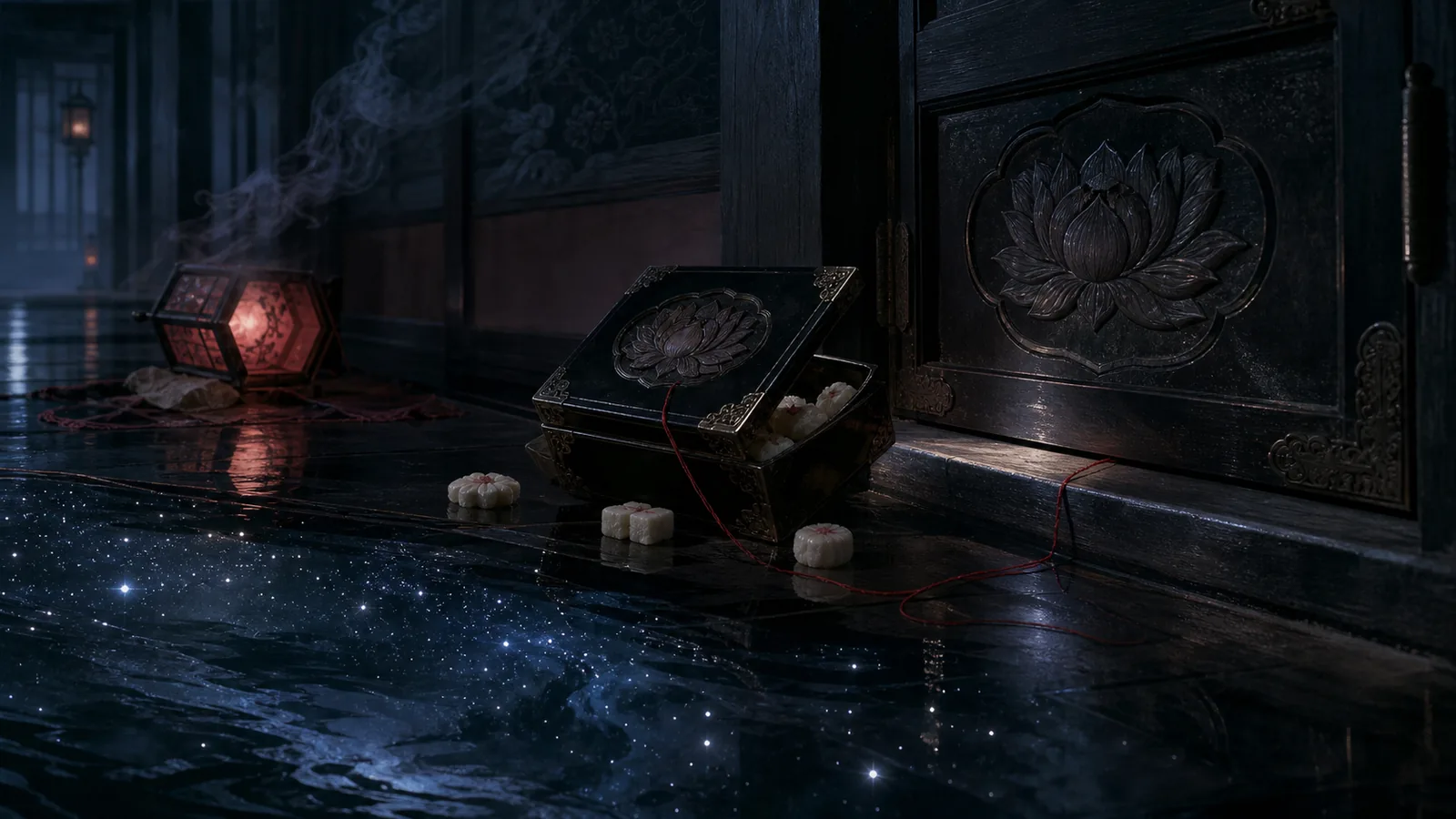
- Prince Inha collapses after eating from a lotus-marked confectionery box, the same delivery method that killed Saeng-gang's mother.
- Sukbin admits she engineered the old royal poisonings, used the pond-spirit tale as cover, and poisoned Saeng-gang; Gu-cheon follows Saeng-gang into the broken ward to fight the possession.
The Crown Prince shows Saeng-gang the poison that killed him just as the King wakes and orders an entire plague village put to death. Gu-cheon has ten days to destroy the spirit, no sight with which to find it, and a shaman who has given the dead prince a living body to use. Prince Inha's appointment brings the old succession plot back into motion, while a lotus-marked confectionery box leads Saeng-gang to the woman she trusts most. The hour pulls the curse off the royal dead and lays it over the living people who manufactured them.
The Crown Prince shows Saeng-gang his poisoning, and the King orders a plague village put to death
The late Crown Prince does not ask Saeng-gang to take his grievance on faith. He takes her back to his last moments, makes her look at the blackened rice in his mouth, and names the hand behind it: “It was Father who poisoned me.” The vision gives the King’s old secrecy a body on the floor. It also gives the spirit a new way into Saeng-gang, who hears that she will be killed next now that she knows.
The King wakes from his collapse and immediately proves why that warning can take hold. His first edict commands the soldiers at Goyang-hyeon to kill everyone in the infected village. When some troops release women and children, he orders those soldiers seized and beheaded before the rest. The Crown Prince calls him a living ak-gwi; outside the vision, the King is arranging public executions for the crime of mercy.
That cut is viciously clean. Episode 5 allowed the King one humane order for a frightened child on the road, then left the refugees behind. This hour removes even that sliver. The plague is a danger he cannot interrogate or threaten, so he contains it by erasing the people who carry it. Saeng-gang wakes with the spirit’s voice insisting that her father will do the same to her.
The King gives Gu-cheon ten days, while the Crown Prince hides inside Saeng-gang
Gu-cheon emerges from the failed ritual bruised, half-blind, and in no mood to perform gratitude. The King accuses him of defying an order, hiding in a jar, exhuming a royal body, and making his sovereign look foolish. Gu-cheon answers with the only fact that matters: the deception saved the King’s life. He refuses to surrender the Crown Prince’s corpse and secures ten days to destroy the spirit, provided the King follows his instructions and permits a protective ward outside his hall.
He finds Saeng-gang unconscious soon after. The Crown Prince used her body to conceal himself, and Gu-cheon’s damaged eyes cannot tell whether any part of him remains attached. Saeng-gang supplies what she learned instead. The black rice proves poison; the Crown Prince’s memory points to the King; and both of them will remain targets unless they uncover what happened 30 years earlier.
Gu-cheon makes her a ward and tries to forbid any further meeting with the spirit. For one brief conversation, his injury offers relief as well as terror. He admits that it is nice, for the first time in his life, not to see a spirit or gwi-mae anywhere. Then he leans close to inspect Saeng-gang and remembers that blindness means he cannot protect her from the thing already using her. The only way forward is finding the shaman who damaged his eyes — and whoever is hiding that man wants the King dead.
Prince Inha is named heir, and Gu-cheon sets upside-down rabbit wards
Saeng-gang takes that question to the Queen Dowager and receives Prince Iksang’s answer instead. He tells the room that the King’s troops killed the children and elders of Goyang-hyeon, then announces that his eldest son has been appointed Crown Prince. The King has reversed his judgment almost overnight. Prince Inha, unfit when the King expected to live, is now adopted into the direct line and summoned to fill the East Palace as quickly as an investiture can be arranged.
The news splits Saeng-gang’s attention in exactly the wrong place. The dead Crown Prince repeats that the King will kill everyone; Saeng-gang becomes certain her father will murder her too. Gu-cheon snaps her out of the spiral, warns that fear leaves cracks a spirit can enter, and puts her to work hanging rabbit signs upside down. Because the Crown Prince was born in the Year of the Rabbit, his soul cannot cross them without a body to hide in.
She hangs one too high. He orders it lower; she reminds him that his failing sight is the only reason she is tolerating the criticism. Their old friction survives, but its job has changed. Gu-cheon tells her to remain close to somebody she can rely on if she cannot keep her mind steady. Saeng-gang thinks she has that person. Royal Noble Consort Sukbin greets her granddaughter warmly, speaks of leaving the frightening palace, and looks like the last safe adult in it.
The shaman accepts the Crown Prince as his presiding deity, and Gu-cheon asks Saeng-gang to flee
The shaman Gu-cheon has been hunting can barely eat or speak after losing his presiding deity. The Crown Prince enters that vacancy with a promise: take me in, and I will become the new one. The possession gives the spirit another human shelter and completes the damage to Gu-cheon’s eyes. By the time he returns to Saeng-gang, he cannot see at all.
There is a way to restore something of his vision, but Gu-cheon will not name it beyond the danger. It requires disturbing what must never be disturbed. He would sooner hide outside the palace and asks Saeng-gang to flee with him. She refuses. Leaving again for something that was not her fault would repeat the expulsion of her childhood, while staying offers a chance to prove the King’s crimes before more people die.
The disagreement strips their promise down to its limit. Gu-cheon offered to save her while he still had the power that made such a promise possible. Saeng-gang now plans to let the Crown Prince approach, trust her own mind to hold, and find evidence without him if necessary. “I don’t wish to leave the palace again for something that was not my fault,” she tells him. He calls the plan insane. She has correctly named the injustice and badly underestimated what the spirit can do with it.
Prince Inha collapses after eating from a lotus-marked box, and Saeng-gang walks into Sukbin’s trap
The Queen Dowager reaches the human explanation from another direction. She asks why the curse killed the other royal sons while the present King alone survived, then sends Lady Jang after the physician who examined the princes 30 years ago. He later vomited dark blood and died with the same symptoms. Whatever targeted the royal house, the Queen Dowager realizes, did not begin with a spirit.
Before she can follow it, Prince Inha collapses. A confectionery box in his chamber bears the same markings as the one Saeng-gang carried to the Queen Dowager, placing both poison and suspicion in the Princess’s path. Lady Jang summons her, but the Crown Prince pushes into the fracture Gu-cheon warned about. Saeng-gang goes pale, drives everyone away, and walks without knowing where she is going.
She comes to herself in Sukbin’s rooms. Her grandmother listens as Saeng-gang accuses the King of poisoning Prince Inha and begs for help forcing him from the throne. Then Saeng-gang hears her dead mother’s warning, notices spells written around the chamber, and remembers the food Sukbin brought after mother and daughter were expelled. The person she chose because Gu-cheon told her to find somebody reliable is the person who supplied the lotus boxes.
Sukbin confirms it by telling Saeng-gang that she has eaten the poison too. The dose will not kill her. It will leave her unable to speak or move, a living corpse who can never repeat what she has heard.
Sukbin admits the royal poisonings, and Gu-cheon follows Saeng-gang through a broken ward
Saeng-gang finally calls her grandmother the pond spirit, and the old court history rearranges itself around the name. Sukbin poisoned the late King’s sons until her own son could become Crown Prince. She made the favored woman’s curse the official explanation, used the Queen Dowager’s crime as cover, and removed anyone who might expose the secret. Saeng-gang’s mother was not killed for discovering the plot later. Sukbin says she helped from the beginning and gained her place as the King’s concubine through it.
The cruelty peaks when Sukbin tells her granddaughter that the throne was built with both her parents’ help and calls her “the product that sin created.” The Crown Prince enters through the shame that follows. He insists there was no spirit trying to destroy the bloodline 30 years ago, only a living ak-gwi who must be stopped, and Saeng-gang leaves behind the rabbit ward that could have barred him.
Gu-cheon reaches Sukbin’s spell-covered rooms too late to prevent the possession. He cannot see her fear, but he can hear enough to ask what sin made her cover every door and what she did to drive Saeng-gang from her own body. With the ward broken, he prepares a straw effigy to take misfortune in his place and chooses the dangerous spiritual path he refused earlier. The ensuing fight is almost wordless: spirits tear at him, water opens beneath him, and Saeng-gang’s mother begs him to save her daughter from the ak-gwi. He finds Saeng-gang at last and calls her back to herself while the Crown Prince attacks.
Tiny details worth clocking
- The rice in the Crown Prince’s mouth turns black in Saeng-gang’s vision; the lotus confectionery boxes turn an old accusation into a repeatable delivery system.
- The King permits his protective ward only outside the hall, limiting even the measure meant to stop him from coughing blood at death’s door.
- Gu-cheon says a spirit can enter through cracks made by fear, then covers those thresholds with upside-down signs bearing the Crown Prince’s birth animal.
- Sukbin announces that the palace is too frightening for an old woman shortly before the shaman accepts its most dangerous dead man as a new presiding deity.
- Gu-cheon tells Ji-yul that the straw effigy will receive his misfortune, but his reason for making it is still Saeng-gang: he needs something else to stand in the place from which he intends to retrieve her.
Final verdict
Episode 6 delivers the court conspiracy the hauntings have been circling since the pond. Sukbin did not merely survive the old curse; she manufactured its death count, promoted her son through the empty places, and let a murdered woman’s resentment take the blame. Saeng-gang calling her the pond spirit lands because the phrase no longer describes a supernatural species. It describes the living person who learned how useful a ghost could be to power.
The reveal also refuses Saeng-gang an innocent parent to recover. Her father poisoned his brother and now answers plague with slaughter. Her mother helped create the throne before becoming another secret Sukbin removed. Her grandmother weaponized care — visits, food, grandmotherly warmth — as access. Gu-cheon cannot see a spirit in this hour, yet he recognizes when Saeng-gang has been driven out of herself and goes after her without asking whether the royal house deserves another sacrifice.
The last fight is less exact than the confession leading into it. The straw effigy has a stated purpose, but the thing Gu-cheon disturbs, the attack he endures, and the water that opens before he reaches Saeng-gang remain deliberately murky. The images are strong; the rules are harder to read. Sukbin’s confession has no such problem. Each earlier clue clicks into place, and the hour leaves its sharpest truth with the Crown Prince: the spirit did not kill those princes. People did, then taught the palace to blame the dead.
Rating: 9.3/10 — A brutal succession reveal that turns Sukbin’s care into evidence and the palace curse into a cover story, despite a murky final ritual.
More episodes from The East Palace — A spirit hunter enters a palace built around a royal curse. Jump to any episode in the season:
Where to go next
Reviewed by Mira Vance · QuizFandom Editor & Lead Reviewer. Every rating is an honest per-watch assessment from the desk that also writes the quizzes — not a press release rehash.