The East Palace Episode 2 Review: "Episode 2" — Saeng-gang Hears the Salt Storehouse Dead, Prince Iksang Makes His Move, and Gu-cheon Grinds Their Bones
What happens — the short version (spoilers)
- Saeng-gang pulls Gu-cheon out of the World of Gwi after his bell falls silent; the pond spirit is weakened, but its identity remains unknown.
- Gu-cheon admits he recognized Saeng-gang as the King's daughter, and she learns he used her royal blood to draw the pond spirit away from Prince Yeongan.
- They agree to work outside the King's knowledge, though Gu-cheon warns that he intends to kill someone inside the palace.
- Prince Iksang sees Prince Yeongan's sickness as a succession opportunity and orders a spirit worker to watch Gu-cheon, whose work could ruin that plan.
- In the salt storehouse, Saeng-gang hears the memory of court ladies starved and burned after Lady Jang claimed they had blamed the Queen, now the Queen Dowager, for a Crown Prince's death.
- Gu-cheon uses the court ladies' bones to release their won-gwi from resentment, and their testimony points to the Most Favored Lady of the Court as the possible pond spirit.
Gu-cheon comes back from the pond with the spirit weakened, his Yang energy nearly spent, and one more reason to keep the King out of his plans. Saeng-gang brings something more dangerous than royal blood to their new alliance: she can hear the dead, including the court ladies sealed beneath a salt storehouse 30 years ago. While Prince Iksang turns Prince Yeongan's illness into an opening in the succession, the two investigators dig up the people erased to protect the palace. The hour makes its case through those buried women: a royal secret stays buried only as long as nobody listens when it starts speaking.
Saeng-gang pulls Gu-cheon from the pond, and the two strike a bargain behind the King’s back
Inside the World of Gwi, Gu-cheon offers half his Yang energy for help, then tries to force the pond spirit to reveal its identity before its soul is destroyed. He still gets no name. The fight leaves him close enough to death that Saeng-gang disobeys his one clear instruction and pulls the rope when his bell falls silent.
He is furious. He is also alive, Prince Yeongan is safe for the moment, and the pond spirit has been weakened enough that it cannot move. Saeng-gang’s attempt at an apology becomes a wonderfully exact inventory of his faults: she had mistaken him for an irredeemable layabout who cared only for himself. Gu-cheon can object only to the past tense. Then he returns the favor by admitting that he knew she was the King’s daughter on sight. Her delicate hands gave her away; her stubborn expression finished the proof.
Gu-cheon used Saeng-gang’s royal blood to draw the spirit away from Prince Yeongan, and his assistant realizes a beat too late that she was bait. Their partnership begins with each catching the other in a concealed use: she was sent to decide whether he should live; he put her blood in front of a murderous won-gwi.
Saeng-gang nevertheless proposes an alliance outside her father’s knowledge. Anyone who learns palace secrets is unlikely to leave alive, and Gu-cheon needs her to prolong his stay until he completes a private task. He gives her his hand and one alarming term: “I am going to kill someone here in the palace.” Whatever trust exists between them is still narrow enough to carry a threat.
Saeng-gang reveals what she heard as a child, and a ggeomeoksali follows Gu-cheon home
Gu-cheon finally asks how Saeng-gang heard his bell. Her answer reaches back to the salt storehouse now tangled in the pond spirit’s history. As a child, she heard a trapped spirit say that the serpent’s shed skin killed the dragon’s child. She reads the dragon’s child as the King’s son and the shed skin as the pond spirit. Gu-cheon reads the rest with his usual lack of tact: a princess who heard ghosts was cast out, and that hidden gift may now be their way into a room full of dead witnesses.
Their argument is cut short by a smaller haunting. Gu-cheon sacrifices the rice cake he had been saving to test what kind of gwi-mae he has found, watches it turn docile, and immediately runs. A ggeomeoksali latches onto a person, drains Yang energy, and kills its victim after showing them terror. Saeng-gang sees only the palace’s spirit expert throwing his snack and fleeing from empty ground.
The ggeomeoksali follows him into his new quarters, merely across from the old ones. Episode 1 made his sleepless room funny without making its gwi harmless; Episode 2 reverses the joke. This one looks cute to the man it may kill, and only he is properly terrified.
Prince Iksang offers a new royal branch, and the King finds a threat at the Queen Dowager’s door
Prince Yeongan’s recovery buys time, not stability. Ministers are already warning that the last remaining prince’s illness endangers the succession when Prince Iksang strolls into the Queen Dowager’s residence fresh from tiger hunting. He mentions his scholarly son, then turns the pitch into river talk: if the main current grows foul and dry, cut it away so a new channel can flow.
The Queen Dowager need not promise him anything. When the court presses the King to choose a new Crown Prince from the royal kin, he asks whether every minister already believes his son will die, then names her into the silence. Thirty years earlier, the King’s brothers died and he alone survived. His mother was a lowborn court lady, and even his reign has not removed that stain in the court’s eyes. A sick prince has reopened the argument over which blood belongs near the throne.
Iksang is not waiting for illness to settle it. In private, he rebukes the spirit worker he planted near Prince Yeongan for failing to command a spirit and for allowing the boy’s health to improve. When he learns that the King’s supposed feng shui master may be responsible, he orders Gu-cheon watched and killed if the suspicion proves true. More spirits mean a King driven further into a corner, which is precisely where Iksang wants him.
Gu-cheon and Saeng-gang are refused an audience with the Queen Dowager. He leaves Lady Jang a vicious message about considering who will rule once the Crown Prince is dead. Outside, they see the King’s birth mother away from her private residence, another reminder that the Queen Dowager and the King share a throne’s history but no blood.
Saeng-gang enters the salt storehouse and hears how its court ladies burned
The dead do not wait for the royal family. A new court lady named Ji-yul brings Saeng-gang gossip about spirits at the Queen Dowager’s quarters and the Saenggwabang. The ggeomeoksali is advancing on Gu-cheon when news of the salt storehouse gives him an escape route.
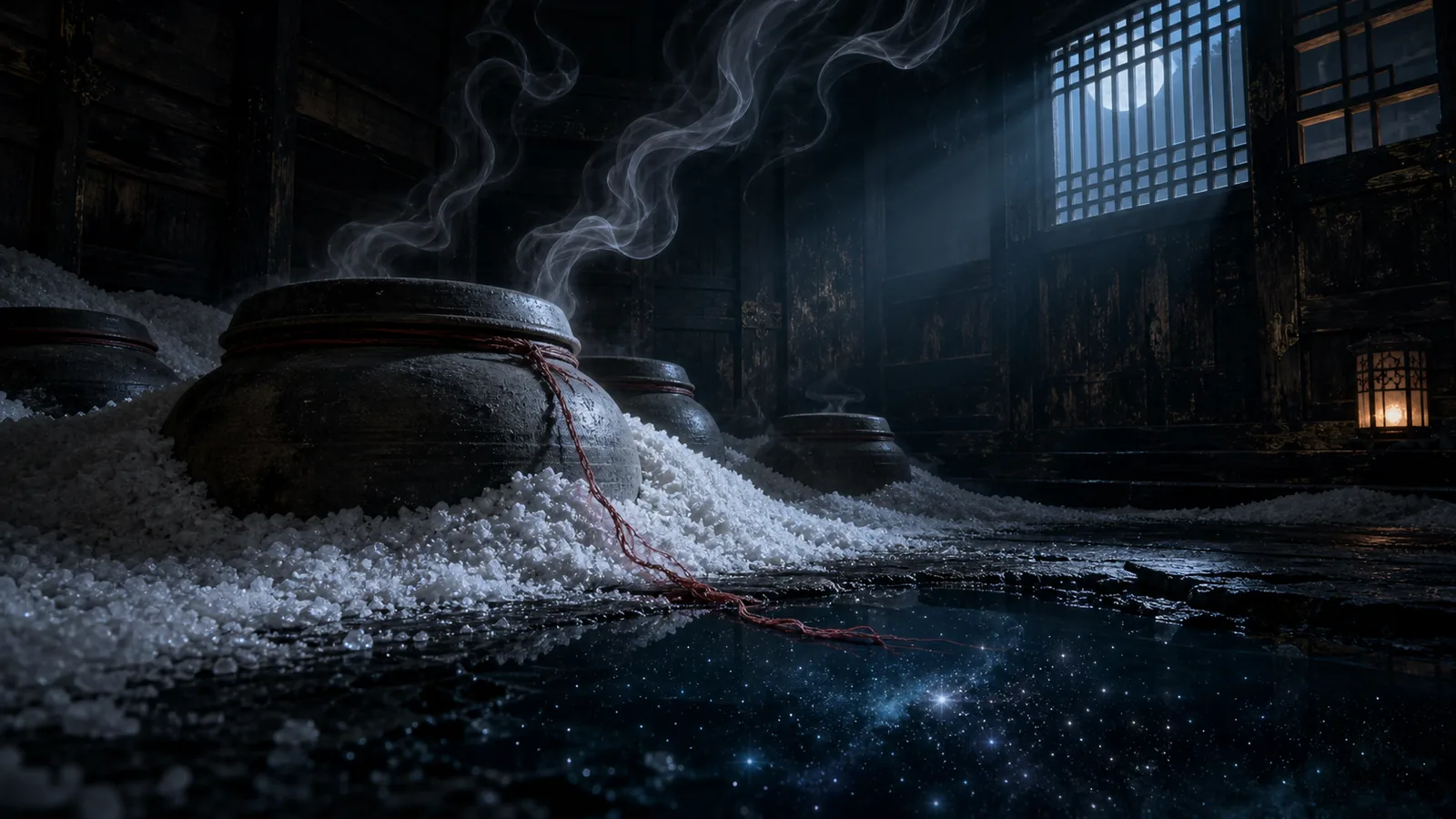
At the storehouse, Saeng-gang can hear murmuring too faint to separate into words. She enters alone, asks the voices to tell her what happened, and receives their memory. Thirty years ago, the words about the serpent’s shed skin appeared on the wall. The Queen in that memory is the woman now called the Queen Dowager, born in the Year of the Snake; Lady Jang accused the court ladies of blaming her for the late Crown Prince’s death. They were locked inside without food or water and burned alive. Their bones were gathered into jars and buried so the vengeful spirits would stay sealed away from the royal house.
That punishment created what it claimed to contain. The court ladies became won-gwi, their resentment fixed to the remains hidden below the salt. Someone who knows what the jars hold has now broken the seals. Fear carries the Queen Dowager toward the answer Iksang needs: she decides the King is wielding spirits against her and orders every court lady to guard her through the night.
Saeng-gang returns with the dead women’s account instead of another convenient culprit. Gu-cheon tells her she has done good work, and her surprise is quiet: “You are the first person to say this strange ability of mine was helpful.” Her father once told her that no child carrying his blood could admit to hearing such things without disgracing the royal house. Gu-cheon has just used the same gift to recover evidence the royal house burned people to suppress.
Gu-cheon grinds the court ladies’ bones, and Saeng-gang carries the powder to the Queen Dowager
Saeng-gang still blames herself for not breaking the jars as a child. Gu-cheon asks what a child could have done, especially one already feared for hearing the dead. He knows that treatment. His comfort is almost tender until he demonstrates possession with a ridiculous face. Now she understands why he is so unusual.
Then he announces that he will grind the court ladies’ bones. Saeng-gang hears a second desecration and tries to stop him, forcing another won-gwi lesson from a man who hates repeating himself. Resentment prevents these souls from passing on; something that recalls who they were can dissolve it. The powder will reach their spirits inside the World of Gwi.
Gu-cheon enters that world while Saeng-gang takes the powder to the Buddhist temple where the won-gwi have gathered around the Queen Dowager. He apologizes before fighting and admits Saeng-gang was right: they are innocent spirits. When his bell rings, her part of the ritual begins. One investigator makes the dead remember; the other keeps their rage from taking another life.
The court ladies repeat a forbidden curse, and Saeng-gang gives the pond spirit a possible name
The ritual pulls the won-gwi’s testimony through the Queen Dowager. They were guilty only of being in the wrong place: they heard the Most Favored Lady of the Court curse the royal line as she died. “From this day on, no royal blood shall flow within these walls,” the condemned woman promised, vowing to return as a spirit and dry out the seed of the East Palace. The court ladies were killed under the pretense that they had written the serpent-and-dragon message themselves.
Saeng-gang follows the evidence to a question, not yet a settled answer: could the pond spirit be the Most Favored Lady of the Court? That distinction matters. The court ladies can repeat the curse and explain why they were silenced, but they cannot yet supply the whole life or grievance of the spirit in the pond. One buried crime has opened onto an older one.
The freed women have one accusation left for the Queen Dowager. They ask why she stood by while they burned. Gu-cheon stops them from taking revenge and promises that those who sin will face punishment without the dead taking a life themselves. He guides them toward rebirth instead. The palace sealed these women as a threat; Saeng-gang and Gu-cheon release them as witnesses.
Tiny details worth clocking
- Gu-cheon identifies Saeng-gang’s royal blood through her hands and resemblance to the King, then adds her stubborn expression as if the insult were the decisive proof.
- His reward for saving Prince Yeongan is a room directly across from the haunted one, an upgrade so small that even Saeng-gang struggles to defend it.
- Ji-yul once shared a room with nine family members, making Saeng-gang’s alarm at having one roommate look like another trace of the princess she must conceal.
- The King survived the deaths that cleared his path to the throne; Prince Iksang now treats the possible death of the King’s last son as a path for his own branch.
- The Queen Dowager orders living court ladies to surround her at night while the court ladies she once sealed gather beneath her feet.
Final verdict
Episode 2 takes the haunting out of the pond and shows how efficiently the whole palace produces ghosts. The salt storehouse sequence is the hour’s center: Lady Jang turns a spirit’s warning into an accusation, frightened authority burns the witnesses, and the Queen Dowager seals their remains under the language of protecting the royal house. Thirty years later, Saeng-gang walks into that room and asks them to speak. The series’ thesis is plain there. Court power survives by deciding which testimony counts as treason; the supernatural gives the silenced another route into the record.
The Gu-cheon and Saeng-gang pairing grows without turning suddenly warm. He used her as royal bait. She is still spying for the man who cast her out. Yet he is the first person to call her hearing useful, and she is the person he trusts to finish the bone ritual on his bell. Their driest exchanges keep the episode mobile around an unusually grim story, especially the ggeomeoksali attaching itself to the one man who knows how frightening it is.
The weaker stretch is the succession material around Prince Iksang. The episode introduces his son, the King’s disputed birth, the Queen Dowager’s separate bloodline, the deaths of the King’s brothers, and a planted spirit worker in quick succession. It becomes clearer once Iksang orders Gu-cheon killed; before that, the family branches require more sorting than the salt storehouse mystery. The final testimony repays the density, narrowing the pond investigation without pretending to solve it.
Rating: 8.9/10 — A strong second hour that turns a buried court atrocity into testimony, deepens its central partnership, and survives one crowded passage of succession politics.
More episodes from The East Palace — A spirit hunter enters a palace built around a royal curse. Jump to any episode in the season:
Where to go next
Reviewed by Mira Vance · QuizFandom Editor & Lead Reviewer. Every rating is an honest per-watch assessment from the desk that also writes the quizzes — not a press release rehash.