Can This Love Be Translated? Episode 9 Recap: Mu-hee Hears the Opera Song in Italy
What happens — the short version (spoilers)
- Mu-hee quotes La Traviata at the opera house and turns the love-and-goodbye line toward Ho-jin.
- Hiro follows Do Ra-mi's invitation to Italy, denies loving Mu-hee, and is bruised by her relief.
- Ho-jin drills Do Ra-mi on Italian so Mu-hee can shine during the opera-house shoot.
- Do Ra-mi steals Hiro's camera so Mu-hee can find it, forcing Ho-jin into an absurd cover-up.
- Ji-sun saves the winery shoot by calling Jin-suk's Italian contact, leaving Ho-jin and Mu-hee to watch old attachments linger.
- Do Ra-mi tells Ho-jin that Mu-hee remembers her mother killing her father and believes she can never be loved.
Mu-hee tries to borrow a happy ending from an opera scene, but Italy keeps translating love into goodbye.
Can This Love Be Translated?, Episode 9 of 12 Netflix
Mu-hee comes to Italy with a kiss she cannot fully own, a message she did not mean to send, and Ho-jin’s voice still living in her ear.
That is a dangerous mix for a romantic comedy this tender. A travel shoot needs sunshine, expensive seats, good food, and two stars who can make an itinerary feel like fate. Mu-hee needs to know whether the feelings she keeps dodging belong to her, to Do Ra-mi, or to the space between her and the man paid to speak for her.
Italian lyrics become Korean. A love song becomes a goodbye. A stolen camera becomes an excuse to talk. A woman who says she wants a happy ending slowly explains why she thinks the safest ending is the one where Ho-jin leaves.
Hiro follows Do Ra-mi’s message to Italy
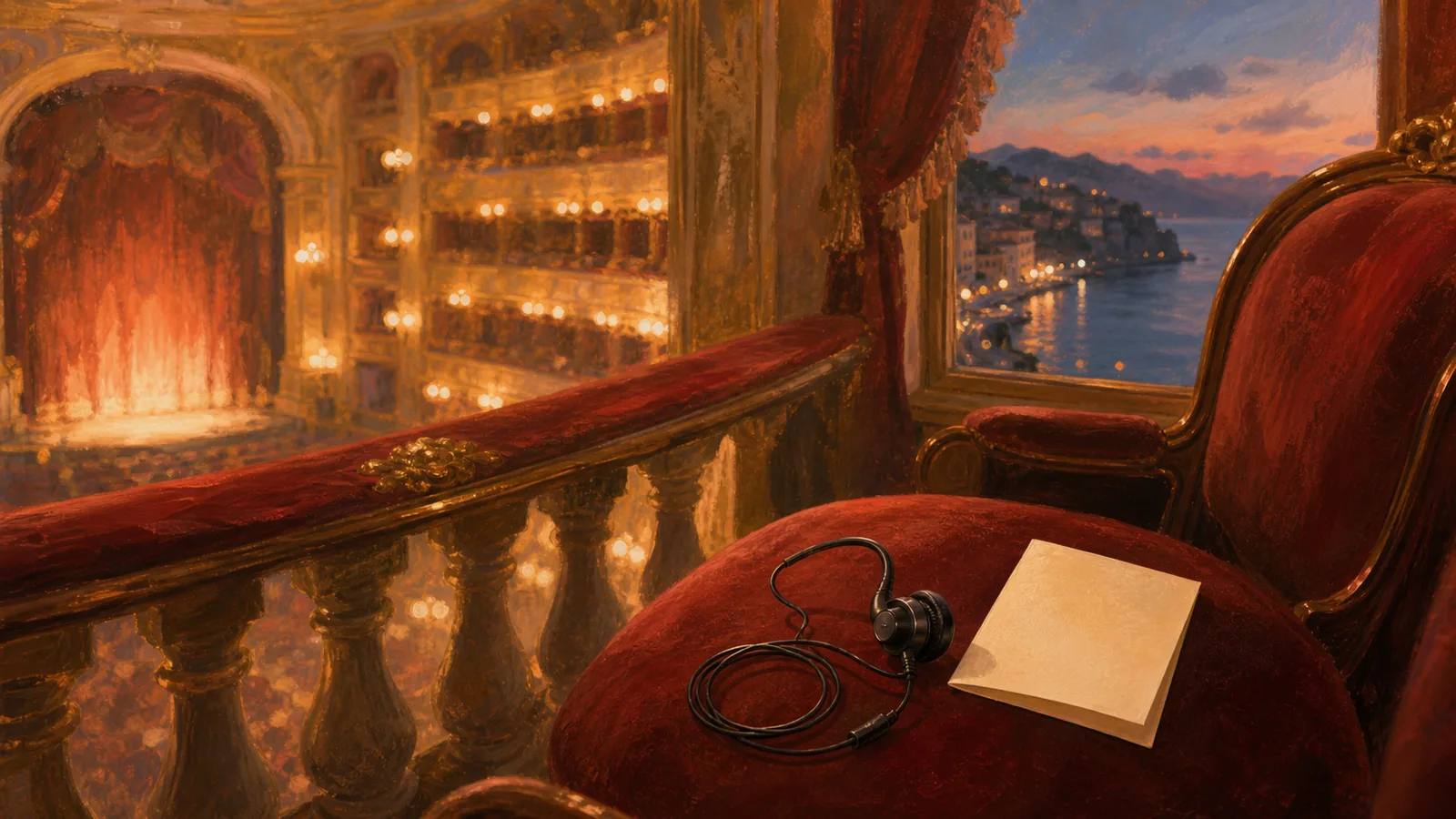
The opera-house shoot looks romantic before it becomes brutal. Mu-hee tells Hiro she wanted to sit in those seats because of Pretty Woman. She remembers the fantasy: expensive seats, a grand room, a love story borrowing music larger than either person can say.
Ho-jin supplies the missing title: Verdi’s La Traviata. Then Mu-hee recites the Italian, and everyone around her is surprised. She has memorized it. She even understands what it sounds like she is saying.
Ho-jin translates the line as love, then goodbye.
Mu-hee turns it toward him anyway. She says, in front of Hiro and the crew, “Love me, Joo Ho-jin,” then finishes the thought with the same goodbye. It is playful, embarrassing, and already sad before anyone names why.
Ten days earlier, Hiro is in Japan pretending he is not waiting for her. Aya-chan is nearby. Hiro says he has been learning Korean, then complains that Mu-hee kissed him without permission and failed to give him a proper time and place to meet. The teasing around him gets mean in the useful way only close people can manage. They bring up his old first love, an older rebel girl like Do Ra-mi, and Hiro denies everything so hard that he basically confesses.
When he reaches Italy, Mu-hee has to sort out what happened. She remembers being alone. She sees the message telling Hiro, “I’ll be waiting.” She knows Do Ra-mi invited him. She also knows these were still her hands, her lips, her name.
So she asks him directly whether he likes her. Whether he loves her.
Hiro says no. He only came to confirm whether she had lied again and to teach her a lesson. Mu-hee is relieved so loudly that it bruises him by accident. She thanks him, promises to work harder, and declares she does not pick fights she cannot win.
Then her card gets declined, which is exactly the right amount of slapstick.
Mu-hee and Ho-jin begin the Italy shoot through the headset
The Italy shoot gives Mu-hee and Ho-jin ordinary professional contact, which is exactly why it knocks her off balance. He puts the headset back in her ear. She hears him ask whether she can hear him. She says yes. He hopes the good weather holds and everything works out for her in Italy.
Mu-hee answers that she is grateful and happy to work with him again.
In Canada, the crew thought Mu-hee and Hiro were awkward. Now the two stars look like seasoned travel partners, joking through a Korean spa-food explanation at an old bathhouse site. The Romantic Trip footage has rhythm again.
Mu-hee, however, keeps finding evidence from a night she did not consciously live: a hat, limoncello, a hangover-shaped unease. Do Ra-mi went out drinking in Italy, and Mu-hee has to stand in the daylight with the receipts.
The crew also notices that Ho-jin is staying away from the main hotel. Mu-hee hears “poor Joo Ho-jin” and wonders whether he is avoiding her because she is annoying.
That is Mu-hee all over: a woman famous enough to move an entire production, still able to reduce herself to the smallest possible explanation for someone else’s distance.
Do Ra-mi memorizes La Traviata with Ho-jin
Do Ra-mi barges into Ho-jin’s evening after closing time, buys a hat, drinks too much limoncello, and calls him “honey” with the confidence of someone who has never respected a boundary she could climb over. Ho-jin tries to get her back to the hotel. She keeps turning his irritation into flirtation.
His reason is painfully sweet. If Mu-hee can say the line from the movie she likes, she will look smart at the opera house and be happy. Do Ra-mi insists she and Mu-hee share the same brain. If Do Ra-mi memorizes it, Mu-hee will know it too.
Ho-jin drills the Italian with her. She mangles the sounds, repeats them, and finally lands the line. It is ridiculous. It is also care in Ho-jin’s driest register. He is helping the version of Mu-hee who annoys him because that version is still carrying something Mu-hee needs.
Do Ra-mi asks for a reward and tries to make it a kiss. Ho-jin refuses to play. When he asks why she is still appearing now that Mu-hee looks happy in Italy, Do Ra-mi jokes that it is a way to keep seeing him.
Then she stops being cute.
She says Mu-hee remembers the accident. She remembers how her parents died. She has been pretending not to know anything since childhood. She smiled to hide sadness, and her relatives treated that smile like something strange.
Do Ra-mi also tells Ho-jin she confronted Mu-hee’s family before visiting his place. She does not want anyone saying Mu-hee should be grateful because her relatives took her in. Mu-hee has said that to herself her whole life.
Ho-jin gives Do Ra-mi water. She calls it kindness and says kindness makes her want to kill him.
He understands more than she expects. Kindness can be scary if you believe it will end. For Mu-hee, being cared for is not automatically comfort. Sometimes it feels like proof that the next abandonment will hurt worse.
Do Ra-mi steals Hiro’s camera before the crew dinner
After the opera-house shoot, Hiro wants to see La Traviata with Mu-hee from those seats. Do Ra-mi is proud of herself. One memorized line, and Hiro is asking for an opera date. Ho-jin points out that Mu-hee does not even like opera enough to stay awake through it.
That is when Do Ra-mi nudges the conversation where Mu-hee cannot. She asks who Ho-jin saw the opera with. Ho-jin tells her Mu-hee can ask him herself if she really wants to know. Do Ra-mi says Mu-hee is too embarrassed to talk unless he is translating for her.
Then Mu-hee does ask.
It is tiny, but it matters. She asks who he saw the opera with, and he answers: an older male author on an opera-book project. Mu-hee’s jealousy has nowhere dramatic to go after that, so it becomes comedy.
Do Ra-mi has already stolen Hiro’s prized camera by then. Her plan is to create a crisis so Mu-hee can find it and earn his gratitude. Ho-jin refuses until Do Ra-mi points out the security-camera problem and the possibility of Mu-hee ending up at a police station.
So Ho-jin gets dragged under his own coat with Do Ra-mi while the crew is at dinner, and the crew sees enough to start gossiping. Someone thinks a young Italian woman was under his coat. Ji-sun is there too, deflecting questions about why her engagement ring is off.
The camera hunt is absurd. Everyone returns to the location. Ho-jin handles the return. Mu-hee gets credit for finding it, and Hiro is genuinely thankful because the camera was a meaningful gift from the photographer who helped him early in his career.
Ho-jin realizes it too. The theft created the opening Mu-hee needed. She and Ho-jin talked like people again, away from performance, headsets, and work emergencies. It was wrong. It was also effective.
Ji-sun rescues the winery shoot while Ho-jin finds Mu-hee’s clovers
The photography exhibit keeps Hiro busy, but it does not keep the production safe. A problem at the winery location threatens the next shoot. Park In-su starts scrambling. Hiro offers a travel-booking contact. Then Ho-jin remembers that Ji-sun’s fiancé once wrote about a large Italian winery.
The crew begs Ji-sun to call. She does. The location is saved.
There is a quiet ache after that. Everyone praises her fiancé as a savior. Ho-jin gives Ji-sun a drink because she was stressed too. Mu-hee is not the only person on this trip trying to act normal near someone who still matters.
Away from the crew, Ho-jin learns another piece of Mu-hee’s heart. A local woman recognizes her from interviews but has protected her privacy. Mu-hee has been visiting and drawing four-leaf clovers, one by one. The woman knows Mu-hee wanted a wish badly.
Ho-jin understands: the Northern Lights.
At the gallery, Mu-hee sees the aurora and cries. She misses it. Hiro sees her tears and cannot make sense of the zombie woman he keeps trying to pin down.
Do Ra-mi tells Ho-jin what Mu-hee remembers
Do Ra-mi comes back to Ho-jin after the gallery, and this time the opera line finally breaks open.
She thinks the song worked because it sounded like a confession. Ho-jin corrects her. In La Traviata, the aria comes before separation and death. Do Ra-mi fights that meaning because Pretty Woman ends with a kiss. To her, a happy ending cannot be scored by goodbye.
Ho-jin answers with the honesty she asked him not to have. Believing she can never be happy is wrong too. If Mu-hee wants a real happy ending, Do Ra-mi has to let go of the setup that keeps bringing her to him.
That is when Do Ra-mi admits the truth Mu-hee cannot say. She keeps coming to Ho-jin because Mu-hee wants to see him. Mu-hee still has feelings for him. Mu-hee is also terrified that he will find out who she really is, which means Ho-jin is one reason Do Ra-mi keeps appearing.
Mu-hee saw her mother murder her father, then try to kill her too. She has pretended to forget because she believed a child who witnessed that could never be loved. Do Ra-mi says Mu-hee wants love, believes she cannot have it, lies, runs, and still wants Ho-jin to keep liking her.
That is a brutal translation. Not pretty. Not polite. Accurate enough to hurt.
Do Ra-mi asks Ho-jin to leave Mu-hee. If he goes, she says, the painful delusion can disappear and Mu-hee can be fine again. That is the happy ending Do Ra-mi offers: not the lover staying, but the danger leaving.
Then she turns the aria into her own farewell. Love me, dear Ho-jin, just like I love you. Goodbye.
Verdict
A strong, aching middle-late chapter comes out of the contrast between Italy’s beauty and Mu-hee’s private grief. The opera premise could have been an easy date setup. Instead, the lyric becomes a test: what happens when Mu-hee borrows a romantic line without knowing it is already saying farewell?
Some of the camera-theft comedy runs a little long, and the Hiro side of the triangle still works better as pressure than as genuine romantic suspense. But Mu-hee and Ho-jin are lovely whenever they are trying not to say the obvious. Do Ra-mi’s bluntness gives the material its charge once she reveals that Mu-hee’s fear of love began with a memory she has hidden from everyone.
The result is tender, funny, and painful. Mu-hee does not need a man to translate her forever. She does need someone kind enough to hear the ugly sentence and stay.
Rating: 8.7/10
More episodes from Can This Love Be Translated? — A global star and the interpreter who speaks for him, episode by episode. Jump to any episode in the season:
Where to go next
Reviewed by Mira Vance · QuizFandom Editor & Lead Reviewer. Every rating is an honest per-watch assessment from the desk that also writes the quizzes — not a press release rehash.