For All Mankind S1E1 Review: A Pilot That Loses the Moon Before It Can Win It
Ronald D. Moore's alt-history premiere stages a national humiliation on live television and then spends fifty minutes on the people who have to keep working in a country that just lost.
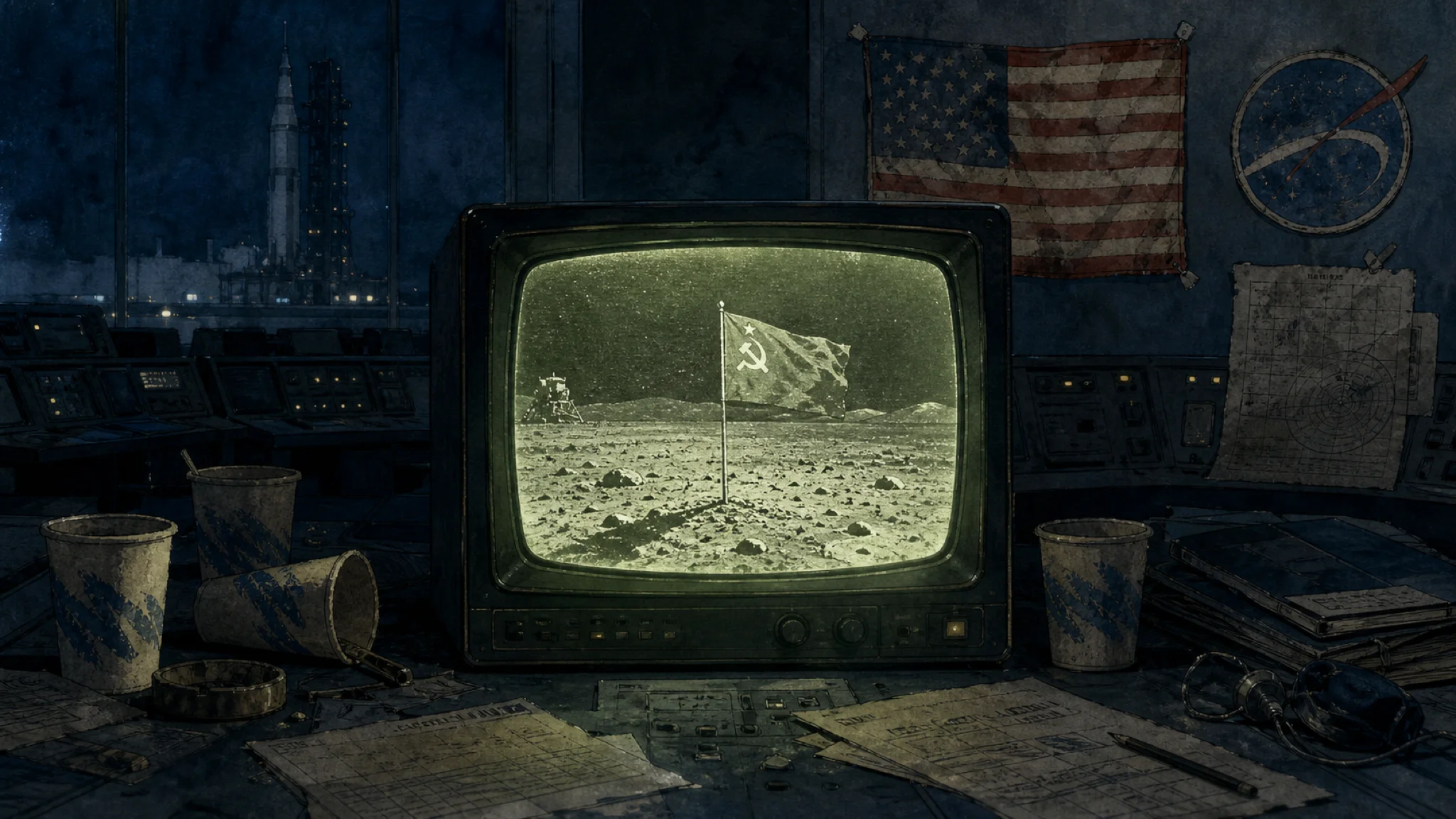
The first hour opens on John F. Kennedy promising the moon and closes on Neil Armstrong scraping into Tranquility a month late. Between those bookends, cosmonaut Alexei Leonov plants the Soviet flag and speaks the phrase that will haunt the season — “for my country, for my people, and for the Marxist-Leninist way of life” — and the premiere stops being a moon-landing story and becomes a workplace story about Americans absorbing a loss they were told would never come. The opening sequence is shot for dread. A grainy TV signal, a Texas living room where a small girl named Aleida Rosales is too young to know what she is watching, a Walter-Cronkite-adjacent anchor walking the audience into a conclusion that turns out to be wrong. “Live from the moon,” he says, three minutes before a Russian voice arrives instead of an American one. The translation lands with a sting the show does not underline: a small step on a journey that someday will take us all to the stars, except the us is theirs. The anchor says he is not sure what to say. The premiere believes him. It lets the silence breathe.
Nixon, on a phone line, calls it tripping at the goal line. He is right and self-pitying in the same breath. Pearl Harbor shock, Deke Slayton calls it later. The country had been told it was the future. The opening minutes take the future away.
A bar conversation that costs an astronaut his ride
The hinge of the pilot is small and verbal. Joel Kinnaman’s Ed Baldwin and Michael Dorman’s Gordo Stevens duck into the Outpost after a humiliating press conference, and a reporter follows them in with a tape recorder running. Ed had been senior astronaut on Apollo 10, the man who flew Snoopy within eight miles of the surface and did not land because landing was never in the mission plan — the LEM had been deliberately built too heavy to attempt it, a fact Ed has clearly chewed on for years. He talks. He talks about the Apollo 1 fire, about Gus Grissom and Roger Chaffee and Ed White, about how NASA stopped taking risks the day it stopped putting men in flight tests that might kill them. The line that lands him in trouble is the one he believes most: “We don’t have guts at NASA anymore.” It hits the newsstand inside twenty-four hours.
Ed delivers the speech without performance. The bar is loud, the reporter is sympathetic, and Ed has been told for two days that the smartest people in America watched a Russian land on the moon. Chris Bauer’s Deke Slayton, a man who manages other men’s anger by absorbing it first, tells Ed the country is in shock and the president is looking for someone to blame. Von Braun reassigns him to the Apollo Applications Project. Apollo 15 is gone. The script does not pretend Ed was wrong about NASA — only that being right inside a moving political crisis is a different problem from being right.
A wife who already knows the next twenty years
Shantel VanSanten’s Karen Baldwin gets the pilot’s sharpest scene. Ed sits at the kitchen table absorbing what Deke told him, and Karen walks him through a future she has already mapped: he goes back to the Navy, they move to Maryland or Patuxent River, he asks for carrier duty, the Seventh Fleet, Pearl, a fighter squadron on Yankee Station flying strike missions over Vietnam. She names the bases in order, the way someone married to a Navy pilot for ten years names them — without dramatics, without illusions. Ed answers, “It’s what I do, Karen.” She tells him that is a goddamn useless thing to say.
The fight that follows is not about the reporter. It is about a pilots’ code Ed broke by telling a stranger in a bar what he had never told his wife. The premiere stages it as a quiet domestic argument and lets it sit. Karen sleeps in the bed. Ed sleeps on the couch that is too small for him. She says she likes it that way because then there is no other choice. The line is the marriage in miniature: choices that cannot be made are still choices.
A young woman in Houston who knew the answer
The second through-line of the hour belongs to Margo Madison (Wrenn Schmidt), introduced not as the future Director of Flight Operations she will eventually become but as a young engineer working under Wernher von Braun who recognizes a 12-02 program alarm on a simulator run and tells the GUIDO controller the landing can proceed. She is right. She is also not in her lane. The simulated landing aborts because she hesitated, and von Braun, in a clipped private scene staged like a job interview the audience never gets to see the rest of, tells her the problem was feelings. “Something is or it is not. That is science.” It is a line the show will return to.
Schmidt’s performance is the pilot’s most controlled element. She gives Margo the slightly older-than-her-years posture of a woman who has learned to make herself invisible inside a building full of men, and the small, ironic “Yes, Herr Doktor” she offers von Braun plays as a private joke the two of them have been telling each other for years. NASA’s interior here is not a meritocracy; it is a hierarchy with an engineer-shaped meritocracy nailed to the front of it. Margo knew the answer. She also knew her place.
Two men in a bar making peace with hope
The pilot’s emotional climax is a long conversation between Ed and Gordo on Apollo 11 launch night. Ed is at his lowest. Gordo is making jokes. Then comes a turn better than commiseration: they ask each other what they would have said if they had been the first man on the moon, and Ed answers with a monologue about Chicago in 1968, the Democratic Convention, the cops crushing kids’ heads with batons in front of the cameras. He says he wanted to give those kids one good thing on television. He lands on the word hope. Not nation. Not science. Hope. Kinnaman does not play it as rehearsed.
Gordo, asked the same question, says he would have come in peace, three times a night. The joke is the joke an astronaut would actually make in a bar at three in the morning four days into a mission that might still kill three of his friends. Dorman plays Gordo as the kind of man who needs a punchline at the door of every serious feeling, and the bit lands because Kinnaman lets it. The friendship reads as twenty years old in eight lines.
A landing that arrives forty minutes late and saves the premise
The Apollo 11 descent is the pilot’s longest sustained sequence. Armstrong calls a long landing because the targeted site is full of boulders. The fuel burns down to twenty seconds. Telemetry drops. Flight Director Gene Kranz works a room that has just lost contact with the LEM, and the premiere does not cut away. It lets the silence stretch. Wives are dispatched to the Aldrin and Armstrong houses. Nixon, off-camera, is rehearsing the speech prepared “for just this eventuality.” Michael Collins, in lunar orbit, tells Houston he is not coming home alone.
When Armstrong’s voice finally returns — “the Eagle has landed… she might have clipped a feather or two on the way down, but she’s still here, and so are we” — the room erupts. The line echoes Deke’s pep talk from earlier, the one about men who get knocked down and pick themselves up and get back to work. The catharsis has been built brick by brick and held for an hour before it is spent. Armstrong signs off with “we had a rough start, but we’ve decided to pick ourselves up and get back to work.” For fifty minutes the premise has been the rough start, not the punchline, and the closing line confirms it.
What this episode is about
The bet, if you want to call it that, is that the loss of the moon is the more dramatically useful version of 1969. Winning was always going to buy one season of triumphalism and then leave the writers with a problem. Losing gives them a permanent grievance to spend. Nixon’s resentment spends it. Karen Baldwin’s mapped-out Navy future spends it. Margo Madison’s silenced-by-a-chain-of-command moment spends it. Ed’s bar interview, which in a different show would be a third-act pivot, lands here as the first-act inciting incident. The premiere is unusually patient about staging consequences before staging plot.
The other quiet move is to put NASA on screen as a workplace before it is a symbol. Deke’s pep talk to the demoralized astronaut office, with its specific memory of James Webb walking into the Cape to tell the Mercury seven that the Russians had put the first man in space, is the kind of scene most pilots cut for time. Moore and his co-writers keep it because the imagined alternate decade ahead will live in the astronaut office, mission control, the wives’ phone tree, and the engineers’ bullpen. The institutions arrive first and the spectacle second, and the spectacle is better for it.
Verdict
The premiere is doing more work than a pilot has to. The opening half-hour is a tight, controlled act of national humiliation; the middle hour is a slower domestic and political accounting of what that humiliation costs five specific people; the descent sequence is the kind of sustained-suspense set piece prestige television had largely stopped attempting by 2019. Ed, Margo, Karen, Gordo, and Deke are calibrated to the same register, which is rarer in a first hour than it should be. The specifics — the 12-02 alarm, the Apollo 10 dress rehearsal, the Snoopy weight figures, the Marxist-Leninist line, Collins’s refusal to come home alone — do not feel like research. They feel like memory.
There are first-hour seams. The Aleida Rosales prologue is a flash-forward seed the show will not pay off for years, and at this distance it plays as a promissory note more than a scene. The Margo plot is staged in closed-door offices without quite enough connective tissue to the rest of the hour; the von Braun confrontation is great writing but lands a little orphaned. Karen’s Navy-future monologue is the best two minutes in the episode and also the most isolated — it sits next to a marriage the rest of the hour barely has time to draw. The bar climax slightly oversells the Chicago monologue; another pass might have trimmed twenty seconds and trusted Kinnaman more.
None of that is fatal. It is a confident, patient, occasionally over-eager first hour that earns the right to ask the audience to wait.
Rating: 8.6/10
More episodes from For All Mankind — The alt-history NASA race begins, episode by episode. Jump to any episode in the season:
Where to go next
Reviewed by Mira Vance · QuizFandom Editor & Lead Reviewer. Every rating is an honest per-watch assessment from the desk that also writes the quizzes — not a press release rehash.