For All Mankind S1E5 Review: Molly Cobb Rappels Into a Crater and Finds the Future
A mid-flight landing-site swap, a winch made of rover parts, and a painted nightmare turn the moon ice mission into the show's first real character verdict.
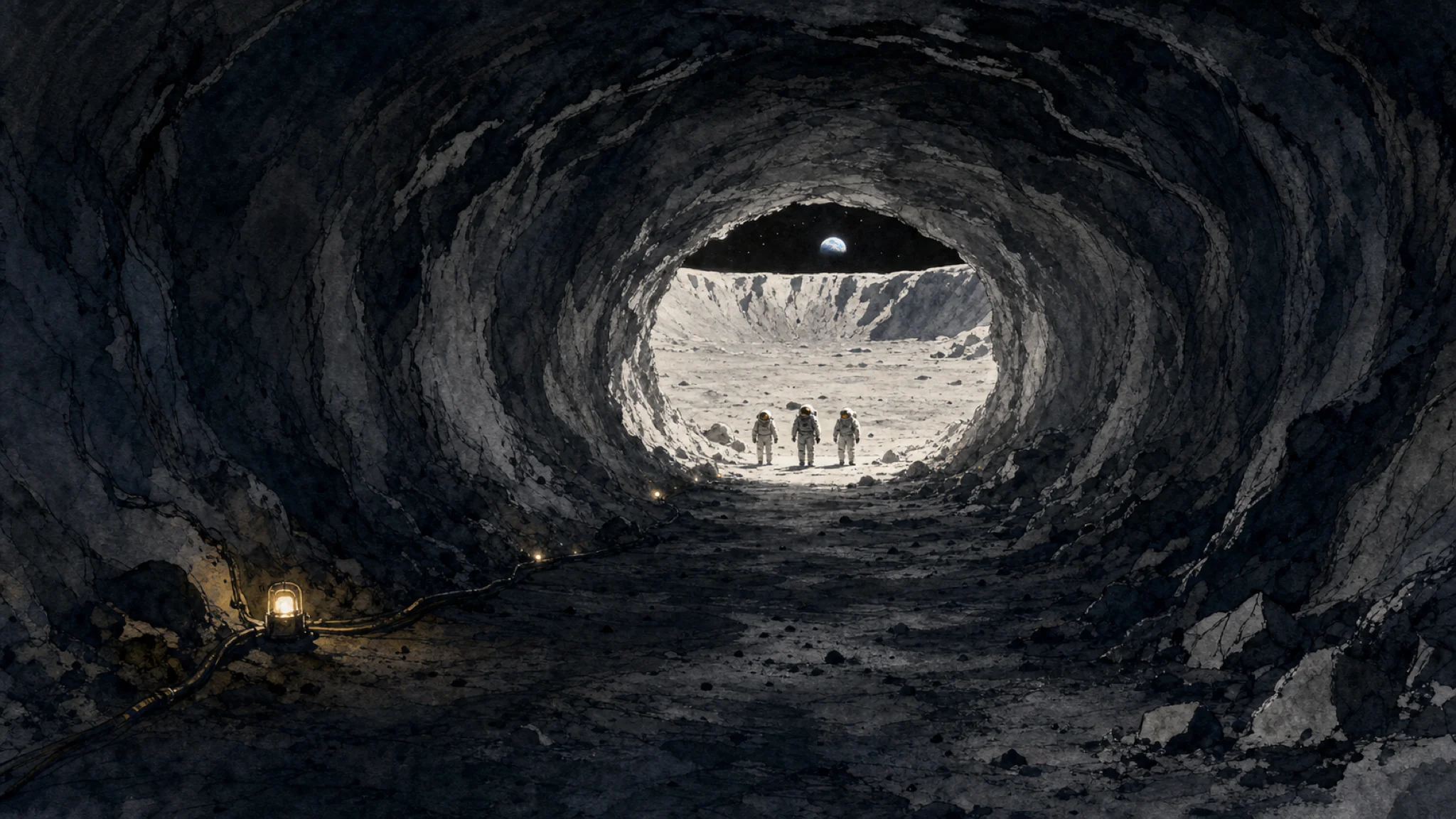
“Into the Abyss” is the episode that earns the rest of the season. The water hunt that Apollo 15 was sent up to do has been theoretical for four hours of television; here it becomes a winch hammered out of rover parts, a 300-foot S-band cable lowered into a crater that has not seen sunlight in two billion years, and a chunk of breccia that turns out to be a lava tube full of ice. The hour braids that lunar climax with the steadiest domestic plot the show has attempted: Karen Baldwin spending the long days of her husband’s mission with Wayne Cobb, painting the dreams neither of them is supposed to say out loud. Both halves are about whether the people who do this work can be honest about what it costs.
The hard six on the far side of the moon
Mare Frigoris is where the mission was supposed to land. The geo team finds the ice signature 4,000 kilometers away, at the south pole, in Shackleton Crater. Joel Kinnaman’s Ed Baldwin makes the case to change the landing site mid-flight; Mission Control says no; Ed turns it over to his crew. Sonya Walger’s Molly Cobb takes the call. The conversation between her and Ed in the cabin is the most precise stretch of dialogue in the episode. He warns her that if they auger in, it will not be “Baldwin screwed the pooch,” it will be “women can’t hack it in space.” She tells him that if they come home empty-handed, it will be “publicity stunt,” and the show has the discipline to make the wash between those two failure modes the entire reason she says yes. The Apollo 10 ghost is right there too, in Ed’s eyes, when he reads “this is close as I got” on the descent monitor. He has flown this profile before, in his head, every night, for years.
The Seahawk landing plays for nerves, not spectacle. Seventeen percent fuel. Fifteen miles short downrange. Dust kicking up at fifty feet. “Picking up a lot of dust.” The set piece is built out of Mission Control jargon and a single line of triumph at the end (“Houston, Shackleton Base. Seahawk has landed”) that nobody is allowed to milk. Ronald D. Moore’s writers room has always treated NASA procedural language as a kind of poetry, and the cold-cock cut from “Shackleton Base” to Molly admitting she has never wanted a cigarette more is the episode telling you it knows the difference between the line and the line reading.
A painter’s room, a marine’s wake, a kitchen full of corn
The Houston half does harder work. Shantel VanSanten’s Karen Baldwin is hosting half the wives at the house while Ed walks the moon; Tracy Stevens has brought roast chicken, the boys are watching Laugh-In, and Ellen’s mother-in-law Gloria has cornered Ellen about why she and Larry have not married. The misery in those scenes is suburban-coded and persistent. Sarah Jones’s Tracy is the one who notices Wayne Cobb is high on his own lawn. The detail does double duty: it makes Wayne legible as the spouse who is unable to perform the stoic-wife script Karen has lived inside for years, and it sets up the visit Karen pays him the next afternoon, when she finds him painting his nightmare onto a canvas in the living room.
The nightmare is Molly’s helmet cracked open and Molly’s face burned black. Wayne paints it because if he does not paint it he cannot sleep. Karen comes over to scold him about marijuana and ends up telling him that when Ed was shot down in Korea she started having a recurring dream of a panther in a clearing eating Ed’s entrails while he called for her like a little boy, and that the dream has come back every time he has gone to space since. Michael Dorman’s Gordo has not entered this thread; Wrenn Schmidt’s Margo has not either. The whole sequence is two civilians admitting in a quiet living room that the official posture of the astronaut family is a lie they are both very tired of telling. When Wayne finishes the panther painting and brings it over to her the next day, the show treats it as a small act of marital aid between strangers. It plays.
Danielle Poole, Clayton Poole, and the ribbons in the sentry’s face
The B plot at Ed’s house operates on a different frequency. Krys Marshall’s Danielle Poole, just assigned to Apollo 18, brings her husband Clayton to Ed’s place for a drink. Clayton is one day back from Da Nang. He threw his service ribbons in the sentry’s face on the way out the door. The scene starts as a courtesy and turns into a long, careful argument about combat, My Lai, and the privilege of asking a veteran what it felt like to overcome the enemy. Clayton’s monologue about the savage joy of the platoon is delivered with the cadence of a man trying to be honest with a stranger who has not earned the honesty. Ed leans in anyway, and Clayton lets him have it.
The fight that follows lands so hard because Ed is not made the villain. He is given exactly the line a decent man in his position would say (“I always wondered how I’d hold up under fire”) and exactly the line a decent man in Clayton’s position would answer (“but not curious enough to give up that astronaut pin and get in the shit yourself”). When Clayton goes after the My Lai question and Ed threatens to kick his teeth in, Danielle is the one who has to drag her husband out of his commanding officer’s living room. The hour does not resolve the scene. It leaves Ed staring at his front door and Danielle saying “you just shoved his nose in it.” A show with a weaker spine would make this a lesson Ed learns; this one lets it be the price of admission to the room.
A tent on the moon and a confession about Shane
The episode’s quietest pivot happens in the lunar module after the first day of sample collecting comes up empty. Ed and Molly cannot sleep. He tells her about the time he failed to teach his son Shane to ride a bike, got angry at the kid for being scared, used Deke Slayton’s arrival at the house as an excuse to walk away, and left the boy standing on the lawn. He calls himself a selfish prick. Molly tells him she let Wayne be terrified about this flight because she wanted it and going was worth the cost. The scene closes on a toast — “to selfish pricks, because we move the ball forward for mankind” — that is half ironic and half not. The show’s title has always been a question the show was trying to answer honestly. This is the version of the answer the founders’ generation can live with.
That tent confession also reframes the rappel. When Ed insists on going down the crater himself and Molly out-argues him on weight, gravity, and rig strength, the scene has the polish of a procedural decision and the residue of the conversation they had the night before. The hard six gets rolled by the smaller crew member because the cable, the winch, and the math say so. Ed accepts it. The marriage between commander and crew has been negotiated, the same way the marriage between Chris Bauer’s Deke Slayton and his pilots has always been negotiated — by whoever is right about the airplane.
What this episode argues
The episode argues that the price of doing what no one has done is paid by other people, and that the people doing it are not entitled to pretend otherwise. Karen and Wayne, in the painter’s living room, are the show’s clearest statement of that thesis. So is Clayton, in Ed’s. So is the off-mic line in the lunar module where Molly tells Ed she chose to go to the moon and to let Wayne live with the fear. “Into the Abyss” is unusually willing to indict its own protagonists’ egomania, and unusually careful to keep them lovable while it does. Moore’s writers have always been good at the procedure of an astronaut’s working day; the new thing here is the procedure of an astronaut’s private failure mode, and the willingness to name it.
The rappel itself is the alt-history conceit working at full strength. The series is asking what NASA looks like if the agency has a culture of risk again, and the answer is the network news anchor calling Shackleton “the most foolhardy thing the agency has ever attempted” while Molly hammers basalt in the dark on the end of an S-band cable. The discovery — a lava tube full of ice — is staged as both vindication and warning. By the end of the hour the Jamestown habitation module is on the ground at the crater’s rim. The lights have been left on for Apollo 21. The first permanent American lunar base has been founded on a hunch nobody at Mission Control would have signed off on a year ago.
Verdict
“Into the Abyss” is the strongest hour the show has aired so far and the first one that makes a structural argument the rest of the season can lean against. The lunar set pieces are procedurally clean, the domestic plot is the show’s clearest character work to date, and the Clayton Poole scene is the rare network-scale TV moment that holds two opposed truths in the room without choosing. Some of the smaller pieces still feel like setup — Gloria’s marriage harangue is shaped like a single beat repeated three times; the press critique of NASA’s “thrown-caution-to-the-wind” approach is delivered in voice-of-God anchor copy a little too proud of itself — but the rest of the hour pays for the room those bits take up.
Molly has been the show’s quietest weapon since the pilot, and Sonya Walger has been carrying her. The hour gives her the rappel, the cabin fight, the tent confession, and the small private flinch when Ed pulls her back over the rim, and she plays the lot of it like a woman who has spent twenty years waiting to be allowed to do something hard. Ed matches her, scene for scene. The Karen-and-Wayne thread is the kind of writing the show should keep doing. The Clayton scene is the kind of writing the show should never stop doing.
Rating: 9.0/10
More episodes from For All Mankind — The alt-history NASA race begins, episode by episode. Jump to any episode in the season:
Where to go next
Reviewed by Mira Vance · QuizFandom Editor & Lead Reviewer. Every rating is an honest per-watch assessment from the desk that also writes the quizzes — not a press release rehash.