For All Mankind S1E6 Review: Apollo 23 Blows Up and Takes the Show's Innocence With It
A launchpad explosion, a closeted astronaut, an ERA-for-rocket-parts trade, and a Nazi engineer carrying a dead father's secret all converge into the season's harshest hour.
“Home Again” opens with a triumph and detonates it eight minutes later. Irene Hendricks takes the White Team flight director chair on Apollo 23 launch day; Gene Kranz, newly installed at Johnson Space Center, drops by to congratulate Mike on a command and toast Neil and Buzz’s bumpy landing. Twelve minutes later, Gene is one of twelve names on a plaque, the launch tower is gone, and three astronauts are marooned at Jamestown with no relief flight in sight. The episode that follows uses every plot it has spent five hours building, lights all of them on fire at once, and watches what burns.
The launchpad explosion as inflection point
The launch sequence is staged with the show’s signature procedural patience, then yanked. Apollo 23 holds for a faulty actuator. Joke about double-decker cheeseburgers. Irene asks FIDO about ascent winds. A wide shot of a beautiful machine on the pad. Then the bloom of light, the long silence, the camera locked on Mission Control’s faces as the actuator-swap crew is incinerated in real time. Wrenn Schmidt’s Margo Madison locks the doors. The show does not cut to debris. It cuts to a sixty-day gap, and to Barbara Walters’ voiceover ticking through casualty counts, FBI sabotage theories, and a three-astronaut crew stranded on the moon with no Saturn V cleared to fly.
The hour-long second act is built on the new geography this explosion creates. Apollo 23 is gone, so the Saturn fleet is grounded. The fleet is grounded, so Joel Kinnaman’s Ed Baldwin, Michael Dorman’s Gordo Stevens, and Danielle Poole cannot come home. They cannot come home, so the FBI has time to spread out across NASA looking for KGB sabotage, which is a pretext for hunting closeted employees. None of this is presented as melodrama. It is presented as plumbing.
Ellen Waverly’s Bayou Landing problem
The closet plot is where the writers’ room shows the most discipline. Special Agent Donahue approaches Larry Wilson with the polite, deniable cruelty the period required. He has heard Larry was seen entering the Bayou Landing dance hall in Houston’s Montrose District last Saturday around one in the morning. The neighborhood, Donahue helpfully volunteers, is full of bikers, artists, and militant homosexuals. Larry claims he is a Republican and a Methodist. He claims a three-year girlfriend. He names her: Ellen Waverly. The bureau will be calling on her.
The scene that follows is the season’s most painful conversation. Larry and Ellen sit on a couch in the dark and rehearse a first-date cover. Ellen asks if lying to the FBI is a felony. Larry says yes and lays out the alternative: shitcanned out of NASA, paraded before the world as a degenerate. The fake relationship is born without sentiment. Sarah Jones’s Tracy is not the only marriage on the show being lived inside a uniform tonight, and the parallel reads pointed.
Ellen’s other scene closes the loop. Pam asks if they should take a break. Ellen tries to play it as fatigue from the bureau, then as a phase, then admits she does not know how this can go anywhere. Pam corrects her, gently: it is who she is. Ellen’s confession that she feels like someone else when she is with Pam is the only piece of unguarded language the character has been allowed all season, and it is immediately squeezed inside a cover story she will spend the rest of her career maintaining. The argument running underneath is about who NASA exists to protect, and it is not Ellen.
A Manhattan Project ghost, a moved valve contract, and the dead-letter Saturn report
The Margo plot is the spine of the episode. NASA administrator Harold Weisner sends her to Huntsville to collect a report from Wernher von Braun on the Saturn V failure. Margo wants no part of it; she calls von Braun a war criminal and is told her opinion is not shared by the board. He will only release the analysis to her. The drive sets up the hour’s longest dialogue scene and the show’s clearest indictment so far of the Kennedy alt-history.
Von Braun’s framing device is a deferred reveal: Margo’s father worked the Manhattan Project. He did the implosion math alongside John von Neumann that made Fat Man possible. The bombing broke him. He spent the rest of his life at home with two martinis, his records, and his stamp collection, unable to look his daughter in the face, and on his deathbed he asked von Braun to tell her the truth he could not. Margo receives this the way Margo receives anything that asks her to feel something. She accepts the file folder. She refuses to stay for dinner. She tells him this does not wipe away what he did in the war. He does not invite the comparison.
Then he pivots. The Saturn V failed because of a defective second-stage LH2 fill-drain valve manufactured by Kirkland Aerospace in Rockford, Illinois. Von Braun gave that contract to a Colorado Springs company in the sixties; it was reassigned to Illinois in 1973. Why Illinois in 1973? Because the new Kennedy administration needed Republican Governor Ogilvie to throw his weight behind the Equal Rights Amendment in a state previously written off, and a major aerospace contract in his re-election district was the price. The ERA ratification that opens the episode, the bottle of champagne the women’s lounge celebrates with, the line Pam delivers about the winds of change blowing — all of it is paid for by a corner-cut valve that detonated twelve men on a pad in Florida. Gene Kranz, von Braun says, died for a political vote.
The bureaucracy closes ranks, Margo opens her own
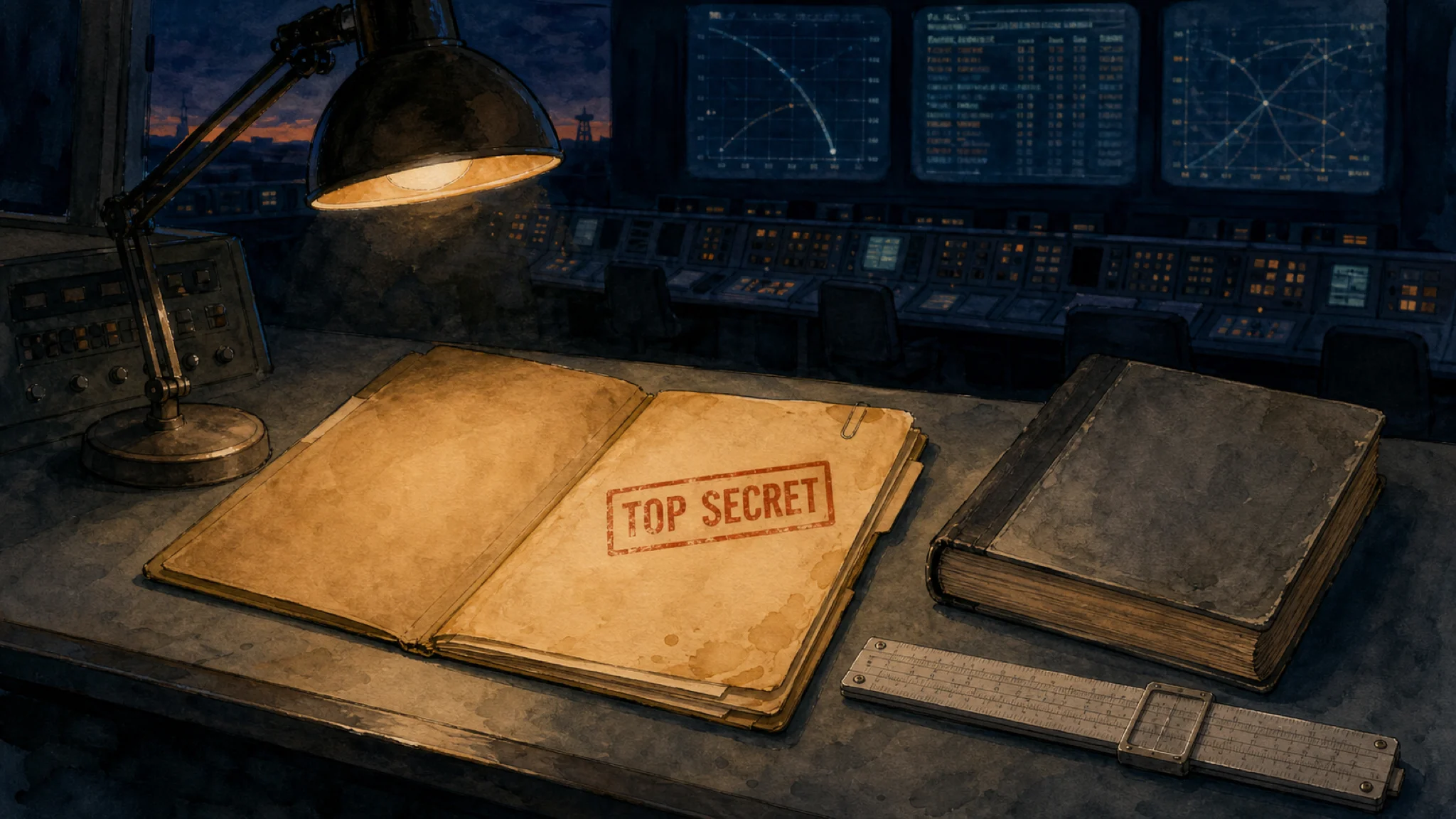
The follow-through is the episode’s coldest sequence. Weisner reads von Braun’s report and classifies it top secret on the spot. He warns Margo that revealing classified information carries twenty years in a federal penitentiary. She has already made a copy. She tells him a friend will mail it to The New York Times tomorrow unless she calls. He asks what she wants. She wants what she deserves: flight director. There are no openings on Red, White, or Blue. Make one.
This is the moment Margo becomes the Margo the rest of the show will be about. The mentor speech von Braun delivered earlier — “you are not a team player, you will never be seen as a team leader, merit alone is not how this works” — is supposed to be a closing argument against her. She uses it as instructions. The closing beat at the Mission Control desk where she hands a slide rule to Aleida Rosales, the janitor’s daughter doing algebra in her office, plants the seed of the protégé arc the franchise will keep harvesting for four more seasons. It is also a soft confession. Margo learned how to fight bureaucracy from a man whose name she still cannot say without flinching, and she is already passing the lesson on.
What this episode argues
The hour’s argument is that the alt-history premise has a cost ledger, and the season has finally stopped showing the credits side of it. The premiere sold the audience on Kennedy living, the ERA passing, women in flight suits, Houston’s mission floor desegregated by a decade. “Home Again” tallies the debits. The ERA passes because a valve contract was moved to buy a vote. The valve fails because that contract should have gone to a company that knew how to build it. Twelve ground crew die. Three astronauts are stranded. Gordo Stevens loses his nerve, Tracy loses her marriage to a radio, Ellen loses her partner to a federal agent’s surveillance van, and Margo loses the last sentimental version of her father to a Huntsville rocket engineer who happens to know more about her family than she does. The trade was always going to come due. The episode is just the bill arriving.
The second argument is about institutional cowardice. Weisner classifies the report without hesitation. He invokes a felony statute against the only woman in the building who actually read it. He frames the cover-up as protecting Teddy’s great achievement. Von Braun told Margo every bureaucracy is corrupt, and the test of that line is whether Margo refuses to participate or learns to leverage it. She picks the second. The show is not romantic about her choice. It films her blackmail the same way it films Donahue’s interview of Larry — flat, lit too brightly, the camera holding on the face that has just agreed to live inside a lie for the rest of its career. The astronauts on the moon are saying “Hi, Bob” to a syndicated rerun for the sixth time. The people back on Earth are the ones running out of oxygen.
Verdict
“Home Again” is the strongest hour the first season has produced, and the one that finally makes a case for the show as a serialized political drama rather than a hardware procedural with feelings. The Apollo 23 cold open is the kind of swing a streaming-era premiere usually gets, deployed instead in the middle of a debut season as a load-bearing pivot. The Margo–von Braun two-hander is the year’s best long scene, anchored by a performance that lets Schmidt play grief, contempt, and recognition inside the same line read. Ellen’s coming-into-focus scene with Pam is heartbreaking in the way that only this period’s gay storylines can be, where the closet is presented as a federal contractor. And Gordo’s last shot, panting outside Jamestown calling rocks “apartments,” is a quiet horror movie inside an otherwise enormous installment.
The episode loads in more than it can pay off in the four hours remaining, which is the only honest criticism to lodge against it. The FBI thread will need to land. The stranded-crew arc has to resolve without a rescue gimmick. Margo’s flight director promotion has to be earned on screen rather than implied by montage. And whatever has cracked inside Gordo will have to come back to the ground eventually. None of which dents what this hour is. The show pulled the floor out from under its own premise and stayed standing.
Rating: 9.2/10
More episodes from For All Mankind — The alt-history NASA race begins, episode by episode. Jump to any episode in the season:
Where to go next
Reviewed by Mira Vance · QuizFandom Editor & Lead Reviewer. Every rating is an honest per-watch assessment from the desk that also writes the quizzes — not a press release rehash.