For All Mankind S3E4 Review: A Solar Sail, A Soviet Meltdown, A Choice
Sojourner unfurls a Jolly Roger, Mars-94 cooks its own reactor, and the race to the Red Planet becomes a referendum on whether rescue is still a public good.
“Happy Valley” is the season’s first hour that asks the question the whole 1990s arc has been circling. If Mars can be won by a private company, can it also be lost by one? The episode runs three races in parallel — NASA’s solar sail trick, the Soviet nuclear-engine gamble, Helios’s billionaire-as-king bet — and then collapses all three into a single decision that does not get made by an astronaut. It gets made by a software patch. By the time the closing rescue tether is pulled taut between a Soviet ship in meltdown and Sojourner’s airlock, the show has reframed the entire season. The frontier is not the destination. The frontier is the chain of command.
A solar sail rewrites the math
The cold open belongs to Helios. Edi Gathegi’s Dev Ayesa is on Phoenix’s bridge in a captain’s cosplay he plainly enjoys, toasting his crew with a champagne speech about a lone ember in the night sky and a fire they all built together, and promising twenty thousand dollars apiece in prize money the day they win. Helios is on top. Phoenix’s nukes ran hot off lunar orbit, and the math says no NASA ship can catch them. Then Krys Marshall’s Danielle Poole, on Sojourner, calls Phoenix and tells the captain she would love to see his face. Mr. Halladay hoists the mainsail. NASA has been hiding a solar sail since launch. Operation Jolly Roger uses photon pressure for constant acceleration and rewrites the arrival board: NASA by eight days, Helios second, Soviets last. Dev’s response is immediate and revealing — dump mass, dump propellant, broken plane maneuvers, comet flybys, anything. Shantel VanSanten’s Karen Baldwin shuts him down with the only line in the room that lands: getting there in one piece is more important than getting there first. Dev tells her first is the only thing that matters, because first is what changes things. The line is set down here so the back half of the episode can detonate it.
The brilliance of the sail reveal is how casual NASA plays it. Ed gets the news from his own daughter Kelly over the deep-space radio show she has been DJ’ing to no one. Danielle’s “I learned from the best” is delivered like a joke and lands like a sentence. The race that defined the season’s first three hours is decided before the act break.
A pirate radio frequency becomes a back channel
Kelly’s “Good Morning Outer Space” is the episode’s tonal pivot, and it earns more than its screen time suggests. She broadcasts the weather across the inner solar system — Houston 18, Shackleton minus 157, Venus 482, Valles Marineris a balmy 21 — and gives out her private frequency for requests. The bit reads as charming filler until a Russian cosmonaut on Mars-94 punches through the static and tells her, in broken English, that his crew is about to do something very dangerous. He says he listens to her show. He says he thinks she can be trusted. Then he hangs up.
The show does not explain the call. It does not need to. By the time NASA’s telemetry catches Mars-94 firing up its nuclear engines at a 20 percent overburn — Roscosmos chasing the lead it lost the moment the sail unfurled — the audience already knows the Soviets pushed too hard on purpose. The cosmonaut tried to warn the only American who could not pull rank. Within an hour Mars-94’s engines are in meltdown, the radiation count starts ticking up, and Soviet command has admitted to Wrenn Schmidt’s Margo Madison that everyone on board will be dead in seventy-two hours unless someone diverts. The cosmonaut’s call is the episode’s only piece of human intelligence that travels faster than the politics. Everything else moves at a five-minute-twenty-nine-second light delay.
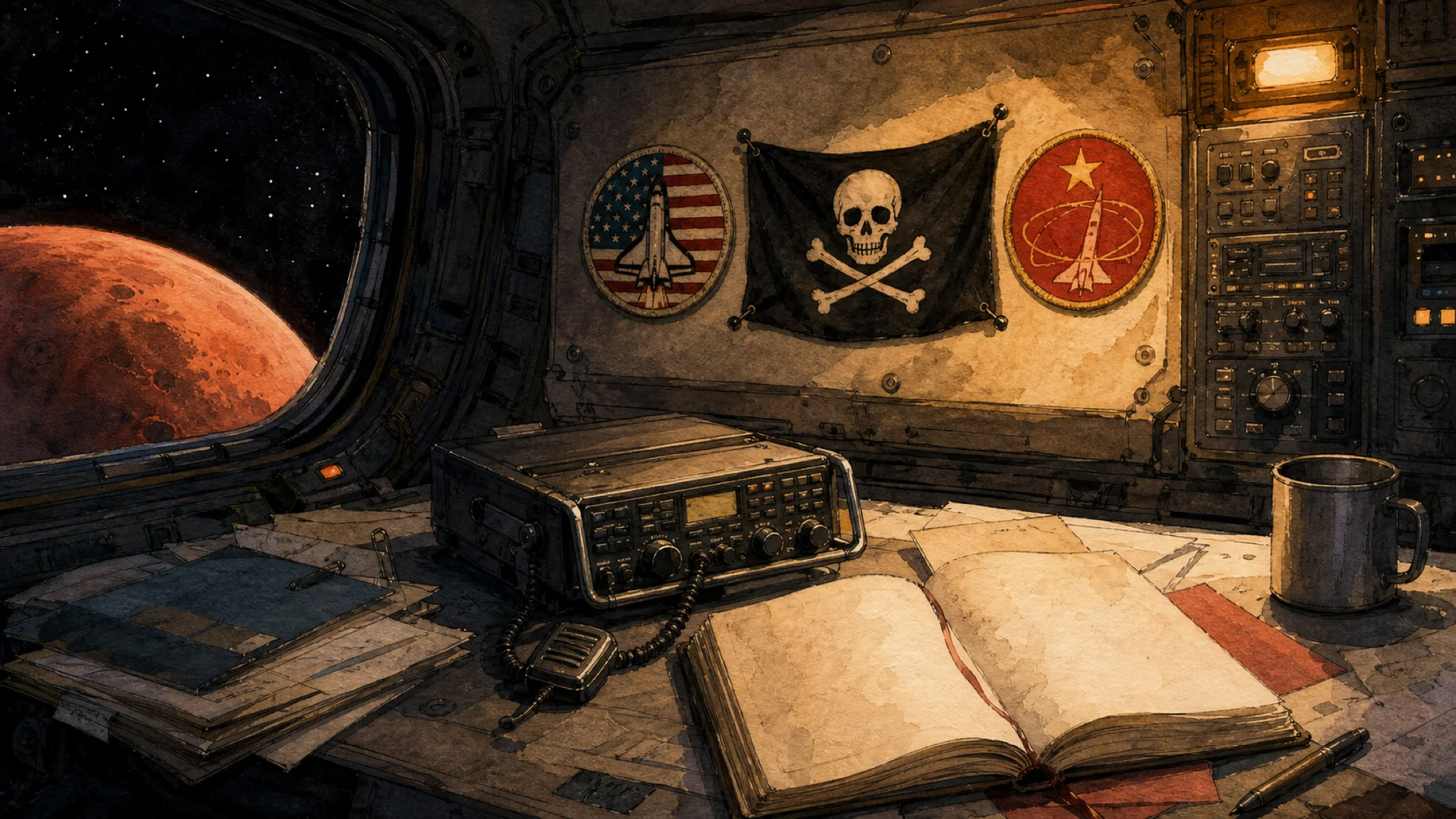
Helios writes a software patch, NASA finds its mission
The rescue conference is where the season’s politics ignite. Phoenix is closer, Phoenix has more space, Phoenix can pick up five cosmonauts and ferry them home on a one-way Earth return. Sojourner is the only ship still planning to land on Mars, and rescuing the Russians means giving up that landing — burning the propellant reserve, losing the parade, losing the Interstellar Exploration Prize. Ed Baldwin, calling from Phoenix, volunteers his ship anyway. He invokes the law of the sea. He even gets in a “Fun with Dick and Jane” jab at Danielle to prove he is still himself. Then Dev Ayesa pulls Helios out of the rescue.
The way he pulls them out is the episode’s coldest move. Dev does not argue. He calls a town hall. He gives a “show of hands” to a crew that has been promised twenty thousand dollars a head if they land first, then accepts the unsurprising vote as a democratic mandate. Joel Kinnaman’s Ed reads the room before the count and asks the question that matters: is that really why you are doing this? It was the group’s decision, Dev says. Ed gives the order to burn anyway. Phoenix’s engine controls will not arm. Manual override does not respond. Tank pressurization drops. The last software update Helios uploaded from Earth has locked Ed out of his own spacecraft. “Dev Ayesa just locked me out of my own spacecraft” is the line of the season so far, and it lands as both technical fact and political thesis. Private Mars is not a partnership. It is a EULA.
That throws the rescue back onto Sojourner. Danielle does not flinch. The “we earned the right to be the first on Mars and no one can take that away from us” speech she gives her crew is the kind of line another show would over-cook. Krys Marshall plays it as a captain doing the math out loud. The crew furls the sail. Clarke calculates an intercept burn. Jodi Balfour’s Ellen Wilson, watching from the Oval Office, gets the only thing this presidency has been hunting for all hour: a moral case with a uniform attached. Saves lives, leads by example, remember? That’s more important than winning a race. The line is for Margo. It is also for the Speaker who, that morning, asked her to defund the agency.
What this episode argues
Underneath all of it, a claim takes shape about who Mars belongs to, and the claim is sharper than this series’ usual middle-ground politics. NASA’s Apollo legacy gets dressed up as the law of the sea — you rescue the ship in distress, period — and Dev’s Helios gets dressed up as the new economy that has decided rescue is a cost center. The episode does not pretend the public-agency side is innocent. Ellen’s morning meeting with the Speaker lays out the cost: helium-3 fusion has hollowed out coal country and Appalachia, the “Save Our Jobs” protest outside JSC is real, Jimmy Stevens is being recruited by a Jamestown-truther conspiracy crank named Charles who survived 1983 and thinks the Polaris narrative was a cover-up. The administration’s victory lap at Mission Control is a photo op for a presidency that is one bipartisan budget knife-fight away from a government shutdown. The episode wants the audience to feel that NASA is the better actor here and also that NASA has earned its growing enemy list.
What the hour argues, then, is that institutional cost has institutional value. Sojourner gives up Mars and saves five lives because there is a NASA flight director on the ground willing to call the ambassador, a president willing to spend political capital, and a captain whose authority is not a function of stock options. Phoenix has none of those, and when the lives are on the line, Phoenix’s CEO simply patches the ship out of compliance. Coral Peña’s Aleida Rosales is barely in the hour, and she does not need to be — the FIDO trying to compute a 5-kilometer separation burn while the light delay eats five minutes off the clock is the show’s whole thesis about why ground control still matters. The cosmonaut on the radio chose Kelly because Kelly’s show was the only voice on his frequency that did not belong to a sovereign or a brand.
Verdict
“Happy Valley” is the tightest, most assured episode of the third season so far. The sail reveal is a genuine surprise that pays off three episodes of setup, the Soviet engine meltdown is staged with the same long-clock dread that made the Jamestown crisis work in season two, and the Dev Ayesa lockout is the kind of villain move that recasts every prior Dev scene without retroactively flattening him. The Jimmy Stevens conspiracy seed and the Sunny-and-Charles recruitment scene are small and could have felt grafted on, but the show is patient with them, the way it was patient with Karen’s Polaris arc. Kelly’s radio plot risked being a stunt and ended up being the episode’s single best structural choice — the only character on the show who is not on a mission becomes the only character with a clean information channel.
Not everything lands. Ed’s “Fun with Dick and Jane” routine with Danielle and the on-Phoenix horseplay with the Apollo 25 movie quotes both run a beat or two long, and Danny Stevens’s slow burn around the movie’s depiction of his parents is the kind of subplot that will either land in a later episode or be remembered as the season’s weak link. But the rescue sequence pays off cleanly. The Soviet engine four heat reading that ends the cold-handshake transfer, the bunk-shy “Welcome aboard, Dimitri” / “Dog of a defector” beat with Rolan Baranov, and the closing call to brace for collision are exactly the kind of half-hour suspense engine the show was built to run. The season has its argument now, and the argument is worth the ten hours ahead.
Rating: 8.7/10
More episodes from For All Mankind — Season 3 — The race to Mars opens a new frontier, episode by episode. Jump to any episode in the season:
Where to go next
Reviewed by Mira Vance · QuizFandom Editor & Lead Reviewer. Every rating is an honest per-watch assessment from the desk that also writes the quizzes — not a press release rehash.