For All Mankind S3E9 Review: A Penultimate Hour That Detonates Four Closets at Once
Ellen Wilson tells the world she is gay, Kelly Baldwin codes on a moon she was never supposed to give birth on, and a North Korean stowaway puts a rifle on the camera.
For all the show’s habit of running plots in parallel, “Coming Home” is the rare hour that braids four different acts of confession into the same forty-five minutes and lets each one cost something. Ellen Wilson (Jodi Balfour) walks to a podium with the speech her staff drafted and reads a different one. Aleida Rosales (Coral Peña) sits across from an FBI agent and discovers what it costs to know what Margo Madison (Wrenn Schmidt) has done. Kelly Baldwin (Cynthy Wu) collapses in the Happy Valley jungle module with a pregnancy emergency Mars was never built for. And a Korean cosmonaut steps out of a sample-return probe with a weapon. With one episode left in the season, Ronald D. Moore’s writers have queued the conditions for everything to land at once.
Ellen reads the wrong speech and the right one
The Oval Office scene with Speaker Dick Hutchinson is the cleanest political setpiece the season has staged. Hutchinson walks in with a NASA bill that would give Congress redline authority over the agency, threatens to defund the Mars program, and frames it as a favor to Wilson’s reelection. Ellen tells him to pass it; she will veto. Then Hutchinson closes the door, brings up Larry Wilson (Nate Corddry)’s perjured testimony about a White House affair, and walks her into the room she has been avoiding for two seasons. The president’s husband lied under oath about sleeping with Jeremy Zielke, the recording system in the Oval Office captured the lie, and Hutchinson will subpoena the tapes.
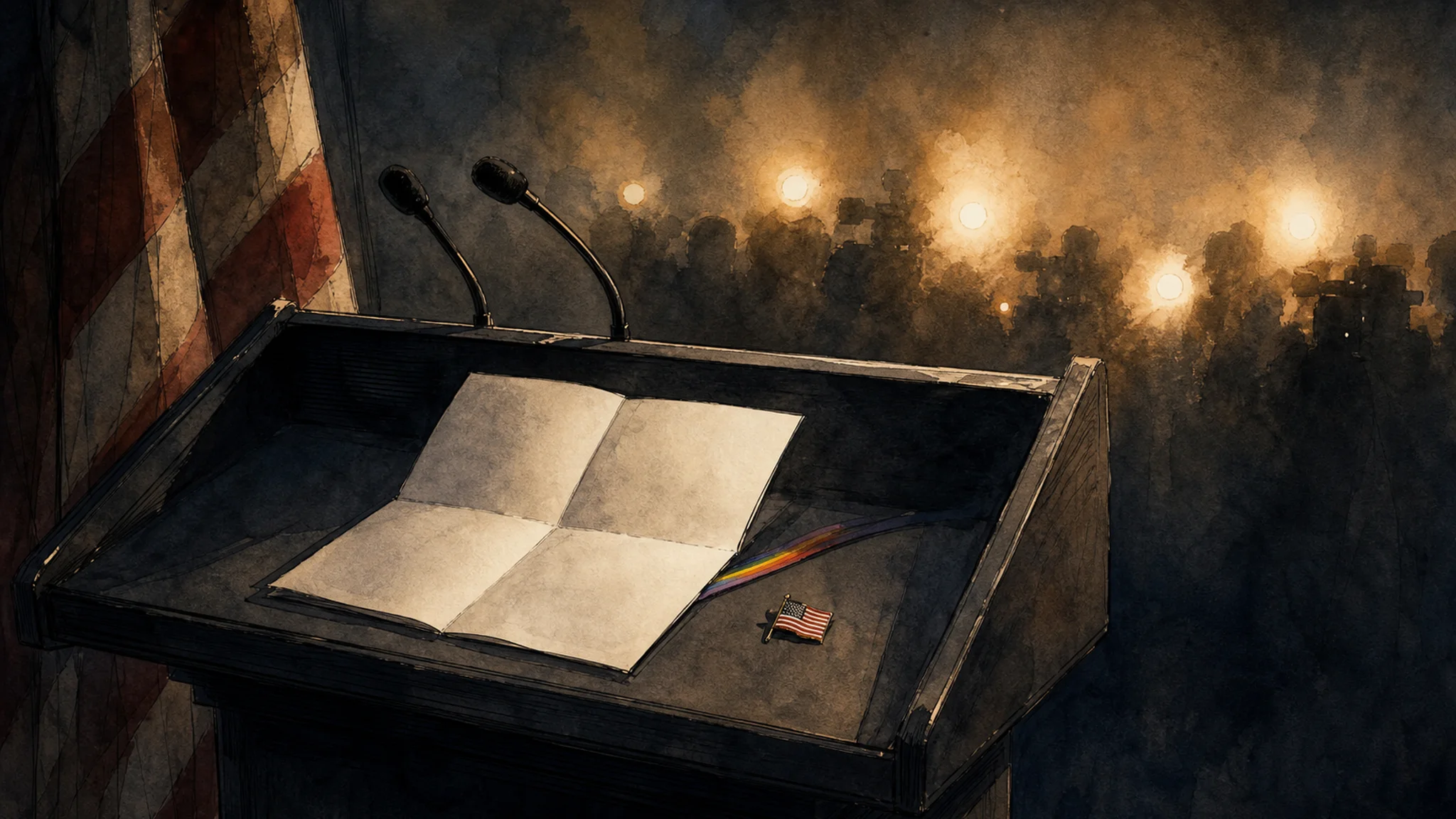
What makes the scene more than a procedural beat is how the writers stage the choice. Larry, sitting in a kitchen in the family residence, offers to throw himself under the bus — he will hold a press conference, say he is gay, take the perjury hit, and frame Ellen as a wronged wife. The two of them keep finding reasons it is the only move and then refusing to make it. Ellen plays the next morning behind a podium with a redrafted speech in front of her and an unredrafted one in her head, and the show lets her stall through three opening lines before she switches binders. “I’m gay, and I have been since the day I was born” is delivered without theatre, which is exactly what gives it weight. The episode then cuts immediately to Will Tyler on Mars hearing the news and Ed Baldwin (Joel Kinnaman) saying he is honored to be Will’s friend, and the staging suggests the political and the personal are running on the same circuit. The speech ends with an executive order opening the military to gay service members and a Medal of Freedom for Will. The catharsis is not free — Larry’s marriage and Ellen’s second term are both visibly on the line — but it is earned by letting Ellen reach it through a closet she was using to leverage a NASA bill.
Aleida puts the proof together and then watches Bill hand it to the FBI
Aleida Rosales’s garage is the season’s other quiet confession. She lays out the impeller blade pass frequency of the Soviet hydrogen turbopump — 2165 hertz, identical to the early NASA design — and walks Bill Strausser (Noah Harpster) through a process of elimination that ends at Margo. Peña plays the realization the way you would expect from someone who already knows the answer and is still hoping the math will refuse to close. Bill’s response is the episode’s first surgical line: “You are not crazy.” The lair-of-a-Batman-villain joke softens the moment for thirty seconds before Bill goes home and calls the FBI without telling her.
The cafe scene that follows is a betrayal the season refuses to soften. The agent across the table is the same FBI that ruined Aleida’s father; Bill knows that and called anyway. Aleida lets the rage land as a single sentence — “You’re fucking dead to me” — and Bill gets no comeback. The episode then drives a stake through the moment by cutting to Aleida at home, her father in dementia, calling her by her dead mother’s name. The two scenes are rhymed deliberately: a confession about a friend who turned out to be a spy, and a confession from a parent who can no longer tell which daughter is in the room with him. The FBI file is open. There is no version of S3E10 in which Margo is still NASA Director when the credits roll, and Bridget Cardenas is already in the building Margo built.
Helios fires Dev, and Karen accepts the seat she did not want
The boardroom plot has been the season’s slowest burn, and the episode finally lights the rest of it. Dev Ayesa (Edi Gathegi) walks into a board meeting with Jamestown analogies and a Calypso ship he wants to begin building. The board has the liability report from the drilling accident — operator error, pinned on Nick Corrado — and a stock price in free fall. They pivot Helios back to helium-3 mining on the moon and decide, off-camera, to remove Dev as CEO. Karen Baldwin (Shantel VanSanten) is the one they ask to replace him. The man who recruited Karen onto the Mars mission because she could tell him no is removed because she did exactly that.
The Karen scenes are the part of the storyline that lifts. VanSanten plays the meeting with the board member who proposes selling Phoenix to NASA as a woman who already knows she is being maneuvered and is trying to figure out whether the maneuver also happens to be correct. The MIT story about Dev cracking fusion — “I knew I was in the presence of greatness” — is the most generous reading of Dev the script has allowed in a season that has otherwise played him as a man being swallowed by his own myth. The hour does not resolve whether Karen takes the job. It only stages the offer at the moment Dev has lost the room, and lets her sit with the math.
Kelly’s preeclampsia drops a clock onto the cliffhanger
The Happy Valley plot has been operating as comic relief for most of the hour — pregnancy jokes, baby-name bickering, Dimitri Mayakovsky’s Soviet-suit fix for Kelly’s hard-shell problem — and the writers use that warmth as anaesthetic for the cut. Will reads news of Wilson’s speech in the jungle module, looks for Kelly to share it, and finds her on the floor. The flight surgeon names it preeclampsia. The single rendezvous radar that could get Kelly up to Phoenix is broken. The Kurs-NA antenna that could replace it is on a North Korean probe 89 kilometers out, and Ed and Danielle Poole (Krys Marshall) are in a rover heading toward it.
This is where the episode’s structural cleverness shows. The Kurs subplot — Lev Mayakovsky’s “you should just use Soviet suit” gag, the briefing about Russia selling Kurs units to India, Turkey and North Korea, Catiche’s table-clearing remark that they have five units on the Martian surface — all of it has been written as engineer-room procedural and ends as a rescue clock. The closer is the rover team finding the Korean probe with a rifle attached to it. “Don’t shoot. Don’t shoot.” A cosmonaut climbs out of a vehicle that, on paper, did not have one. The penultimate hour has weaponized Mars’s biggest design constraint — the launch window — and overlaid it with two life-or-death timers. Kelly will not make Phoenix without that antenna. The antenna is now hostile property.
What this episode argues
For All Mankind has always argued that the alt-history is not really alternate — every new frontier brings the same closets, the same betrayals, the same exiles. “Coming Home” makes that thesis explicit. Ellen’s gay confession, Aleida’s discovery about Margo, Larry’s perjury, and a North Korean cosmonaut who has been hiding on Mars for years are all the same plot beat in different rooms: the moment somebody who has been keeping a secret stops keeping it. The show lets the political triumph (Wilson’s executive order, Will’s medal) sit beside the betrayals (Bill calling the FBI, the board firing Dev, the perjury that survives the press conference) without flattening either. Mars is where everyone goes to escape who they were on Earth, and the season is closing on the recognition that the closets stowed away in cargo.
The argument extends to the cliffhanger. The Korean probe and its stowaway were not a setup the show telegraphed; they were a payoff to the season’s quietest premise — that no nation actually let go of the Mars race when the headline race ended. Kelly’s preeclampsia and the Soviet-derived antenna she now needs to survive close the loop. Even the rescue depends on borrowing tech the show spent a season’s worth of espionage plotline being unable to get.
Verdict
This is the rare penultimate hour that does the heavy lifting the finale will get credit for. Jodi Balfour’s Ellen anchors the political plot with a podium scene the show has been telegraphing since season two and finally pays off without flinching. Coral Peña’s Aleida does her best work of the season in two rooms that are mostly her face — the garage diagnosis, the cafe ambush. The Helios board firing Dev gives Edi Gathegi’s Dev his strongest scene since the Jamestown speech, and Shantel VanSanten’s Karen finally gets to play with leverage instead of grief. The Kelly emergency is the only plot beat that arrives slightly under-prepared — the show has been so busy with the comic register of the Mars baby that the pivot to medical crisis lands a half-step ahead of its setup — but the rescue clock it imposes on S3E10 is the right kind of cruel.
The one structural cost is that with this much detonating in a single hour, the finale now has to land four arcs and a hostile-cosmonaut standoff in roughly the same runtime. Moore’s writers have earned the benefit of the doubt on that math. Whether the finale gets there cleanly will depend on whether the show is willing to let any of these confessions go uncashed. On the evidence of “Coming Home,” it will not.
Rating: 8.8/10
More episodes from For All Mankind — Season 3 — The race to Mars opens a new frontier, episode by episode. Jump to any episode in the season:
Where to go next
Reviewed by Mira Vance · QuizFandom Editor & Lead Reviewer. Every rating is an honest per-watch assessment from the desk that also writes the quizzes — not a press release rehash.