For All Mankind S3E8 Review: A Landslide Buries Everyone's Reasons for Being Here
A ridge collapse on Mars pries open every conversation the colony has been postponing, and none of the survivors get the absolution they were reaching for.
For All Mankind has always staged disaster as a confessional. The Apollo fires, the Jamestown siege, the Sojourner mishaps — each one strips a character down to the sentence they have been avoiding for an entire season. “The Sands of Ares” runs that pattern at colony scale. A landslide at the Helios drill site buries hab 1 under twenty meters of debris, kills three astronauts on the surface, and traps Joel Kinnaman’s Ed Baldwin and Casey W. Johnson’s Danny Stevens in an air lock with six hours of air and a wound that needs surgery they cannot perform. By the time the rescue charge fires, four marriages, two careers, and one secret pregnancy have all been pried open with the same shovel.
The ridge falls and Helios Base disappears with it
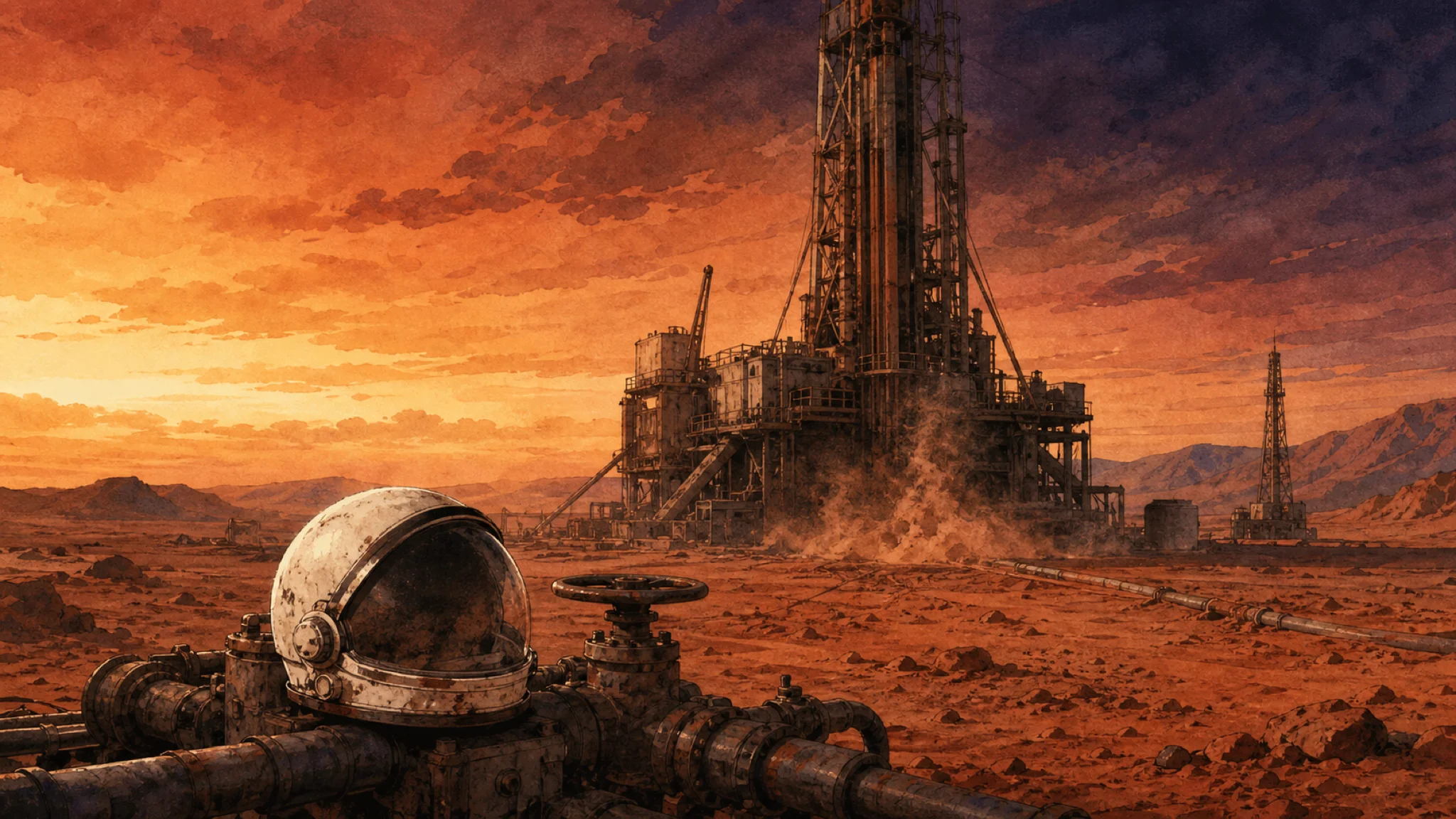
The episode opens with the kind of cold cup of coffee the show specializes in. Rolan offers stolen French vanilla packets. The seismograph spikes. Within ninety seconds, an isosceles wave reading and a glance at the epicenter tell Helios that the avalanche the drilling has been threatening for three episodes has finally arrived. Phoenix is eight minutes from acquisition of signal. Krys Marshall’s Danielle Poole prepares two rovers, fills the tanks, and tells Kelly and Alexei to shelve their interpersonal crap. The orbital pass arrives and confirms the worst case. The MSAM, the habs, the fuel factory — all gone. Lava tubes have caved in. The granular debris flow has moved like a mudslide and left no surface signature. Hab 2 is barely standing. Hab 1 is somewhere under twenty meters of regolith and is still beaconing.
The show has trained the audience to brace for this since the drilling on the ridge was first staged as a Helios shortcut, and the payoff is restrained. There is no Roland Emmerich crash sequence. The catastrophe arrives through a single seismograph, a static-filled radio call, and the dust-blown wide of two suited survivors stumbling forward with a Mayday. Alexei Poletov walks half a kilometer in low gravity, finds Louisa Mueller, and then finds Nick Corrado’s body next to Isabel Castillo’s. The math does the rest. The world holds its breath, Christine Francis tells the cable audience back home, and the pivot to a Stelebris Plus erectile-dysfunction ad in the middle of a search-and-rescue broadcast is the season’s sharpest single shot of how Earth has decided to metabolize Mars.
Ed and Danny finally have the conversation neither one wanted
The hab 1 air lock is the episode’s furnace. Ed has been hit by drill shrapnel, no exit wound, abdomen punctured. Danny patches him with QuikClot, then declines to put on his suit because he would rather freeze than ride out a horrible death. The CO2 climbs over twenty. The temperature drops to negative seventy-three on the surface. Ed accuses Danny of withdrawal from the anabolics he has been shooting into his ass for five years. Danny accuses Ed of being the kind of man who terrorized his own son. The argument should feel like script bait. It does not, because the show has been priming both of these men’s deflections for two seasons.
Ed’s MASH-unit anecdote — the people who lost hope died first — is exactly the kind of foundational Baldwin myth the show has been chipping at all year. Danny’s response, that some of them lost hope because they were going to die anyway, is the first time anyone has directly contradicted Ed Baldwin’s worldview. The fight that follows reopens Ed’s wound and pries out a confession. Danny tells Ed the truth about Shane: that Shane was the one who tried to please everyone, that Ed terrified him, that the bike-riding lessons Ed remembers as bonding were torture. Then, when Ed is half-conscious and the QuikClot has set, Danny tells him the rest. The trouble Shane got into was Danny’s idea. Danny taught him how to shoplift. Danny is the reason Karen grounded Shane the day a car killed him.
This is the line the show has been walking around since the Outpost flashbacks. The confession is staged with no music, no reaction shot wide enough to soften it, and one more reveal queued behind it — the Karen affair, the “something else I need to tell you” — that the rescue charge interrupts. The detonation is the only thing that has ever stopped Danny Stevens from talking, and the show times it for maximum cruelty. Whatever absolution Ed was about to receive or refuse, the air lock takes it back.
Kelly’s search becomes Alexei’s deathbed and the colony’s next problem
The B-plot looks like procedural relief and turns into the episode’s quietest tragedy. Cynthy Wu’s Kelly Baldwin rides out with Alexei in rover 1, runs a ground-penetrating-radar grid against the hab 1 beacon, and the show lets the search be boring for as long as it can stand to. They find the beacon. They radio coordinates. Twenty meters of debris flow. The lava-tube geometry that Edi Gathegi’s Dev Ayesa will need in the next scene is established here in two sentences and a map overlay.
The grief talk between Kelly and Alexei is the part the show is really after. Kelly tells Alexei she has spent her whole life lying in bed at night rehearsing the moment her father might die, and that the worst part of the present is realizing she was right to be afraid. Alexei tells her about his own father, the Soviet air-force pilot who named him after Leonov and his sister after Anastasia. His headache is the warning. He cannot lose it. The aspirin is the warning. The slurring at the hab 2 ramp is the diagnosis. Dimitri Mayakovsky reaches for the drill and the A-positive transfusion. Kelly is the donor. The procedure plays out with surgical-instrument close-ups and one held wide of Kelly’s hand on Alexei’s, and it does not work.
The closing two-hander between Mayakovsky and an off-screen Russian colleague is the bomb the season has been building toward. The Baldwin girl is pregnant. Moscow must be told before her commander. The whole crew is at risk if the wrong person hears it first. The audience has just watched Kelly donate her own blood to the man whose child she is carrying, and the only people who know are about to use it as a piece on a board she cannot see. It is a brutal kind of dramatic irony, played with the room temperature of a chess move.
The collapse on Mars unmakes the lives on Earth
“The Sands of Ares” plays the Helios disaster as a public catastrophe and a private clearance sale. Pam Horton confronts Jodi Balfour’s Ellen Wilson with the only honest accusation the season has aimed at the closeted Republican presidency: that the woman Pam met at the Outpost twenty years ago, the one with the fire, has spent her first term making compromise after compromise. Ellen’s answer — that she is not as powerful as Pam imagines — is the show’s quietest verdict on the limit of what high office can do. Larry catches her returning to the residence and frames the affair as a discretion problem. The episode declines to call Larry wrong. It declines to call him sympathetic, either.
Dev’s Mission Control monologue does the same work for the founder generation. The mythologized immigrant rise — no money, achieved his dreams — gets half a sentence. The Saturn V job in Rockford, Illinois, ended at Apollo 23, the explosion on the pad. His father drove a taxi for a few years and died before Dev graduated college. Wrenn Schmidt’s Margo Madison hears it the way Margo hears most things, by saying very little and meaning a great deal. The exchange that follows — your father would be proud of you; was yours? — is the conversation the show has been earning since Korzhenko’s defection plot started. The “we go up” lava-tube plan that comes next is the only redemption Dev gets, and the show is honest about how thin it is. He almost lost the room before he won it.
Verdict
This is one of the strongest hours For All Mankind has produced and it works because the rescue is staged as the easiest thing in the episode. Will Tyler and Rolan Baranov rappel into the lava tube, walk seven hundred meters in suits, drill the roof, pack the charges, and run. That is the plot. The harder labor sits everywhere else: Karen showing up at Amber and Jimmy’s house instead of phoning, Shantel VanSanten playing the steadiest grief on the show; Ellen sneaking out of the White House to face the one person who can still tell her the truth; Mayakovsky lifting an A-positive needle into a daughter to save a father she does not yet know is the father of her child; Dev finally telling Margo about Apollo 23. The disaster does the carrying. The confessions are the freight.
“The Sands of Ares” is not unblemished. The Pam-Ellen reunion does what it needs to and stops one beat short of where it should land — the cell-phone buzz that pulls Ellen out is a mechanical interruption rather than a written one, and Pam’s exit line (“it’s good to hear you say that anyway”) is one of the few sentences in the hour that sounds like a script note. Danny’s bike-riding monologue is also calibrated to within a hair of melodrama, and the show’s decision to cut to the explosion before he finishes confessing the affair is either masterful pacing or a cheap stall depending on which way the next two episodes land it. The bet, either way, is on payoff. The series has been a reliable closer.
What lands cleanly is the show’s continued refusal to treat survival as victory. Three astronauts are dead. Alexei is dead with a child on the way he will never meet. Kelly does not yet know what she carries. Ed has lived through a wound and a confession that has rewritten his understanding of his own son. Danny is alive and has handed Ed a debt nobody can collect. Ellen is back at the residence and Larry is right and that does not help her. Helios Base is gone. The colony is one MSAM short of stranded. Dev has saved two lives by inventing the most dangerous rescue in space-program history, and Margo now knows the cost of his composure. None of it is staged as triumph. All of it is staged as bill.
Rating: 9.1/10
More episodes from For All Mankind — Season 3 — The race to Mars opens a new frontier, episode by episode. Jump to any episode in the season:
Where to go next
Reviewed by Mira Vance · QuizFandom Editor & Lead Reviewer. Every rating is an honest per-watch assessment from the desk that also writes the quizzes — not a press release rehash.