Monarch: Legacy of Monsters S1E1 Review: Aftermath Opens the MonsterVerse's Human Wing
A 1950s Geiger-counter expedition and a post-G-Day Tokyo apartment share a hard drive, a dead father, and a chamber under the Kazakh steppe.
The MonsterVerse has spent a decade asking what it would feel like to live in a world where Godzilla is a meteorological event. Legendary’s films answered with skyscrapers cracking and aircraft carriers turned to driftwood. Apple’s series picks up the question from ground level and refuses to let it go. The opening seconds put a soldier in a Kazakh forest writing a letter to a son he is about to leave behind, then drop a creature on him before the page can dry. Forty-five minutes later, the camera is in a Tokyo cab listening to a driver explain that San Francisco was a CGI hoax and there is a podcast about it. The premiere makes the case that the MonsterVerse has always needed the second scene more than the first, and “Aftermath” builds that case with the patience of a show that knows it has ten hours.
Two timelines, one inheritance
Chris Black and Matt Fraction’s pilot interleaves a 2015 strand set roughly a year after the Battle of San Francisco with a 1950s strand following three Monarch founders on a Soviet-occupied stretch of central Asia. Both halves share a shape. People walk into terrain that should kill them, looking for confirmation that the thing they have been studying is real, and the terrain answers in kind.
In Tokyo, Anna Sawai’s Cate Randa lands at Haneda for what she has been told is a probate trip. Her father Hiroshi died in a bush-plane crash over Alaska. She has the keys to an apartment she did not know existed, the lease for it in his name, and a sense that the trip is a formality. The apartment is occupied. Ren Watabe’s Kentaro is in the kitchen with his mother when Cate lets herself in, and within a single scene the show has stripped Hiroshi of his alibi, his geography, and his fidelity. The reveal is staged without melodrama. Two adult half-siblings stand in the same room holding pictures of the same man and arrive at the same arithmetic before either of them has put down a bag.
In 1959, Wyatt Russell’s young Lee Shaw is the army minder for two scientists chasing an impossible radiation reading deep in the Kazakh steppe. Mari Yamamoto’s Keiko Miura and Anders Holm’s Billy Randa have what Shaw calls a theory and what the brass back home would call insane fantasy. The Geiger counter climbs into the thousands of millirems on the drive in and then drops to nothing at ground zero. A Russian boy with a basket of irradiated mushrooms tells them what the old folks say: the government burned a hole through the earth, all the way to hell. The premiere lets that be the working hypothesis. Whatever should be eating the soldiers is eating the radiation instead, and the three of them set linked charges in a diamond grid to map the void below.
Both strands close on confirmation. The 1959 charges resolve into sonar readings of insectoid larvae nested in a bedrock chamber. The 2015 hard drive Cate and Kentaro pry out of Hiroshi’s safe surrenders an encrypted partition full of satellite maps, a Monarch logo, and a photo of Kentaro’s grandmother standing inside what is unmistakably a chamber of the same shape. The episode does not need to explain that yet. It only needs to put the two images on the same wall.
Tokyo after Godzilla, one year on
The post-G-Day Japan the premiere builds is the strongest world-building in any MonsterVerse property to date. Haneda has decontamination misters at the gate and a flight attendant who calls it the illusion of safety while a passenger calls it spraying for parasites. The cab driver from arrivals through downtown narrates the new economy unprompted: missiles, drones, monster prep, big business now. He has a podcast about how San Francisco was faked. Cate listens with the practiced patience of someone who lived through the thing the driver is denying, and the show does not stage her contempt as drama. It stages it as exhaustion. Conspiracy is what happens to a population a year after a building falls on them, and the show knows it.
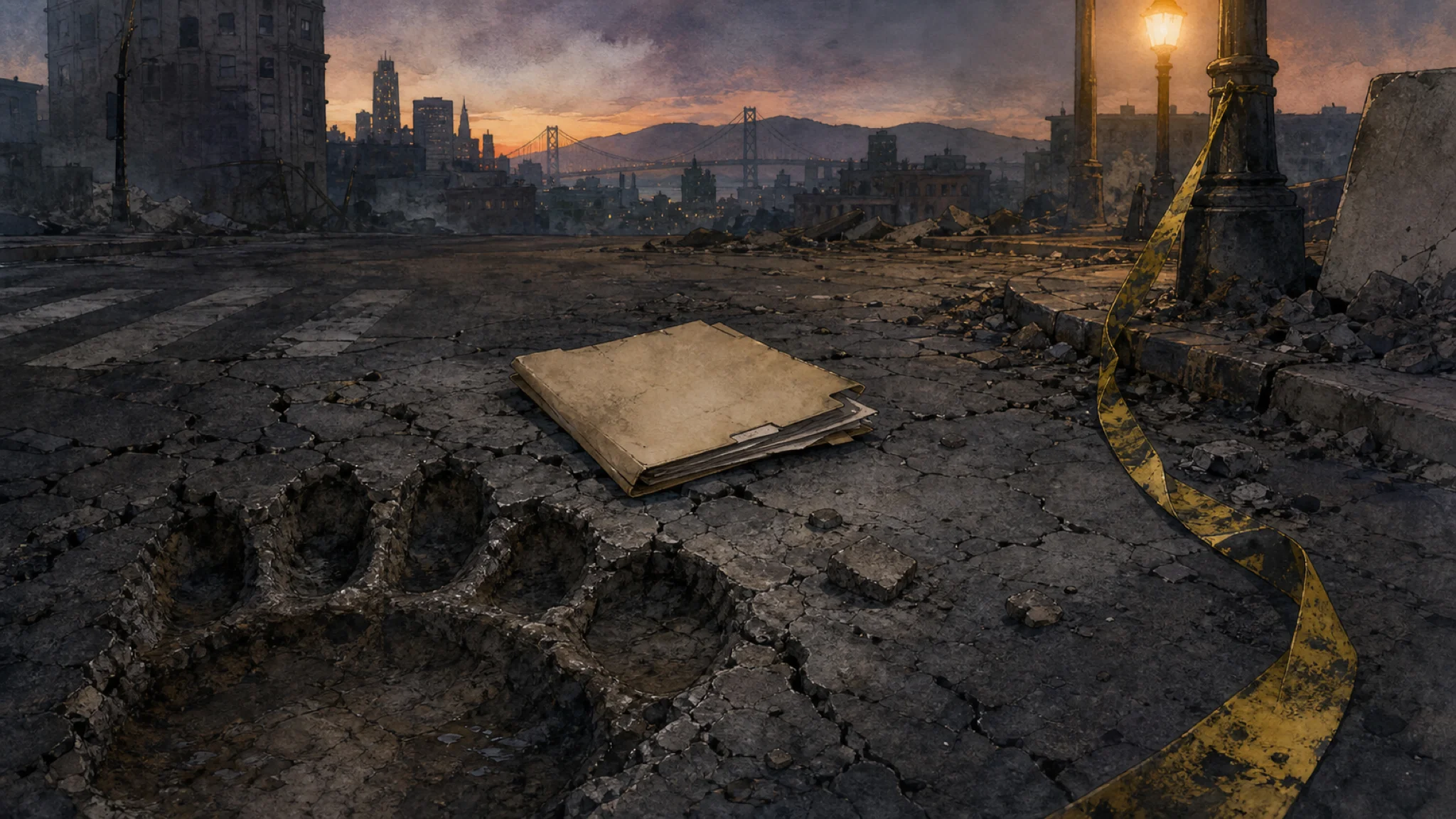
The civil-defense drill that triggers mid-episode is the showpiece. Cell phones screech. Schoolchildren take cover. A roar offstage shatters glass. Cate’s PTSD kicks in before the all-clear sounds, and we stay on her face long enough that the cut to a flashback feels less like a flashback than a hijack. The San Francisco scenes are gray, screaming, and brief. The episode never shows Godzilla intact. It shows a child she could not save and a leg pinned under a car and a column of uniformed personnel with the Monarch logo on their sleeves photographing the wreckage like a field trip. That single shot lays out the entire premise. Whatever organization her father worked for has been hovering over disasters with cameras and clipboards, and a year later Cate is the one with the keys to the file cabinet.
The half-sibling tension scales properly off that backdrop. Kentaro is bitter in the way of a son who got the absent half of a busy man and assumed it was the whole of him. Cate is the daughter who got the present half and now has to revise. She fans out a half-life of photographs on the kitchen counter, and the writing in that scene is sharper than anything the MonsterVerse has previously asked of itself. Camping at the Redwoods. A backyard playhouse built when she was five. A sunset cruise for the thirtieth anniversary. The mother in the kitchen, who has waited longer than Cate has, watches and does not break. The premiere refuses to adjudicate which family Hiroshi loved more. It lets both halves of the room stipulate they were each the other woman and move on.
Kiersey Clemons, Wyatt Russell, and the show’s bench
Kiersey Clemons enters as May, the Tokyo coder who used to be something to Kentaro and is currently nothing to him until he turns up with a 1970s data format and a request. The premiere wastes no time letting her be the smartest person in the apartment. She clocks the encryption as forty-year-old military grade and runs it through commodity software in the time it takes Cate and Kentaro to argue about who their father loved. Her hardest scene is the one where she lets Kentaro know, in a single line, that she is not going to be treated like tech support and that ghosting her for months does not buy a favor. The trio is not going to coalesce around the lone-genius dynamic that powers most MonsterVerse spinoffs. May is going to want a co-author credit.
Wyatt Russell’s Shaw, meanwhile, is the premiere’s funniest performance and its sneakiest. The 1959 banter between Shaw, Billy, and Keiko reads as romantic-comedy on the surface and as a quiet love triangle if you look at the cuts. Billy’s flirt about a previously entertaining idea, Keiko’s “we are scientists, we only want to help” in calm Russian to a teenager with a hunting rifle, and Shaw’s army-minder shrugs at every safety violation all land cleaner than the dialogue has any right to. The premiere does not yet tell us how the triangle resolves. It does tell us that Keiko is the one who goes over the railing on a rope, that she is the one screaming “I can’t hold on,” and that her last word on screen is a name. The crosscut to a present-day Kurt Russell has already been promised by the casting. The premiere earns the wait by making the woman they are about to lose into the most magnetic person in the 1959 strand.
The supporting bench is built to a similar standard. Joe Tippett’s Tim, the Monarch data-culling supervisor who quietly suppresses the IP trace on Cate’s decryption attempt and asks his subordinate how her Japanese is, runs the show’s procedural plumbing. He will be the reason Verdugo, whoever Verdugo is, does not learn what Cate has found until the plot requires it. The premiere drops his scene in late and lets the viewer flag it without underlining. That restraint is what separates this pilot from the Legendary films it shares a universe with.
What this episode is reaching for
“Aftermath” is the first MonsterVerse property to treat the kaiju as the climate and the humans as the show. The Geiger-counter expedition in 1959 and the Tokyo half-sibling argument in 2015 are not two plots running in parallel. They are one plot, sixty years apart, about the cost of looking at something that does not want to be seen. The franchise’s missing register has always been domestic. A father with two families and a hard drive full of satellite maps is not a smaller subject than a giant lizard. He is the human-scale version of the same secret, and a generation later his children are pulling the same data the founders almost died for out of a safe under his desk. The show is staking out a territory the films were structurally unable to touch, and it is staking it out at the pace of prestige drama rather than tentpole spectacle.
The other through-line is institutional memory. Monarch the organization has spent seventy years collecting evidence, mislabeling it, and burying it in cabinets that an unsentimental coder with off-the-shelf decryption can crack in an afternoon. The premiere stages that as the central tension. Tim is suppressing the alert. Cate and Kentaro are racing to read what Tim is suppressing. Keiko, sixty years dead by 2015, is the woman in the photograph who already knew. The show cares about the relay between the people who went down on the rope and the people who inherit the rope without being told what is on the other end. The keys Hiroshi left behind are the literal version. The season is going to make them the metaphor.
Verdict
“Aftermath” is a stronger MonsterVerse pilot than Legendary has put on screen before, and the gap is not small. The 1959 strand has the texture of a John Le Carré expedition; the 2015 strand has the texture of an Apple prestige family drama; the crosscuts between them are precise. Cate (Anna Sawai) carries the PTSD register without spilling it into the dialogue, Kentaro (Ren Watabe) sells half-sibling resentment in two languages without subtitling either one, and Major Shaw (Wyatt Russell) makes a smart-aleck army captain in a hazmat suit charismatic enough to make the cliffhanger sting. May gets the sharpest hand-off in the cast and a clean laugh line. The kaiju appear in three brief bursts and the show is better for the restraint.
A pilot this disciplined will live or die on whether the dual-timeline structure pays off, and how soon the present-day Shaw enters the room to bridge it. The premiere bets that the audience will follow the keys, the photographs, and the encrypted partition for as long as the writers can keep them in motion. The bet looks good. The MonsterVerse has finally produced an installment in which the most interesting thing on screen is a conversation between two adults about the man who lied to them both.
Rating: 8.6/10
More episodes from Monarch: Legacy of Monsters — The MonsterVerse goes prestige — Godzilla and Kong meet the Randa family, episode by episode. Jump to any episode in the season:
Where to go next
Reviewed by Mira Vance · QuizFandom Editor & Lead Reviewer. Every rating is an honest per-watch assessment from the desk that also writes the quizzes — not a press release rehash.