Monarch: Legacy of Monsters S1E08 Review: Kazakhstan, the Portal, and the Bigger-on-the-Inside Theory
The penultimate hour finally lets Billy and Keiko name what they've been seeing for two decades while the present-day team walks straight into a reactor full of empty shells.
For a season that has spent eight hours rotating two timelines around the same map, the penultimate episode is the one that lets the map start talking back. Monarch has been a chase story dressed in a family-secrets coat, and it has been patient. The Randa siblings have wandered from Tokyo to Alaska to the Algerian desert without quite earning the right to call any of it theirs. The Apex team has trailed a man who keeps detonating things and then vanishing. The 1950s flashbacks have built a Monarch that nobody in 2015 quite remembers. This episode locks all of that into one shape. The Cold War half writes the case for Monarch’s existence in three days, and the modern half walks into the place where the case ran out, which is a reactor in Kazakhstan that is no longer behaving like a reactor.
A budget hearing turns into a Monarch origin story
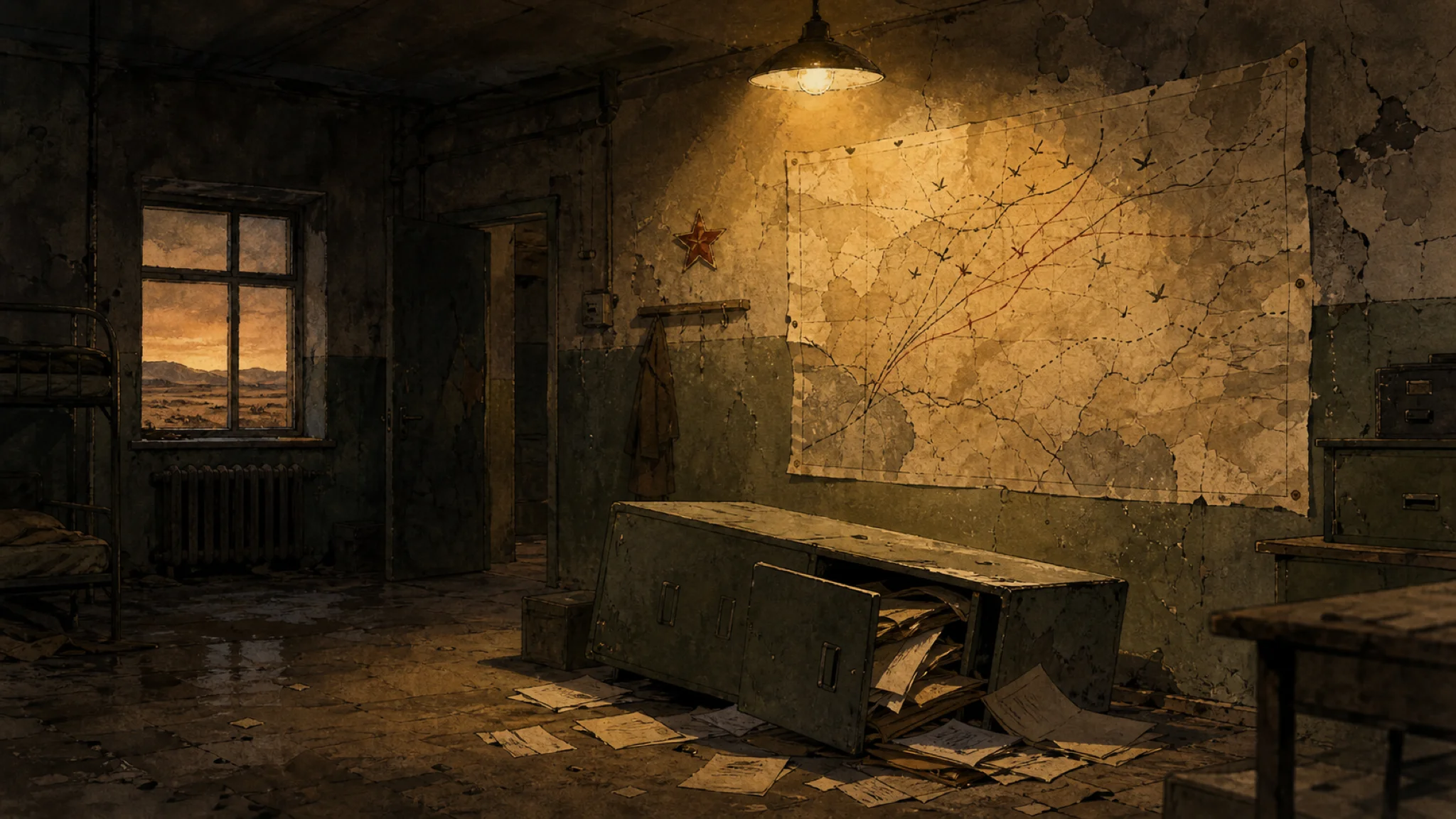
The flashback opens with a man named Hatch running a hostile audit of the operation Billy and Keiko have built, and the show lets him stay in the room long enough to be useful. Hatch calls the Titan files blurry photos, campfire stories, and unreliable witnesses, and tells General Puckett that the country’s real threat is hostile foreign agents, not animals nobody can produce on demand. He pulls Keiko’s background and uses the word juicy in front of a roomful of officers. Billy puts his fist through the man’s jaw before he finishes the sentence, which is the cleanest piece of physical writing the show has staged all season. Lee Shaw watches from the side of the room, then walks Billy and Keiko down to a basement office with a single hanging bulb and three days to save the project.
What follows is the closest the season has come to a procedural, and it is the best stretch of writing in the episode. Shaw tells them to draw a map. Keiko, two scenes in, has reorganized the field notes by tier of evidence and is striking the Siberian sightings because two witnesses were drunk and one was blind. Billy protests; she threatens his other hand; he relents. The scoring system is color coded. Confirmed sightings at Bikini and Hateruma. The Lawton dragon off Hawaii and the Philippines. Yucatán marked possible but unconfirmed because blurry photos are still photos. Watching them argue about epistemology under a fluorescent tube is the show admitting what kind of story it wants to be remembered as, which is one where the science department actually does science.
Bigger on the inside, said out loud at last
The other scene worth circling is the one in Keiko’s apartment, which has been hiding the season’s biggest emotional bomb for seven episodes. Billy arrives uninvited with a maintenance question about ants and a theory about Titan movement. The ants are real; the theory is the theory of the show. What if the Titans live underground. What if their underground is not just underground. What if it is another realm, not just beneath the earth, but inside of it, alongside it, existing together. Keiko Miura finishes the sentence for him: bigger on the inside. The line lands twice, once as physics and once as a description of Keiko herself, because the next person to walk into the room is her son. Hiroshi, four years old, the juicy tidbit Hatch was holding over her, the child she has been saving Monarch paychecks to bring to California.
The scene works because it refuses to play either reveal as a twist. Keiko is not ashamed of her son; she is correctly afraid of what a 1950s Defense Department will do to a Japanese widow trying to raise one alone. Billy does not react to the secret; he reacts to the math. The show has been telling us for half a season that Hiroshi grows up to be a man who builds a private map of gamma-ray sites and disappears into one of them. Letting his mother introduce him in the same scene that names her bigger-on-the-inside hypothesis is the kind of structural move the season has been quietly setting up. Mari Yamamoto plays the introduction with one hand on her son’s shoulder and the other still half-pointing at her diagram, and the show lets the geometry of the moment do the work.
A reactor full of empty shells
The 2015 plot picks up in Tim’s lab, where Cate, Kentaro, and May are being asked to do something the season has not asked of them before, which is read their family’s archive as a working document. Tim lays out the case: gamma-ray readings spiking at sites on Hiroshi’s map, Shaw detonating something in Alaska, the local emissions dropping to zero while a dozen other sites lit up to within a whisper of G-Day levels. The number that does the dramatic work is the date stamped on a maintenance request: July 7, 2008, Cate’s eighteenth birthday, the day her father was at Monarch updating the Geosynchronous Titan Anomaly Sensing System instead of at home. The show has been litigating Hiroshi’s absences for seven episodes; here it tells us the absences were never about another family, they were about this one.
Cate finds the file that closes the loop. Operative lost during field assignment in performance of duties. Missing, presumed killed. Randa, Keiko. Kazakhstan. Signed by Major Leland L. Shaw, requesting that her death benefits be issued to her surviving spouse. Kiersey Clemons’s May reads the document out loud while Anna Sawai’s Cate works out the implication: Shaw is going to Kazakhstan because Kazakhstan is the place where everything went to hell for him, and a man trying to rewrite the past goes back to where it broke. Verdugo wants to send professionals. Cate volunteers herself and Kentaro on the theory that Shaw is, at minimum, sentimental about bloodlines. Tim, who has spent the season being everybody’s apologetic exposition delivery service, volunteers to go with them. The Goonies joke earns its laugh because Tim is correctly the least qualified person in the room.
Kazakhstan, when they get there, makes the second half of the hour’s argument. The reactor is fenced off as a meltdown site, but the radiation reading is two-tenths of a millisievert per hour, less than a chest X-ray, in a place rated uninhabitable for a thousand years. Something has been eating the radiation. The corridor floor is covered in what Kentaro initially screams at and then identifies as molted exoskeletons, the way an insect outgrows its skin. Ren Watabe plays the recognition in two beats: panic, then a quiet “oh, no” once he understands what kind of animal molts on this scale. The reactor core itself is not a meltdown crater; it is a perfectly circular hole, ringed in wind and silence, that Tim names a portal and Shaw will later call an entry point. The siblings are standing in their grandmother’s grave and looking down through it into the world she described to Billy fifty years earlier.
What this episode argues
The bet the season has been making finally gets stated in this hour, and it is that Monarch is a show about belief, not about monsters. Wyatt Russell carries the Cold War half of that argument; Kurt Russell delivers the present-day version of it word for word. Cate finds elder Shaw in the dust outside the reactor and asks him to explain what he is doing with several pounds of plastic explosive in a place full of molted hides. Shaw tells her it is not about the data, it is about belief, and to some small degree atonement. He has been to the world below. He cannot describe it, but he learned from it the thing Keiko was trying to scream at the Bikini Atoll task force in 1954, which is that Godzilla is not here to hurt us. Godzilla is the seal on the door. He is keeping his kind in their world and us in ours, and Shaw, by demolishing every portal he can find, intends to do that work for him.
The disagreement plays honest. Cate brings him the same gamma-ray spikes Verdugo brought to her, the readings that are climbing toward G-Day. Shaw answers that Monarch can cherry-pick any data they want to justify continuing to sit on their hands, and that what he saw down there was not data, it was a place. The episode does not arbitrate. It cross-cuts to the 1950s, where Lee Shaw the young major walks into a hallway and hands General Puckett a map and tells him plainly that Godzilla survived Castle Bravo. He sighted it himself. The line he chooses to defend Billy and Keiko with is the one that has cost him everything: their sole authority over Monarch’s scientific operations will remain unchallenged. The younger Shaw saves Monarch in that hallway. The older Shaw is in Kazakhstan blowing up the reason it was saved. The hour argues that both choices are the same choice, made twice, by a man who has not stopped trying to honor a woman he failed to bring home.
The Duvall scene with Tim does the episode’s clearest emotional work. Joe Tippett’s Tim accuses Shaw of having lost it. Elisa Lasowski’s Duvall, holding a rifle on a colleague she does not want to shoot, answers that Shaw at least is not sitting around waiting to find out whose city gets destroyed next, whose family dies. She has read the file too. She knows this is the place where Keiko was lost. She tells Cate the operation is at least partly an act of grief, and Cate, who has spent the season grieving her own father, does not have a counter. The episode’s most dangerous idea is not the portal. It is that the founders’ generation may be right about the threat and wrong about the cost, and the audit-grade discipline Keiko built into Monarch in 1955 may be precisely the thing that lets a 2015 disaster happen.
Verdict
This is the strongest hour Monarch has produced. The 1950s strand finally pays off the actor work Wyatt Russell and Mari Yamamoto have been doing in fragments, lands Hiroshi as a four-year-old in his mother’s apartment, and walks Billy and Keiko’s epistemology of monster-hunting onto a hallway floor where it can save the program. The 2015 strand stops asking the Randa siblings to play detective and starts asking them to play heirs, which is the role the season has been trying to find for them since episode three. The Kazakhstan reactor is the most striking set piece the show has staged, and the closing chase, with the rumble under the floor and Lee grabbing Cate by the wrist as she goes over an edge, is a hook earned by the hour’s patience rather than by its action.
There are still seams. The Goonies joke, the Tinfoil-hat-land joke, the “monster nerds” line all gesture at a tonal looseness the show has not fully integrated with its 1950s register. Hatch is a one-note antagonist whose racism is the only depth the script gives him, and the scene where Billy decks him is satisfying precisely because the writing has not bothered to make him three-dimensional. Kurt Russell’s Shaw is doing more dramatic lifting than the dialogue gives him, and the show occasionally lets him underline the metaphor when he could be left to imply it. But these are objections to a very good hour. The premise has finally caught up to the pilot. The map has a key. The portal is open. The penultimate episode of a first season is not supposed to feel this assembled, and this one does.
Rating: 8.7/10
More episodes from Monarch: Legacy of Monsters — The MonsterVerse goes prestige — Godzilla and Kong meet the Randa family, episode by episode. Jump to any episode in the season:
Where to go next
Reviewed by Mira Vance · QuizFandom Editor & Lead Reviewer. Every rating is an honest per-watch assessment from the desk that also writes the quizzes — not a press release rehash.