Monarch S1E6 Review: Suzuki Calls Godzilla, And The Bomb Fails
A 1950s ballroom, a Saharan rendezvous, and a gamma-radiation lure converge on the episode that finally puts Monarch's founding sin in the same frame as its present-day reckoning.
Monarch has spent five episodes promising that its dual timeline would eventually rhyme. “Terrifying Miracles” is the hour where the rhyme lands. The 1950s thread opens with a Hawaii dress-uniform reception and closes with a hydrogen bomb that fails to kill the creature it was built to kill. The 2015 thread opens with Lee Shaw being lifted out of a Monarch transport by a French operative named Duvall and closes with the splintered Randa party walking out of the Sahara in three different directions. In between, we finally hear the conversation Monarch was founded to avoid having: that the old men with budgets will always treat a wonder as a weapons program, and that the scientists who report to them will always be the last people in the room consulted. Nobody on screen has to argue it. The bomb argues it for them.
A 1950s ballroom turns a romance into a recruitment problem
The cold open is the longest stretch of pure character work the show has attempted. Wyatt Russell’s young Lee Shaw arrives at Mari Yamamoto’s Keiko Miura’s hotel room with a corsage she is supposed to wear and a dress she calls a suffocation device. General Puckett is downstairs, ready to call her “one of the good ones” with the casual racism of a man who genuinely believes he is being generous. The Monarch budget proposal is on Friday. Billy is back at the lab. Lee is the singing voice the project sends to charm money out of generals, and Keiko is the brain the generals are supposed to fund without ever quite seeing.
The hammer-and-nail exchange is the scene’s spine. Lee gives her the American version: to a hammer, the whole world is a nail. Keiko gives him the Japanese one: the nail that sticks up gets hammered down. He tells her she is going to change their minds because that is what she does, because that is who she is, because she is a force of nature. The line is sincere and also a recruitment pitch. He needs her to keep walking into rooms full of Pucketts and surviving them. She kisses him in the elevator and the lobby attendant interrupts with a message from Billy Randa, and Lee mutters “the things I do for Monarch” twice in the space of a minute. We already know what choice he is going to make when Puckett asks him to make it.
The Hawaiian backyard scene a half hour later is the answer he gives. Puckett at the grill, calling Lee a cowboy, offering him a hot dog and a future at the grown-ups’ table. Generals and soldiers, the colonel says. Lee says he understands. Puckett tells him he could not have fooled him. The deal is laid out plainly: come home, sit at the right table, and Monarch is yours to run your way. The cost is the field, and the field is Keiko. The episode does not show Lee making the choice in the moment. It shows him in the Sahara fifty years later still trying to atone for it.
Suzuki builds a Titan phone, and the Castle Bravo answer
The Japanese island sequence is the strongest stretch the 1956 thread has put on screen. Mari Yamamoto and Anders Holm’s Billy land on what a deranged, delighted scientist calls Monster Island. Dr. Suzuki has built a gamma radiation simulator out of what looks like salvaged radar equipment and pure obstinacy. He calls it a Titan phone. Keiko calls it Titan bait. The reading goes flat for a day and Suzuki quotes his father on the difference between fishing and catching. Lee arrives by boat, ditching the budget meeting in Washington, and Keiko tells him he was not supposed to come. He says his place is with her. She asks if that is why he flew across the Pacific. He cannot say yes. She cannot say no.
The kiss in the lab is the bluntest scene the show has put on screen because of what follows it. Keiko pulls back and says they cannot do this, not because she does not want to, but because neither of them can trust the other to put the project ahead of the want. “How long before either of us makes a decision based on what we want to do instead of what Monarch needs?” The greater good before our own desires, she says. They risk losing everything. Lee tells her he does not care. She tells him yes, he does. The machine stops whirring just before we cut to the water. Suzuki’s bait has worked.
What surfaces is Godzilla, and the show lets the reveal play long. He rises out of the bay in a shot the episode does not undercut with quick cutting. The Air Force response is already inbound. A hydrogen bomb detonates on the horizon. Keiko, Lee, and Billy watch the mushroom cloud bloom and then watch Godzilla walk out of it. “We didn’t kill it,” Lee says, twice, as if saying it again will make the second time less terrifying. The line reading is the episode in miniature. The United States military has just deployed the most powerful weapon it owns and learned that the thing it was built to kill is unkillable. The grown-ups’ table just lost its argument.
Keiko knows what Puckett will do next. Build a bigger bomb. If they cannot find Godzilla, they will find someone else to use it on. The line is the episode’s load-bearing claim about the founding generation of Monarch. The scientists understood from the first detonation what the budget men would refuse to understand for sixty years. The show stops there. The next scene is the change of command. A naval officer is at Puckett’s desk with their field reports in his hands. Captain Shaw’s “unauthorized absence” has cost him the project. The cowboy chose the field one too many times, and the grown-ups’ table reconvened without him.
The Sahara reunion, and three Randas walking in three directions
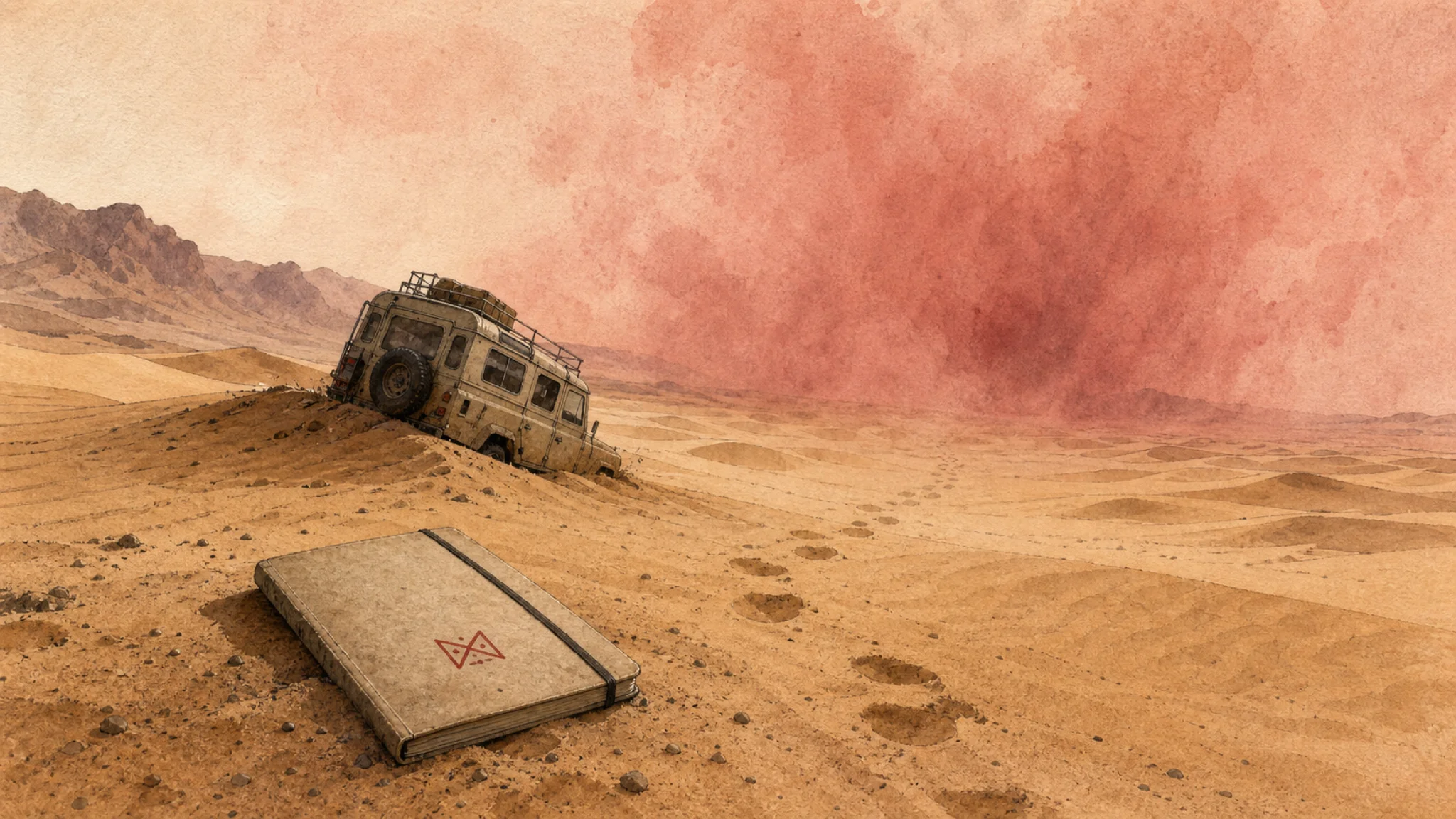
The 2015 thread runs on parallel rails. Kurt Russell’s elder Lee Shaw is extracted from a Monarch transport by Elisa Lasowski’s Duvall, a French operative whose sister died at Janjira and who has been waiting for someone to show her how to mean “never again.” The Taser is a cover. The dossier check in French is a vetting. Shaw passes and Duvall delivers him to Anna Sawai’s Cate, Ren Watabe’s Kentaro, and Kiersey Clemons’s May in a desert garage with Hiroshi’s hand-drawn map on the floor. The plan is the same one the kids have been running since Alaska. Find their father. Shaw’s plan is the one he has been running since 1959. Stop what is coming. The two plans share a destination, which is the only reason the alliance survives the drive.
Back in Tokyo, Joe Tippett’s Tim and Mirelly Taylor’s Verdugo turn a perforated office wall into the episode’s best procedural set piece. The holes in the pegboard behind Hiroshi’s desk match Monarch outpost coordinates. The clusters match the gamma ray spikes Hiroshi was secretly retargeting deep-space satellites to record. Tim’s subway-map metaphor turns the family’s chase into a transit problem. Godzilla’s emergence west of Hawaii. The swim west. The Alaska spike where they pulled Shaw and the kids and the new Titan. Three more clusters Hiroshi flagged. Central Asia. Vietnam or Cambodia. And the one in the Sahara that is about to become a corpse-strewn crater. Verdugo gets Collins in data culling on the phone and a Monarch hunter team in the air before the Randas have finished unpacking the jeep.
The desert reunion is built for catharsis and then drained of it. Cate and Kentaro spot Hiroshi waving on a ridge and run toward him shouting “Dad.” He waves back. He is also, as the next minute makes plain, waving them off. The gamma simulator on the salt pan is already running. Whatever is coming is not the family reunion the kids have driven across two continents for. Hiroshi vanishes before they reach the ridge. Whether he was running from Godzilla or trying to lure him away from his children, the episode refuses to settle. Kentaro picks the kinder reading. Cate does not commit.
The Monarch helicopter is on top of them when Godzilla surfaces under it. The aerial sequence is the most expensive set piece of the season, and we watch it through Cate’s helmet visor rather than wide shots of the kaiju. Godzilla looks at her. She looks back. “He saw me.” Yeah, Kentaro says. He did. The hunter team is dead in the crash. Shaw uses the chaos to take the map and tell Cate he is not chasing Godzilla to stop him. He is chasing Godzilla to help him. Cate calls him insane. He calls himself done debating. Duvall drives off with him. May, the last to fold, confesses she sold them out to Monarch back in Tokyo, that her name is not May, that she has money she has been afraid to touch, and that she will pay their way wherever Cate wants to go. Cate tells her to go to hell. The episode ends on three people walking out of the desert toward civilization with no map, no leader, and no plan beyond the next ten kilometers.
What this episode argues
The episode’s argument is that Monarch’s original sin is institutional, not personal, and that the children of the founders are inheriting both the institution and the sin. Puckett gets the hydrogen bomb. Verdugo gets the satellite redirect. The throughline is the same. The men with budgets keep deciding that the answer to a wonder they do not understand is a weapon they do not control, and the scientists who could explain why that will not work keep getting written out of the meeting where the decision is made. Keiko’s “greater good” speech in 1956 is the same speech Cate could give Shaw in 2015 if she had the words for it. The episode trusts the audience to hear the rhyme without underlining it.
The other argument is about what trust costs. Lee and Keiko do not become lovers because neither one can promise the other that Monarch will not always come first. Shaw and Cate do not stay partners because Cate cannot accept that Shaw’s loyalty is to the thing under the sand and not to the family on the ridge. May and Cate fracture because May lied to survive and the survival lie made her useful to the people the family was running from. Three generations of the same betrayal, played as three different scenes, scored with the same chord. The show does not need to draw the line for us. It draws the map and lets the gamma spikes do the rest.
Verdict
“Terrifying Miracles” is the episode the season has been building toward, and the one that finally proves the dual timeline was worth the bookkeeping. The Hawaii reception is the most assured period piece the show has written. The Suzuki sequence pays off the gamma-ray plumbing that has felt like homework for five hours. The hydrogen-bomb reveal is staged with the patience of a series that knows the audience already knows what happens to Godzilla in a Castle Bravo blast, and chooses to make the moment about the faces watching it rather than the cloud. Wyatt Russell and Mari Yamamoto turn an elevator kiss and a lab kiss into the same character study from opposite ends. Kurt Russell sells Shaw’s fifty-year guilt without ever explicitly naming it. Anna Sawai and Kiersey Clemons play the May confession as the small, sour scene it deserves to be rather than the operatic one the genre would allow.
“Terrifying Miracles” cracks the season’s first real momentum problem. The Verdugo subplot has graduated from B-plot procedural to A-plot pursuit. The Randas have splintered in a way that gives each of them somewhere new to go. The 1956 thread has its loss locked in, with Shaw on the wrong side of a change-of-command memo and Keiko about to pay a price the show has been telegraphing since the Kazakhstan flashback. Suzuki is the best new character the series has introduced. The Castle Bravo answer to a Titan reframes every Monarch decision in the present timeline as the long tail of a single bad night on a Pacific atoll. It is the episode that earns the season finale that follows.
Rating: 8.7/10
More episodes from Monarch: Legacy of Monsters — The MonsterVerse goes prestige — Godzilla and Kong meet the Randa family, episode by episode. Jump to any episode in the season:
Where to go next
Reviewed by Mira Vance · QuizFandom Editor & Lead Reviewer. Every rating is an honest per-watch assessment from the desk that also writes the quizzes — not a press release rehash.