Money Heist Season 2 Episode 2 Recap: Tokyo Pays for Her Revolt
Money Heist (La Casa de Papel), Season 2, Episode 2 Antena 3 / Netflix · Created by Álex Pina · 2017
Tokyo tests Berlin with a loaded gun, while Raquel and Sergio each try to turn custody into escape.
Money Heist Season 2 Episode 2 opens with one of the robbery’s funniest practical problems: the Professor has been arrested, but not by someone who knows what he is.
Alberto thinks he has a nervous, irritating man in the back seat. Sergio knows he has one small window before fingerprints, evidence bags, and a proper station booking turn his fake life into paperwork. Inside the Mint, Tokyo has a different problem. Berlin has handed her over to the police once, and everyone is still pretending the group can vote its way back to peace.
This is a bruised hour, full of people trying to keep control after control has already left the room. Raquel builds a trap around Ángel’s hospital bed. Tokyo tries to break Berlin before he can break her. Helsinki gives Oslo the only mercy left.
Who can wait longer?
Sergio tricks Alberto on the road
Sergio’s escape begins with humiliation, which is exactly why it works.
He sits beside Alberto and complains about his stomach. Too much coffee, some colon trouble, a bacterial problem, the kind of bathroom emergency no one wants to discuss in a moving car. Alberto is already irritated. He wants the suspect delivered, not a medical essay from the man Raquel cuffed in a bar bathroom.
So he pulls over.
Álvaro Morte’s Sergio does not turn into an action hero. He stays fussy, apologetic, almost pathetic, and then the body changes. A strike, a scramble, a stolen chance. Alberto loses the advantage because he never understood the kind of person sitting next to him.
The joke has teeth. Alberto has spent the series as Raquel’s awful ex, the man who hurt her and still talks as if her life is something he can supervise. Sergio, of all people, becomes the one who says the quiet part in the car.
Sergio wins the fight, but not cleanly. Alberto gets him arrested for assaulting an officer before the Professor can fully disappear. That matters because the police station is full of things Sergio cannot afford to leave behind: his fingerprints, the hangar keys, and the digoxin bottle tied to his attempt to poison Marisa.
Tokyo’s narration lays out the disaster like a list of ways to fail at being a criminal mastermind. Booked by the police. Fingerprinted. Personal effects emptied into evidence.
Raquel turns Ángel’s hospital bed into bait
Raquel is working from pain, but she is still working.
She asks Pilar about Ángel’s car and the fluid pipes that may have been tampered with. The answer is not proof, but it is enough to sharpen what Raquel already suspects. Ángel did not simply crash because he was drunk, frantic, or unlucky. Someone wanted him quiet. If he wakes up, that person may try again.
So Raquel sets a trap.
The move is clean because it comes from two places at once. Inspector Raquel Murillo (Itziar Ituño) is protecting a witness. Raquel, the woman who saw Ángel humiliated and broken for telling the truth too early, is trying to make sure the next attempt does not succeed.
She is not calm. Suárez can hear that. But she is no longer wandering through Sergio’s lies in the dark. She has a pattern now: the Toledo house, the bar, the hospital, the person close enough to hear police conversations and desperate enough to erase Ángel before he talks.
Sergio has already been in her home. He has already stood near Marisa. He has already turned tenderness into access. Raquel’s instincts are catching up to him, but every new fact arrives a few hours late. That delay is the season’s real pressure point. She can solve the case and still lose the minute that mattered.
Meanwhile, Sergio’s arrest briefly gives the police something solid. The fingerprints could connect him to the investigation. The bottle could connect him to Marisa. The keys could connect him to the escape plan. He is surrounded by evidence in a building built to process evidence.
Then he starts performing again.
He calls digoxin heart medicine. He keeps his body small. He lets the police think they are handling a strange civilian with bad luck and worse manners. Sergio’s advantage has always been that people underestimate the gap between his posture and his intent.
Raquel does not underestimate him anymore, even while he keeps slipping away.
Tokyo points a revolver at Berlin
Inside the Mint, Tokyo’s anger stops being background noise.
Berlin handed her to the police after the vote. He wrapped her in procedure, called it order, and let everyone else live with the shame. When she returns to the group before being expelled, she does not ask for an apology. She wants the Chernobyl Plan, the final escape route Berlin is keeping in his pocket.
Berlin refuses.
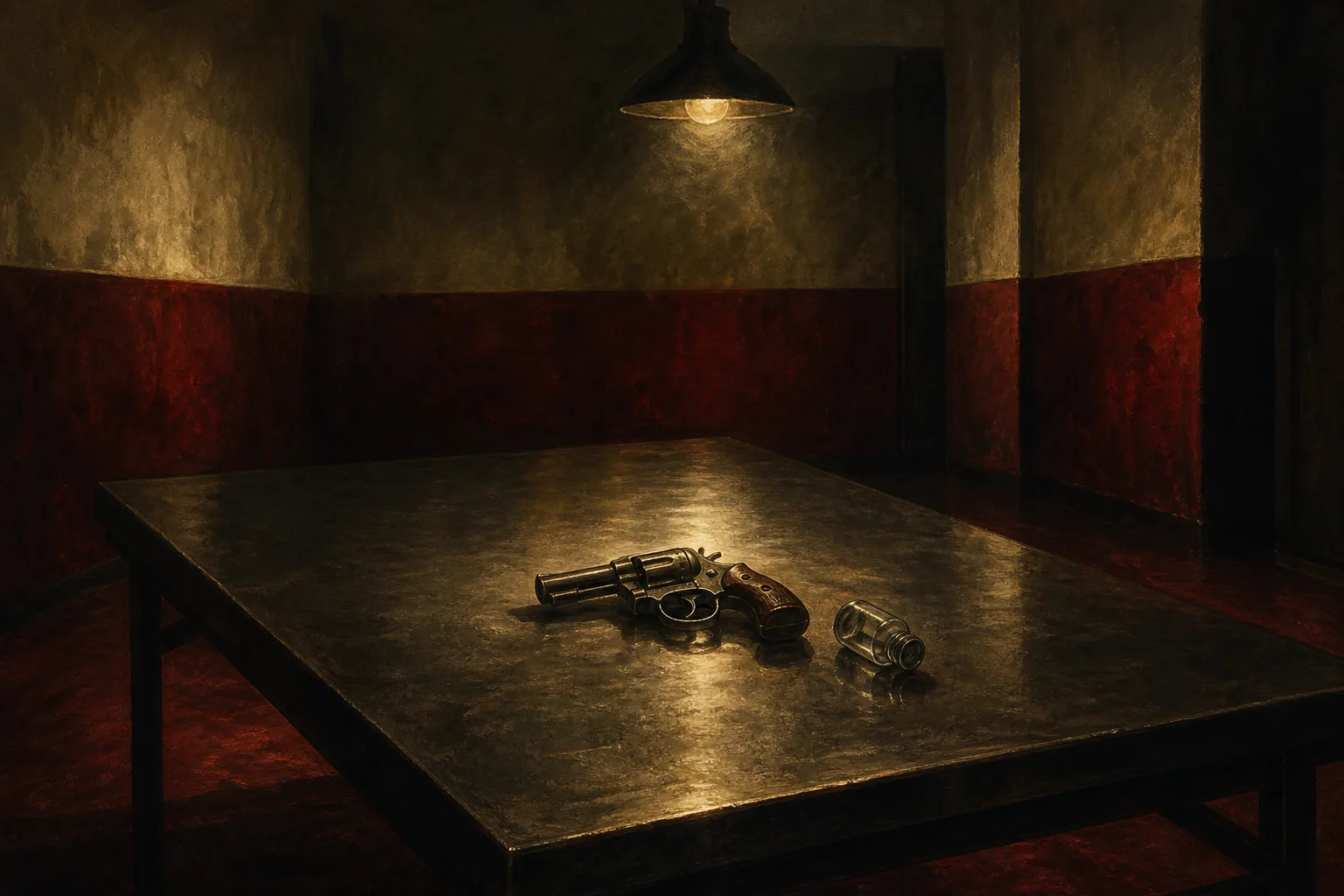
Then Tokyo starts smashing his medicine.
Pedro Alonso’s Berlin treats the vials like little bottles of time. His terminal illness is not news to him, but the crew has to sit with it now. He can make any room theatrical, and that is part of the danger. He does not beg. He turns Tokyo’s threat into another stage where he can look bored, clever, and superior.
That is why she reaches for the revolver.
The Russian roulette sequence is ugly because everyone in the room knows Tokyo is not bluffing in a normal way. She is hurt, abandoned, and furious enough to confuse revenge with leverage. Denver looks terrified. Rio is gone in grief before anything even happens. Nairobi tries to stop the spiral and gets dragged into it when Berlin finds the one wound he can press.
Nairobi’s son.
Tokyo says the child will not know her, that he already has parents, that Nairobi lost her chance. It is cruel, direct, and too personal to count as strategy.
Berlin survives the chamber because death is not the thing he fears most. Losing command is. Tokyo has forced the crew to decide whether this is still a plan or just one sick man winning arguments by daring everyone else to blink.
Moscow says what several of them cannot.
Berlin has gone mad.
The vote still holds. Tokyo leaves. But the vote feels less like justice than exhaustion with rules around it.
Helsinki says goodbye to Oslo
The quietest passage belongs to Helsinki.
Oslo has been gone since the hostage escape, but Helsinki has had to keep moving with that loss beside him. There is digging to supervise, hostages to control, Berlin to endure, and the plan still demanding labor from men who have not slept enough to feel human.
Then Helsinki gets his moment alone.
Darko Perić’s Helsinki says goodbye without decoration. He stands near Oslo, takes in the finality, and does what has to be done. The subtitles give Tokyo a plain line over it: “Rest in peace, Oslo.”
That is enough.
So much of Money Heist runs loud, which makes the restraint matter here. Helsinki does not need a speech to prove grief. He has carried it in his body since Oslo was beaten. He carries it now while the group argues about Tokyo, Berlin, and whether anyone is still following the Professor.
The funeral beat also changes how Berlin’s command reads. His talk about platelets and wounds, about broken pieces needing to unite, sounds polished but empty next to Helsinki’s silence. Berlin is trying to make a fractured group obey again. Helsinki is just trying to bury his person and keep standing.
Those are not the same job.
Rio’s near-exit gives the grief another shape. He believes Tokyo is gone, the Professor is arrested, and the tunnel may lead nowhere if no one is waiting on the other side. He is young enough that Berlin can mock his love as a first summer romance, but the pain is not imaginary. Tokyo is his person inside the Mint, and Berlin has removed her like a loose part.
Mónica steadies him with gentleness. She does not command. She asks him to believe in love without letting panic do the driving. That small kindness feels important because the room has become addicted to domination. Berlin threatens. Tokyo attacks. Rio runs. Mónica slows him down long enough for the decision to be his.
It is one clean human save in a room full of pressure.
Tokyo buys time from Prieto
Berlin does not kill Tokyo. He does not even torture her. He ties her to a stretcher, rolls her out in front of the police, and lets the perimeter panic over the possibility of explosives.
Tokyo is stripped, checked, shouted at, and dragged through anti-explosive protocol while Prieto tries to understand why one of the robbers has been delivered to him like a warning. The humiliation is the point. Berlin wants her gone and diminished. He also wants the police busy, guessing, and reacting to a spectacle they did not choose.
Tokyo still has one weapon left: time.
In flashback, Sergio tells her that if she is caught, the golden rule is to gain time. Exhaust every option. Give them enough truth to keep them leaning forward, then pull back before they get what they need. He calls it flying a kite, feeding out the thread with one hand and stopping it with the other.
So Tokyo does exactly that.
Úrsula Corberó’s Tokyo knows she can hurt Berlin by talking, but she also knows revenge would hit Rio. She could give the police the escape plan. She could give them the hangar. She could burn the whole job down. Instead, she chooses the version of loyalty that still leaves room for hatred.
She tells Prieto enough to keep the interrogation alive. Eight robbers. Toledo. Five months of preparation. Then she corrects his language, needles his military pride, and refuses to hand over the Professor.
It is not noble. It is discipline under rage.
The final question hangs there: “Who’s the Teacher?”
What works
Tokyo and Berlin’s confrontation supplies the heat. The roulette scene is reckless, nasty, and tied to the crew’s broken trust. Tokyo is wrong in several directions, but the betrayal that fuels her is real.
Sergio’s road escape and police-station scramble keep the outside story moving with comic anxiety. He wins by looking ridiculous, then nearly loses because bureaucracy is harder to charm than a person.
Helsinki’s goodbye to Oslo is handled with rare quiet. It lands because it does not ask for extra decoration.
Raquel’s hospital trap also keeps her sharp after the emotional blow of discovering Sergio. She is wounded, not stupid, and that distinction matters.
What stumbles
The subtitle track makes some tactical details harder to parse than they should be, especially around Alberto’s arrest and Prieto’s interrogation. The broad beats are clear, but several lines arrive bent out of shape.
Berlin’s illness dialogue also leans into his taste for speeches. That fits him, but his scenes occasionally circle the same note: he is dying, he knows more than everyone else, and he wants the room to admire the pose.
The police processing material moves fast enough that the evidence chain feels slightly slippery. The fingerprints, keys, and digoxin are all important, but the material rushes to get Tokyo in front of Prieto.
What this sets up for Episode 03
Tokyo is outside the Mint, alive, furious, and in police hands. That gives Prieto a real prisoner and gives the crew a missing member who knows too much. Her silence protects Rio for now, but silence is a hard thing to keep under pressure.
Inside the Mint, Berlin has survived the revolt without healing it. Rio knows the Professor may not call. Nairobi has been wounded in the ugliest possible place. Helsinki has buried Oslo and still has to keep digging.
Outside, Raquel is close enough to smell Sergio’s trail. The heist is still alive because everyone keeps buying minutes. Episode 03 has to decide how expensive those minutes become.
Rating: 8.5/10
More episodes from Money Heist (La Casa de Papel) — Berlin's last stand, the tunnel escape, and Raquel's impossible choice — episode by episode. Jump to any episode in the season:
Where to go next
Reviewed by Mira Vance · QuizFandom Editor & Lead Reviewer. Every rating is an honest per-watch assessment from the desk that also writes the quizzes — not a press release rehash.