Money Heist Season 2 Episode 5 Recap: Raquel Cuffs Sergio in the Bathroom
Money Heist (La Casa de Papel), Season 2, Episode 5 Antena 3 / Netflix · Created by Álex Pina · 2017
Raquel catches the man beside her while Mónica makes the choice Arturo cannot survive.
Money Heist Season 2 Episode 5 begins with promises nobody fully believes.
Berlin tells the remaining hostages that the released workers are safe and that the million euros will be sent to their homes. Arturo mutters from the crowd because Arturo hears every speech as a personal insult. Inside the Mint, Berlin needs labor, obedience, and time. Outside, Raquel needs one clean path to the man who keeps embarrassing the police.
The Professor has already ruined the hospital trap with clowns, a fake casting call, and a GoPro planted where the police thought they were waiting for him. Ángel is still unconscious, but the danger around his hospital bed tells Raquel that he must have seen something real.
Then Salva walks into Hanoi with postcards and beach fantasies.
That is when the day turns.
Raquel follows the Palawan clue back to Salva
Raquel is tired enough to ask Salva for company and sharp enough to keep watching him while he offers it.
She leaves him a message and heads to Hanoi, the bar where their flirtation has always been able to pretend it belongs to another life. Salva arrives with an envelope waiting for him and a familiar smile. For a few minutes, he looks like the answer to her exhaustion: a man who knows nothing about command posts, dead leads, and the humiliation of being outplayed in front of every officer under her.
Then the postcards come out.
Raquel says she was trying to clear tomorrow so they could leave together. Salva asks her to choose the beach. She lets him pick instead. He lands on Palawan, then immediately knows where it is, how many people live there, and the name of its capital.
That should be charming. It is too precise.
Ángel had warned her about Salva. Alberto had described a man who fought like a “ninja with glasses.” The actor in the Professor’s hospital decoy operation had worn an orange clown wig. The Professor had known exactly how to bend the police operation around Ángel’s room. Palawan does not solve the case by itself, but it makes all the loose details point in one direction.
Itziar Ituño’s Raquel does not blow up at the table. She excuses herself to the bathroom and calls Suárez for the last piece she needs. Then she returns to Salva with a different performance: desire, risk, the first time without a lifejacket, a dive into the deep end.
Sergio follows because he has spent too long believing he can read every version of her.
He is wrong.
In the bathroom, Raquel orders his hands against the wall, searches him, cuffs him, and arrests him for collaboration in the Royal Mint heist. The hurt on her face matters as much as the handcuffs. She is not only catching a suspect. She is catching the man who sat in her house, met her daughter, spoke to her mother, and turned her private courage into cover.
Álvaro Morte’s Sergio stays quiet because quiet is the only weapon left. Raquel reads him his rights with poison in her mouth.
This is not romance finding a dramatic obstacle. This is betrayal arriving with paperwork.
Mónica blocks Arturo and becomes Stockholm
Inside the Mint, Arturo gets the kind of chance he always claims he has been waiting for.
He has a real gun because Mónica stole it from Denver. He has hostages ready to move. He has convinced himself that Berlin, Denver, and Helsinki are bluffing with blank weapons and bad tempers. When Helsinki steps away, Arturo tries to turn the whole room toward escape.
For a second, it almost works.
Denver realizes the gun is gone. Arturo pushes the group toward the door. Mónica stands at the control panel with everyone yelling at her from both sides. Arturo tells her to open it. Denver tells her not to listen. Arturo says Denver is taking advantage of her, because Arturo cannot imagine Mónica acting from any feeling he did not authorize.
Mónica blocks the door.
The choice costs her immediately. Arturo points at her and calls her one of them. The hostages see it. Berlin sees it. Denver sees it. There is no tidy way back to her desk, her pregnancy, her old life, or the story where she was only a victim waiting for police to arrive.
Esther Acebo’s Mónica treats the aftermath with a panic that keeps swerving into comedy because the situation is too much to hold straight. She asks for a cigarette while pregnant, kidnapped, shot, and now likely to face charges for helping an armed robbery. When Denver promises she will come with them, she knows how ridiculous that sounds. She is a secretary. She does not picture herself running from police, firing weapons, or hiding in a country without extradition.
So she reaches for the legal word before the codename reaches her.
Stockholm syndrome.
Denver hears “Stockholm” and treats it as a name. It could be silly. It almost is. But the moment lands because Mónica is not being awarded a new identity by the man who loves her. She is trying to survive a choice she made in public. Denver offers a door, clumsy and sincere. Mónica still has to decide whether to walk through it.
Arturo cannot stand that part.
He wanted her choice to prove his hero story. Instead, it exposes him as the man who would rather endanger Denver than admit Mónica has left him behind.
Helsinki straps explosives to Arturo
Helsinki has slept four hours in five days, and Oslo’s death is sitting behind every breath.
That does not excuse what he does to Arturo. It does explain why the punishment feels less theatrical than Berlin’s usual cruelty. Helsinki is not trying to impress the room. He is trying to stop the man he blames for Oslo, the failed escape, and Denver almost getting killed.
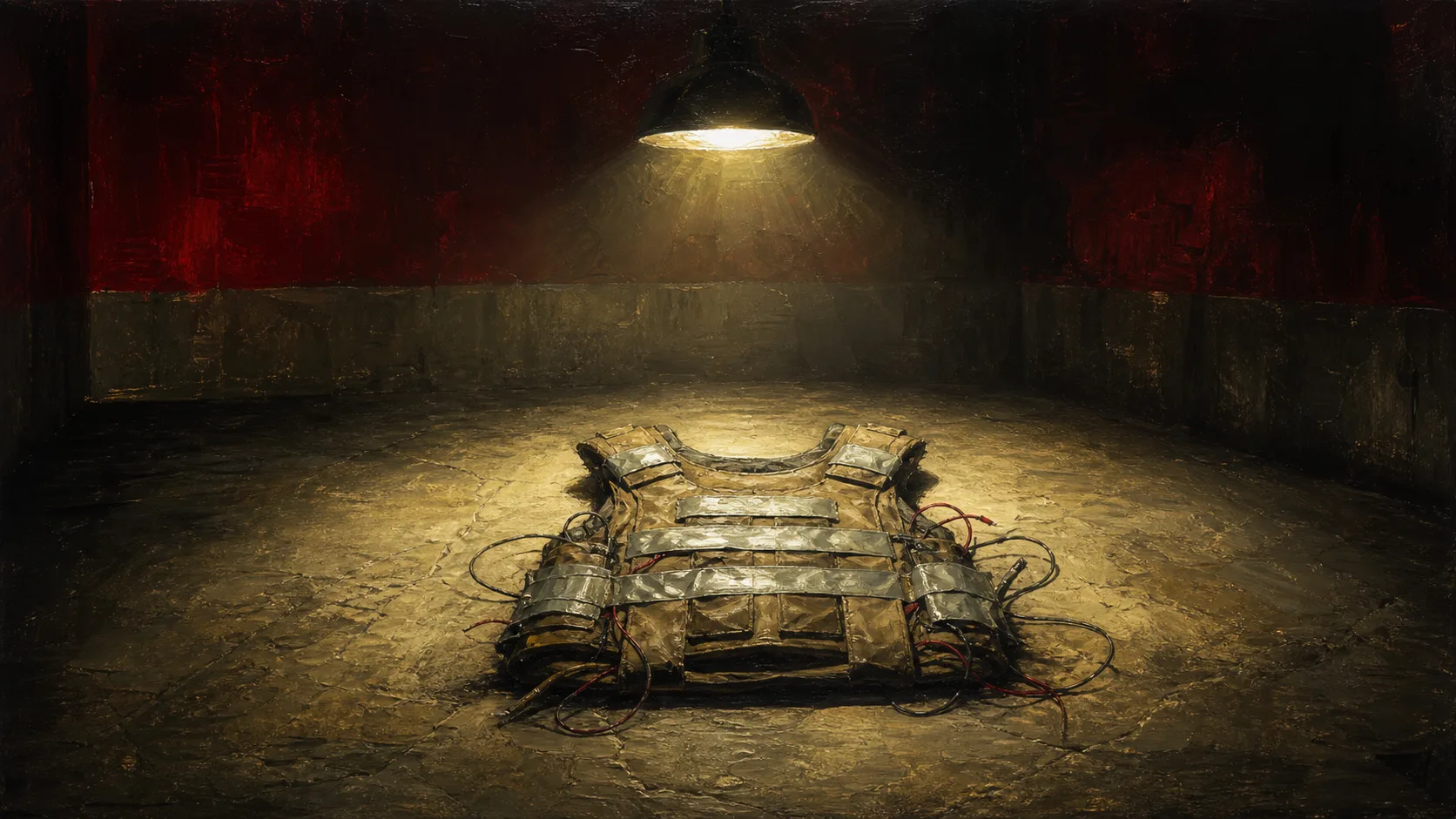
Darko Perić’s Helsinki takes Arturo into a side room, makes him strip, and straps explosives to his body. He tells him that shooting him would be too quick. Arturo will suffer because he will not know when the blast is coming.
Rio looks shaken. Denver and Moscow look shaken too. Even Berlin, still resting, has not yet returned to turn the punishment into public doctrine. For a brief stretch, the Mint belongs to exhaustion. Everyone is short on sleep, patience, and mercy.
Arturo, for once, understands that attention has found him in the wrong form.
Helsinki lists the reasons with almost no flourish. Oslo died because of him. Denver almost died because of him. Arturo has been a bigger problem than the police. The grief is plain, and that plainness is what makes it hard to watch. Helsinki loved Oslo. Now Arturo is standing where the grief can reach.
The vest also changes the hostage room. Arturo has spent the heist treating fear as a stage he could climb onto. Now nobody wants to stand close to him. Nobody wants his leadership. Nobody wants his sweat.
His great escape attempt leaves him isolated with wires across his chest.
Berlin wakes up and takes command again
Nairobi’s brief rule ends because the room has moved past persuasion.
She tried to give the hostages a version of the robbery that made sense: work, money, no Berlin, no unnecessary cruelty. She tried to make their cooperation feel rational after Oslo’s death and Tokyo’s removal. Then Arturo gets a gun, Mónica crosses the line, Helsinki loses patience, and the tunnel still has to be finished.
Berlin wakes to that mess after following the one rule nobody else has managed: rest.
Pedro Alonso’s Berlin first gives Nairobi a private offer that says too much about him. He invites her to join him after the heist for a distant trip, a short pleasure, and whatever remains of his life and money. His illness is present in every word, but Berlin never lets it become humility. He can speak about dying and still make it sound like a seduction he expects someone to applaud.
Nairobi does not give him the answer he wants. She also does not fight him when he returns to the room.
Berlin takes command back with open contempt for the idea that kindness has worked. He says the cooperation experiment has failed. He threatens the hostages with torture and sends them to dig until their hands bleed. Then he displays Arturo in the vest as a warning: betray them, yearn for freedom, sweat too much, and death follows.
It is ugly, effective, and very Berlin.
Everyone moves toward the tunnel again, but the human map has changed. Raquel has Sergio in cuffs. Mónica has a codename she may not be ready to carry. Helsinki has turned grief into punishment. Berlin has the room again, and his version of order always arrives with someone humiliated in public.
The Mint is working.
Nobody inside it is fine.
What works
Raquel’s arrest of Sergio is the strongest stretch because it gives her the catch without taking away the wound. She solves the pattern through details, not luck, and the bathroom trap lets her use his confidence against him.
Mónica’s codename moment also works because it stays messy. Stockholm begins as a panic defense, then becomes a possible future. Denver wants to save her, but the choice remains hers.
Helsinki’s grief gives the Arturo punishment a human temperature. The vest is grotesque, but it comes from a man running on almost no sleep and a loss he has not had time to carry.
Berlin’s return restores pressure inside the Mint. He is funny, monstrous, practical, and vain in the same breath, which is exactly why everyone is worse off when he is rested.
What stumbles
The hospital clown diversion is fun, but it has already happened by the time the main story settles in. The explanation arrives quickly: fake casting, decoy agent, GoPro, police confusion. It works as a trick and feels a little crowded as aftermath.
Arturo still repeats himself. His cowardice and vanity are useful because they keep creating real danger, but his speeches can circle the same grievance too long before the next choice arrives.
Berlin’s concentration-camp threat is meant to be vile. It is. It also lands so bluntly that it briefly flattens the room into shock value when the tunnel pressure was already enough.
What this sets up for Episode 06
Raquel has Sergio arrested, but catching him in a bathroom is only the first problem. He still knows the plan, Tokyo is still in transit toward the next move, and the police have not yet connected every version of Salva to the Professor.
Inside the Mint, Mónica’s old life is gone even if she has not fully accepted the new one. Stockholm is now on the table. Arturo has lost the room. Helsinki has crossed a line that grief cannot erase. Berlin has command and a tunnel full of hostages to drive forward.
Episode 06 inherits a heist that can still escape on schedule and a crew that keeps paying for every minute it survives.
Rating: 8.7/10
More episodes from Money Heist (La Casa de Papel) — Berlin's last stand, the tunnel escape, and Raquel's impossible choice — episode by episode. Jump to any episode in the season:
Where to go next
Reviewed by Mira Vance · QuizFandom Editor & Lead Reviewer. Every rating is an honest per-watch assessment from the desk that also writes the quizzes — not a press release rehash.