Notes from the Last Row Episode 1 Review: "Episode 1" — Mun-oh Calls a Paper Trash, Kang Writes Se-yun, and a Professor Steals Contest Questions
What happens — the short version (spoilers)
- Mun-oh opens the semester by calling a student's work trash, then loses control of his own lecture when Kang corrects his Werther reading.
- Professor Park asks Mun-oh to host Kim Su-hun, whose public success and private connection to Eun-joo reopen Mun-oh's oldest wound.
- Kang submits pages about entering Se-yun's life, meeting Se-yun's family, and turning friendship into a route toward someone else's story.
- Mun-oh's wife reads Kang's pages, and Mun-oh begins treating the student's manuscript as the thing his own stalled writing cannot produce.
- Kang asks Mun-oh to help him cheat in the writing contest, and Mun-oh rejects the request before later stealing the questions himself.
- Mun-oh uses Park's attendance system to cover the break-in, copies Kang's USB file, and ends the premiere with panic instead of triumph.
Episode 1 opens like a campus satire and tightens into something colder: a professor who cannot write anymore discovers a student whose envy is alive enough to become material. The hour braids Mun-oh's public humiliations with Kang's private manuscript about Se-yun, then lets both men mistake access for purpose. By the time Mun-oh is copying files from Professor Park's computer, the first theft has already happened: the decision to treat someone else's life as a story waiting for your name.
Mun-oh marks a student’s paper as trash, then hears his own failure repeated in the hallway
The premiere starts in the place its title promises: the back of a required writing class, where attention is thin, attendance is still taken on paper, and Professor Heo Mun-oh has already decided most of what he reads is beneath him. A student challenges the word he has written across an assignment – trash – and Mun-oh performs the insult.
He counts the damage like evidence: 12 paragraphs, 167 sentences, a stream of copied sentiment with nothing personal enough to mean anything. Then he asks what better word he should use. It is cruel, precise, and very revealing. Mun-oh knows how to diagnose dead writing. He also knows, from the students muttering outside, that everyone has diagnosed him back: one novel 20 years ago, no second book, all that frustration laundered into standards.
That is the hour’s first clean move. Mun-oh’s authority is real; his eye is not fake. The problem is what he does with it. He can recognize empty sentences in a student’s paper, but he cannot hear the emptiness in his own life until somebody else says Kim Su-hun’s name.
Professor Park asks Mun-oh to host Kim Su-hun, and Su-hun refuses the testimonial Mun-oh wanted
Professor Park enters with exactly the kind of practical cheer Mun-oh cannot stand. He wants help with a College of Engineering cultural event. Kim Su-hun, famous author and old university friend, will give a lecture on his new novel, Eyes of the House, and he has asked for Mun-oh to host the conversation. The request lands less like an honor than a summons.
The next scene makes the wound specific. Mun-oh had wanted Su-hun to write a testimonial. Su-hun has read the manuscript and refuses politely, which is worse. He says he has been writing too many testimonials lately; when pressed, he admits he had trouble understanding what the writer was attempting to say and tells Mun-oh to revisit good sentences.
The show has a dry little academic cruelty streak, and this is where it sharpens. Mun-oh just told a student that words on a page do not equal writing. Su-hun hands the same verdict back with better manners and a bigger career: a friend declining a favor under a restaurant awning, somehow more humiliating than a fight.
Kang corrects Mun-oh’s Werther lecture, and his assignment turns Se-yun into a doorway
Back in class, Mun-oh tries to recover power by lecturing on first sentences. He quotes Goethe, talks about The Sorrows of Young Werther, and then loses control over a ringing phone. When he identifies Werther’s friend as Albert, Lee Kang corrects him from the room: Werther’s friend is Wilhelm; Albert is Lotte’s fiance, the rival Werther envies and idolizes.
It is the kind of correction Mun-oh deserves and cannot safely punish. Kang is not trying to show off, exactly. He is thinking through the word “friend” as if it might hold envy, affection, rivalry, and longing in the same shape. The question carries straight into his assignment, where he writes that he first met Kim Se-yun by coincidence, then became his friend by plan.
Kang’s first pages are not innocent. In them, he finds Se-yun’s lost item, turns up at YDOC with the same bag, introduces himself as an Electronic Engineering student, and lets Se-yun invite him over for coding help. The manuscript says the quiet part itself: becoming friends was his plan. That is what catches Mun-oh. Not because it is healthy. Because it has pressure.
Mun-oh’s wife reads Kang’s pages, and Mun-oh turns envy into private lessons
At home, Mun-oh’s wife reads the assignment and asks the basic reader questions Mun-oh does not want: why did this boy write it, and what does he want? Her answer is simple enough to annoy him. Kang is envious. He has seen something in Se-yun’s life that he desperately wants, and since he cannot do anything with the feeling, he is putting it into writing.
Mun-oh’s wife also says the pages are good. That matters. No mystery clue has hooked Mun-oh yet; talent has. He asks Kang to stay after class, probes whether Se-yun has read the pages, and then names the thing Kang has not named. Kang wants to be Se-yun. Se-yun’s assignment contains nothing about Kang. The envy is one-sided, which makes it lonelier and more useful.
Mun-oh’s pitch almost sounds generous until you listen to the money inside it. Kang works part-time and cannot afford extra lessons, so Mun-oh offers to pay for the lost hours. When Kang asks why, Mun-oh recoils at the implication and then keeps going anyway. You’ll never be Kim Se-yun, he tells him, but he can write about the desire to become him. If Kang can digest that feeling, Mun-oh says, that is literature.
He is partly right.
That is the uncomfortable part.
Kang enters Se-yun’s house, finds beauty and suspicion, and realizes the competition is his way back in
The manuscript layer gets stranger once Kang reaches Se-yun’s home. Before he enters, his narration asks whether a person can feel nostalgia for a place they have never been or longing for someone they have never met. In Kang’s account, Se-yun’s house looks like the photos and then exceeds them. The house is beautiful. The people are beautiful. Kang is already writing like someone trying to turn another family’s air into proof.
Se-yun’s mother has reason to notice. She is kind when she finds Kang in the wrong room after he wanders off from coding practice. She tells him where the bathrooms are and does not embarrass him at dinner. Later, though, Kang overhears what she really thinks: he seems sneaky, he gives off the wrong feeling, and she wishes Se-yun would stop bringing him over.
That overheard judgment sends Kang back to Mun-oh with the practical crisis beneath the literary one. If he cannot keep visiting Se-yun’s house, he has nothing to write about. If he cannot write about Se-yun, the private lessons lose their purpose. The coding competition becomes a gate. Win it, and Se-yun’s parents have a reason to tolerate him a little longer.
Kang says he is better than Se-yun, but not good enough to win. Then he suggests the questions.
Mun-oh rejects Kang’s cheating request, then asks for the same corruption after Su-hun survives him in public
For one clean moment, Mun-oh reacts like a teacher. He calls Kang crazy, throws him out, and refuses to cheat for him. The anger is real enough. So is the moral line. The premiere does not pretend Mun-oh was always a criminal waiting for a button to be pushed.
Then the Kim Su-hun event pushes it.
Su-hun’s lecture is a small masterpiece of professional ease. He explains Eyes of the House as a mystery that matters less for its solved murder than for the scrambled sequence of scenes and the relationships inside them. Mun-oh tries to turn the room by reading an ugly “student” question about Su-hun accommodating the masses and having no stories of his own left. Su-hun absorbs the attack, thanks the questioner, and turns “accommodate” into a defense of making space.
Afterward, the table keeps finding new ways to praise Su-hun. Seven novels. Four story collections. A daughter who won the Literary Debut Award under a pen name. Mun-oh sits inside the noise, smiling less and less, until he runs into Kang working at the restaurant. Kang says he is thinking of entering the Literary Debut Award because the prize money is big, because Mun-oh said he has talent, because he has not found the story he wants to write yet.
That is when Mun-oh changes. In his head, Kang is already on a stage thanking Mr. Heo Mun-oh for opening his eyes to real writing and real life. The fantasy is so naked it is almost embarrassing. A student with talent is no longer a student. He is a second career with legs.
So Mun-oh makes the offer Kang had asked him to make. If Kang gets the coding questions ahead of time, will he take writing seriously? Will he take individual lessons?
Mun-oh uses Park’s attendance system as cover, and the premiere ends with a USB drive and a panic attack
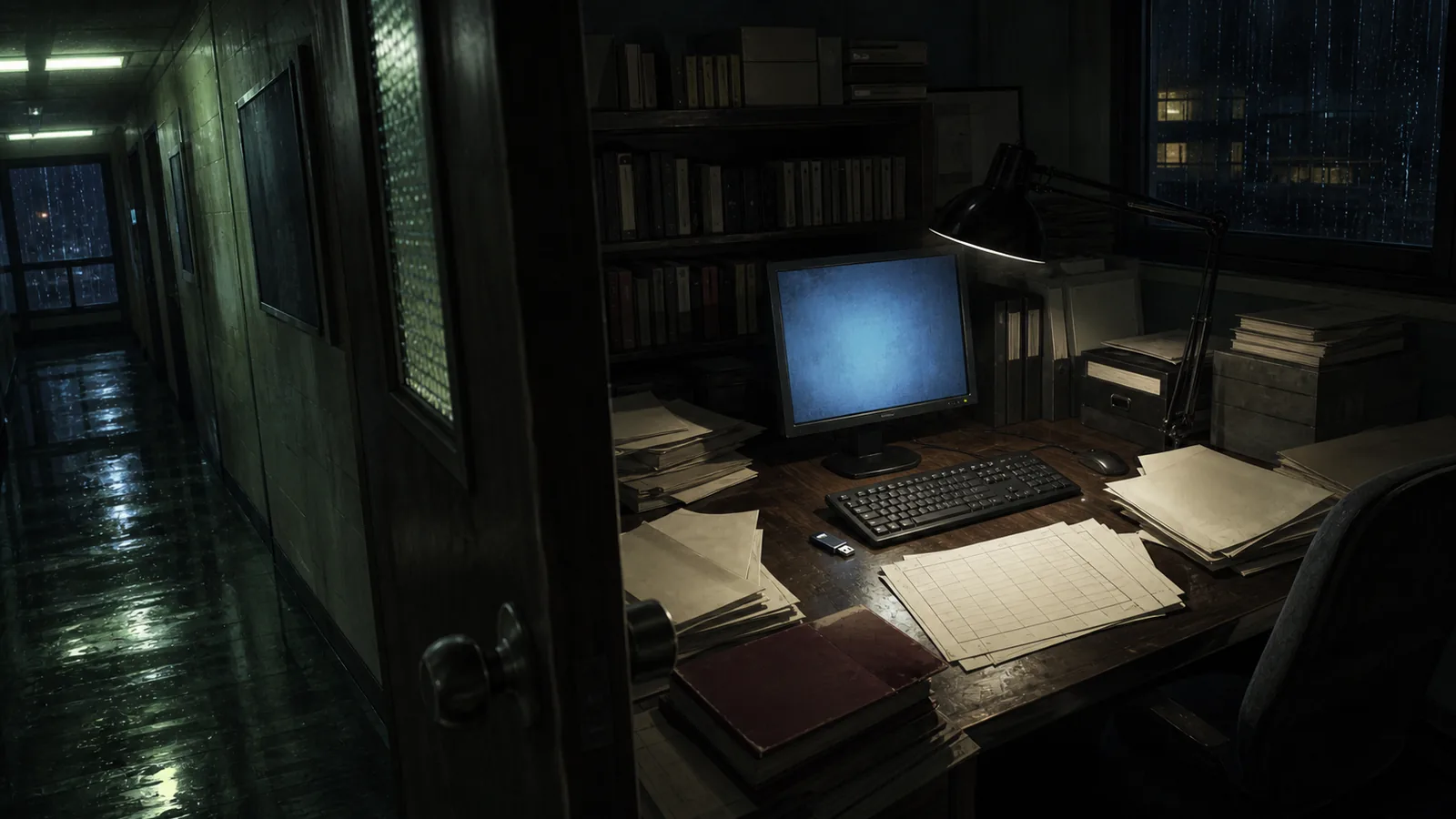
The theft sequence is funny because everyone involved is bad at pretending. Kang has a plan: Professor Park heads the competition committee, the files should be on his computer, and Mun-oh can use Park’s beloved attendance program as the excuse to get inside the office. Mun-oh worries, stalls, sweats, and keeps doing exactly what Kang tells him.
Park is almost too easy a mark because he wants so badly to be useful. He agrees to show Mun-oh the system, gets pulled out of lunch, logs into his account, and starts explaining automation while Kang waits nearby. When Mun-oh loses nerve, Kang reminds him it is too late. When they need Park out of the room, Mun-oh fakes chest pain and sends him to the car for angina medication. The medication, of course, is for hemorrhoids.
It is the hour’s broadest stretch, and also its ugliest little joke. Mun-oh keeps saying he is a professor, as if the title should save him from the act his hands are already doing. Kang searches the folders, panics over the unknown file name, finds the Yeonseo University Programming Competition answers and problems, and copies them while Park hurries back with the wrong medicine and the right concern.
Mun-oh leaves the office intact on the outside. Then the campus music swells, students greet him, and the episode lets him have the fantasy-walk for about 30 seconds before he says the obvious to himself: he has gone crazy. The USB drive works less like a cliffhanger than a receipt.
Tiny details worth clocking
- The first object Mun-oh clings to is paper attendance, and the crime later depends on him pretending to modernize it. His old-fashioned stubbornness becomes the cover story for theft.
- Kang’s correction of Werther is not trivia flexing. It gives the hour its emotional grammar: the rival can also be the person you idolize.
- Mun-oh’s wife is the first person to say Kang’s pages are good, and his face changes because the praise does not come from him.
- Su-hun’s “accommodate” answer quietly humiliates Mun-oh twice: it survives the attack and makes the attack sound less intelligent than the answer.
- The fake angina medication being hemorrhoid medicine is exactly the show’s office-comedy register: petty, bodily, and morally damning without needing a speech.
Final verdict
Episode 1 is an assured premiere because it separates the mystery hook from the moral hook. The murder-book language around Su-hun’s Eyes of the House points toward the season’s larger shape, but this hour waits on the body and watches a professor cross the first line he can still explain to himself.
The late theft sequence does broaden the hand. Park’s office caper is deliberately comic, and the pop-song needle drop gives Mun-oh’s panic a little too much bounce after an hour built on quieter humiliations. The setup is precise enough to carry it, but the shift is visible.
Still, the architecture holds. The classroom cruelty, Su-hun’s refusal, Kang’s manuscript, his wife’s readerly bluntness, and the USB drive all point to the same scene: Mun-oh looking at Kang’s talent and seeing not a student, but a way back into literature. That is the episode’s cleanest accusation. Writing may turn envy into form, but Mun-oh has already started turning Kang into property. For a show about authorship, that is a sharper first crime than the theft itself.
Rating: 8.8/10 — a controlled premiere with a strong literary nerve, broader in the final caper than in its best scenes but exact about how envy turns into evidence, mentorship, and exploitation.
More episodes from Notes from the Last Row — A campus novel turns into accusation, obsession, and evidence. Jump to any episode in the season:
Where to go next
Reviewed by Mira Vance · QuizFandom Editor & Lead Reviewer. Every rating is an honest per-watch assessment from the desk that also writes the quizzes — not a press release rehash.