Notes from the Last Row Episode 6 Review: "Episode 6" — Kang Gives Mun-oh the Novel, Hyeon-suk Leaves, and the Three Ducks Come Back
What happens — the short version (spoilers)
- Kang refuses to fabricate the hospital murder, asks Mun-oh to finish the manuscript, and leaves him to put his own name on Notes from the Last Row.
- Kang calls thirteen times, says Su-hun is about to burn the house down with Eun-joo and Se-yun inside, and sends Mun-oh rushing into a false alarm.
- Mun-oh returns home to find Hyeon-suk packed; she says Kang reached out about Mun-oh's Eun-joo obsession and leaves to decide which story matters for herself.
- An anonymous forum post accuses Mun-oh of forcing slander, bribing Kang with coding questions, stealing the novel, and targeting Kim Su-hun.
- Kang's last assignment returns to an orphanage where child Kang learned from Mun-oh's three-duck exercise that pain can be turned into story.
- Freshman Kang meets Se-yun, Min-hui's accident gives him the special hook Mun-oh once said a story needed, and the finale ends with Kang asking for professional guidance on a new story.
Episode 6 closes the season by giving Mun-oh exactly what he asked for: a story with blood, scandal, a famous target, and his own name on the title page. The hour braids Kang's public trap with the private memory that built it, turning the Kim Su-hun case into a harsher question about who first taught Kang to make pain useful. By the time the finale returns to the orphanage, the season's last row is no longer a hiding place. It is a writing desk, a witness stand, and a trash can with Mun-oh's name on it.
Kang refuses to invent the hospital scene, and Mun-oh writes himself onto the title page
The finale opens exactly where Episode 5 left Mun-oh: asking a student to supply the murder that the curtain refused to show. Kang hears the instruction cleanly. Mun-oh wants him to pretend he saw Su-hun kill Min-hui at the hospital, then call that invention truth because it completes the shape of the case.
Mun-oh’s defense is the season’s ugliest craft lecture. Su-hun went to the park because of the letter. He behaved like a guilty man. Kang witnessed enough to know the truth, so a little invented hospital scene is only creative license. Artistic liberty is not fraud, he says, which is a spectacular thing to tell the student he has been training to observe reality as it is.
Kang refuses, then hands the poison back. His father is unwell, he cannot finish the manuscript, and Mun-oh is the published author in the room. Finish my story. Please is not surrender. It is bait shaped like humility. Mun-oh rages when Kang hangs up, then hears the sentence he has been waiting decades to hear in the worst possible form.
He sits down and finishes it.
The title page matters because it is so plain: Notes from the Last Row by Heo Mun-oh. A whole season of stolen files, unauthorized lessons, wounded families, and moral lectures collapses into that byline. Mun-oh wakes to the finished manuscript like a man discovering oxygen. I’m the author now is the happiest he has sounded all season, and the most damning.
Kang sends Mun-oh to save Eun-joo from a fire, and the Kim house turns into a false alarm
Kang lets him enjoy the second novel for a few minutes before yanking the leash. He has called thirteen times. Se-yun has left terrified messages. According to Kang, Su-hun has found out Eun-joo knows too much and is planning to burn the house down with his wife and son inside.
The voicemail is staged perfectly for Mun-oh because it names every weakness at once. Eun-joo is in danger. Su-hun is the monster Mun-oh has been trying to expose. Se-yun is the child witness. The house that has been all locked rooms and private rot may finally become a crime scene anyone can see.
Mun-oh does not think like a teacher, husband, or citizen. He thinks like the man who has been writing Eun-joo’s rescue into his head for thirty years. He calls emergency services, refuses to pull over when the police chase him, and drags the whole civic apparatus to Su-hun’s gate. If Eun-joo dies in that fire, he screams, he will kill Su-hun himself. This is not her story sounds noble until the scene proves he is not rescuing a woman. He is trying to seize the ending.
There is no smoke.
That silence is brutal. Firefighters find no visible fire. Paramedics arrive for injuries that are not there. Mun-oh keeps shouting about Su-hun killing his family until the family appears alive, confused, and publicly embarrassed by the professor losing his mind outside their home. Eun-joo recognizes him from school. Su-hun turns the situation into a household problem to be taken inside. Se-yun sees his professor standing in the wreckage of a scene Kang wrote for him.
The trap works because Mun-oh has trained himself to believe any story that gives him the moral role he wants.
Hyeon-suk lets Mun-oh imagine the worst, then leaves with Kang’s version of the story
Mun-oh chases Kang and loses him. Then he comes home to the marriage he has already hollowed out. Hyeon-suk has packed, and the bottle on the table tells him Kang was there before him.
The scene is careful about what it does and does not answer. Hyeon-suk does not owe Mun-oh a clean confession, and the episode refuses to give him one. He asks what Kang said, whether they drank together, whether she invited the student into her bed. She lets him imagine the picture because imagination is the only faculty he has respected lately.
Kang’s actual wound is sharper than any affair accusation. He reached out because he was worried about Mun-oh’s obsession with Eun-joo. He told Hyeon-suk the mentoring was an excuse, that Mun-oh had used both of them, and that she was never the woman his novel was about. Hyeon-suk already knew that last part. She had spent years calling it creative license because that was easier than naming the fact that her husband had made her a substitute in her own house.
The episode gives her exit the plainness Mun-oh never deserves. Kang is bright because he knows which story matters. Mun-oh does not. Hyeon-suk wants a life where she decides what counts, and then she leaves while Mun-oh finally uses her full name like a man discovering it at the door. His I can’t live without you is true enough to hurt and too late to matter.
When he says he lost his wife, the wording is almost funny. Hyeon-suk was not misplaced. She walked out.
An anonymous forum post accuses Mun-oh, and the campus turns “trash” back on the professor
Professor Park calls before Mun-oh can even understand the damage at home. The student forum has a post claiming that Heo Mun-oh forced a student to write defamatory material about Kim Su-hun, fabricated scenarios to ruin a rival, offered stolen coding-competition questions as a bribe, then stole the finished novel and called it his own.
The accusation is not cleanly honest, which is what makes it cruelly effective. Mun-oh did not invent every wound in Kang’s manuscript. He did push Kang toward fraud, steal questions, trespass into a student’s work, and write his own name over a story made from other people’s lives. Kang does to him what Mun-oh tried to do to Su-hun: gather half-truths, arrange them into the ugliest possible narrative, and let public appetite finish the job.
The novel goes online. News reports describe Su-hun as the target of a slanderous manuscript. Kim Su-hun’s side prepares a defamation suit. Yeonseo calls Mun-oh before a disciplinary committee, where his defense sounds pathetic even when parts of it are true. He says he was deceived by the student he mentored. The committee asks the only question left: if Kang lied, why did he do it?
Mun-oh has no answer he can use.
The best visual punishment is still the simplest one. Trash belongs in the trash can! appears where students can see it, and the insult Mun-oh once made into classroom theater comes back as campus weather. The show has been waiting for that word. It does not land as cosmic justice. It lands as office gossip, media churn, committee procedure, and a man staring at the rubble of a reputation he mistook for authorship.
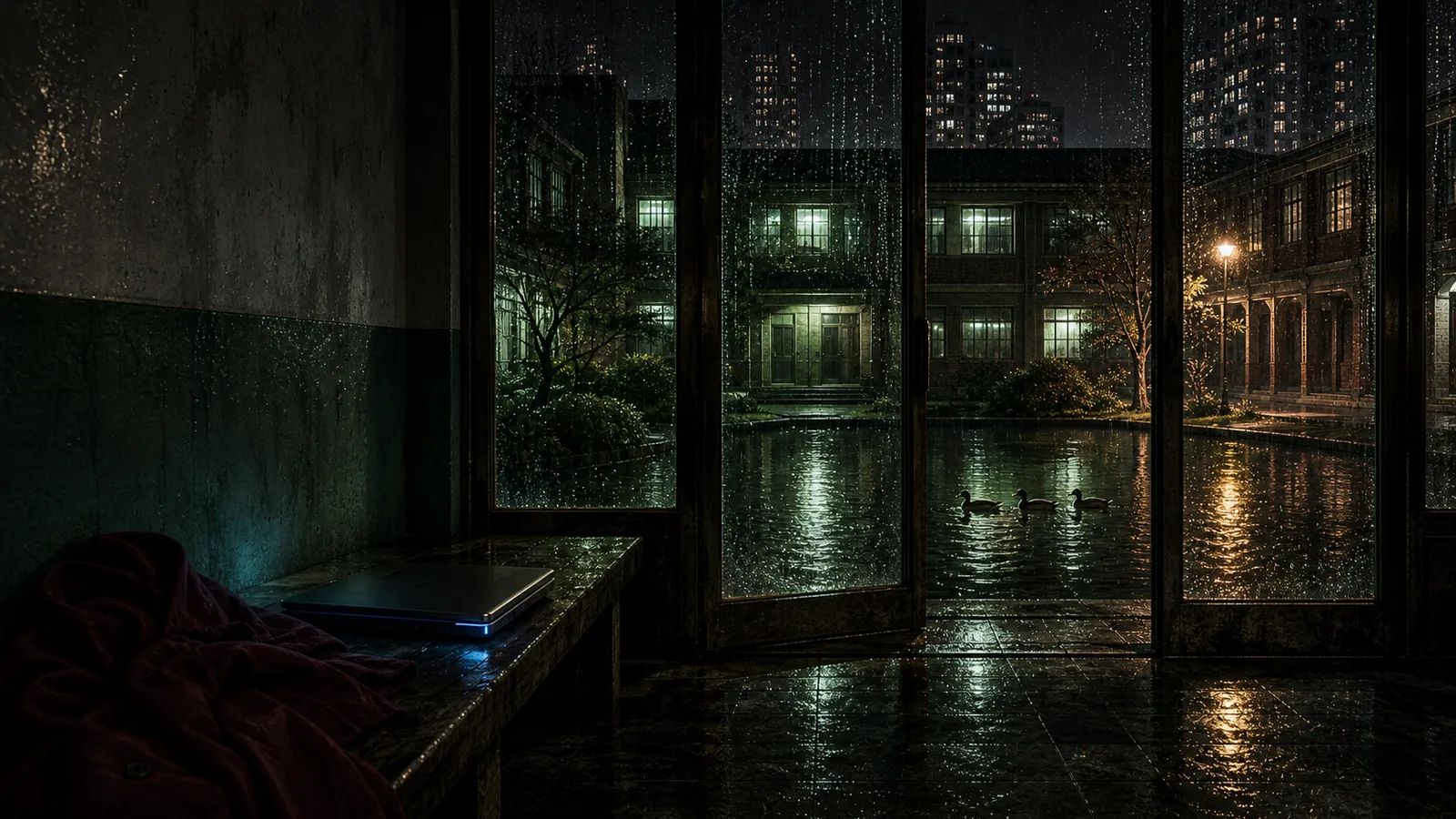
Kang’s last assignment takes Mun-oh back to the orphanage, where the three ducks begin
After the public collapse, Kang finally contacts him as a writer would: by email, with a title line and control of the frame. He calls it his last assignment and takes Mun-oh back twelve years, to a day Mun-oh barely remembers because he did not think the child in front of him was material.
Hyeon-suk is the reason they are at the orphanage. She is working with the children, trying to coax them into a game about common answers and stickers. Mun-oh is the sullen husband dragged along for fresh air, irritated by a pothole, and convinced he is bad with children before any child has had the chance to disappoint him.
Then he meets the boy who will become Lee Kang. The child refuses the group exercise because he knows what comes after it. If he talks about his parents to strangers, the memories will stop being special. An eight-year-old already understands that narration can cheapen what it touches.
Mun-oh, for one brief scene, is better than his own life. He points the boy toward three ducks on the water and suggests they talk about that family instead. The duckling can be lonely. The parents can be gone. The story can be his without forcing him to say it directly. The little boy opens up, remembers his father’s truck, the picnics, the laughing, the missing so large he cannot stand it.
The kindness is real. That is what makes the next scene colder. Hyeon-suk tells Mun-oh the boy wanted his address, that his name is Lee Kang, that Mun-oh showed him how to make a good story. Mun-oh dismisses him as another orphan with the usual tragedy, nothing special enough to inspire. He forgets the boy because the boy’s pain does not stand out.
Kang does not forget the man who taught him that grief needs a hook.
Freshman Kang meets Se-yun, Min-hui’s accident supplies the missing spark, and Mun-oh becomes the real author
The flashback to campus makes the season’s architecture click into place without flattening the mystery into a prank. Kang grows up, arrives at Yeonseo, and meets Se-yun through a shared YDOC bag. Se-yun is friendly, rich, and careless in the way people can be when a family story has always protected them. He mentions that Mun-oh and Su-hun were in the same program, that Su-hun was the better writer, and that Mun-oh used to follow Eun-joo around.
That is already enough for Kang to recognize an old shape: a professor who taught him to turn sorrow into story, and a famous household tied to the professor’s envy. Then the accident happens. Min-hui is hit. Su-hun is there. The housekeeper Kang had been writing near, or around, becomes the injured woman in front of him. Kang later calls the accident a lucky coincidence, which is an awful sentence and exactly the right one for this show.
From that moment, the story starts needing Mun-oh as much as Mun-oh thinks he needs it. Kang brings him pieces. Mun-oh supplies hunger, grievance, literary language, and permission. When the hospital scene lacks proof, Mun-oh supplies the missing image. When the byline needs a thief, Mun-oh walks into it gladly.
The finale keeps cutting that revelation against Kang’s life with his father, which is the hour’s quietest mercy. Kang is not only a manipulator with a long fuse. He is also a son visiting a sick man who calls him family, jokes about being a drill sergeant, and asks how his story is going. The nursing-home thread does not absolve Kang. It keeps him from becoming a puzzle box with a backpack.
His answer to Mun-oh is still merciless. From then on, Kang says, he was not writing the story anymore. Mun-oh was. That is the trap’s real title page.
Kang asks whether the story stands out, and Mun-oh finally sees the trap he taught him to build
Kang’s last questions are not legal or moral. They are workshop questions. How’s your story these days? Is it special? Are you enjoying it? Does it stand out?
Mun-oh laughs before he breaks because he recognizes the elegance. Kang took the professor’s oldest cruelty, his hunger for a special story, his obsession with Su-hun, his buried Eun-joo wound, and his contempt for ordinary grief, then built a manuscript that could only be completed by Mun-oh’s worst self. The three ducks were not a sentimental origin story. They were the first lesson in laundering pain through distance.
The finale’s coda keeps Kang moving. He buys Faust, corrects a stranger on how long Goethe worked over it, and asks for professional guidance getting his own story out. That last turn is dry enough to sting. Mun-oh wanted a second novel after decades of silence. Kang has time, patience, and a working knowledge of how authors are made, ruined, and used.
The final to be continued does not feel like a teaser for another case so much as a diagnosis. Stories continue because someone keeps needing them. Mun-oh needed one that made him an author again. Kang needed one that made Mun-oh remember him. Neither need made the story innocent.
Tiny details worth clocking
- Mun-oh’s title page uses the show’s title in its bluntest form. The object he celebrates as a second novel is also the evidence Kang uses to make him look like a thief.
- The false fire sends police, firefighters, and paramedics to Su-hun’s house, which turns Mun-oh’s private fantasy of rescue into a public nuisance before Eun-joo even speaks.
- Hyeon-suk’s “creative license” line turns Mun-oh and Kang’s writing language against the marriage. She has been editing herself around his obsession for years.
- The orphanage scene makes the duck story tender before it becomes an indictment. Mun-oh really does help the child speak, then immediately decides the child’s grief is too ordinary for literature.
- Kang choosing Faust is almost too on the nose, which is why the bookstore exchange works: the show lets him know exactly what kind of bargain he has been writing.
Final verdict
Episode 6 is a viciously satisfying finale because it refuses the cleaner version of revenge. Kang does not expose Mun-oh by telling the whole truth. He exposes him by building a story Mun-oh is too vain, wounded, and hungry to resist. The season has been asking whether a writer can use another person’s life without stealing it. The answer here is uglier: sometimes the theft is the test, and the thief signs his name before anyone has to force him.
The weakness is that the false-fire set piece is broad compared with the show’s best private-room material. Mun-oh leading the police to Su-hun’s house, screaming at emergency responders, and finding no smoke is narratively sharp, but it plays bigger than the finale’s more patient humiliations. The Hyeon-suk confrontation, the forum fallout, and the orphanage reveal cut deeper because they do not need sirens to show how completely Kang has read him.
What makes the hour land is the tenderness of the original sin. Mun-oh did not create Kang by being monstrous to a child. He created him by being kind for five minutes, then treating that kindness as failed material. Kang spends twelve years proving that his grief can stand out after all. Mun-oh finally gets the special story he wanted, and it destroys him because he taught the author exactly what special should cost.
Rating: 9.1/10 — a ruthless, formally elegant finale with one slightly theatrical trap, but an excellent final reversal that turns Mun-oh’s authorship hunger into the proof against him.
More episodes from Notes from the Last Row — A campus novel turns into accusation, obsession, and evidence. Jump to any episode in the season:
Where to go next
Reviewed by Mira Vance · QuizFandom Editor & Lead Reviewer. Every rating is an honest per-watch assessment from the desk that also writes the quizzes — not a press release rehash.