Notes from the Last Row Episode 2 Review: "Episode 2" — Kang Moves In, Min-hui Gets Framed, and Mun-oh Meets Kang's Mr. Kim
What happens — the short version (spoilers)
- Kang takes second in the writing competition, brings white roses to dinner, and uses his family history to make himself useful to Se-yun's parents.
- Hyeon-suk catches the P.S. in Kang's work, Mun-oh admits the contest cheating, and the couple returns to the same room after years of distance.
- Kang buys Mun-oh's old novel, asks what is autobiographical, and announces that he is moving into Se-yun's family home.
- Kang chooses the dusty room, speaks with Jeong-hu by video call, and meets Min-hui as the house's first open obstacle.
- Kang uses the scarf accusation against Min-hui, then tells Mun-oh he saw Su-hun and Min-hui together in the garage.
- Kang lies about an accident, pulls Mun-oh out at night, and lets the episode reveal Se-yun's father as Kim Su-hun.
Episode 2 turns the premiere's stolen contest questions into a more intimate crime: Kang gets inside the Kim house, and Mun-oh starts teaching him how to turn that access into material. The hour braids Kang's manuscript about a borrowed family with Mun-oh's marriage, where one rash confession has thawed 13 years of separate rooms. By the time Min-hui is hurt and Kim Su-hun appears, observation is no longer neutral; the watcher wants the story to move.
Kang takes second place, brings white roses to dinner, and turns his family history into a key
The episode opens with the result Mun-oh bought and Kang moderated. Kang and Se-yun come second in the Yeonseo University programming competition, exactly the kind of success that can pass as plausible. Kang is proud. Mun-oh sees the gap immediately: they could have won, so why settle?
Kang’s answer is almost funny in its restraint. He does not want to take a spot he did not earn, and winning would look suspicious. His moral line starts after the theft: polish the result until it looks earned.
Mun-oh hears the useful part. The parents are thrilled. Kang has been invited back. The lessons can continue, but only if the secret stays buried. At dinner, Kang arrives with three white roses, a gesture Se-yun recommended because white roses are his mother’s favorite. When Se-yun’s mother starts asking about his parents, Kang opens the smaller door.
His story is brutal: his mother left when he was eight, his father was injured, dementia moved him into assisted living, and Kang became the adult long before he should have had to. Then he turns that pain toward Se-yun with a sweetness that lands a little too perfectly. Around Se-yun, he says, it feels like looking at a blue and cloudless sky.
That is the trick. The confession gives the Kims a suffering child to shelter and gives Kang a language for wanting what they have. Se-yun’s mother apologizes, his father opens the family door wider, and Kang ends the chapter thanking Mun-oh because the story would have stopped without the stolen questions. The P.S. is gratitude and blackmail at once.
Hyeon-suk catches the P.S., Mun-oh confesses the cheating, and the couple returns to the same room after 13 years
The P.S. detonates at home first. Hyeon-suk reads Kang’s pages in Mun-oh’s office, sees the line about the contest questions, and refuses to pretend she has not seen it. Their fight is domestic and literary at the same time: she has invaded his office; he has invaded a student’s competition.
Mun-oh eventually confesses, but not like a man asking for forgiveness. He says he stole the questions for Kang and then admits the part that should scare both of them. It was thrilling. His heart raced, his ethics went out the window, and for a moment he felt as if he had escaped a prison he made himself.
Hyeon-suk’s response is sharper than outrage. She hears the exhilaration in it, and she hears the change in him. He has come into her room uninvited; instead of throwing him out, she lets him stay. Then they name the old wound: they started sleeping apart when they quit IVF. Thirteen years later, cheating for Kang is what gets him back through the bedroom door.
Kang buys Mun-oh’s old novel, asks what is autobiographical, and announces he is moving into Se-yun’s family home
The first lesson starts with Hyeon-suk almost too interested in the student her husband has been hiding. She asks whether Mun-oh knew Kang’s family story and says a writer should not keep human experience at arm’s length. Mun-oh wants her gone. Kang arrives with flowers, and Mun-oh catches him reusing the same modest-bouquet line from dinner.
That little repetition matters. Kang has a gift, but he also has material he knows works. When Mun-oh asks whether the parent story is true, Kang gives the episode’s best craft answer: his lies and truth spill into the narrator. Then he produces Mun-oh’s old novel, Twelve Women, and asks the same question back. Mun-oh admits the book is “sort of” autobiographical: 12 imagined women, one real woman.
Kang does not let the lesson stay on Mun-oh for long. He is moving into the Kim house. Se-yun’s parents offered after a basketball-and-burgers afternoon; Jeong-hu’s room is free while she is away, and the family has decided they can pay it forward. Kang is thrilled for the rent savings, but more for the pages. Mun-oh tells him to stop seeing the heroic father at face value and watch how Mr. Kim treats people one-on-one. It sounds like serious instruction. It is also a professor telling a lonely student to hunt for cracks in his new home.
Kang chooses the dusty room, meets Jeong-hu by video call, and finds Min-hui waiting as the house’s first enemy
The move-in sequence is written like a wish, then corrected by the housekeeper. Kang does not take Jeong-hu’s bright bedroom, even though the family offers it. He chooses the dark storage room and frames it as generosity toward a sister he has never met. The room is a palace to him because it is his.
The video call with Jeong-hu is important for how ordinary it feels. She teases Se-yun, says she loves her family, asks about vitamins, and turns Kang into “new roomie” before he can become only a narrator’s object. Kang asks whether he finally has a home he can miss. For a moment, the episode lets that be as sad as it is manipulative.
Then Seon Min-hui enters. She spills juice, sneers that Kang belongs in his old craphole, and tries to blame him for a cigarette butt with lipstick on it. Se-yun’s mother defends Kang and threatens to fire Min-hui if it happens again, then later tells her husband why she has not done it: Min-hui is a single mother, came through the church group, cooks well, and would be embarrassing to dismiss. The Kims can discuss charity, reputation, labor, and inconvenience from a bedroom.
Mun-oh scolds Kang for spying, Hyeon-suk asks if they look in love, and Kang turns Twelve Women back on the marriage
Kang’s assignment goes where Mun-oh pointed it. He watches Se-yun’s father massage Se-yun’s mother, listens long enough to catch the intimacy, and comes back with a writer’s defense: he took notes. Mun-oh calls it voyeurism, tells Kang there is a difference between observing and spying, and then almost immediately uses the material to lecture about marriage.
Kang sees small touches and calls them affection. Mun-oh pushes the older, uglier reading: a touch can be desperation against indifference. Kang asks whether Mun-oh has lived that experience, and the question lands because Hyeon-suk is already close enough to hear the lesson echo through their own rooms.
At lunch, Hyeon-suk makes the private lesson public. She asks Kang whether she and Mun-oh look in love. Kang says Mun-oh is lucky to have her, that she obviously loves him, and that he is harder to read. Hyeon-suk used to think still waters run deep; maybe the water has turned to ice. Then Kang mentions Twelve Women and the one woman behind all 12. Hyeon-suk absorbs it as a first-love revelation; Mun-oh hears a student turning his old book into marital damage.
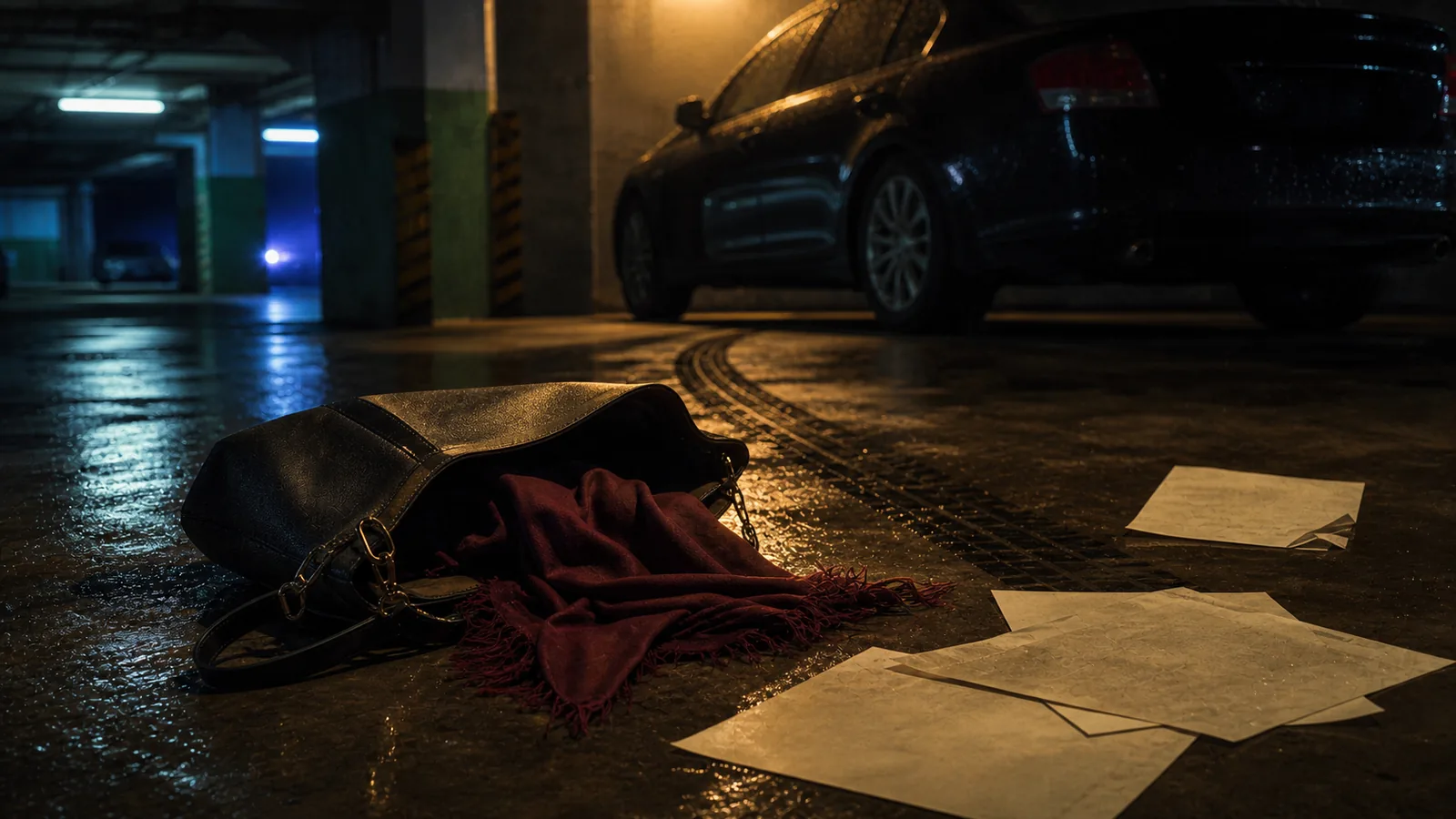
Kang frames Min-hui with the scarf, then tells Mun-oh he saw Su-hun and Min-hui in the garage
The hour’s tree does not need a typhoon. It needs a scarf in the wrong purse. Kang writes the argument as if it simply happened: Se-yun’s mother accuses Min-hui of stealing an expensive designer scarf, Min-hui denies it, Se-yun rushes for his mother’s pills, and Se-yun’s father heads outside to confront the housekeeper. Mun-oh spots the missing hinge before Kang can dress it up. Kang orchestrated it.
The rebuke is the clearest Mun-oh has been all season. A writer observes the situation, he tells him; a writer does not meddle with it. Kang stole from the household and framed a woman he disliked, then tried to call it a prank because Min-hui had been cruel to him first. Mun-oh is right, and also the man who stole contest questions so Kang could keep entering that house.
Kang saves his biggest observation for last. After Su-hun followed Min-hui out, Kang says he saw what looked like a couple’s fight, then a shaking car in the garage. He is certain Su-hun is having an affair with Min-hui. Mun-oh does not accept the leap. Kang saw movement, not faces; he is swinging assumptions around like the hammer in his phone game. The lecture turns almost noble: to write the truth, you cannot make your own. For a story to have a moral, you have to have morals yourself. It would land cleaner if Mun-oh’s own line were not built on stolen files.
Kang lies about an accident, drags Mun-oh out at night, and Kim Su-hun walks into the story under his real name
Mun-oh tries to quit Kang after that. Hyeon-suk, who sees sweetness where Mun-oh now sees danger, suggests the obvious wound: maybe Kang’s potential makes him uncomfortable. Maybe he is jealous. Mun-oh dodges it, then wakes to Kang’s call.
Kang says he has been in an accident and needs someone to pick him up. He could have called Se-yun or Mr. Kim, he says, but Mun-oh was the first person he thought of. It is calibrated to pull Mun-oh out of the house: fear, preference, urgency, dependence. When Mun-oh arrives, Kang is unhurt. He wanted Mun-oh to see that Su-hun and Min-hui had gone inside together, proof that the affair claim was true.
Mun-oh is furious enough to end the mentorship in the street. Then the real emergency breaks open. People call for an ambulance. A woman is hurt, and Mun-oh understands she is Min-hui. The man nearby is Se-yun’s father. Mun-oh finally understands the scale of the manuscript he has been reading. “Mr. Kim” turns out to be Kim Su-hun: famous novelist, old rival, public friend, and the man whose name has been haunting Mun-oh since the premiere. Kang has moved into a family, and into Mun-oh’s unfinished envy.
Tiny details worth clocking
- Kang settling for runner-up is not remorse. It is calibration: enough success to earn dinner, not enough to trigger scrutiny.
- The three white roses do double work. Se-yun gives Kang the correct family detail, and Kang repeats the “small bouquet” line later because he has learned how useful humility sounds.
- Hyeon-suk notices Kang looks familiar before the show gives Mun-oh the Su-hun reveal. The episode keeps planting recognition as a domestic itch, not a mystery-board clue.
- Kang refusing Jeong-hu’s room lets him look considerate while preserving the room as a shrine to the family’s real daughter.
- Mun-oh’s hammer-game metaphor works because the episode already showed Kang making a phone game with a kill button. Even his harmless play has the same blunt instrument inside it.
Final verdict
Episode 2 is talkier than the premiere, and a few teacher-student exchanges underline the observing-versus-spying argument with a heavy pencil. Mun-oh tells Kang the rule, Kang violates it, Mun-oh restates it, and the episode occasionally trusts the lecture more than the images.
The images are stronger. Kang in the Kims’ doorway with flowers, Mun-oh sleeping beside Hyeon-suk after calling corruption exhilarating, Min-hui’s lipstick on the cigarette butt, Jeong-hu’s room left intact, the scarf in the purse, the call for an ambulance with Su-hun visible: those beats do the work. They turn a campus-writing story toward class access, marital erosion, and the violence that starts when a writer wants the world to arrange itself for him.
The episode’s sharpest scene is the one in the middle, where Mun-oh condemns Kang for framing Min-hui and then cannot escape the fact that he built the conditions for it. He wanted Kang to observe beyond the surface. He wanted the family knocked off its pedestal. What he gets is a student willing to push until the pedestal cracks, and a rival’s name standing beside an injured woman at the end. That is a colder escalation than another file theft would have been.
Rating: 8.7/10 — a strong hour with one over-explained craft lesson, but a nasty expansion of Kang’s access, Mun-oh’s envy, and the show’s argument about writing as trespass.
More episodes from Notes from the Last Row — A campus novel turns into accusation, obsession, and evidence. Jump to any episode in the season:
Where to go next
Reviewed by Mira Vance · QuizFandom Editor & Lead Reviewer. Every rating is an honest per-watch assessment from the desk that also writes the quizzes — not a press release rehash.