Notes from the Last Row Episode 3 Review: "Episode 3" — Min-hui Dies, Kang Finds the Premier Suite, and Se-yun Calls His Sister
What happens — the short version (spoilers)
- Mun-oh leaves the accident scene, learns Se-yun's father is Kim Su-hun, and remembers Eun-joo choosing Su-hun in their university years.
- Mun-oh's inciting-incident lecture collapses, and Kang explains that the last row lets him see everything without being seen.
- The Kim family treats Min-hui's absence like an inconvenience until a call says she died in the ER and Se-yun collapses at breakfast.
- Mun-oh finds Kang at a corner store, restarts the lessons, and tells him Su-hun must never know what they are doing.
- Hyeon-suk turns Mun-oh's date into a group dinner where Su-hun appears, praises his own future work, and recalls Mun-oh as a last-row watcher.
- Kang meets Jae-sik at the hotel, learns Su-hun was a premier-suite regular, and ends with Se-yun telling Jeong-hu their father murdered someone.
Episode 3 turns the accident into the season's first real body, then watches everyone decide what kind of story Min-hui's death can become. The hour braids Mun-oh's old jealousy of Kim Su-hun with Kang's manuscript about Se-yun's household, where guilt and suspicion arrive before evidence does. By the time Kang meets Jae-sik at the hotel, investigation has already become authorship: a professor and a student chasing facts because facts might finally give their obsession a plot.
Mun-oh leaves the accident scene, learns Se-yun’s father is Kim Su-hun, and remembers Eun-joo choosing the other man
The episode picks up with the woman on the pavement and Kang doing the practical, cowardly thing. He tells Mun-oh they should go before Mr. Kim sees him there. Kang apologizes in the car, says he only wanted to prove he was telling the truth, and then finds out the one fact Mun-oh cannot forgive him for withholding: Se-yun’s father is Kim Su-hun.
Kang’s ignorance is almost insulting because it is genuine. He knows Su-hun as Se-yun’s father first, a famous author second, and Mun-oh’s wound not at all. When he asks whether that matters right now, the episode cuts into the old campus triangle: young Mun-oh offering Ahn Eun-joo a book of poems, Eun-joo lighting up when Su-hun arrives, Mun-oh becoming the last-row watcher before the phrase has a theory.
The hour makes the flashback nastier by pairing it with the present: Su-hun gently telling Eun-joo that her peace of mind matters most to the family, then Mun-oh alone with the thought that Su-hun has Eun-joo and still might have Min-hui. Mun-oh does not yet know what happened in that hotel, but his old envy gives the new suspicion somewhere to live.
Mun-oh loses his inciting-incident lecture, and Kang says the last row lets him see without being seen
Back in class, Mun-oh tries to teach the idea of an inciting incident and cannot keep his own story out of the room. He talks about an event that sets the story in motion, something intrinsic to the characters’ inner conflicts, then loses the thread. It is a tidy little humiliation: the professor defining narrative pressure while becoming proof of it.
So he pulls Kang outside and asks the question the show has been saving since the title. Why does Kang always sit in the back? Kang’s answer is too clean to be accidental: it makes it easier to see everything without being seen. The last row is not shyness. It is a method.
Mun-oh pretends he wants information because he was there too. He asks how Su-hun reacted, what has happened since, whether Kang can talk to anyone else about it. Kang gives him the fact that changes the hour’s temperature: Min-hui died. The police called. Then Kang turns the interrogation around and asks how well Mun-oh knows Kim Su-hun. Mun-oh lies badly, Kang catches him with the guest-lecture detail, and the mentorship almost ends again.
It does not end because Kang has written it down.
The Kim family calls Min-hui a sulking employee, then hears she died in the ER while Se-yun collapses at the table
Kang’s pages return to the Kim house on the morning after the accident, where the family’s ignorance is its own indictment. Eun-joo thinks Min-hui has skipped work out of spite. Su-hun calls her attitude exhausting. They discuss notice, replacement meals, takeout, and the inconvenience of hiring again before anyone knows the woman is dead.
The call arrives in the middle of breakfast. Eun-joo cannot get the words out, so Su-hun takes the phone and turns the shock into admin: yes, he is listening; call his cell, not the house; here is the number. Se-yun is having a panic attack beside him, and Su-hun is still managing which line receives the next piece of information.
Eun-joo’s guilt is more visible. She remembers treating Min-hui badly and says she should not have let her leave like that. Su-hun comforts her with a line about what people cannot control, which would sound kind if Kang’s narration were not pressing another word against it: malice. Mun-oh reads the word as if it were evidence already. Kang has put a feeling on the page, and Mun-oh wants the feeling to become usable.
Mun-oh finds Kang at the corner store, restarts the lessons, and turns suspicion into real-world research
Mun-oh goes to Kang’s corner store pretending he only needs cigarettes. Kang laughs because the lie is obvious, and that little reversal says plenty about where the power is now. Mun-oh has come to rescue the lessons he himself canceled.
The ethical language Mun-oh uses is almost comic in its self-protection. Su-hun is no stranger, he says, and the situation is not free of ethical concerns. Still, continuing the lessons is the right thing for Kang’s studies, and for Mun-oh too. Then he makes the real rule: Su-hun must never know about any of this.
Once that secrecy is secured, Mun-oh asks about Kang’s words. Why malice? Why hatred? He tells Kang not to jump from an affair and a smile to murder, not without rationale. The first thing is to ask questions. What led to the accident? In literary terms, he calls it real-world research.
Kang hears permission, not caution. His heart starts pounding. He wants to go back to the hotel immediately, and he even invites Mun-oh along with a dare about losing face. Mun-oh insists he has plans.
For once, he almost does. He asks Hyeon-suk to go for a walk or see a movie, then says the quiet part with all the stiffness of a man relearning ordinary marriage: he is asking her on a date.
Hyeon-suk brings friends to Mun-oh’s date, and Su-hun makes the old last-row wound public over dinner
The date becomes a group dinner because Hyeon-suk, wonderfully and terribly, thinks two people alone might be boring. Mun-oh sits at the table while Kang texts from the hotel. The comic timing is mean in the show’s preferred way: Hyeon-suk’s friends are trying to celebrate the marriage thaw, and Mun-oh is checking his phone like the student affair is his actual spouse.
Then the conversation turns too honest. Hyeon-suk tells the table Mun-oh has been sleeping in her room again. Her friend is delighted, then bulldozes straight into the old IVF years, miscarriages, loneliness, and Mun-oh’s absence. Mun-oh flees to the restroom just as Kang sends the assignment.
By the time he returns, Su-hun has joined the table. Professor Park found him after dinner with a publishing president and brought him over like a prize. Su-hun is gracious, famous, productive, and apparently already talking about the book after his next one. Mun-oh asks where the ideas come from, and the question is transparent enough that Hyeon-suk explains it for him: Mun-oh has struggled to write another novel and wants to know how Su-hun does it.
That is the evening’s cleanest injury. Su-hun also tells Hyeon-suk that Mun-oh used to sit behind everyone in the last row, watching, making him nervous. The phrase passes from Kang to Su-hun and lands on Mun-oh. He has been judging the boy’s method without admitting it was his own.
Kang runs into Jae-sik at the hotel, and the premier suite turns Su-hun into a regular with expensive wine and cheap ice cream
Kang’s hotel investigation begins badly. The desk will not give guest information, a worker does not recognize Su-hun’s photo, and Kang wanders where he is not allowed. Then luck does what craft sometimes cannot. A hotel employee recognizes him as Lee Kang, and Kang recognizes him back: Jae-sik, from the summer before, now working the hotel where Min-hui was hit.
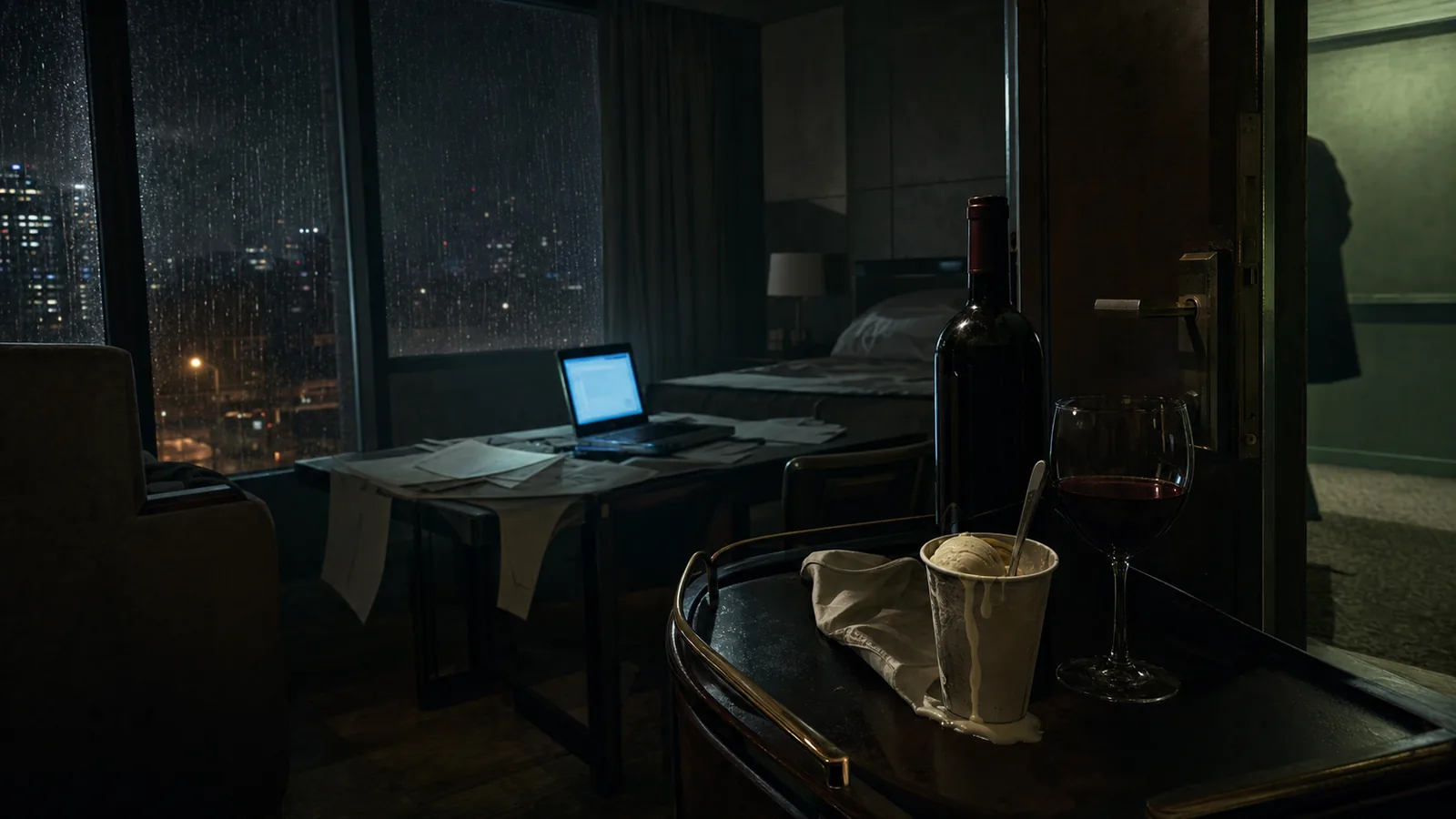
Jae-sik gives Kang the kind of testimony writers dream about because it comes with texture. He says Su-hun was a regular in the premier suite, visiting three or four times a month, always the same room, always high-end wine and cheap ice cream. The detail is absurd enough to feel true before it is useful.
He also says the outfits changed: nurse, bunny, schoolgirl. The episode lets the information sit beside Su-hun on the phone in the suite, telling someone he is away without his wife and not writing yet. The public author who had made such polished space for himself on campus now has a private room full of appetite, routine, and lies.
Kang asks whether that was what happened the night of the accident. Jae-sik says no. That day was different.
Jae-sik hears Min-hui threaten proof, and Se-yun calls Jeong-hu to say their father murdered someone
The difference is the threat. Jae-sik says he saw Su-hun and Min-hui outside, and the episode shows enough to make the account hard to ignore while still keeping it as testimony. Min-hui tells Su-hun to let go. He tells her not to walk away. She threatens to show everyone who he is and prove it. A car hits her before any proof reaches the screen.
Jae-sik adds the second needle. Another young man came to the hotel asking the same questions and wondering whether the crash could have been intentional. Jae-sik did not hear that man hear the threats, so the question bothers him. What made him think murder was possible? What did he know?
The episode cuts that question against Min-hui and Su-hun’s room argument: she tells him this is all he has, he calls her a leech, and the threats turn physical before the hallway confrontation. Mun-oh reads Kang’s assignment at home, finally asking the right question in the wrong emotional register. Who is Su-hun? What has he done?
Then he calls Kang in the middle of the night and abandons every rule he gave him. Find the other guy. Check security cameras if necessary. Kang has to tell him to calm down. Mun-oh, who turned caution into a lecture at the corner store, now wants proof because proof might make Su-hun’s ugliness legible.
The final scene belongs to Se-yun. He calls Jeong-hu, says he is scared, and then says the line the whole hour has been approaching without permission: Dad murdered someone. He thinks he did it.
Tiny details worth clocking
- The “inciting incident” lecture breaks down on the word “intrinsic,” which is exactly the point. Mun-oh cannot teach plot mechanics because Su-hun has become intrinsic to his own conflict again.
- Kang’s last-row explanation mirrors Su-hun’s memory of young Mun-oh. The student and professor are not opposites; they are two men who learned to watch from behind other people.
- Su-hun asking the police to call his cell, not the house number, is framed as practical, but it also keeps Min-hui’s death moving through a private channel he controls.
- The hotel order is grotesquely specific: expensive wine and cheap ice cream. The class contrast is doing half the characterization before anyone explains a motive.
- Hyeon-suk’s group-date mistake is funny until her friend says the IVF years out loud. The show keeps using awkward social scenes to expose the facts couples hide from themselves.
Final verdict
Episode 3 is the season’s best hour so far because it lets evidence and envy contaminate each other. Mun-oh suspects, Kang chases the hotel story, and Se-yun panics. The rot is in how quickly each turns fear into a form that serves him.
The hotel investigation is also the hour’s most convenient stretch. Jae-sik recognizing Kang at exactly the right door, remembering the suite habits, and becoming a witness with nearly every missing detail is a lot of machinery arriving at once. The show sells it through specificity and by making Kang’s luck feel grubby rather than heroic, but the hinge is visible.
What works is the pressure around that hinge. Mun-oh’s failed lecture, Hyeon-suk’s wounded date, Su-hun’s dinner-table superiority, Kang’s corner-store grin, and Se-yun whispering to Jeong-hu all point to the same accusation: watching is never neutral once you need the world to prove your story back to you. Min-hui is dead, and before anyone has grieved her properly, she has become material for Kang, leverage for Mun-oh, terror for Se-yun, and a secret Su-hun may still be trying to contain.
Rating: 8.9/10 — a sharper, more anxious hour with one convenient witness turn, but excellent control over how suspicion becomes research, research becomes narrative, and narrative starts eating the dead.
More episodes from Notes from the Last Row — A campus novel turns into accusation, obsession, and evidence. Jump to any episode in the season:
Where to go next
Reviewed by Mira Vance · QuizFandom Editor & Lead Reviewer. Every rating is an honest per-watch assessment from the desk that also writes the quizzes — not a press release rehash.