Pachinko S2E4 Review: A barn becomes a country, a phone call settles a life
Kogonada threads wartime evacuation and 1989 Tokyo into the same nocturne, watching three women decide what counts as a life worth choosing.
The fourth hour of Pachinko’s second season takes place almost entirely after dark, and it is structured around three rooms a woman should not be in. The young Sunja climbs into a truck with the man she once loved and drives it into the mud. The older Sunja walks unannounced into her grandson’s Tokyo apartment and finds out who he has become. A third woman, the foreman’s wife Kyunghee, stands by a rice shed she helped fill and watches it burn. No theme music connects them. They just rhyme.
A boys’ war and a brother’s burden in the same morning
The opener belongs to Mozasu, a child here, hammering wooden spikes into the dirt with Mr. Kim to defend the farm against an American invasion that exists only in his imagination. Mr. Kim humors him for a minute, then pivots into a speech the season has been writing toward since season one. Noa, he says, is head of the household now. That is as much a burden as a privilege. There is no room for failure for the older brother. You probably can’t yet see what I mean, he tells Mozasu, but believe me, yours is the easier life.
The scene is brief and almost throwaway in its staging — two boys, a sweating handler, a pile of pointed sticks — but Kogonada has the patience to let the line sit. The rest of the season will spend itself on whether Noa can carry that weight. The morning just plants the stake.
A few minutes later Noa is in the woods with Minoru, a Japanese classmate who used to be cruel to him. Minoru tells a story about his father, a man who never passed an exam in his life but used both fists on his son the night he learned Noa was Korean and outranking him at school. Then Minoru, blunt the way only twelve-year-old boys can be, asks Noa if they are friends now. He apologizes. Noa hands him a wooden sword. The truce holds for the rest of the night, and it is never oversold. Minoru is still the foreman’s son. The foreman, by the end of the episode, will be on the ground bleeding.
Solomon’s apartment, his grandmother, and the woman in the doorway
The 1989 thread runs as a single continuous interruption. Solomon Baek is on the phone to Tom Andrews when his door buzzes. He opens it expecting Naomi Ichizaki for dinner. He finds his grandmother instead, holding tupperware of galbi-jjim and complaining about the dust on his floor. She has come because she had a dream. She does not remember the dream.
What follows is one of the most carefully shot apartment scenes Pachinko has ever staged. Naomi arrives, hands Solomon a newspaper about the land deal in Tokyo and the bones beneath it, and pivots immediately into Japanese once she registers the older woman in the kitchen. Sunja makes Naomi take off her shoes, makes her put on slippers, makes her eat. Naomi tries three times to leave. Sunja refuses to let her. The dinner that follows is the engine of the episode’s quieter half, because it gives Naomi space to say out loud what she has been holding back for two episodes: that watching Solomon hold his line on the land deal empowered her. That she has been working on something at Shiffley’s that could be hers. Yotsuba Finance. A 30-to-50 billion yen IPO. Ten percent free float now, she is pushing for more.
She tells him because she trusts him. She tells him because she has misread the kind of man he has become. We cross-cut her confidence against Solomon on a different phone earlier that day, calling the loan on Abe-san. The audience holds both scenes at once. Naomi does not. Nobody punishes her for that. The point is what Sunja sees when she watches it happen.
Sunja’s late-night speech to Solomon, after Naomi has gone, is the spine of the modern half. Whatever scheme you have, she tells him, I will not ask questions. I do not want to hear your lies. Just this one thing. Do not forget the kind of man you are. Can you do that? Solomon answers, after a long pause, that he wants to. That is not the same as yes. He knows it. So does she.
A driving lesson, mud, and the line Sunja will not cross
The longest sequence belongs to Hansu and the young Sunja, and it is built like a chamber piece. Hansu finds Sunja outside the barn at midnight, asks if she has ever driven a car, and tells her everyone should drive at least once in their life. She climbs in. He teaches her the clutch. The car lurches. They laugh. The radio plays. They almost hit something, swerve, and bury the truck in mud.
They push it out together. Sunja offers to fetch Mr. Kim and Noa for help. Hansu says the two of us can do this. The line is the rule he lives by. Then they kiss. Then Sunja stops.
The dialogue that follows is more exposed than Hansu has ever been, and his face plays it in a register he has rarely had to use. Your husband is gone, he tells her. You don’t owe him anything. She corrects him. I owe everything to my husband. He asks how long she will serve a grave. He says everything I do is for you and my son. She tells him her heart is too late. There are no strings, almost no underscoring — just the engine idling in the background.
The real payoff arrives in the next room. Sunja walks back to the barn caked in mud. Her mother is awake. He’s the father, isn’t it, she says. It is the first time in the season that Yangjin has named it out loud. She plays the question as exhausted recognition, not accusation. Sunja does not deny it. Her mother tells her the boy must never know, and that whatever is happening with Hansu must be discreet. Sunja, washing the mud off her own face, tells her mother not to worry. I remembered myself with him, she says. The line is the hinge of the entire hour. It is the closest the season has come to naming what a love affair under occupation actually costs the woman.
A foreman, a chicken, and the violence Hansu actually trades in
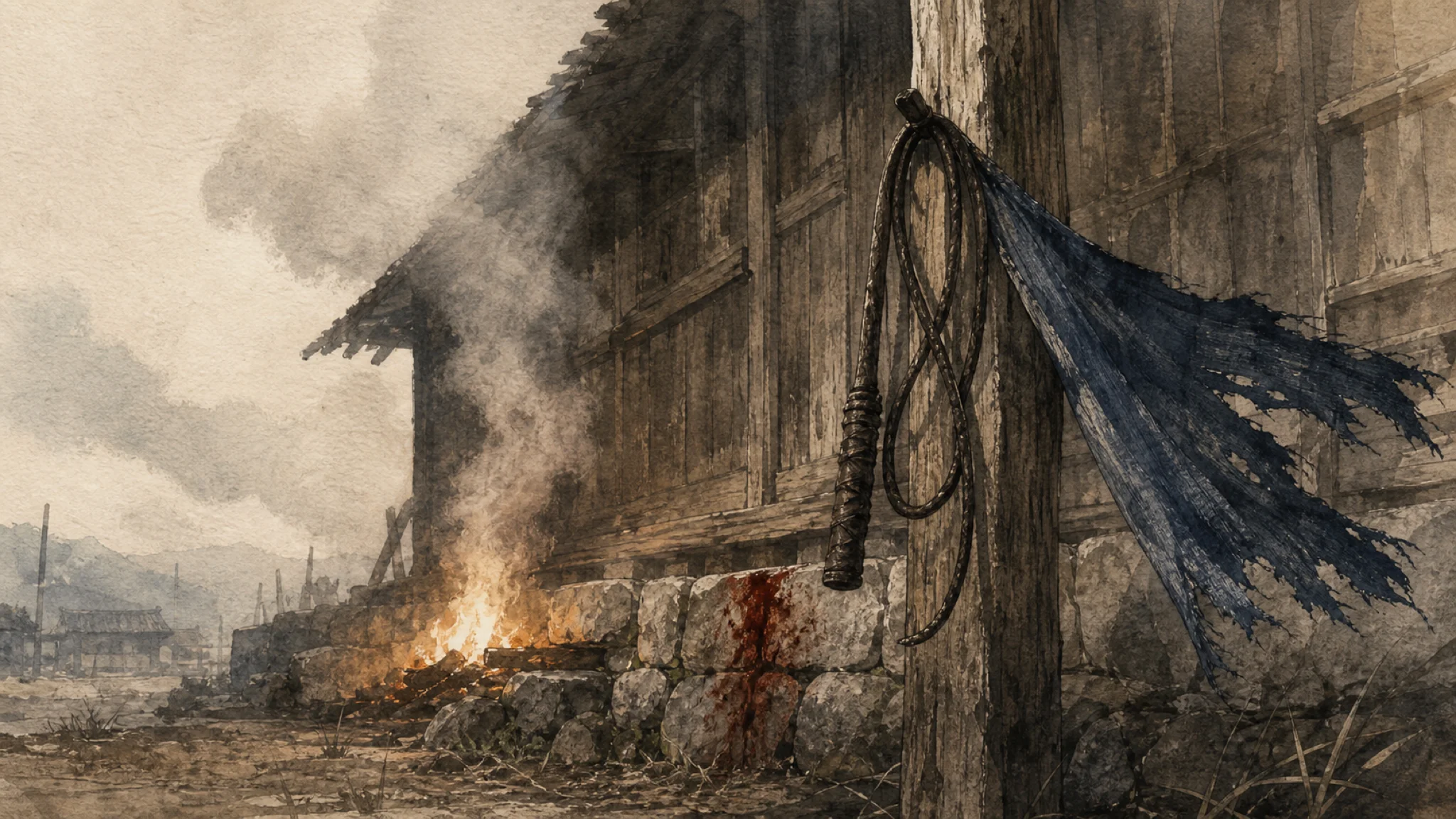
The final movement of the period story is what retroactively reshapes everything before it. Hansu, after dropping Sunja off, drives to the foreman’s quarters. The foreman is the one who let Kyunghee borrow a chicken for the welcome dinner earlier that day. Hansu drags him out of bed and beats him in the dirt yard. The foreman pleads. It was just a few chickens. Forgive me. Hansu does not stop.
Noa, sneaking out with Minoru to chase fireflies, watches the beating from the trees. Minoru calls his name. Noa cannot move. The shot of the boy watching the man he has spent the season trusting is held longer than it needs to be. No score lifts. No cut to Hansu’s face. We stay on Noa.
What this sequencing argues is that the driving lesson and the kiss were not Hansu’s love story. They were Hansu’s idea of one. The same man who told Sunja the two of us can do this is the man who can be in the mud at midnight bleeding a working-class Japanese foreman over poultry. The setup has been patient. It pays off in one cut.
What this episode argues
Three women, three rooms they choose to stand in. Sunja chooses the barn. Her mother chooses to stop asking. Naomi chooses Solomon’s bed without yet knowing what she has walked into. Kyunghee, the foreman’s wife, runs to a burning rice shed and asks Mr. Kim, plainly, whether she has lived a life well-lived. She says she does not believe in the life after. She says this one life is her only one. If the Americans come tonight and drop their bombs, she asks, could I really say I have lived a good life? Noa is twelve years old and outside the same conversation, watching a different man fail the same question.
The quiet argument is that the women in this story have been doing the thinking and the men have been doing the bargaining. Hansu trades a beating for a thank-you. Solomon trades a loan call for a promotion. Mr. Kim trades nothing. He follows Kyunghee into a burning shed and admits he came because she knows why. That last admission is the only one in the hour that arrives without a price tag, and it goes to a man the audience barely knows.
The phone call between the older Sunja and Kato-san that closes the modern half is the closest anyone comes to being released from anything. He has been waiting for her call. She has been worrying about her grandson. He asks about Naomi. Sunja tells him she is Japanese. He asks if that is a problem. With the little time I have left, she says, I get to choose what I see. Have we not earned that right? The question hangs. Then we cut to the rice shed burning.
Verdict
The fourth hour is the best Pachinko has been so far this season, and it works because Kogonada and writer Soo Hugh trust the material to land without underlining. The driving lesson is staged with the same composure as the fish-market haggle in the pilot. Kyunghee’s monologue at the burning shed is the kind of scene most prestige dramas would build a whole episode around; here it functions as the final note of a chord that has been resolving since the cold open. Mozasu does not appear in his adult form here, but the morning scene carries the same offhand warmth he always brings.
The only real risk is that Hansu becomes visibly worse without losing Sunja’s interest, and viewers who arrive wanting the driving lesson to be a love scene rather than a warning may bristle. It is a warning. Noa’s face in the trees is the audit. The swing taken here is earned.
Rating: 9.1/10
More episodes from Pachinko — Season 2 — Sunja's family enters the postwar reckoning, episode by episode. Jump to any episode in the season:
Where to go next
Reviewed by Mira Vance · QuizFandom Editor & Lead Reviewer. Every rating is an honest per-watch assessment from the desk that also writes the quizzes — not a press release rehash.