Pachinko S2E5 Review: An empire ends, a household reorganizes around the man it was built to deny
Kogonada's fifth hour collapses Japan's surrender, a brother-in-law's recognition, and a son's exam into a single ledger about whose name a family will finally speak.
The fifth hour of Pachinko’s second season opens inside a Japanese munitions factory weeks before the surrender, and closes inside a Korean War broadcast that reaches Noa through the radio while he sits an entrance exam he has staked his whole adolescence on. Between those two bookends, Pachinko does what it does best at full pressure. A man on a tatami floor is recovering from a bomb blast. A rival walks into the room and explains, with quiet precision, that the family the man thought he was the head of belongs to someone else. Empires lose. Households lose. Both losses get processed by the same small set of people who keep going to work the next morning.
A chisel, a cheers, and a factory two days from a visit
The cold open sits with Yoseb on the factory floor in Nagasaki, sweeping aisles for a foreman who calls Koreans roaches under his breath. Taehoon, a younger conscript who has already lost his entire village to cholera, pulls him aside at a sake bar and asks which of his father’s two sayings applies tonight, whether the drink turns joy to sorrow or sorrow to joy. Yoseb tells the kid plainly that he wants to drink in peace and is asking as his elder.
What Taehoon tells him later, on the factory line, is the hour’s first quiet detonation. Out of eighty-nine people in his village, the boy was the only one who lived. He has spent the war asking why, and after the foreman’s banzai speech announcing that an imperial advisor will visit the factory in two days, he believes he finally knows the answer. He has hidden a chisel. Yoseb tells him not to commit a sin. Taehoon repeats the word back with something close to wonder, and asks whether his elder really thinks that is what this would be. Yoseb gives him a blessing instead of an argument. May your cup runneth over. The love you speak of, may it nourish you. The blessing is not a counter-argument. It is a farewell.
The dignitary arrives. The chisel does not. We see Yoseb shoved aside by a soldier, then a flash of light, then nothing. We never see Hiroshima. We hear the Emperor’s voice on a radio in a farmhouse where Yoseb has been hidden, telling his subjects that continued resistance would mean the obliteration of Japan and the destruction of human civilization. Kogonada plays the broadcast as a sound-design event under a sleeping man’s face. It is the only way to film a surrender that big without overplaying it.
Hansu walks into the sickroom and reorganizes the family
Yoseb wakes on a farm he does not recognize, his face seamed with burn-scars, and finds Hansu sitting beside him. What follows is the episode’s structural spine — one of the clearest conversations Pachinko has staged so far. Hansu introduces himself as a family friend. Yoseb places him almost immediately and asks the only question that matters. You are the boy’s father. Aren’t you?
Hansu does not lie. He has the right to be near Noa, he says, because Noa is his son. Yoseb counters that it was his brother Isak who raised the boy, and Hansu refuses the comfort of letting the moral high ground stand. Your brother left him a pauper. Yoseb threatens to murder him for that line, even if it means bursting out of what skin he has left, and the threat lands with the full weight of a man who has nothing left to lose and knows it.
Hansu lets him have the threat, then explains the situation as a balance sheet. I was the one who saved you. I saved many of your family, and not from any goodwill. Sunja and Noa compelled me. Because they are mine. The sooner you understand this, he tells him, the easier it will be for you.
The writing gives Yoseb his moral seniority and Hansu his actual leverage in the same scene, without picking a winner. The household has been reorganized while Yoseb slept. He is technically still the head of the family. He just no longer controls the supply lines that keep the family alive. This is not a defeat for Yoseb. It is the new equilibrium everyone in the room has to live inside. Even his wife Kyunghee, steadying his shaking hands at breakfast a few scenes later, has to absorb what it means that her husband can no longer pretend not to know.
Sunja’s restaurant and Noa’s refusal
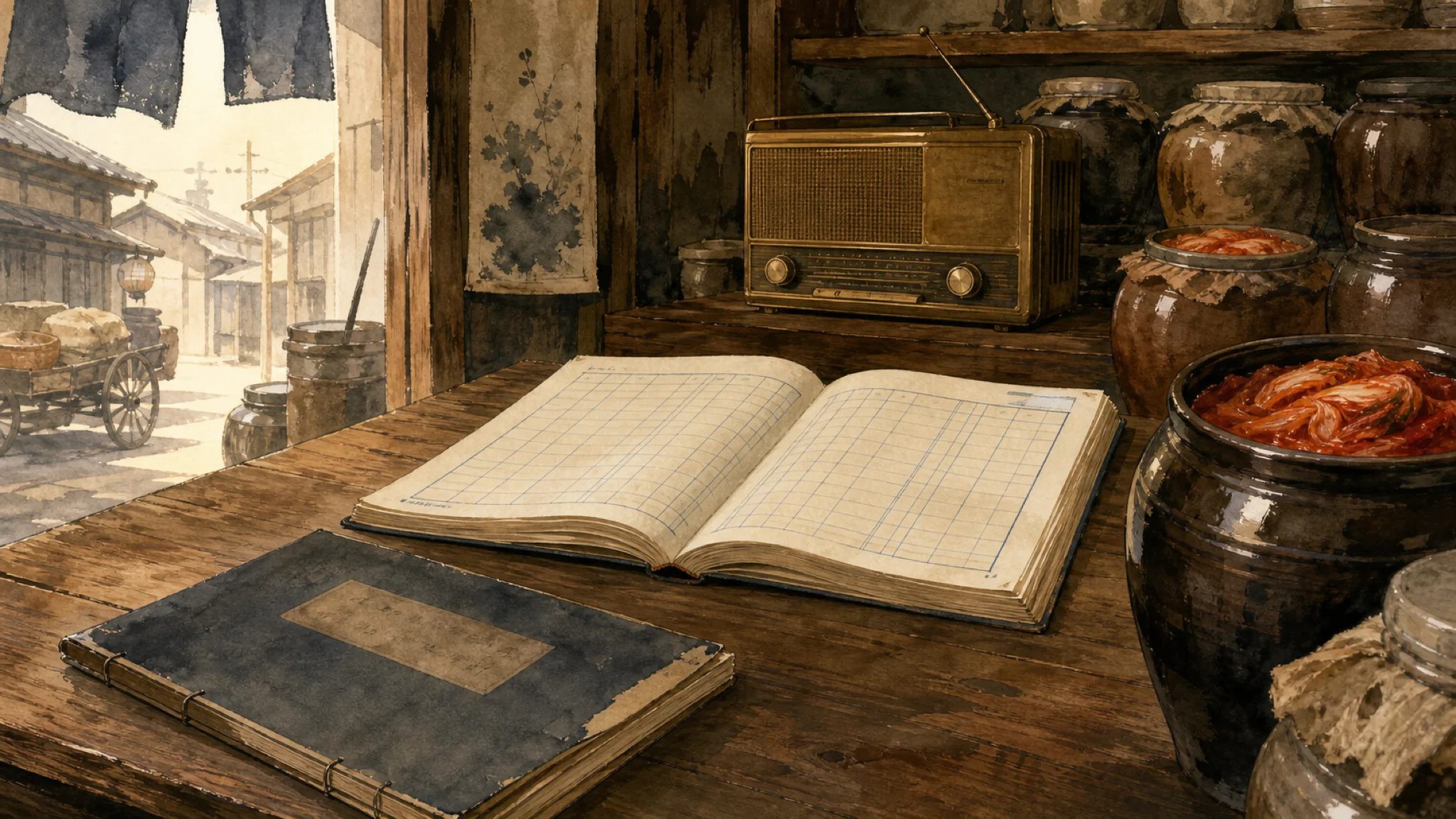
The middle section moves to the Osaka market, where Sunja is selling kimchi and noodles out of a stall and being courted by Goto-san, a local broker who claims to know the perfect storefront near the train station. The Americans will ease restrictions soon, Sunja tells him, and they have been saving every scrap. Sunja plays the conversation as a woman who has been mentally booking expenses for months and is allowing herself, for the first time, to imagine a business with her name on it.
That hope sits next to a harder question that belongs to Noa. Noa works the telegraph office during the day, studies for Waseda’s entrance exam at night, and falls asleep over his books. His mother sits beside him in the dark and apologizes for making it so hard. She tells him Hansu offered the money. She knows they could have taken it. The line she does not finish, and that Noa finishes for her, is that taking it would have made the path his, not theirs.
I wouldn’t want that to be how I did it, Noa says. You understand, don’t you? It is the clearest he has been about what he is defending. Not Waseda specifically. The principle that the entrance must be earned in a currency Hansu cannot print. Sunja nods. Her face does something more complicated than agreement. She knows what Noa does not. She knows whose money has been keeping them alive on this farm for months. She does not correct him.
A girlfriend, a loan, and Solomon learning what his clients learned a decade ago
The 1989 thread continues the season’s slow accounting of Solomon’s descent. The Shiffley’s meeting has him pitching a golf-range play on the Abe-san parcel, four hundred billion gross, three hundred billion net, members-only club at two hundred fifty million yen a head. The director’s foreign partner Andrew tells him bluntly that the appetite is bottomless. Tom, Solomon’s former mentor, then delivers the quiet 1989 turn. Shiffley’s will not be calling the loan, because Solomon’s former colleague Naomi made a convincing case on Abe-san’s behalf.
Naomi never appears in this episode. She does not need to. The Japanese partner asks Solomon whether he can convince his girlfriend to change her tune, framing it as a routine ask between men. Solomon’s face does the math in real time. The fact that the room knows about him and Naomi before Tom did is the actual content of the scene. Solomon promises he will handle it. The director smiles and tells him better him than me, don’t you think.
Later we cut to Solomon’s apartment, where his current girlfriend has fallen asleep waiting for him with the television on. She apologizes for not being more exciting. He tells her this is the highlight of his day. The scene is gentle. The context is not. We have just watched him agree to weaponize someone who trusted him, and we are being asked to hold both halves of him in the same hand. The season-one premiere taught us to do this. The fifth episode is pressing on the bruise.
A North Korean broadcast finds Noa at the desk
The closing movement is one of Pachinko’s most deliberate compositions. Noa sits the entrance exam. The proctor tells the students to wait for the minute hand to reach the half-hour mark, then open their books. We watch Noa’s hand. The hand opens the book. We cut away to a Japanese radio broadcast announcing that on the morning of the 25th, North Korean forces crossed the 38th Parallel and shelled the South at eleven locations along the border. President Syngman Rhee has ordered up defense forces. A red alert has been issued. The country is at war with itself.
The cut is the whole point. Noa has been working since the surrender to claim a Japanese university place by sheer mathematical attainment, and at the exact moment he opens the booklet, his home country is splitting in half on the radio. We never see his score. We do not need to. Whichever way the page turns, the ground he is being tested on is gone.
What this episode argues
The hour’s argument is that surrender is administrative. The Emperor’s broadcast does not end the war so much as redistribute its costs. Yoseb survives Nagasaki but loses the fiction of headship. Sunja keeps the family fed but learns that the money she has been refusing on Noa’s behalf has been there the whole time. Noa earns his exam day but inherits a war his country has just started without him. Solomon wins his loan-call argument with Tom, then discovers that the win was made by someone he is now being asked to compromise.
Each of these losses sits inside a household routine. Kyunghee steadies a hand. Sunja folds noodles. The market vendor with the tofu stall, a girl Noa hardly notices, tells him without prompting that she is certain he will not fail. None of these gestures stops the larger machine. The real question is how a family keeps performing small kindnesses inside a system that has just been reorganized over their heads. Pachinko asked it in the premiere. It asks again here at higher stakes. The answer has not changed. You do the next thing. You bring breakfast upstairs. You go to work.
Verdict
The fifth episode is the season’s most efficient hour. Hansu plays the sickroom scene with a stillness that lets the writing do its work, and the choice to give him the line about goodwill, rather than soften it, is the most honest acknowledgement Pachinko has made of who actually saved this family. The Taehoon strand is brief but devastating, the kind of self-contained tragedy Pachinko is willing to spend a quarter of an hour on because the war is its biggest character and individual conscripts are how that character speaks. The 1989 thread, often the season’s lighter ballast, lands harder here because the betrayal is not yet executed. Solomon has agreed to do something. Nothing has happened yet. The episode waits.
The hour’s only friction is the structural distance between its two strongest scenes. Yoseb and Hansu’s confrontation arrives so early that the episode spends its second half rebuilding tension from a calmer baseline. The Goto storefront conversation and the tofu-stall exchange with Noa are warm and well-observed, but they read as connective tissue between the surrender and the exam. A small structural cost for an episode that otherwise puts more weight on screen than most prestige dramas attempt in a season. The final cut, from Noa’s hand opening the exam book to a war broadcast he cannot hear, is the most assured composition this season has produced.
Rating: 9.0/10
More episodes from Pachinko — Season 2 — Sunja's family enters the postwar reckoning, episode by episode. Jump to any episode in the season:
Where to go next
Reviewed by Mira Vance · QuizFandom Editor & Lead Reviewer. Every rating is an honest per-watch assessment from the desk that also writes the quizzes — not a press release rehash.