Star City S1E7 Review: Petrovsky Weaponizes Salyut, Raskova Makes Irina a Double Agent, and Venera Calls Home
What happens — the short version (spoilers)
- A Soviet film capsule recovered in the United States exposes Salyut-1's military surveillance work, and Petrovsky orders Raskova to make an example of engineer Burkov when he resists the new program.
- Raskova visits the former Chief Designer under house arrest; he gives her the Venera image-compression algorithm as a possible fix for Salyut's transmission problem, then refuses to give more.
- Tarasov offers Belikova command of the next Salyut rotation, but admits her return to orbit will provide an alternate public narrative for the station; at Baikonur, she identifies Anatoly Frolov as KGB before launching and docking successfully.
- Petrovsky asks Irina to find proof for Raskova's removal and orders her to plant a bug, but Irina brings it to Raskova, who directs her to keep reporting to both Petrovsky and Raskova.
- Sergei gets Stepanov to reach Belikova on a secure channel, has her tune the UHF transmitter to 922.76 megahertz, and receives compressed data using his Venera algorithm; he realizes the craft could be returning to Earth now if it was not destroyed.
Petrovsky turns a space station into a surveillance platform with a public-relations problem, Belikova gets the return to orbit she wanted on terms she did not choose, and Sergei finds a signal that may put Venera back in the sky.
“Plow Deep” begins after the disaster, when Star City has had time to arrange the language. Venera is no longer an impossible mission or a crime unfolding in real time. It is a thing Petrovsky says Raskova failed to stop. Valya is no longer a man in an airless ship. He is a closed case. The old Chief Designer is no longer the program’s hidden architect. He is a man under guard on a farm, useful only if his old work can be stripped for parts.
What remains is Salyut-1: a station built to look scientific while photographing American silos and air defenses. When a film capsule lands on American soil, the cover is damaged, but the project is not. It simply needs a better story, a more obedient engineering staff, and the right woman back in orbit to make the story convincing.
That woman is Belikova. Her return has the shape of a gift for exactly one scene. Then Tarasov explains its use, a KGB attachment joins the mission, and she is asked to wave at a camera while the state turns her most private desire into a repair job for its public lie.
This is a quieter follow-up to the Venera emergency, but its pressure is just as specific. Petrovsky wants Raskova weakened. Raskova wants Petrovsky watched. Sergei wants out of Star City until a piece of old data gives him a reason to stay. The new evidence raises a familiar question: what happens when the people who buried a truth receive proof that it might still be alive?
Petrovsky turns Salyut-1 into a political weapon, and Raskova is told to break Burkov
The opening report makes the new order uncomfortably plain. Salyut-1 has been limited to Earth orbit after last summer’s deaths, but its supposedly scientific work is already being used to monitor Western military installations, ICBM silos, air defenses, and nuclear capability. The station is doing intelligence work from above the atmosphere. The machinery works. The delivery system does not.
When the Americans recover a Soviet film capsule, public denial cannot erase the obvious problem: Salyut’s photographs are proof of what it has been doing. Petrovsky does not treat the exposure as a reason to reconsider the project. He treats it as a failure of transmission, then a failure of loyalty. Raskova’s engineer Burkov, he says, is too attached to the former leadership to find the answer Petrovsky wants.
Raskova knows what that instruction means before he says it directly. Petrovsky wants an example made. He arrived in Star City after Venera, and he uses the Mironov affair, the illegal mission, and the resistant engineers as leverage. Raskova argues that she stopped Venera and ended Mironov’s threat. Petrovsky hears a subordinate trying to preserve her own record. The warning is that bigger changes are available if she cannot impose order herself.
He even asks after Irina with the calm of someone looking over a piece on the board. Raskova calls Irina promising but undisciplined, too eager to impress. Petrovsky counters that he had the same flaws when he was young. It sounds like generosity until the later scenes reveal its purpose. He is not protecting Irina from Raskova. He is measuring whether she can be separated from her.
Burkov gives Raskova the resistance Petrovsky needs her to punish. He calls Petrovsky a KGB stooge, refuses to sign a confession for sabotaging Salyut, and says the missing technical answer cannot be produced by force. Engineers need inspiration. Everyone in the room knows who he means. Raskova still removes him and elevates Stepanov to lead engineer. Petrovsky gets a cleaner chain of command, while Salyut loses one more person willing to say that a technical problem is not solved by a political threat.
Raskova reaches the former Chief Designer for Venera’s algorithm, while Sergei tries to leave
Raskova has no affection for the former Chief Designer, but she does have a problem that Petrovsky cannot bully away. She visits him under house arrest and asks for a secure way to get Salyut’s surveillance images back to Earth. He answers with the contempt of a man who knows he has been kept alive because the people who replaced him cannot do what he did.
Their argument carries the season’s history without stopping to restate it. He calls Petrovsky inadequate. She reminds him that he accepted responsibility for the Venera fiasco and that his co-conspirators avoided prison because he did. He reminds her what happened to his engineers, his “Eagles,” and refuses to let patriotism make the old abuse sound noble.
Raskova tries anyway. She invokes the gulag, the starvation and cold he survived, and the fact that he returned to work when the state called. He calls himself a fool. It is a sharp correction to her version of loyalty. The state has always been able to translate survival into devotion after the fact; the former Chief Designer is old enough to hear the translation and reject it.
He still gives her something: an algorithm from the Venera computer that could downgrade high-resolution images into data that can be transmitted. The code may still be in Salyut’s communications system. It is not a reconciliation, and the review should not dress it up as one. It is an old man protecting Star City from Petrovsky’s damage in the only way he has left.
Sergei is moving in the opposite direction. He asks someone to pass along an application for a university post, explaining that he needs a change because Star City is not what it used to be. The line lands after Burkov’s removal and before the signal discovery, when escape still looks like a rational ambition rather than a plot turn. Sergei has watched the Venus project become a disaster, watched its people removed or arrested, and learned that Petrovsky can turn an engineer’s disagreement into a confession.
Tarasov gives Belikova a return to space that doubles as a cover story
Belikova’s parents’ farm provides the hour with its most controlled version of normal life. Her father tends the land, her mother manages the household, and a state film turns their home into proof that the cosmonaut came from proper soil. The film also rewrites Sasha into a clean national sacrifice and presents their marriage as a boundless shared commitment. Belikova has to stand in the room while the state turns the man she loved, and the marriage it arranged, into usable footage.
Tarasov comes after the screening with another proposition disguised as gratitude. Belikova has done everything the state asked, he says, and now it is time to return the favor: she will command the next Salyut-1 mission. The offer reaches the exact place he knows it will. She has wanted to return to space ever since Luna 16. She also knows, immediately, that he has not driven to her family’s home merely to make her happy.
The explanation is brutally practical. The United States is accusing the Soviet Union of using Salyut for intelligence. A triumphant return to orbit by the famous woman who went to the moon will create an alternate narrative. Belikova’s command is not a restoration of trust. It is a human face placed over a surveillance project that has been exposed.
She agrees because space is still the one place she can imagine as hers, even after the state has repeatedly claimed her name, image, marriage, and grief. The timing leaves no room to make it her decision in any meaningful sense. A plane takes her from Taganrog to Baikonur the next morning, where Anatoly Frolov is introduced as part of the latest cosmonaut attachment. Belikova immediately identifies him as KGB. When he begins to refer to the mission’s real purpose, the exchange cuts away before he can say more.
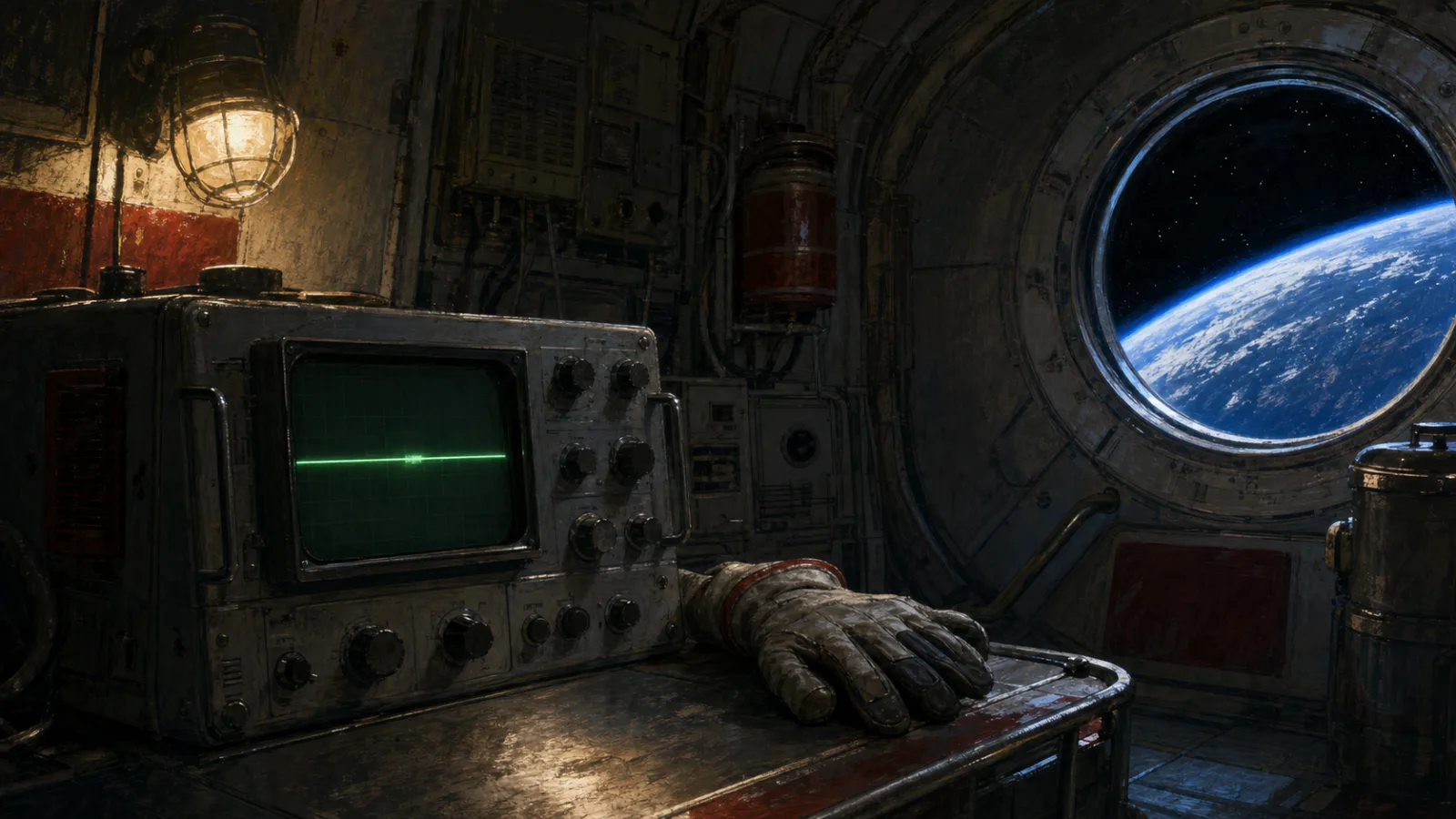
Her launch and docking are allowed to be competent without becoming liberating. She handles the Soyuz approach to Salyut-1, gets soft capture, and hears the station welcome her aboard. It is a fine spaceflight sequence because it returns her to the work she can actually do. It is also surrounded by people who have selected her for a story, a security monitor built by Frolov, and cameras waiting for her public answer. The state has given her altitude, not autonomy.
Petrovsky recruits Irina to move against Raskova, and she brings the bug straight to Raskova
Petrovsky’s meeting with Irina has the polished intimacy of a recruitment pitch. He tells her Raskova is holding her back, says Star City needs younger people who understand science and technology, and names them both as the people who should control its future. His argument has enough truth to be dangerous. Raskova has taught Irina through fear, used her work, and repeatedly refused to let her possess the full authority she craves.
Then Petrovsky makes the personal material explicit. He refers to the abuse Irina endured before coming to Star City, names her daughter Zoya as the good thing that came from it, and invokes their shared Rublyovka background. None of this is tenderness. It is proof that he has looked through the parts of Irina’s life that are supposed to be hers and decided they can be put to work.
What he wants is proof that removing Raskova serves the state. Irina does not accept the offer in the room, but the question follows her. Petrovsky has chosen his target well: he offers advancement, recognition, and a version of power that does not require her to keep waiting for Raskova’s approval.
Irina’s next move is the episode’s most satisfying reversal. She brings Raskova the surveillance device Petrovsky ordered her to plant. She does not try to hide the assignment or pretend she refused it from pure loyalty. Raskova’s response is colder and more useful. When the head of Star City gives an order, Irina must follow it. From now on, she will report to Petrovsky and to Raskova.
It is the first clean version of Irina’s double position. Earlier, she survived by twisting an operation or withholding a piece of it. Here Raskova turns the split into a formal strategy. Petrovsky thinks he has put a listener inside Building 12. Raskova lets him believe it, while making Irina carry two masters in the same body. For Irina, promotion has once again arrived as a more sophisticated trap.
Belikova docks with Salyut-1, while Sergei asks Stepanov for one unauthorized call
The Salyut material uses space to show how quickly hierarchy settles into every new environment. The outgoing crew jokes about bringing their vodka home; Belikova looks out at the station and calls it beautiful; then the docking checklist takes over. Fuel reactor cells, closing rates, latch alignment, contact points. She is good at this, and the show is careful to let that competence stand beside the political use being made of her.
Back at the facility, someone asks why Kirill has not shown up for work. The absence is brief but unsettling in a place where nobody is simply missing by accident. Sergei is already trying to leave through a university job. He is now surrounded by a new Chief Designer, an intimidated Stepanov, and an office with one more unexplained empty place. No wonder he moves quickly when the Venera data begins to make sense.
He finds Stepanov outside the building and asks for access to Salyut-1. Stepanov is already frightened of Raskova and does not want to be seen with Sergei, but he gives him a minute. Sergei needs to speak to the station immediately. The urgency comes from data he has been studying from the Yevpatoria Telescope, though he cannot explain the whole thing without invoking Venera in a building where that word has become dangerous.
On the station, Belikova recognizes that the voice claiming to be Stepanov is not Stepanov’s. Sergei identifies himself as the engineer who told her how to reduce the carbon dioxide in her suit during Luna 16. Her response is a small but important piece of memory: he told her to make a hole in her suit, and it saved her life. The call begins with a lie, but their shared history gives it a form of trust that neither Petrovsky nor Frolov designed.
Sergei’s frequency test finds compressed data from the craft that was not supposed to survive
Sergei asks Belikova to set the UHF transmitter to 922.76 megahertz and relay what she receives. The request sounds narrow, almost routine. Then a signal comes through, carrying compressed data. Sergei recognizes the compression before he can finish explaining it. It uses the Venera algorithm.
That fact changes the room. The technology on Salyut was derived from Venera, but there is only one other spacecraft capable of transmitting on that frequency with Sergei’s algorithm. Belikova understands the implication before Sergei can make it safe to say. Venera was supposed to have been destroyed.
Sergei will not claim certainty. He works the calendar, calculates the timing, and says that if the craft was not destroyed, its return to Earth would be due now. The calculation stops short of identification, any answer about who might still be inside, or a chance for Petrovsky and Raskova to take possession of the evidence.
That restraint makes the reveal work. The plot is not announcing a miracle; it is presenting a transmission and asking what the people who erased Venera will do if the transmission has a source. The old Chief Designer’s algorithm, offered to save Salyut’s surveillance system, has become the thread that may pull his forbidden mission back into history.
Verdict
“Plow Deep” is a strong penultimate hour because it rebuilds the season’s machinery after Venera’s catastrophe without pretending the catastrophe is over. Petrovsky wants a usable Salyut, a cowed Raskova, and an Irina who can help him achieve both. Raskova wants the technical answer only the former Chief Designer can offer, then turns Petrovsky’s recruitment attempt into a double-agent arrangement. Belikova gets back to orbit only by serving as the smiling proof that Salyut is harmless. Sergei tries to leave, then finds the one signal that makes leaving impossible.
The best material is the collision between public narrative and private knowledge. Tarasov sells Belikova a command while telling her exactly why her face is needed. Raskova listens to a former prisoner reject the patriot story built around his survival. Petrovsky calls Irina the future while using the most intimate facts about her life as a file. Every offer comes with its real purpose tucked behind it.
The weakness is structural rather than dramatic. The new arrangement requires Petrovsky’s authority, Burkov’s removal, Salyut’s communications problem, Frolov’s role, Irina’s double reporting, and Sergei’s telescope data to be established in quick succession. Some scenes necessarily carry information in a way the Venera crisis did not. But the pieces converge cleanly at the transmitter, and Belikova’s recognition of Sergei gives the final technical reveal a human anchor.
Star City has spent seven episodes showing the Soviet program burying its failures inside reports, propaganda, arrests, and substitutions. Now the thing they buried may be broadcasting. That is a good place to leave a season finale: not with an answer, but with a signal nobody in power can safely ignore.
Rating: 9.1/10
More episodes from Star City — The Soviet space program's hidden cost, told from inside the cosmonaut city — episode by episode. Jump to any episode in the season:
Where to go next
Reviewed by Mira Vance · QuizFandom Editor & Lead Reviewer. Every rating is an honest per-watch assessment from the desk that also writes the quizzes — not a press release rehash.