Ted Lasso S2E1 Review: A Mascot Dies, a Striker Yips, and Therapy Walks In
AFC Richmond opens its Championship season on a seven-tie streak, and Dani Rojas's penalty kills the team's beloved greyhound mascot on live national television.
A season-two opener carries a job most pilots never face: re-prove the tonal balancing act after a beloved first run, without coasting on the goodwill. “Goodbye Earl” solves it by killing the dog. The cold open ends with Dani Rojas striking a ball into Earl Greyhound, the club’s mascot, and the rest of the half-hour patiently asks what a relentlessly kind coach does when the relentlessly kind striker stops being able to do his job. The answer arrives as a tiny American woman with a clipboard and a clean refusal to flatter anyone.
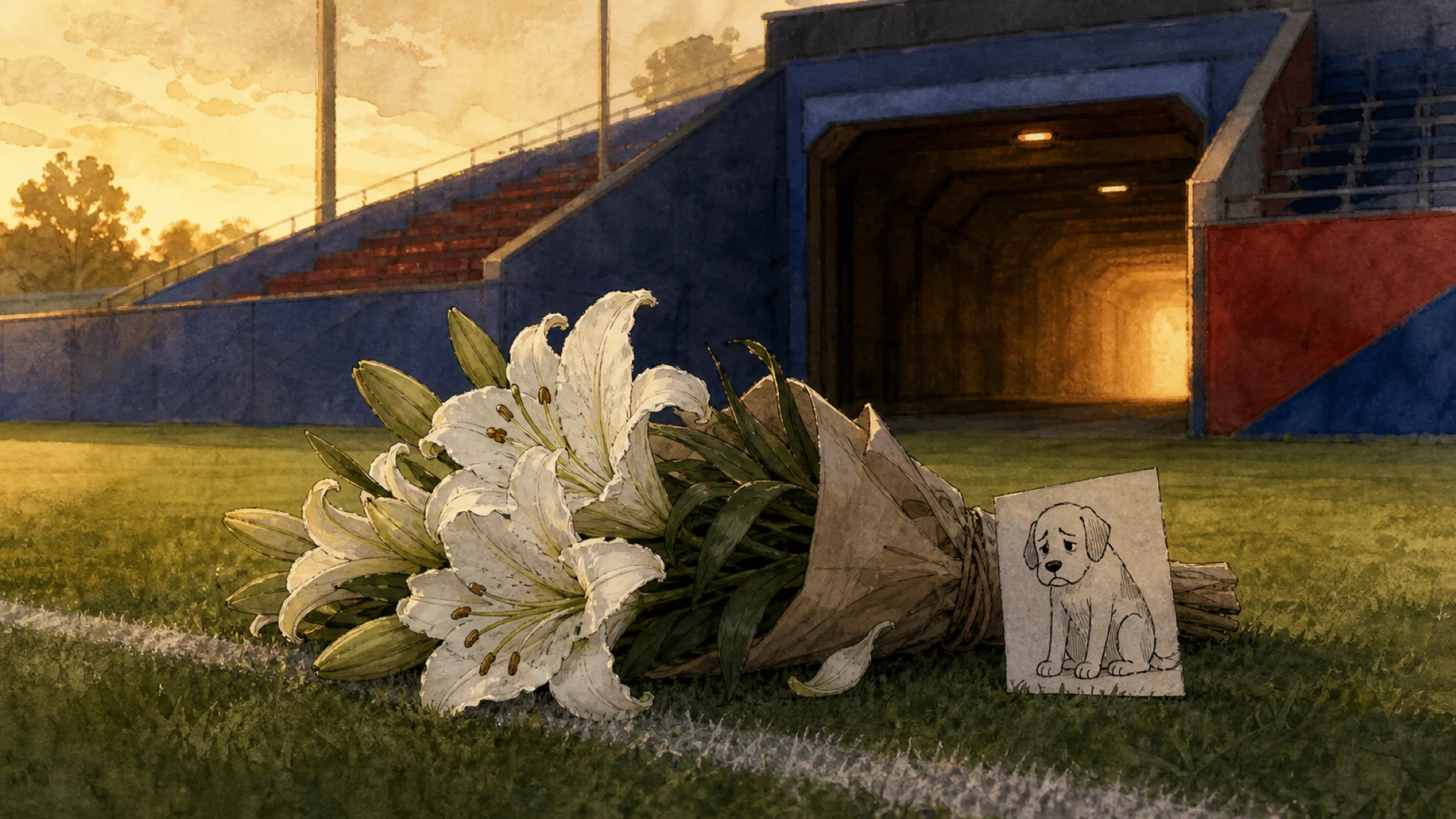
Earl dies, and the show declines to make it a joke
The opening sequence is the boldest tonal move the writers have tried since the pilot. Arlo White’s commentary frames AFC Richmond on a seven-draw run, one penalty kick away from the club’s first win since being relegated to the Championship. Cristo Fernández’s Dani Rojas crosses himself in the tunnel, asks if it’s okay if he prays, and gets the show’s signature Sudeikis benediction back: yeah, of course, but to which god and in what language. Dani breathes the catchphrase into the camera. Football is life. The ball goes off Dani’s foot, into the mascot, and Earl is dead before the title card.
The writers refuse the easy version of this. There is no slapstick replay, no laugh sting, no comic recovery. Instead Hannah Waddingham’s Rebecca and Jeremy Swift’s Higgins watch Twitter eat the team alive over coffee in her office. Higgins notes that the lower division gives Richmond fewer televised games. Rebecca reminds him about the internet. Did we really make Michael Jordan cry? It is the season’s first sustained joke and it lands with the show’s truest hand: small, contained, with the dread underneath.
The presser is where Sudeikis takes the wheel. Trent Crimm asks coldly if Ted has any comments on Earl, the dog Dani Rojas killed today. Jason Sudeikis pauses. Then a slow story about a neighbor’s dog named Hank who bit Ted as a toddler, then a high school neighbor who lost his wife and stopped caring for the same animal, then Ted feeding Hank, walking Hank, eventually putting Hank to sleep. The thing about the things in your life that can make you cry just knowing they existed, then make you cry knowing they’re gone. The room goes silent. Trent goes silent. The pilot established Ted as a man with a private inside; the season-two opener establishes that the private inside has a press-conference voice now, and that the press-conference voice is the same voice. He has been holding a Hank story for months.
Dani Rojas, the yips, and a word no one wants to say
The second act starts on a training pitch and ends with one of the funniest cold pivots the show has staged. Dani is missing every penalty. Brendan Hunt’s Coach Beard reports the situation with his usual restraint. Jan Maas, the Dutch import who is not being rude, he’s just being Dutch, observes that they are watching the end of someone’s career. Not now, Jan.
Ted’s first instinct is the kindness economy. He pulls Dani aside, attempts to reframe the dog as an unlikely coincidence not too dissimilar from those seen throughout Paul Thomas Anderson’s 1999 opus, Magnolia. Beard and Dani debate whether Tom Cruise’s ponytail in Magnolia is shorter than the one in The Last Samurai. The bit works because the writers let it run an extra beat past the laugh, which puts Dani’s actual problem at the back of the frame. Then Dani steps to the spot, lines up a corner instead of a penalty, and clears a parked car. Football is death, he announces with the same conviction he previously gave football is life. Nick Mohammed’s Nate writes the word down rather than say it out loud. The yips.
Nate is the one who suggests bringing in a sports psychologist. Beard agrees it’s not a bad idea, Coach. Sudeikis plays the next ten seconds with more visible static than he has ever shown on the show. General apprehension and a modest Midwestern skepticism, he says, which is the kind of self-diagnosis people offer when they have been asked to look at a specific door they would rather not open. He thinks about it. He gets his thinking thing on. Yeah, let’s do it.
Dr. Sharon Fieldstone refuses to flatter the room
The introduction of Sarah Niles’s Dr. Sharon Fieldstone is the half-hour’s structural masterpiece, and it is staged with the patience of a writer’s room that knows exactly what they have. She walks into Higgins’s makeshift office mid-paper-football game, watches Higgins’s last attempt miss, and absorbs Ted’s beatboxed welcome song without expression. Ted is mid-jingle — “It’s nice to meet you, ooh, consider this song our way to greet you” — and she lets it land like weather she does not have to acknowledge.
Then she names the yips. The room flinches. She asks why. Because of a superstition, Nate finally manages. I see, she says, and the cut to her finishing the sentence is the cleanest writing in the episode: the yips are not a superstition, they are a mental condition, one that can be fixed with discipline, not denial. Ted asks if she’s pretty confident she can help. She turns the question on him and asks if he is good at his job. He says yes after a forced pause. I believe you, she says. Well, as good as you are at your job, I’m twice as good at mine. Then she walks out to set up in Higgins’s office.
Niles plays the scene flat. No warmth currency, no charm offensive, no comic dial-back to soften the room. The show has spent a full season teaching audiences that Ted’s kindness lets him in anywhere, and “Goodbye Earl” introduces the first person in West London who does not require Ted’s kindness to do business. She seems fun, Beard says after she leaves. The line is the half-hour’s quietest joke and its loudest red flag.
Roy on the touchline, Keeley on the couch, and a date called fine
The B-plot keeps the world ticking. Juno Temple’s Keeley is now living with Brett Goldstein’s Roy and trying gently to get him out of the under-nine girls’ touchline and into a Sky Sports studio. Roy’s response, that he would rather shit out his own mouth than do that fucking shit, is the longest unbroken Roy aria yet committed to film, and Goldstein plays it without any visible enjoyment of his own joke. Niece Phoebe collects a pound per swear word and announces her own coaching highlight, a red card for elbowing a girl in the neck, with serene pride.
The double date with Rebecca and her new man arrives at Mae’s pub. Annette Badland’s Mae sets the table by remembering Earl fondly and the owner Nigel less fondly: him and Earl came in here all the time, till Nigel started shitting and pissing all over the place. Roy is monosyllabic. Keeley is generous. Rebecca’s date John Wingsnight tells a long, charming story about almost fighting Martin Short over a wallet at a Stomp meet-and-greet, and the table laughs with the right rhythm. Waddingham plays Rebecca’s polite engagement with the precision of someone running an interior diagnostic in real time.
The Roy and Keeley walk home carries the episode’s emotional weight. Tell the truth, he says. He’s fine, Keeley says. That’s it. Nothing wrong with that, most people are fine. Goldstein’s read of the next line, the one viewers will quote at each other for a decade, lands without sentiment: you deserve someone who makes you feel like you’ve been struck by lightning. Don’t you dare settle for fine. Not that it’s any of my business. Rebecca says nothing. The episode lets her keep saying nothing for a beat longer than expected.
The morning coffee scene with John pays the bill the lightning line opened. Rebecca rambles about intimacy, about her friend Flo’s definition of intimacy as leaving yourself open to being attacked, about needing to be brave enough to let someone wonderful love her without fear of being safe. Are you breaking up with me, John asks. I’m so sorry, she answers, I didn’t know I was going to do that. Coffees are on me.
What this episode argues
The pilot’s argument was that Ted’s kindness is a strategy, not an accident, and that it costs him something. “Goodbye Earl” extends that thesis into a harder claim: kindness is not always the right tool. Ted talks Dani down from the edge with a Magnolia bit. The yips persist. He convenes a coaching brainstorm with a Gin Blossoms reference. Dani still kicks the ball over a parked car. The first interventions the show built its inaugural season around are not working on this problem, and the new character in the room is unmoved by the techniques the show has spent twelve episodes celebrating.
Sharon Fieldstone is the second-season engine for the same reason Rebecca was the first-season engine: she enters the room with a goal that does not require Ted’s approval. Rebecca was hiding a sabotage. Sharon is hiding nothing. The threat she presents to Ted is more interesting than the threat Rebecca presented because Sharon’s threat is real-world useful. Dani is fixed by the end of the half-hour. Other players line up for sessions before she leaves the building. The B-side of the kindness economy is that some people respond faster to discipline than to charm, and the show is now adult enough to admit it.
Verdict
Season premieres usually carry too much furniture. This one mostly does not. The cold open is a structural risk that the writers cash in immediately: Ted’s Hank monologue earns the episode’s emotional credit before the credits roll, and the rest of the half-hour spends that credit on a comedy of psychological resistance. Niles is the find of the season. She gets one extended scene, plays it without a single concession to the warmth the show is built on, and walks out having reset the room. The Rebecca breakup with John is wordier than it needs to be; Keeley and Roy’s domestic scenes still feel like they are catching up to a romance the show is asking us to take on faith. Jan Maas is funny twice. Trent Crimm gets one line and uses it perfectly. The fact that Ted held back from the Hank story for a full season and waited for a dead-dog presser to release it is the kind of patient character writing this show was never required to perform, and it performs it anyway.
Rating: 8.5/10
More episodes from Ted Lasso — Season 2 — Richmond after promotion: therapy, doubt, and Nate's slow turn. Jump to any episode in the season:
Where to go next
Reviewed by Mira Vance · QuizFandom Editor & Lead Reviewer. Every rating is an honest per-watch assessment from the desk that also writes the quizzes — not a press release rehash.