Ted Lasso S2E6 Review: A Fish Pie Excuse and a Father's Voice Off-Field
Ted ducks a panic attack mid-match, Higgins says the thing nobody wants to hear, and Nathan parks the bus into the Premier League conversation.
“The Signal” is where Ted Lasso stops being able to outrun a sound it has been carrying in the back of every scene for half a season. Three crises of intervention drive this half-hour: a friend who should be told an inconvenient truth, a player who should be told he is allowed to be himself, and a coach who keeps insisting he is fine until he is sprinting out of a tunnel into a London afternoon. The win goes, on paper, to Nathan. The diagnosis goes to Ted.
Higgins calls an emergency Diamond Dogs meeting
The cold open and the office sequence quietly set the same theme twice. Hannah Waddingham’s Rebecca walks into a kitchen where her mother has installed herself for a fourth or fifth iteration of leaving her father, and within thirty seconds Deborah is quoting Esther Perel at her naked boyfriend and her own daughter. Across town, the Diamond Dogs convene because Jeremy Swift’s Higgins is worried about Coach Beard and Jane. Brendan Hunt’s Beard has rolled in like a man who slept under a fluorescent light, announced that he and Jane are back together, and asked if anyone else thinks that is a good idea.
Jason Sudeikis’s Ted does not back Higgins up, and Higgins calls him on it. Ted’s reason is a Marcus Girard story about telling a friend his fiancée was a pill and being uninvited from giving the best man speech. The lesson he draws is the lesson he draws about most things lately: it is bad business to get all up in anyone else’s business. Nathan rationalizes a related principle from a father-induced sabotage of his first crush, Nadia Shookums, who listened to Nate’s father in year four when he sat both children down and said they could do better. Both men decide, in front of each other, that the kindest thing to do for a friend is nothing. Higgins, in protest, declares the meeting unsanctioned because Beard is absent. He dismisses the Diamond Dogs alone, into a room that has been muted by two grown men refusing to risk a friendship. The hour will spend the next thirty minutes asking whether that policy survives contact with anybody who actually loves the people they are not telling the truth to.
Roy finally coaches Jamie by insulting him into a person
Roy Kent’s refusal to coach Phil Dunster’s Jamie has been a low-stakes joke for several episodes. Brett Goldstein finally cracks it open in the locker room, and the breakthrough is one of the cleanest pieces of character writing the show has done in Season 2. Jamie asks Roy why he will not coach him, and Roy answers honestly: because Jamie is a prick. Jamie agrees that he plays in a dull and conformist way. He agrees that he is ugly with bad hair, with one small contractual amendment on the hair. The “yes, and” rolls until Roy gets angry enough to do the actual work.
The diagnosis lands without sentiment. Roy tells Jamie that Ted’s coaching has made him a team player, and in doing so has made him average. Jamie has a gear that lives in his worst instincts. He is supposed to use it. “Be a prick,” Roy says, sometimes. When it is appropriate. The compromise is that they will give him a signal. Roy, of course, refuses to invent the signal in advance.
What makes the scene work is that Roy is being a coach the only way he knows how — by being the player he was. Jamie is being coached the only way he can hear it — by being told what is wrong with him until he stops apologizing for it. Juno Temple’s Keeley sets up the whole thing with a throwaway tactical note: agree with everything Roy throws at you, it takes the wind out of his brat sails. The fact that the show’s Adonis-shaped striker takes communication tips from his ex-girlfriend’s current boyfriend’s ex-girlfriend without flinching is a Season 2 mood unto itself.
The signal arrives, and so does the fish pie
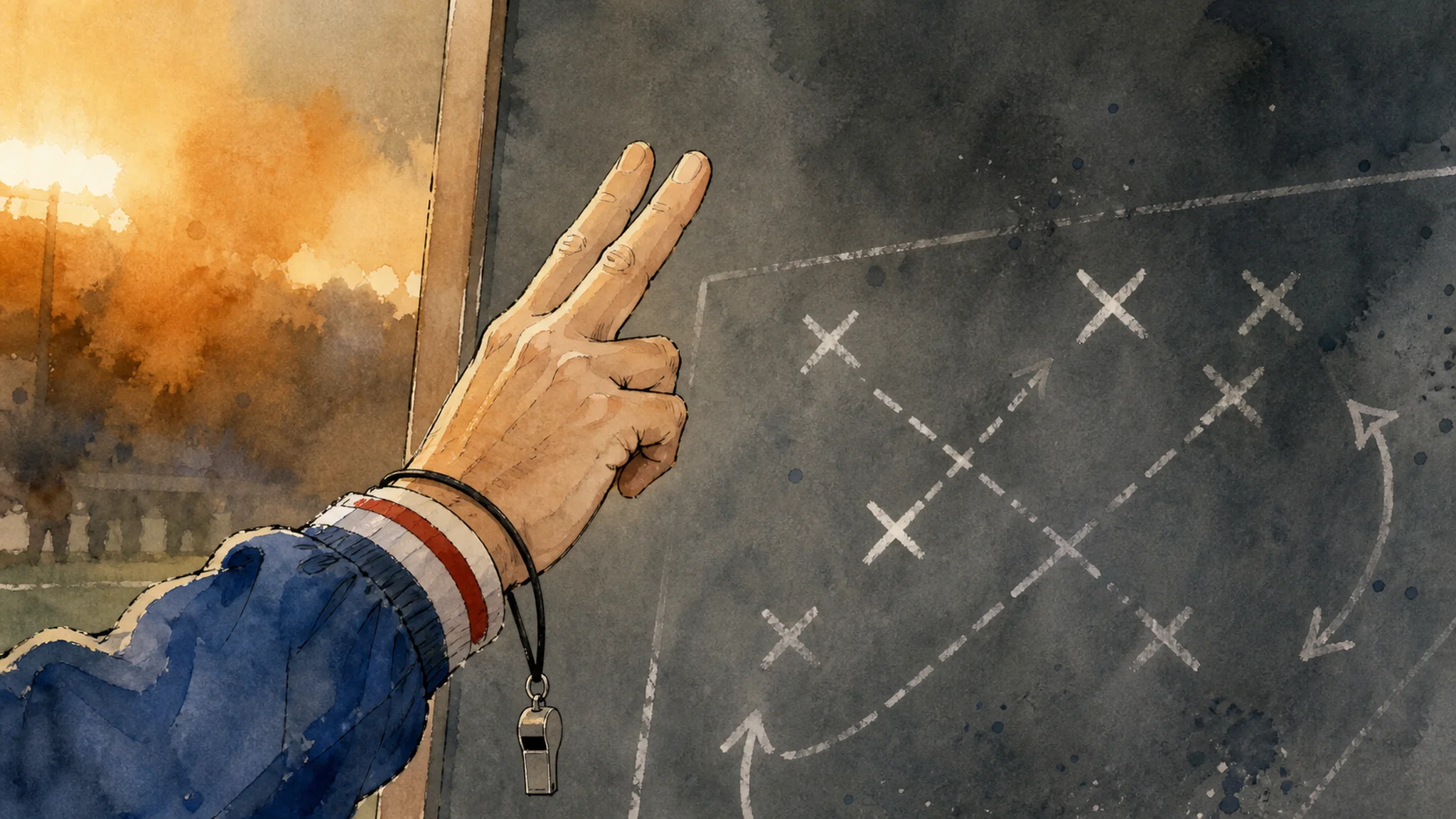
The FA Cup quarterfinal against Tottenham is the engine that runs the back half of the hour. Richmond go up after Jamie talks Barnett into fouling him by promising to score from the resulting free kick, then doing it. The signal turns out to be three middle fingers in a row from the bench, an image so flagrant the broadcast apologizes for the fruity sign language in real time. The joke is that the show was never going to invent a discreet hand cue for Roy Kent.
What is going to be remembered about this episode is what happens in the closing minutes. Spurs equalize on a Barnett header that, in any other half of television, would be a Roy Kent monologue cue. Instead, the stadium noise distorts on Ted, the crowd jeering blurs into a low rumble, an unseen voice that sounds like Jamie’s father pushes through with “you’re better than that, Jamie,” then a child’s voice — Henry’s — calls out the chant that the Richmond supporters have made into an ironic anthem all season. Ted says his stomach hurts. He runs. Sudeikis plays the run with no comedy in his face. The commentary booth, which has spent the season being the cushion under every joke, decides this is a bad fish pie, and the show does not correct them. The lie is the whole point. Nick Mohammed’s Nate, left in charge for stoppage time, parks the bus, holds the draw posture long enough for a Tottenham slip to open a counter, Sam threads the diagonal, Jamie buries it. Richmond, impossibly, are on top. The first words out of Nate’s mouth to the touchline reporter afterward are about the wonder kid he just was — a slip into wunderkind he insists be cleaned up in editing, then learns is live, then doubles down on with a smile.
What this episode argues
The argument is in the title. Every relationship here keeps asking for a signal that the other party either cannot or will not send. Beard is asking Jane to be a person he can stay with. Jane is asking Beard to be a person who never leaves. Rebecca is asking her mother to be the woman she pretended to be at lunch. Deborah is asking Rebecca for shepherd’s pie and forgiveness on a rotation. Jamie is asking Roy for permission to be himself. Roy is asking Jamie to stop hiding behind the team. Higgins is asking Beard to hear an uncomfortable sentence from a friend who has been there. Ted is asking himself to be the kind of man who does not need to leave the bench.
Three of those signals get sent in this episode, and the show is honest about the asymmetry of their reception. Roy gets through to Jamie because he tells him what is wrong with him. Higgins gets through to Beard because Beard, eventually, walks away to think. Rebecca cannot get through to Deborah because the conversation Deborah agreed to have over shepherd’s pie is one she has been escaping for forty years, and the Tesla is faster than the conversation. And Ted cannot send any signal at all to himself, because the panic attack arrives mid-coach-talk and the only word he has for it is “stomach.” The voicemail Rebecca leaves him at the end, asking for a pep talk because she is on the way home for a difficult conversation, sits unheard. He is sitting on a bench in the dark in his office. The signal he needs to send to Sarah Niles’s Dr. Sharon Fieldstone has, until this hour, been the one he refused to send all season. He sends it.
Verdict
This is the episode where Season 2’s quiet anxiety stops being subtext, and it earns the upgrade in two ways. The first is structural. Putting a Jamie-Roy breakthrough, a Higgins-Beard confrontation, and a Ted panic attack in the same hour, then letting Nate’s tactical instinct rescue the match Ted abandoned, makes the show’s central question — what happens to AFC Richmond when the coach who promises to be there for everyone cannot be — into a live problem rather than a thematic one. The second is performance. Sudeikis plays the tunnel-run without the cushion of a punchline; the audio distortion does most of the literal work, but the bewildered, unshowy panic on his face is the choice that sells it. Toheeb Jimoh’s Sam is given almost nothing to do, which is a Season 2 pattern the show is starting to owe IOUs on. Deborah is written as a one-note Mum until the Tesla note lands and the joke turns cruel, which is the right shape, but the lunch scene leans on quirk longer than it should. Nathan’s “wonder kid” sign-off to the touchline reporter is the first time the show stops cushioning his ego and lets the audience see it as a problem, which is the bet the rest of the season is making. The fish pie running joke is the kind of broadcast filler the show used to write more sparingly. None of those are fatal. This is the best episode of Season 2 to this point because it finally trusts that its bright surface is built to protect something, and lets the audience watch the protection fail in real time.
Rating: 8.7/10
More episodes from Ted Lasso — Season 2 — Richmond after promotion: therapy, doubt, and Nate's slow turn. Jump to any episode in the season:
Where to go next
Reviewed by Mira Vance · QuizFandom Editor & Lead Reviewer. Every rating is an honest per-watch assessment from the desk that also writes the quizzes — not a press release rehash.