Ted Lasso S2E12 Review: Promotion, a Leak, and the Quiet Slam of a Door
Richmond clinch promotion on a Sam Obisanya goal, but the season finale spends its real currency on a betrayal, a leak to The Independent, and a kit man who finally says what he came to say.
A finale that delivers a fairy-tale promotion and then refuses to let anyone enjoy it has set itself a hard job. “Inverting the Pyramid of Success” is the season’s last chance to land the slow turn it has been writing in pencil for ten weeks, and it lands almost all of it. Richmond go up. Sam stays. Rupert buys West Ham. Nate quits. By the time the closing montage cuts to him in a West Ham tracksuit, the show has burned a fan-favorite character on purpose, and the only honest question is whether it earned the match.
A leaked panic attack opens the hour, and the locker room reacts before Ted does
The cold open is a Sky Sports panel. Jeff Stelling, Chris Kamara, George Cartrick. The headline is that Ted’s mid-Tottenham exit was a panic attack, not a stomach bug. George calls the manager unfit. Jeremy Swift’s Higgins offers compassion. The source is anonymous, paid by The Independent, filed by Trent Crimm.
Ted is kept off-screen for the first reaction beats. The postwoman gives him a worried glance outside his flat. A jogger calls him a wanker about Normandy. The first time we see Ted, he is on a couch with Beard, eating salt-instead-of-sugar pastries because his coffee maker is a metaphor now. Ted keeps the same easy smile he has used since the pilot, except his hands won’t stop moving. Higgins lobbies to find the source. Ted says no, because everything in the article is true.
That choice — to refuse the witch-hunt — is the rule Ted lives by for the rest of the hour. He does not want to know who leaked it. He suspects. He decides not to push. Nate then walks into widening rings of provocation until the kit man stops being a kit man.
Nate and the Diamond Dogs, who arrive too late to do anything useful
The Diamond Dogs sequence in the coaches’ office is the structural heart of the hour. Roy walks in mid-meeting, doesn’t know how the bit works, asks for “advice” without saying advice, and gets a one-time visitor’s pass. Brett Goldstein plays the request as if every syllable costs him a year of life. The confession is the Vanity Fair shoot — Keeley looked great on her own, the photographer didn’t use any pictures with him in them, and it would have been weird if he was. Then Jamie’s “I love you” at the funeral. Then the forgiveness, which still has him “fucking furious.”
The hand-off to Nate is the small, terrible move. Nate confesses that he kissed Keeley on their shopping trip. Roy already knows. Roy says it’s fine. Mohammed plays Nate’s reaction the way a child plays a child who has not been hit when he expected to be hit. He asks Roy to headbutt him. Roy refuses. The provocation Nate built was meant to produce punishment, because punishment is at least attention, and Roy declines to give it. Nate cannot tolerate being forgiven for a thing he is using as evidence that he is bad.
The two scenes mirror on purpose. One man learns that not every confession requires a verdict. The other hears the same lesson and reads it as proof he does not exist.
The match itself is a fable, and the show knows it
Brentford. Promotion or another year in the Championship. False-nine formation the coaches argued about at half. Nate wants to abandon it. Roy points out, dryly, that the players are the ones playing it. Ted asks the room. Jan Maas tells the truth as he understands it — the tactic is sound, the team is capable, it will work. Sam scores in the second half. Jamie wins a penalty and gives the ball to Dani Rojas. Football is life. Dani slots it. Richmond go up.
The beats are written for adoration. Arlo White’s “grit, determination, and most of all belief” is a line the show has been daring itself to deploy uncut. The locker-room celebration lasts long enough to be a real party — “we are going up” gets the room. Brendan Hunt’s Beard takes a fan slap to do a hug. Phil Dunster’s Jamie wins the penalty and refuses it, and Dunster plays the handoff as the calmest decision of the episode. Then the camera leaves the pitch.
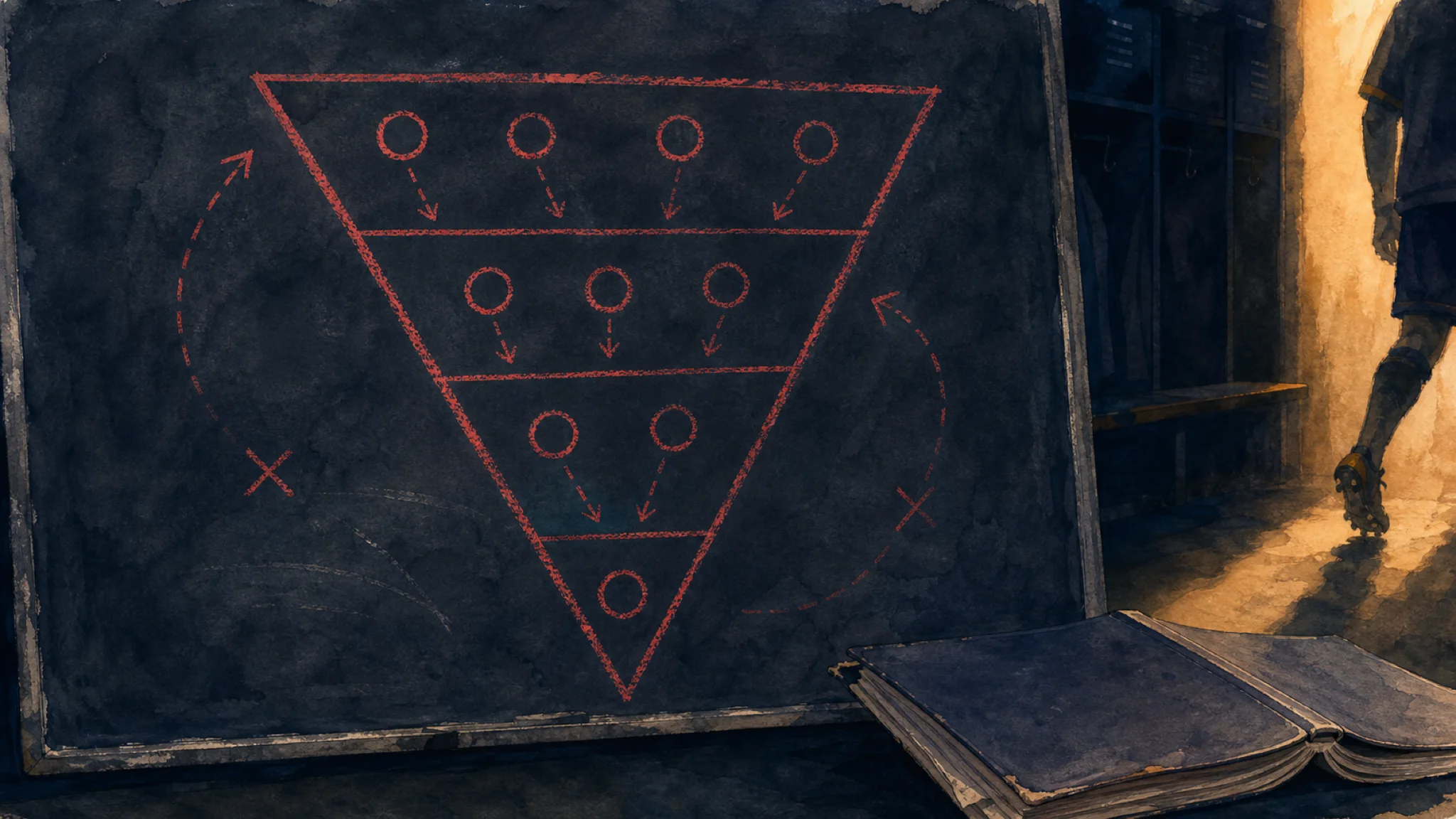
Nate quits in the parking lot of his own promotion
The fight Ted has been refusing to push for arrives anyway. Nate finds him after the match. Ted, slow, asks him what’s wrong. Nate gives the bill.
You made me feel like the most important person in the world. Then you abandoned me, like switching out a light. I worked my ass off to get your attention back. The more I did, the less you cared. You haven’t put up the photo I gave you for Christmas. Just a picture of dumb Americans. Everybody loves you. The Great Ted Lasso. I think you’re a fucking joke. Without me, you wouldn’t have won a single match. They would have shipped your ass back to Kansas, with your son. Because you sure as hell don’t belong here.
Mohammed has been climbing toward this monologue all season. He plays it without theatrics — no sneer, no pivot to villain. Sudeikis plays Ted’s response by not playing one. He says “I know you did, Nate,” softly, when Nate says he earned this. He apologizes. Nate calls it shit. Nate walks. The exchange runs less than ninety seconds and is structured like a divorce.
The show has been honest about Nate’s wiring since the wonder-kid promotion at Wembley last year — bullying Will the kit boy, scorching his father in private, spitting at his own reflection in a men’s-room mirror. The risk a series like this takes when it burns a beloved supporting character is that the audience reads the ending as a betrayal of the character rather than of Ted. Reviewers split here. Some read Nate’s leak and resignation as the season’s strongest arc; some read the West Ham reveal as a step too schematic, a cliffhanger wearing the season’s grace away to set up a third-season villain. Both readings are honest. The episode does its job by refusing to give Nate a clean motive. The closest he gets is the picture of dumb Americans.
Rebecca, Sam, Rupert, Roy, Keeley — five doors closing in quick succession
The finale is restless about endings. Hannah Waddingham’s Rebecca opens her champagne for the Vanity Fair piece — the bottle she did not open when her mother moved north or when England got zero points in Eurovision — and then Rupert buys West Ham thirty seconds later. Anthony Head’s name in the news alert sets the season-three calendar.
Sam tells Edwin Akufo no. Akufo, who arrived as a billionaire eccentric with a personal handshake guy, melts down in a corridor with one of the meanest tirades the show has put on screen — pinky-dick, kenkey, a monologue about burning down the childhood home and pooping on the ashes. Akufo plays it as a man who has never been told no by another person in his adult life. Sam stays not because of Rebecca and not because of his father’s universe theory but because he wants to stop worrying about how others feel about him. Sam delivers it quietly, no underline.
Keeley gets the funding for her own PR firm and a six-week holiday she cannot take. Roy gives her airplane tickets from a travel agent named Kathy. She turns them down. He goes alone. They do not break up. He asks if they are, and her answer is the answer of a woman just handed a company.
And Trent Crimm. James Lance’s reporter shows up outside the building, fired for revealing his source — to Ted, in person — and now looking for “something different. Deeper.” Ted gives him “Trent Crimm. Independent.” It is the only door the episode props open on the way out.
What this episode argues
Niceness was Ted Lasso’s opening pitch. This finale argues that niceness can be a wound from the receiving end, that the same warmth which pulls a person up can register, when diluted by attention elsewhere, as abandonment. Sharon’s voicemail in the cold open quotes the season’s mental-health thesis word-for-word: the truth will set you free, but first it’ll piss you off. Ted’s truth is that he had a panic attack at Tottenham and did not tell his players. Nate’s truth is that the only way he knows to read affection is as a comparison with whoever else is in the room. The season has been a long study in mental-health treatment as work the characters do or refuse to do, and the finale’s quiet cruelty is that Ted does the work in public while Nate’s work-refusal hardens into a resignation letter delivered in person.
The show’s bet is that it can afford to burn Nate because the burn is the season’s argument. The risk is the West Ham reveal. Putting Nate in Rupert’s tracksuit twenty seconds after his exit reads as a season-three setup. As a finale beat, it is the rare moment in this hour that feels structural rather than emotional.
Verdict
Twelve episodes is too many for a season this size, and S2’s middle leaned hard on the Sharon arc and the Sam-Rebecca app-romance to fill the order. The finale is the case for the season anyway. The Diamond Dogs scene with Roy is genuinely funny. The Sam-Akufo blow-up takes a real risk with another country’s character, and Akufo plays it big enough to land. The match earns its goosebumps. The Nate confrontation is the heaviest scene in the series so far and Nate lands it without a single line of mustache-twirling.
The West Ham button does not quite earn its place. Putting Nate in a West Ham tracksuit twenty seconds after his exit will read, for some viewers, as a season-three setup. For others it will read as the honest endpoint of where Nate’s wiring was always going to take him. The middle of this finale beats the bow on top.
What lifts it is the precision of two scenes. Roy walking in to ask for help without asking for help. Nate walking out to deliver the verdict the show has been postponing for ten weeks. The same room, twenty minutes apart, doing opposite work. Mohammed and Goldstein give the best performances of their seasons. Sudeikis lets Ted not say the thing in his own defense, and the silence is the season’s argument made flesh.
Rating: 8.4/10
More episodes from Ted Lasso — Season 2 — Richmond after promotion: therapy, doubt, and Nate's slow turn. Jump to any episode in the season:
Where to go next
Reviewed by Mira Vance · QuizFandom Editor & Lead Reviewer. Every rating is an honest per-watch assessment from the desk that also writes the quizzes — not a press release rehash.