The Madison Episode 1 Review: "Pilot" — Preston and Paul Chase One Last River, Stacy Identifies the Bodies, and a Cabin Starts Answering for a Marriage
What happens — the short version (spoilers)
- Preston spends his birthday trip fishing with his brother Paul in Montana, where their jokes about hoppers, nymphs, work, and memory establish the river life Preston wants more of.
- In New York, Paige is mugged and stitched up by Dr. Steele while Stacy manages charity-event manners, family logistics, and a dinner table where fear turns into blame.
- Preston asks Stacy for one extra day because Paul can fly him into remote water; a storm later catches the Cessna near Borah Peak, and Officer Shepherd calls Stacy to say Preston and Paul did not survive.
- Stacy travels to Idaho with Abigail, Paige, Russell, Macy, and Bridgett, identifies the remains, and spends a hotel night with pizza, ice cream, pills, and A River Runs Through It.
- At the cabin, Stacy tastes the smoke in Preston's coffee, realizes pictures were never the same as being there, and starts to feel the life he kept trying to share.
- A garden-and-elk dinner breaks the family's city habits open, then Preston's 25-year journal sends Stacy toward Stacy's Valley, where she plans to bury him and begin visiting the places he wrote about.
The Madison begins with two lives running on opposite banks. Preston and Paul are in Montana, making trout jokes and birthday plans in the kind of country Preston treats as oxygen; Stacy is in New York, smoothing philanthropy etiquette and family logistics in a city her husband keeps wanting to escape. The pilot lets those worlds feel mutually inconvenient, then sends a storm over Borah Peak and turns inconvenience into inheritance. By the end, Stacy is no longer looking at Montana through Preston's phone camera. She is sitting in his cabin, drinking smoke-tasting coffee, and realizing how much of her marriage was still waiting there.
Preston and Paul fish hoppers, argue about work, and fly toward one more secret stretch of river
The opening river sequence is all texture before plot. Paul teases Preston for slapping the water with his cast, tells him to stop trying to hail a cab on Fifth Avenue, and hooks a fish the second he demonstrates the correction. Preston answers by tying on a nymph on his last day, threatening a streamer if Paul pushes him, and keeping the trout because his brother is cooking it.
The cabin conversation later sharpens the joke into a choice. Preston is 64 and counting the years before memory replaces appetite. He tells Paul about a Caribbean resort full of people who finally bought the vacation they were too old to enjoy. Paul quit that math already. I make a memory a day, brother, he says. Preston’s protest is lonely and practical: Paul has no wife, no children. Paul is sharing this one with him.
New York has people. Montana has time. Preston wants both, and the hour puts that ache under every joke.
Paige is mugged on Fifth Avenue, and Stacy’s New York dinner table turns fear into blame
Back in the city, Paige is hit, robbed, and left crying on the sidewalk with two white shopping bags gone and blood on her face. The staging is blunt: Hermès, Brunello, the Greenwich, a charity opening, then a stranger’s fist. The pilot cuts from Paul’s river corrections to a police officer asking Paige what color the attacker was, and it lets her panic sit in the ugly gap between wanting to help and not wanting to give a wrong answer.
Stacy’s response is immediate and familiar. She leaves the Women’s Center event, gets Paige to Dr. Steele, and manages the wound in the language of a mother who has solved expensive problems all her life. Six stitches. Scar later. Take the car next time. Paige keeps returning to the same small fact: he hit her. She would have given him the bags.
Dinner turns the assault into family weather. Russell tries to make Dutch cargo ships sound interesting and gets politely flattened. Paige is angry that the police asked about race; another voice at the table calls that information important. Stacy finally snaps because everyone is hiding from the person across from them. Phones at dinner are rude to her, rude to each other, rude to the staff. Just rude.
The best cut comes when Preston calls from under a full moon. Stacy steps out of the restaurant’s noise into his starlight. He wants one more day because Paul has permission to fly him into virgin water. She has bad news about Paige. Preston’s first instinct is the car, the apartment, the machinery of money. Stacy does not let the fight run. The problem will still be there when he gets back.
He does not get back.
A storm catches the Cessna over Borah Peak, and Officer Shepherd’s Idaho call empties Stacy’s lunch
The final fishing morning has the softness of a farewell before anyone names it. Preston forgets his rod, Paul laughs, caddis are hatching, and the river gives them the kind of day Preston says he could use. A storm sits over the mountains, visible enough to worry him. Paul says they are not going that way, then says storms build every afternoon, then says they can leave now if Preston wants.
Preston’s answer is the whole tragedy in five words: I don’t ever want to leave.
The crash sequence keeps the mechanics narrow. The plane shudders. Alarms beep. Paul calls Big Sky Approach, asks for a route around weather, and climbs toward 11,000 feet. The show gives us turbulence, thunder, Preston’s fear, Paul’s focus, and Preston screaming Stacy’s name as the world drops out.
Then Stacy is at lunch, talking with a friend about whether anyone in New York ever does more than complain about leaving. Connecticut, the Hamptons, the Catskills, trout in the Hudson: rich-person exit strategy as social small talk. Stacy is not pretending the city is easy. It is her city. It has gone to hell before. It will come back.
Officer Shepherd’s call cuts through all of that. Preston Clyburn was involved in a plane crash on Borah Peak. Stacy asks to speak to him before her mind accepts what the sentence already means. Shepherd says no. Preston and Paul did not survive. Silverware still clatters. Stacy’s life falls out of her hands in public.
Stacy identifies Preston and Paul, and the hotel room turns grief into pizza, pills, and A River Runs Through It
The Idaho stretch is the pilot at its most punishing. Paige tries to hold out one inch of denial, saying they only think it is him. Stacy cannot afford the mercy. At the coroner’s office, Hastings explains the state requirement: visual identification by a relative or close friend.
Stacy’s case is simple and unwinnable. Before Preston left, he kissed her and smiled. If she goes into that room, the last image of him in her mind changes forever. Abigail offers to do it. Stacy refuses. The mother goes in because the wife cannot let the daughter carry that image.
The scene does not need gore. The question which is which? tells us enough. Stacy recognizes Paul first, then faces what that means for the second body, then comes out to find Paige asking why fingerprints were not enough. Stacy’s how dare you? lands as grief protecting the one task nobody else should have to understand.
Afterward, the hotel room gives the family its first honest shelter. Liliana calls with will, insurance, funeral, and cabin questions that are both necessary and obscene. Stacy says she will take care of Paul too. Then the daughters and granddaughters arrive for a slumber party with terrible pizza, ice cream, a sleeping pill from Abigail, and A River Runs Through It because it was Preston’s favorite.
It is exactly the wrong movie and exactly the right one. Stacy admits she never got through it. Abigail thanks her through tears for making everyone feel better. Stacy remembers that Preston cried over that and Rudy, because only men get to cry over fishing and football. Then she says the line the pilot has been walking toward since the first cast: Preston died living, not existing. She hopes Abigail finds a man worth missing.
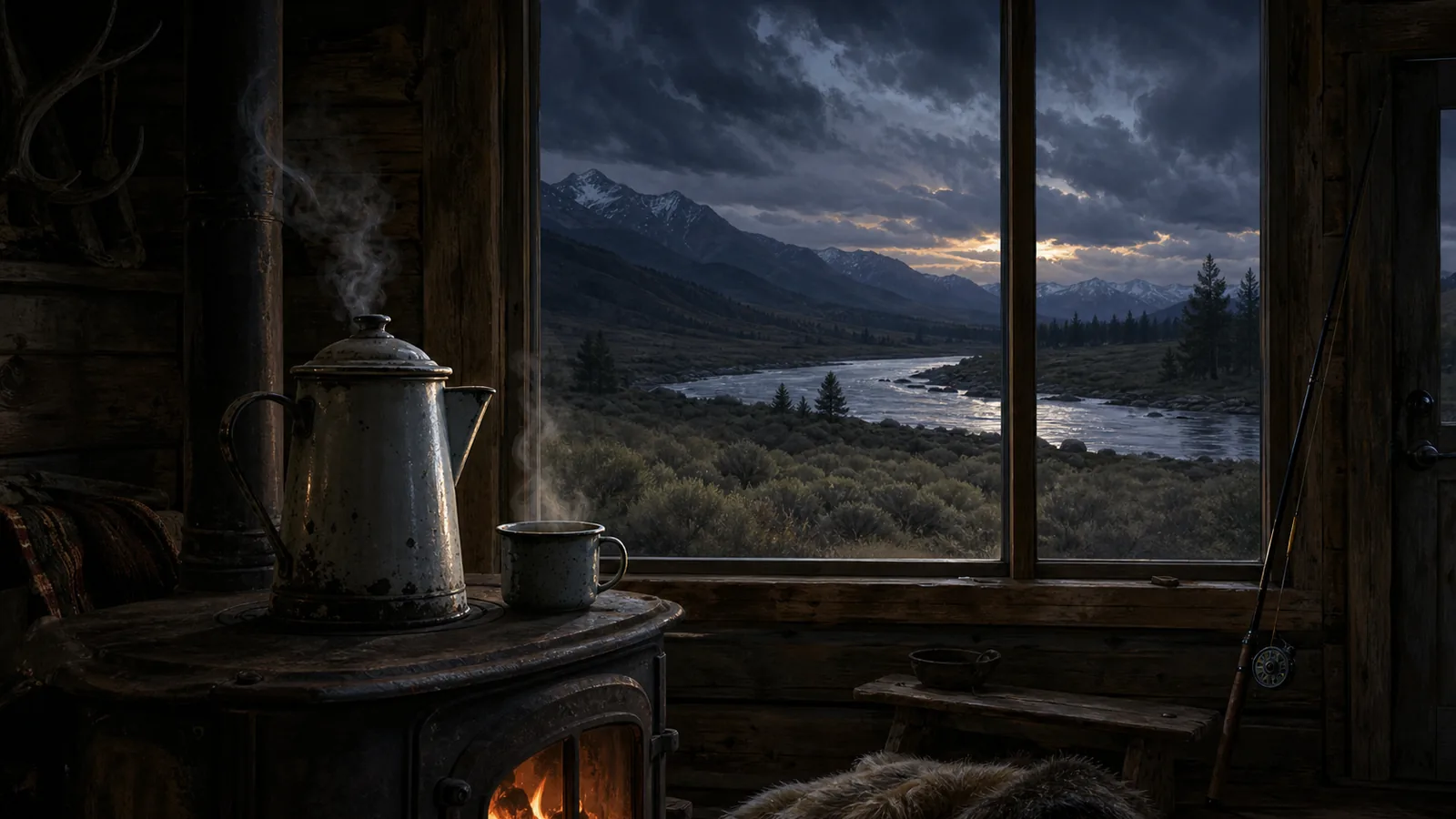
The family reaches the cabin, and smoke coffee gives Stacy the life Preston kept asking her to see
The road to the cabin plays like a bad vacation before it becomes a visitation. The family has no service. The nav says they are close. Paige clocks the sink, shower, and outdoor toilet with open disgust. Russell finds bear spray, then learns that Preston’s silence about bears gives him no comfort. The cabin is inconvenient in every possible way Stacy once used as a reason not to come.
Then she walks into Preston’s cabin and the past answers. The episode folds in the earlier phone call from the bath, with Preston explaining the percolator, the river water, the stove, and the coffee you can taste the smoke in. Stacy laughed at him then. She called herself a city mouse.
Now she is there, boiling the coffee herself, and the joke has left the room. She tells Abigail that Preston sat in that spot and called her, talking about fish while she pretended to care. Pictures were not the same. She thought she would be bored, or a third wheel. Instead, the cabin makes the loss larger: she robbed Preston of sharing it with them.
Abigail gives the hour its gentlest correction. Stacy had a loving marriage for nearly 40 years in New York City. No blame. Paige is still measuring by fatherhood. Abigail sees the marriage.
Elk dinner breaks Paige open, and Preston’s journal sends Stacy toward Stacy’s Valley
The pilot’s strongest domestic passage is the cabin dinner, because it lets adaptation happen through hands. Stacy finds garden vegetables with Macy and Bridgett, recoils from a snake, and catches the girls failing to remember the last sunset they noticed. Russell discovers the freezer meat says elk. Stacy tells him that, for tonight, it is beef.
That secret lasts about as long as any secret survives around Paige. The granddaughters like the steak. Abigail and Stacy argue grits versus polenta. Then Abigail tells Paige what she is eating, and the table detonates.
Stacy’s answer works because it stays practical. She did not kill the elk. Paul will not kill another. The food can rot, feed worms, or feed them. The vegetables came from the garden. The meat came from the country Preston loved. They made a meal together from this little world. She thinks Preston would love it.
Paige’s cruel little line about who has to die for them to make another meal together is unfair in the way grief gets when it has nowhere decent to go. Stacy does not chase her. She goes to the journal.
That journal turns the cabin from shrine into map. Preston kept 25 years of river notes, stove warnings, and one secret about a spot upriver he called Stacy’s Valley, where the grass grows tall and yellow because the elk do not graze there and it reminded him of her hair. Stacy cannot say goodbye while there is more to know. She decides to find the valley, bury Preston there, take the book, and visit every place he wrote about. She is 65. Her window for reckless choices is small.
Abigail asks if she wants company. Stacy says she would love some. Paige, Russell, and the girls come too, with Russell formally registering his objection to any exploratory venture afoot. The family has not found Stacy’s Valley yet. They have only started walking.
Tiny details worth clocking
- Paul’s Fifth Avenue casting insult lands twice: brotherly teasing first, then shorthand for how much New York still lives in Preston’s wrists.
- The coffee flashback works because Preston sells Montana as a process: build the fire, fill the pot from the river, boil it, taste the smoke.
- Paige’s mugging and the elk dinner mirror each other through unwanted contact with violence: a random blow in the city, a useful death on the table.
- The final walk keeps the promise unfinished. Stacy plans a burial in Stacy’s Valley, but the episode ends before discovery, which makes the decision the climax rather than the destination.
Final verdict
“Pilot” is strongest when it trusts objects and chores: a hopper on the water, a nymph tied in rebellion, two white shopping bags, a body bag zipper, smoke coffee, bear spray, elk sliced to resemble beef, a journal full of rivers. Those details carry the grief better than the broader city-versus-country dialogue, which can be blunt. Laura’s nutritionist talk and the New York escape chatter both arrive with the underline already drawn.
Still, the emotional architecture holds. The hour makes Stacy arrive too late to share the life Preston kept offering, then gives her a choice about what “too late” means. The thesis sits in the smoke-coffee scene: love can be real for 40 years and still contain rooms nobody entered.
That is a sturdy pilot for a grief drama. Preston and Paul die early, but the show lets them live long enough for the loss to have shape: jokes, philosophy, irritation, a birthday plan, a fish that counted even if Paul said it did not. Stacy’s turn toward Stacy’s Valley works because it is curiosity under shock, and maybe guilt, and maybe love finally learning the geography it ignored.
Rating: 8.2/10 — a handsome, sometimes blunt premiere with a strong domestic center, best when the cabin’s practical details make Stacy’s grief more specific than any speech could.
More episodes from The Madison — A New York family, a Montana cabin, and grief in big-sky country. Jump to any episode in the season:
Where to go next
Reviewed by Mira Vance · QuizFandom Editor & Lead Reviewer. Every rating is an honest per-watch assessment from the desk that also writes the quizzes — not a press release rehash.