The Madison Episode 6 Review: "I Give Me Permission" — Paige Punches a Coworker, Stacy Walks Out of the Memorial, and Cade Finds Her Back in Montana
What happens — the short version (spoilers)
- A flashback shows Paul raging after Melissa's death while Preston learns that brotherly help can mean keeping quiet, listening, and letting grief burn without trying to fix it.
- Lili builds Preston's New York memorial around staff, flowers, and catering, but Hailey at the coffee shop still expects Preston to come back and ask for advice.
- At Paige's office, grief is politely offered after Fashion Week, then a coworker's comments about Preston's crash push Paige into punching her and facing arrest.
- Abigail's friends turn Van into a Montana fantasy at lunch, while Van talks Abigail and a New York officer through Paige's assault problem from a highway shoulder.
- Stacy talks Harmony out of pressing charges, then Phil's tequila-and-truth therapy session forces Stacy to say she is terrified of everyone else saying goodbye while she still has to live without Preston.
- At the memorial, Phil tells Stacy the permission is hers to give, so she leaves without her phone, heads south, and turns up at the Montana cabin, where Cade points her toward Murdoch's in Bozeman for everything she needs.
The Madison's sixth hour brings the Clyburns back to New York and lets the city do what it does best: schedule grief, cater it, dress it, and make room for it only after Fashion Week. Stacy has buried Preston in Montana, but every room at home tries to turn him into a social occasion she can survive by standing still. Paige discovers that the office can offer compassion and still need Yankees suites handled by lunch, while Abigail discovers that Van is easier to describe to friends than to stop missing. The hour's Montana thread is small but pointed: Paul once taught Preston that grief is sometimes carried by shutting up, and Stacy ends the episode choosing a place where nobody asks her to perform being okay.
Paul breaks in front of Preston, and Preston remembers the brotherly work of shutting up
The opening memory belongs to Paul, which is fitting for an episode about what help actually looks like. He is past the clean stage of missing Melissa. Looking at the world only makes him angrier, because order would suggest a rule, and a rule would suggest somebody decided a woman should be run over in a crosswalk. Paul does not want God credited for a miracle after that. He does not want a lecture either.
Preston gives him neither. He pops the cork, admits he is doing this against his better judgment, and lets his brother say the only sentence that matters: I just fucking miss her, man. The scene is ugly in the right way. Paul is not ennobled by grief. He is drunk, furious, repetitive, and still expected to wake up at sunrise because the fish do not care about his problems.
Preston’s voiceover makes the memory into an instruction manual. He says he does not know what sisters do, but brothers stay out of the way. They let the grieving man scream and hate, keep their mouths shut, carry him home if needed, or let him find his own way. The hardest part is listening.
That lesson keeps moving under the rest of the hour. Lili tries to arrange. Abigail tries to solve. Russell tries to chase. Phil tries to translate. The only people who really help Stacy are the ones who stop making grief behave on their timetable.
Lili builds Preston a New York memorial, and Hailey asks when he is coming back for coffee
New York returns as a house full of staff, flowers, and angled furniture. Lili is doing what Lili does: not collapsing, not making speeches, and making sure the kitchen traffic does not block the fireplace. She has given Preston’s friends a room where they can gather and call it celebration, remembrance, goodbye, whatever word makes the evening easier to schedule.
Stacy sees the machinery before she feels any comfort from it. She asks when the memorial starts, then when it ends, and decides she will see everybody at nine. Lili reminds her that there cannot be a memorial service without her. Stacy’s answer is small and telling. The apartment may be hers, but the ritual feels like something other people have built around her absence.
Then the hour sends her into the coffee shop for a quieter knife. Hailey knows Stacy as Mrs. Clyburn, knows Preston as a regular, knows enough to ask about school and milk options and future advice. She does not know he is dead. She jokes that she will hold Preston’s coffee hostage the next time he comes in, and Stacy has to stand there with the fact that there will be no next time.
The tip is too large because there is no correct amount of money for that moment. It is the sort of city transaction Stacy has done a thousand times, suddenly broken by one person not knowing the central fact of her life.
Paige is offered more grief after Fashion Week, and a coworker gets punched for saying Preston deserved the crash
Paige goes back to work before she is ready, and the office receives her exactly the way this show receives New York: with manners sharp enough to draw blood. Ellen asks for her. A colleague says she knows exactly how Paige feels, then admits her own father is alive, triathlon-trained, and probably immortal. The sympathy is real for about six seconds. Then it has to fit around Fashion Week.
That is the episode’s cruelest workplace joke. Paige can have more time to grieve as soon as the calendar allows it. Before that, there are suites to arrange for the Yankees, doors to close, and professional niceness to perform.
The break comes when Paige overhears the crash being turned into office politics. Preston becomes “another privileged white millionaire” with a private plane and a carbon footprint. His brother becomes a detail in somebody else’s argument. Then a coworker looks at Paige and says the line nobody in that room should survive saying out loud: He deserved to crash.
Paige’s right hook is stupid, illegal, and completely legible. The episode does not pretend grief makes assault a civil liberty. Van, on the phone later, says it cleanly: you cannot go around assaulting people for being assholes. Still, Paige’s body reaches the truth before her manners do. She has spent five episodes trying to turn discomfort into complaint. Here, for one second, the complaint gets a fist.
Abigail’s friends make Van into a fantasy, and Van explains New York assault law from a Montana shoulder
Abigail’s espresso-martini lunch is the lighter version of the same problem: other people keep trying to make grief useful to them. Her friends want details about Van because Van is easier to talk about than death, divorce, children, or Dallas being jealous after the marriage is over. They see his photo and immediately start writing a different life for Abigail, barefoot and pregnant beside a stove in Montana.
Abigail gives them the details she can bear to give. Van is a sheriff’s deputy, a river guide, a man who ropes steers from horses, a father of two boys, and a widower. He is soulful and kind and understanding. He is also in Montana, which makes every attractive quality feel less like a beginning than a geography problem.
The cut to Van makes the fantasy practical again. He is on a highway shoulder, dealing with a couple who have chosen the dumbest possible way to enjoy each other in a moving car. Van does not moralize. He tells them sex may be legal, but this is a dumb way to die, points out the national forest and an empty campground, and sends them off with more mercy than they have earned.
Then Abigail calls, and the same man has to talk her through Paige’s problem from across the country. He speaks to the New York officer, translates the difference between provocation and legal justification, and tells Abigail what nobody else wants to tell her: Paige needs a lawyer now. The call is useful, which makes it more painful. Abigail thanks him, then stops herself from softening too much. She is still mad at him. He answers anyway.
Stacy talks Harmony out of charges, then Phil makes her say she is terrified
At the precinct, the officer starts to stop Stacy from speaking to Paige. Stacy keeps repeating the credential with actual power: she is Paige’s mother. The officer softens. Some jurisdictions mothers do not recognize.
She does not excuse Paige. In fact, she is almost funny about it. If punching people who offend you is the new plan, Paige’s arm is going to get tired in New York. But Stacy also knows where the bruise really is. Harmony lost her own father to cancer, which means she did not misunderstand grief. She chose to weaponize a version of loss she already knew.
Stacy does not beg. She makes Harmony look at the difference between a long goodbye and no goodbye at all. Harmony got to tell her father she loved him. Paige woke up and Preston was gone. Pressing charges will not fix Harmony’s face, and it will not make the ugliness she said any cleaner. By the end, Harmony drops the charge and asks for an apology. Stacy’s reply is colder than an apology would have been: Paige’s bruise is bigger. You just cannot see it.
Therapy picks up the same thread and strips away the performance. Phil pours tequila, absorbs Stacy’s sweater insults, and lets her use him as a target until the target stops working. He is amused, too handsome, too boundary-loose, and exactly useful enough to make the scene dangerous in an intentional way.
What he will not let her do is narrate the memorial from a safe distance. Stacy can explain the coworkers, the fake offers to call, the men who will claim closeness she never saw. Phil keeps asking how she feels until anger finally burns down to fear. Stacy is terrified that the memorial means everyone else will say goodbye and return to life while she stays with Preston stuck inside her. They were supposed to become old together, joke about wheelchair races, then disappear side by side. Instead he is gone, she is healthy, and there is still a life in front of her she did not ask for.
That is the first real confession of the episode. Not that she misses him. She has been saying that in different ways since the pilot. The confession is that surviving him feels like a betrayal of the plan.
The memorial becomes Wall Street with two bars, and Phil gives Stacy the only permission that matters
The ride to the memorial is its own little disaster. Abigail exposes Paige’s firing and disorderly-conduct charge before Paige can tell Russell, Bridgett reminds everyone they forgot to pick up Dallas, and Dallas immediately proves why every car in this family needs a referee. He compliments Bridgett’s dress in language Abigail shuts down on contact, recognizes Alexander McQueen, and leaves Russell begging the driver to go faster.
The memorial itself is gorgeous and almost unbearable. Carbone caters, which immediately becomes a conversation about Carbone being a chain now, Goodfellas as a restaurant, and whether il Buco would have been the classier death option. Lili reports that most of Wall Street and a good chunk of Long Island are there. There are two bars. There is no structure. People are meant to gather and remember Preston, but half the room seems better equipped to discuss hospitality investments than the man whose face is on the flowers.
The children are stranded at their first cocktail party. Russell tries to talk private equity with Dallas. Dallas tries to talk music without being able to name the roots he is returning to. Abigail finds Phil at the bar and clocks him immediately as the “fuckboy therapist,” which is harsh, accurate, and possibly hereditary.
Stacy is not in the room. She is in the bedroom, measuring the cost of entering. Abigail gives her the field report: the memorial could be mistaken for a birthday party if not for Preston’s photo and the flowers. Stacy sends for Phil because she needs guidance fast, and his answer is almost too simple to trust. Is there anyone in that room whose comfort she needs? No. Is there anyone who needs comfort from her? Her children, maybe, but they are there to support her.
Then he gives her the title without making it sound like a slogan. The permission is not his to give. If Stacy wants to stay in her room, it is her home. If she wants to leave until the memorial is over, she can give herself that permission too. Stacy says the one thing she has been trying to dress up all day: she does not want to be there.
Abigail says they can handle the party. Stacy looks at Phil and finally admits what everyone around him keeps having to admit. He is good.
Stacy walks south without her phone, and Cade finds her back where the leaves have changed
Leaving the apartment is not dramatic at first. Russell and Lili see her trying to go, and Russell does the most useful thing he has done all night: he runs interference. Lili is hurt because she thought the memorial would help. Stacy answers without cruelty. This is just what you do.
That sentence does not reject Lili. It rejects the script. New York knows how to gather, cater, toast, gossip, remember, and send cars. It does not know how to leave Stacy alone with the part of grief that has no room to stand in.
So she walks out without her phone. A driver asks where to go, and Stacy does not know. South, she says. Just head south. By the time Abigail and Paige realize her phone is still in the apartment, the night has changed from family worry into a missing-person call. Abigail gives the police her mother’s full name like a fact she can control: Stacy Anne Clyburn.
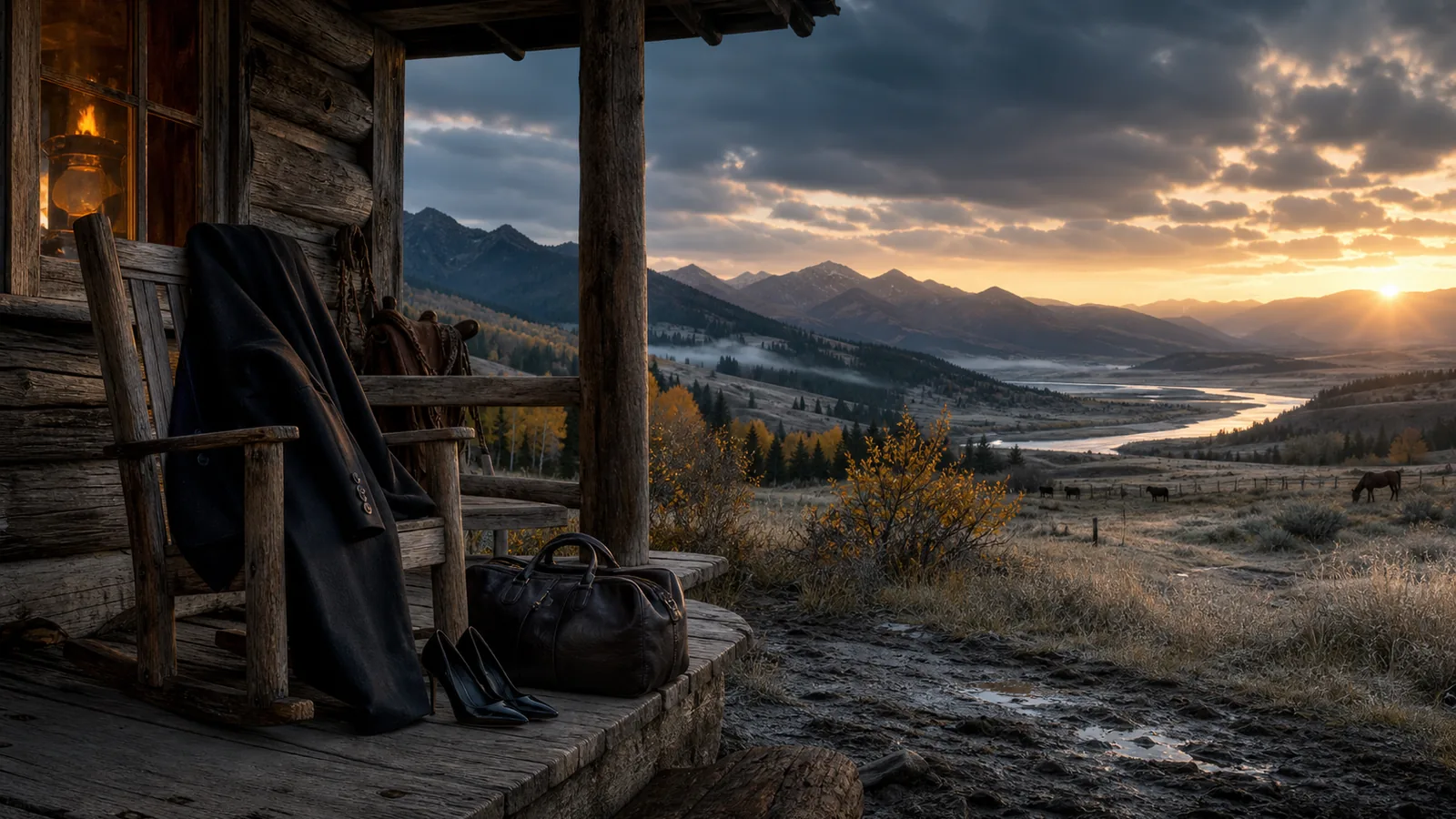
The answer comes quickly, and it matters. Morning is in Montana. Cade is dealing with cattle, muttering through one of those mornings, when Stacy appears at the cabin in city clothes and a different face. The leaves have changed. She says she came for sunrise and because walking around alone gave her a “lions, tigers and bears” worry. Cade tells her there are no tigers out here, but the other two are worth worrying about, and offers to teach her how to use what she is carrying.
Stacy has not found peace. She has found space. She missed the quiet, the scale of it, the room around her own thoughts. Then the practical question arrives, because Montana on this show is never only a feeling. She needs everything, head to toe. Cade sends her to Murdoch’s in Bozeman, and Stacy accepts the advice like a woman no longer visiting a costume department. If she is going to be here, she has to dress for the place.
Tiny details worth clocking
- Preston’s brother advice in the opening memory pays off through Russell at the memorial. He does not fix Stacy. He keeps people off her long enough for her to leave.
- Hailey’s philosophy-degree joke hurts because she treats Preston as part of the coffee shop’s future. Stacy has to absorb, in public, that ordinary strangers are still living in the old timeline.
- The office’s “after Fashion Week” compassion and the memorial’s two bars are the same joke at different tax brackets: grief is welcome once logistics approve it.
- Van’s highway warning about the national forest turns into Cade’s later warning about lions and bears. Montana is freer than New York, but the hour keeps refusing to call it safe.
- Dallas recognizing Bridgett’s Alexander McQueen dress is a perfect Dallas detail: attentive in the most useless possible direction.
Final verdict
The New York material is sharper here than it was in Episode 5, even if a few pieces push right up against caricature. The office scene is effective, but the coworker’s cruelty is so precisely designed to trigger Paige that the machinery shows. Phil’s hug and the memorial invitation also sit in that strange space where the show wants his boundary problems to feel both alarming and useful. Stacy keeps cutting him down to size, but the scene knows it is playing with fire.
Still, the spine is strong. Preston learns that a grieving person may need silence more than rescue, then the hour surrounds Stacy with people who confuse action for help. Lili plans the memorial. Paige punches the wrong person. Abigail calls Van. Russell searches half Manhattan. All of them love her. None of them can stand inside the loneliness she names in Phil’s office.
That is why the ending lands. Stacy does not flee to Montana because Montana fixes grief. She goes because the apartment has become a room where everyone else can say goodbye, and the cabin is the one place large enough for her not to. The hour’s plainest truth is sitting between Phil’s permission and Cade’s practical advice: surviving Preston means Stacy still has to make choices, and the first honest one is refusing a ceremony that belongs more to everybody else than to her.
Rating: 8.3/10 — a bruising, funny, slightly overstuffed hour, strongest when Stacy admits she is terrified of outliving the plan and when her escape turns the memorial’s polished goodbye into a dawn return to Montana.
More episodes from The Madison — A New York family, a Montana cabin, and grief in big-sky country. Jump to any episode in the season:
Where to go next
Reviewed by Mira Vance · QuizFandom Editor & Lead Reviewer. Every rating is an honest per-watch assessment from the desk that also writes the quizzes — not a press release rehash.