The Madison Episode 2 Review: "Let the Land Hold Me" — Stacy Claims the Valley, Hornets Wreck the Cabin, and Preston's Journal Shows What He Built
What happens — the short version (spoilers)
- A flashback shows Preston climbing for phone signal, describing the mountains as jagged teeth eating clouds, and promising Stacy he will be back by Friday for the Met Gala.
- At the cabin, Stacy cooks Mennonite-flour pancakes while Paige gets stung by hornets in the outhouse and Russell gets stung trying to redeem himself with calamine lotion and violence against the nest.
- Stacy takes Abigail to Stacy's Valley and says she wants to bury Preston there; Abigail worries about access, care, and moving on, then admits her last words to Preston were about paying him back.
- Cade Harris, a ranch worker from the neighboring place, brings casseroles, fry bread, a phone number, bacon-paste hornet advice, and the name of Waverly and Sons funeral home.
- After Paige complains about strangers' food, Stacy explodes that they are not on vacation, her husband and their father are dead, and everyone has forgotten why they are in Montana.
- A funeral director warns Stacy that future owners could block access or move the bodies, so Stacy decides to bury Preston and Paul in the valley, sell the Manhattan townhouse, and fund a trust to preserve the land.
The Madison's second hour puts grief inside chores, bugs, food, and people who need things from a woman who has not had time to breathe. Stacy reaches Stacy's Valley and turns a feeling into a burial plan; the family back at the cabin keeps treating Montana like a rental with bad plumbing. There is more comedy than in the premiere, sometimes almost too much, but every joke keeps circling the same bruise. Preston loved this place as a future, not a weekend, and Stacy spends the episode realizing the future was already standing there in wood, water, and a second cabin full of toys.
Preston climbs for a signal, sells Stacy on jagged teeth, and promises to be back by Friday
The opening flashback is small enough to hurt. Preston hikes to higher ground so the call will hold, sends Stacy the mountain view, and gets the exact answer he should expect from the woman who married him: pretty, but she is a beach girl. She likes waves, a clean horizon, comfort in the crash. Preston looks at the same line of sight and sees the opposite, a horizon made of jagged teeth eating clouds.
That is the marriage in one image. He is not trying to escape her. He is trying to translate a place she has never needed to read. Stacy hears the pitch and makes the practical bargain: he can say goodbye to the teeth by Friday, because the Met Gala is on Saturday and the hors d’oeuvres will be different from last year’s theme.
The scene also keeps the dead man domestic. Preston can be lyrical about country and still petty about Abigail’s ex. Stacy has to remind him that a divorced husband with two children is never truly out of their daughter’s life. It is a funny, ordinary correction, which is why it lands. This is the kind of call that should have had a dozen more versions.
Stacy makes Mennonite pancakes, Paige finds the hornets, and Russell tries to redeem himself with pink lotion
Morning in the cabin starts with Stacy cooking as if she has already decided to learn the place by using it. The pancakes are not gluten-free. The sausages are unidentified freezer meat. Macy and Bridgett bring school-fed nutrition certainty to the table, and Stacy answers with 30,000 years of bread, Mesopotamia, bromide, bleach, and flour milled by local Mennonites.
It is a very Stacy kind of adaptation: she has been in Montana for five minutes and is already giving a historical lecture over pancakes.
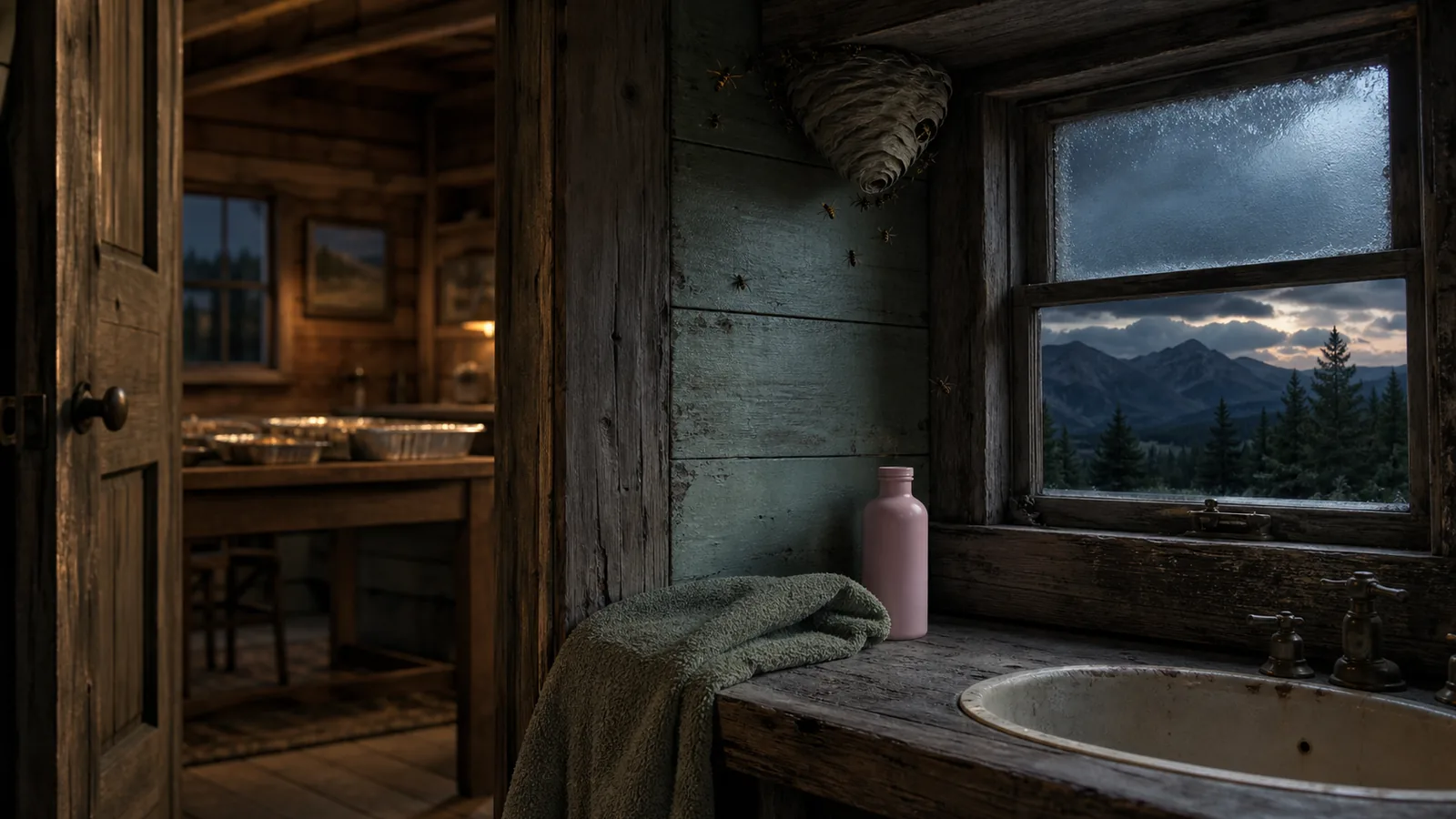
Then Paige tries to use the bathroom and the cabin reminds everyone that rustic charm has teeth. Hornets swarm her in the worst possible place. Russell admits, badly, that he knew there were hornets, and the whole family understands at once that this will not save him. Stacy and Abigail go into crisis-mother mode with Benadryl, Tylenol, and calamine lotion. Russell is sent to destroy the nest and comes back with his own eye swelling shut.
The family dynamic keeps the sequence exact even when the staging goes broad. Paige’s pain turns into prosecution. Russell’s helpfulness becomes evidence against him. Abigail doses despair like a field medic. The girls watch their parents spiral and ask whether divorce is coming, while Stacy stands in the middle of the cabin trying to keep everyone alive, medicated, and clothed.
Stacy brings Abigail to the valley, and a burial plan becomes a fight about keeping Preston close
The first quiet after the hornets belongs to Stacy and Abigail. Stacy takes her daughter to the grass Preston named for her hair, corrects herself when she speaks about him in the present tense, and says what she came to say: she wants to bury him there.
Abigail’s resistance is not cruel. It is the objection of the daughter who can see logistics before the widow is ready to. If Preston is buried there, how does Stacy visit him? What happens if the land has new owners? Who takes care of the cabins, the land, Stacy herself? The episode lets the argument stay practical because that is where grief usually hides. The land, Stacy says, takes care of itself. She is not Paige. First Avenue can be dangerous too.
Then the practical talk breaks. Stacy says she has no intention of moving on, ever. Holding on to Preston is the closest she will get, and she brought Abigail to share the decision, not approve it. The line could play as stubbornness if the valley were only scenery. Instead, the camera has already taught us what Preston saw there. This graveyard has a body before it has a grave: grass he loved enough to name after her.
Abigail’s own wound comes out after that. The last thing she said to Preston was that she would pay him back. In her mind, that makes her the disappointment who ran out of time. Stacy asks what he answered, and the answer is the softest cut in the hour: I wouldn’t accept it if you tried. Stacy does not fix Abigail’s grief. She gives it one true fact to stand on.
Cade brings casseroles, fry bread gets corrected, and Stacy finally says what the cabin guests keep forgetting
Cade Harris enters like a neighbor before he becomes a plot door. He works for the ranch that shares a north fence, says Paul and the ranch owner were close, and brings the food people sent because everyone assumes the Clyburns are starving in Paul’s sparse little world. Lasagna, garlic bread, beef casserole, buttermilk pie, fry bread. It is grief expressed in foil pans.
The city-country friction here is sharper than the easy version. Cade calls the fry bread topping Indian tacos, one of the girls calls it racist, and the room freezes. The correction is not wrong. It is also coming from someone receiving the casserole, the cell number, the funeral-home lead, and the bacon-paste hornet remedy from a stranger trying to help.
Stacy knows both things and hates how much teaching is required. She tells the girls that someone being wrong does not erase their kindness. Later, after Paige snipes at the food from people she does not know, Stacy finally snaps the episode back to its reason for existing. Strangers spent time, money, and thought on them. The family has been in Montana less than two days and has already turned the cabin into complaints about bathrooms, food, Wi-Fi, and leaving.
Then she says the obvious thing nobody has been letting her say cleanly. Her husband is dead. Their father is dead. They are not on vacation. She thought losing him might bring them closer, and instead she is still the person expected to carry the room when everyone else wants out.
It is the episode’s best harsh scene because it does not make Stacy saintly. She goes too far. She calls out the spoiled women she raised, hits Paige and Abigail through the grandchildren, and leaves with the rental keys. But the anger has a clean source. Every casserole on that table is kinder to Preston’s memory than the family’s impatience has been.
A funeral director warns Stacy about strangers, and Preston’s journal shows the cabins were an invitation
The funeral home scene turns Stacy’s romantic decision into paperwork. To bury Preston on the land, she needs a private cemetery registered with the county and the state. She needs a deed, a survey, probably an attorney. The official speaks gently, but his warning is brutal: if the land is ever sold, new owners do not have to let the family visit. They can remove the cemetery, exhume the bodies, move them, cremate them.
That warning is the hinge of the hour. Stacy can bury Preston in the valley only if she protects the valley from everyone who might someday treat it as an asset. The show sends her back into the grass alone, asking Preston for help because she does not think she is strong enough to do this without him.
Back at the cabin, the answer arrives through the journal. Preston writes about a freak June snow, a drunken snowman with Paul, and the girls who never built one because there was no yard in New York. Then the thought becomes architecture. Maybe he can convince his girls that the woods are liberating. Maybe he can build an outhouse. Maybe cabins where the tents are. A place to gather.
Stacy follows that thought to the other cabin and sees the old games and toys. What looked weird to Abigail is suddenly legible to Stacy: one cabin for the daughters, one for her, a family settlement built by a man who kept waiting for them to arrive. Her line, I’m so blind, is not self-pity. It is recognition arriving too late and still demanding to be useful.
Paige and Russell make peace in the loft, and Stacy sells Manhattan to protect the valley
The hour’s funniest reconciliation belongs to Paige and Russell, partly because neither of them can move without pain. She forgives him for the hornets; he is foolish enough to ask what he is being forgiven for. She explains that forgiveness does not return them to the moment before the wrong. It returns them to the beginning, when he was cute with a good sense of humor. He gets to apply itch cream and maybe cuddle, but the marriage is still on probation.
Under the jokes, the scene does what the family keeps failing to do elsewhere. Paige and Russell admit they are city mice, then immediately revise the metaphor because Russell would rather be an urban tiger. It is ridiculous and tender. Montana has not converted them. It has only forced them into the same bed with no armor left except banter.
Stacy’s final walk gathers everyone into the valley. She has taken the funeral director’s warning literally. Preston and Paul will lie there. Someday she will too. The daughters can choose the same or choose something else, because it is their last decision, as Stacy dryly puts it.
Then she announces the real cost. To protect Preston and the land, she will sell the Manhattan townhouse and put the money in a trust that exists only to preserve the place. Nobody in the family will be able to lose it or sell it. Paige reaches for Abigail to stop her. Abigail cannot. She sees the same thing Stacy has been seeing all day: when Preston died, the old family died with him, and the new one is being asked to begin in the middle of nowhere.
Tiny details worth clocking
- Preston’s beach-versus-mountain conversation echoes Stacy’s later choice: she liked the clean horizon, but she ends the episode choosing the jagged one.
- The pancake lecture is Stacy adapting through control. She cannot make the cabin easy, so she makes the flour historically defensible.
- Cade’s bacon-paste advice is funny because it is both absurd to the Clyburns and completely confident in its own local usefulness.
- Preston’s journal turns the outhouse from a punchline into proof. He did not build roughness to punish them; he built around the thing he knew would scare them off.
- Paige’s barn scene keeps the episode honest about Montana. The valley can be sacred and still have a bathroom situation from hell.
Final verdict
Episode 2 is a looser hour than the pilot, and the hornet comedy pushes right up against sitcom shape before the grief pulls it back. Paige and Russell’s loft scene also runs long enough that the joke starts to outrun the episode’s deeper tension, even though it gives their marriage a warmth the pilot only hinted at.
Still, the hour knows what it is building. Every inconvenience becomes a test of whether this family can receive a place without turning it into a service complaint. The thesis lands in the second-cabin discovery: Preston was not keeping Montana from Stacy and the girls. He was preparing it for them, badly perhaps, hopefully for sure, and they never came long enough to see the work.
That makes Stacy’s final choice feel less like an impulsive widow’s gesture and more like the first hard act of stewardship. Selling Manhattan is dramatic, maybe reckless, and absolutely the sort of decision the show needs from her. If grief has turned the cabin into an argument, Episode 2 lets Stacy answer it with money, land, and a promise nobody else is ready to understand.
Rating: 8.1/10 — funnier and messier than the premiere, but strong where it counts: the valley, the journal, and Stacy’s decision to protect the place Preston built for a family that arrived too late.
More episodes from The Madison — A New York family, a Montana cabin, and grief in big-sky country. Jump to any episode in the season:
Where to go next
Reviewed by Mira Vance · QuizFandom Editor & Lead Reviewer. Every rating is an honest per-watch assessment from the desk that also writes the quizzes — not a press release rehash.