The Madison Episode 5 Review: "No Name and a New Dream" — Stacy Buries Preston and Paul, Van Lets Abigail Go, and Russell Finds the Question Under the Ashes
What happens — the short version (spoilers)
- Macy asks Stacy what happens after Preston and Paul are buried, and Stacy explains bodies returning to the land, memories like movies, and the limits of comfort when a movie cannot hug you.
- Van and Cade decide the graves must be dug by hand and the caskets brought by wagon, while Lili buys black dresses in Bozeman and tells Stacy the girls have arranged a plane home that night.
- At the burial, Stacy realizes she forgot a preacher, Swenson offers a prayer, and Paige asks which casket is Paul before cursing him for taking Preston from the family.
- Neighbors arrive with food and stories, including Bill's account of Preston and Paul building cabins on railroad ties and arguing the outhouse was mobile because of shopping-cart wheels.
- Van tells Abigail that his sheriff's-deputy life, rope-horse plans, elk trips, and Montana limits cannot fit her New York life; she leaves angry after he chooses missing her over starting a doomed affair.
- Back in New York, Phil's whiskey-soaked therapy gives Stacy permission to rage and consider leaving, Paige breaks down until Abigail brings rocky road, and Russell admits at a no-name bar that he and Stacy both need a new dream.
The Madison's fifth hour is a funeral episode that refuses to behave like one. The burial itself is plain, almost unfinished, and the real ceremony comes from everything around it: Macy asking what heaven is, neighbors bringing food, Van choosing pain before fantasy, and Stacy returning to New York with Montana still on her skin. The hour keeps turning grief into a practical question. What do you do with a place, a marriage, a daughter, a body, a dream, when the person who gave it shape is gone?
Macy asks where Preston goes after burial, and Van and Cade make the graves possible the old Irish way
The hour starts before the funeral, which is the right place for it. Macy walks the land with Stacy and points out tracks, first elk and then moose, with the confidence of a child who has absorbed Montana faster than half the adults. Stacy has no lecture ready. She is trying to answer a question no grandmother should have to answer before breakfast.
Macy wants to know what happens after they bury them. Stacy reaches for the language the valley has given her: bodies returning to the land, souls maybe returning with them, Preston’s heaven being this place. Then Macy catches the gap in the comfort. If he is here, why is everyone so sad he is gone?
That is the hour in one child-sized question. Stacy can tell Macy that memories are like a movie you replay in your mind, and she can mean it. Macy can answer that a movie cannot hug you, and be more accurate than every adult in the show.
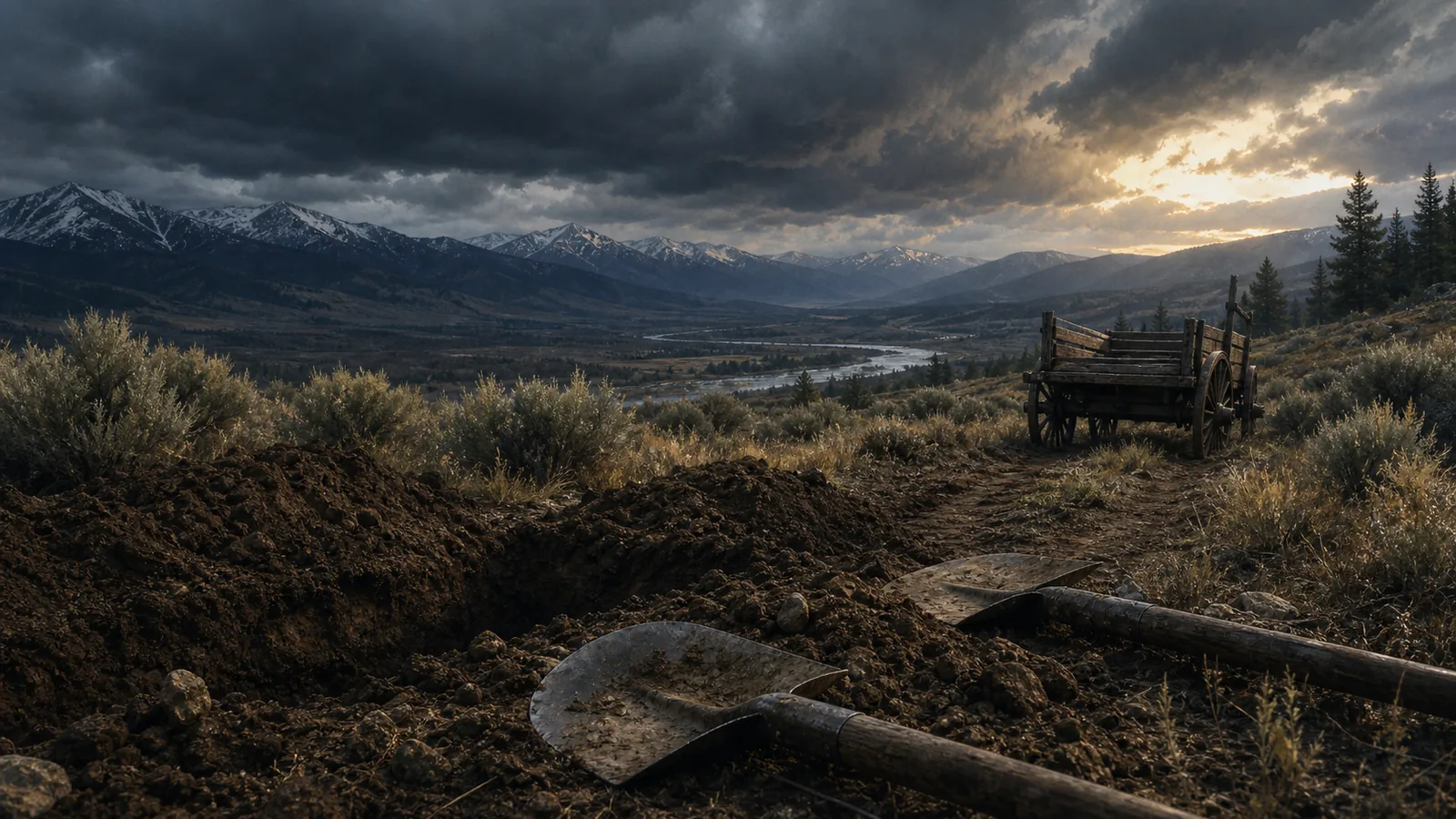
Across the land, Van and Cade are dealing with the same fact without any poetry. The graves are where the marked map puts them, but no backhoe is getting there. A tractor might come up from the river and still be useless. Cade and Van look at the ground, the grade, the bodies waiting, and the work becomes obvious. The holes are getting dug by hand. The caskets are coming by wagon. One man calls, the other runs for shovels.
Nobody says the land will hold them. Men pick up tools and make the sentence true.
Lili buys black dresses in Bozeman, and the plane home waits before anyone reaches the graves
Inside the cabin, the living are doing what the living always do before a funeral: making calls, fixing clothes, finding cream, pouring something into coffee, and pretending logistics can create steadiness. Abigail is on the phone with a school that apparently believes volleyball remains urgent during a death in the family. A child worries over what she has to wear. Abigail gives her the only answer available. It will have to do.
Lili has found cream, black dresses, and evidence that Bozeman can still surprise a New Yorker. Stacy thinks Preston would prefer her in jeans. Lili argues for the little black dress because Preston deserves the formality. They are deciding what grief should look like in a place with dirt paths and a noon walk to two graves.
Then Lili gives Stacy the practical knife: the girls asked her to arrange a plane for that night. Paige and Abigail need closure. They have lives to get back to. Lili is leaving too, partly because she has a worried husband and partly because friendship has limits even when love does not.
Stacy does not fight it yet. In earlier hours she would have turned need into command. Here, she hears the plane, the memorial service, Carbone, the apartment, the Explorers Club, and lets the New York machinery begin moving around Preston before the Montana dirt has closed over him.
The Kahlua in the coffee settles nothing. It is just enough courage to put on the dress.
Swenson gives the prayer Stacy forgot, Paige curses Paul, and the valley brings its own wake
The burial is blunt. The family walks to the graves. The caskets arrive by wagon. People offer condolences that are too small because every condolence is too small. Then Stacy realizes what she forgot: a preacher, a person to run the room, any script at all for putting her husband and his brother in the ground.
Swenson steps into the blank space with the ease of someone who has seen death arrive in many shapes. He asks whether she minds a prayer, then gives one that is both practiced and useful. Stacy hears the repetition in it. He has said this before. Out here, repetition is part of care.
No one in the family really speaks. Stacy says she has plenty to say, but not today. Paige finally breaks the silence by admitting she does not know what anyone is supposed to say, then asking which casket is Paul. The question lands with a horrible clarity. Preston is her father; Paul is the man who put him in the plane. Paige’s grief needs a target, and Paul is the only one lying there beside him.
So she gives him the anger first, then gives Preston the love. It is ugly, honest, and probably the most Paige has been Paige all season. She cannot make herself into the correct daughter at the graveside. Nobody should ask her to.
From that unfinished funeral, the valley refuses to let the day stay unfinished. People arrive with food and stories, teasing Stacy for trying to bury the brothers without telling anybody. Bill tells the kind of story that does more than eulogize: Preston and Paul building cabins on railroad ties, arguing by silence with a tax assessor, turning a shopping-cart wheel into legal philosophy for an outhouse. The brothers become men again in the telling, not bodies, not estate problems, not a crash recording.
That is the wake the family did not know how to ask for. Indian tacos, cookies, old neighbors, laughter at the exact spot where speech failed.
Van gives Abigail the shape of his life, and she hears goodbye at her father’s funeral
Abigail thanks Van because he has earned it. He helped with the burial, stood near the worst parts, and did not turn her family into a story about himself. She tells him they are flying out, but she wants to come back. Or maybe he could come to New York.
Van kills that dream gently at first, then thoroughly. The only way he is going to New York is if it secedes and he is drafted to take it back. The joke is funny until the inventory starts. He is a sheriff’s deputy making $52,000 a year, with $12,000 in the bank and half of it already mentally spent on an average rope horse. He will trailer that horse around Montana trying to win the money back. He will take his boys into the mountains in October and fill the freezer with elk. No beaches. No Europe. No big-city life.
Then Abigail walks him through hers: gymnastics, Pilates, therapy, coffee with friends about the therapy, ballet, recitals, competitions, St. Barts, Italy. The romance does not die because either of them lied. It dies because both of them tell the truth.
Abigail tries for the honest temporary version. There is no future, but there is attraction and kindness and grief, so why not ruin it together for a little while? Van cannot do that. He already knows what missing someone costs, and he would rather start there than climb into a loss he can see coming.
It is a clean, painful choice, and the timing is awful enough to make Abigail’s anger completely fair. She has just buried her father. The man who helped her breathe in the previous episode is now choosing absence before she has even left. When she tells him this is his chance to miss her, she is not wrong.
Russell tells Stacy a terrible joke, and Lili sends her to the therapist she does not want
New York does not welcome Stacy back so much as absorb her. The apartment has its surfaces, its serviceable food, its television noise, its memorial planning. Preston is everywhere and nowhere. That is why Stacy starts interrogating Russell about his father.
The question is simple enough: when did he die, where is he buried, what does Russell miss? Russell answers with the odd domestic limbo of modern grief. His father’s ashes were meant for Montauk and ended up in a jar on the mantle, above a fireplace full of ashes. What he misses is the Monday phone call and the dirty joke that came with it.
Then, because Russell is Russell, he tells Stacy one of the jokes.
It is wildly wrong for the moment, which is exactly why the scene works. Russell knows halfway through that the material has chosen him rather than the other way around, and Stacy’s face does the rest. The punchline hits the room like a dropped tray. For one second, New York manners, Catholic imagery, dead fathers, and Russell’s need to be useful all crash into each other.
Stacy still finds the one sharp observation inside it. Father Riley seems to be the common denominator in those nuns’ problems. It is a small, vicious little sign of life.
Lili sees the larger problem. Abigail is nursing the Van wound. Paige has gone quiet. Stacy thinks Paige will suffer hardest because she built so much of herself around getting Preston’s attention. Lili suggests a therapist. Stacy rejects the idea for exactly the reason she needs one: she wants opinion, not the book on death.
Lili cannot be impartial because she loves Stacy. Stacy does not need a pamphlet. She needs someone who can take the blast.
Stacy takes Phil’s whiskey, says every ugly word out loud, and considers leaving New York
Before therapy, a memory gives Stacy and Preston back their New York rhythm. He is packing for Montana, pleased with his boots like a boy with sports gear, while she talks charcuterie, Joe’s pizza for Paul, and Gucci-sale economics. It looks light until the ring comes off.
Stacy teases him about his mountain mistress. Preston answers with a practical confession: he once lost the ring in the river and spent two days looking for it. He puts it somewhere safe now because panic taught him. The moment is tiny. It also says what the whole series has been saying about Preston. Montana was not the other woman. Montana was the place where he was terrified to lose the proof of Stacy.
That memory follows her into Phil’s office, where she starts on Madison Avenue and the Madison River and ends somewhere much less polished. Phil first sounds like exactly the kind of therapist Stacy was prepared to despise: measured, interpretive, asking how she feels about a fact that has already torn her open. Stacy responds by setting the room on fire.
She names Preston as husband, father, center, soul. She denies being a bored woman trying to justify a tennis-coach affair. She is hurting, and she would like help if he has any.
Phil finally becomes useful when he stops trying to sound useful. He pours whiskey. He tells her she needs talking, yelling, crying, and a great deal of it. He tells her memory may become fond again, that she may love again, and that she will never be whole in the old way. The mercy is that he does not dress the truth up.
Then he invites her to insult him, and Stacy discovers how good a certain word feels in her mouth. It is funny, and it is the first therapy the scene believes in: permission.
By the time Stacy admits she is thinking about leaving New York, the idea has stopped sounding like a whim. Phil does not tell her to go to Montana. He tells her to consider everything because considering a future means she still believes she has one. For Stacy, that may be the first new dream the hour can offer.
Paige breaks in bed, Abigail brings rocky road, and Russell finds the bar with no name
The episode saves Paige’s grief until after everyone is back where Paige should feel competent. That is cruel and right. In Montana she could convert discomfort into complaint. In New York, with the burial behind her and her father’s absence becoming permanent, her body makes the argument for her. Russell calls Stacy because Paige is in bed, hyperventilating, unable to stop crying.
Stacy knows exactly what to do, and the answer comes before speech: rocky road, milk, and chocolate chips, made the way Paige liked it as a child. Abigail arrives with the ingredients before Russell can turn the errand into a committee. The sisters and their mother know this recipe like a family emergency code.
Then Stacy gives Paige the plainest comfort in the hour. The pain is how much she loved him, and her body does not know where to put all that love now. She also refuses to lie. Paige will feel this again when Stacy dies, when Russell dies, when friends die, and one day her children will feel it for her. Paige’s answer is perfect: thanks, Mom, she feels much better.
What actually helps is the old dessert, Abigail’s insult, Paige’s return insult about bad roots, and the room remembering how to be itself. Grief does not leave. It gets enough sugar in it to sit down.
Afterward, Stacy takes Russell to the SoHo version of a dive bar, which turns out to have no name, no clear identity, and a paycheck that says some LLC nobody cares about. The title finally lands there. A bar with no name, a widow with no old life, a son-in-law who has mistaken purchases for plans.
Stacy asks Russell what his dreams are. He starts with the townhouse, and she stops him. A purchase does not count as a dream. He starts with Paige, with children, with wanting them somewhere they can trick-or-treat and play ball and run into the street. Stacy reminds him that she raised hers here. Then she asks what the dream is after the children are grown.
Russell does not have one. His best answer is the saddest one: he thought Stacy and Preston were the dream. Stacy did too. Now that dream is over, and the man who has spent five episodes trying to be helpful finally says something useful. Maybe they both need a new one.
Tiny details worth clocking
- Stacy’s heaven explanation to Macy rhymes with Swenson’s later prayer. One is improvised from grief and land; the other is practiced from faith and repetition.
- The funeral dress argument quietly reverses Preston’s journal logic. Stacy thinks he would want jeans; Lili insists he gets the little black dress because ceremony still counts.
- Bill’s cabin story turns Preston’s stubbornness into community memory. The tax dodge is funny, but the real point is that other people knew this version of him for years.
- Abigail and Van’s goodbye is strongest because nobody is confused. They both understand the attraction; they both understand the calendar.
- The rocky road recipe is a better family portrait than any speech at the grave. Stacy and Abigail know the exact childish medicine Paige will accept.
Final verdict
Episode 5 is less cleanly shaped than Episode 4, but that feels partly by design. Funerals rarely behave like good television structure. The burial is short, the wake wanders, New York interrupts Montana, therapy almost turns into a two-person bar fight, and Russell somehow gets an obscene joke into the same hour as two caskets going into the ground. A few beats push long, especially the joke and the therapy-room sparring, which both trust the performances longer than the writing strictly needs.
But there is a strong spine underneath the wandering. Ceremony fails and reappears in stranger places. Stacy forgets the preacher; Swenson has a prayer. Paige has no speech; she has an accusation. Abigail cannot keep Van; she gets an honest goodbye. Paige cannot breathe; her mother and sister bring dessert. Russell cannot define a dream; a nameless bar gives him the room to admit that the one he borrowed from Stacy and Preston is gone.
That last scene is why the episode works. The Madison has spent four hours making Montana the argument, but “No Name and a New Dream” is careful enough to bring the question back to New York. Stacy may leave. She may not. The point is that Preston’s death has made staying a choice too, and she cannot keep calling the apartment, the marriage, the children, or the old calendar a life simply because they used to have his shape.
Rating: 8.2/10 — a looser but emotionally honest hour, strongest when the failed funeral becomes a wake, Van refuses a fantasy he cannot live, and Russell finally helps Stacy name the empty space after Preston.
More episodes from The Madison — A New York family, a Montana cabin, and grief in big-sky country. Jump to any episode in the season:
Where to go next
Reviewed by Mira Vance · QuizFandom Editor & Lead Reviewer. Every rating is an honest per-watch assessment from the desk that also writes the quizzes — not a press release rehash.