Bridgerton S04E2 Recap: "Time Transfixed" — The Mask Starts to Slip
What happens — the short version (spoilers)
- Sophie borrows Lady Penwood's gown and silver shoes after servants help her reach the masquerade.
- Benedict asks Penelope to print a discreet Whistledown signal for the unnamed woman.
- Violet identifies the glove crest as Penwood and sends Benedict to call on the household.
- Lady Penwood finds the dress and shoes, exposes Sophie's illegitimacy, and dismisses her from the house.
- Benedict finds Sophie being harassed at Cavender estate, intervenes, and offers to find her safer work.
Sophie Baek gets one stolen night as a lady, and London spends the rest of the week making her pay for wanting it.
Bridgerton, Season 4, Episode 2 — “Time Transfixed” Netflix
Sophie Baek knows exactly how a ballroom looks from the wrong side of service: who cleans the room, who turns down the beds, and who gets blamed when Rosamund Li loses a mask under her own dressing table.
That is why one night matters so much.
Sophie does not want a husband, a fortune, or a crown. Not yet. She wants to walk into a beautiful room without being treated like furniture. She wants to be looked at as if she belongs there. The cruelty of “Time Transfixed” is that she gets exactly that for one masquerade, and the feeling does not vanish when the mask comes off.
Neither does the risk.
Benedict Bridgerton leaves the ball with a glove and a romantic notion. Sophie leaves it with marked shoes, a secret under her mattress, and the first real proof that Lady Penwood’s house was never going to forgive her for dreaming above her station.
Sophie Baek borrows Lady Penwood’s silver shoes for the masquerade
The masquerade begins, for Sophie, with someone else’s accusation.
Rosamund’s embroidered mask disappears minutes before the carriage is meant to leave. Sophie starts sewing a replacement, but the original turns up under Rosamund’s dressing table, and Rosamund decides the explanation must be envy. Posy tries to defend Sophie. Lady Penwood silences her.
Sophie apologizes because survival in that house has trained her to do so.
Only after the Penwood women leave does she say the truth out loud. She is envious. Not of Rosamund’s manners, which hardly deserve the compliment, but of the chance to attend a ball and take it for granted. Rosamund and Lady Penwood will return complaining about decorations, gowns, and every small imperfection. Sophie would give anything for one glorious night.
The servants hear the ache in it.
Alfie and the others turn a reckless idea into a plan. The ball is a masquerade. No one has to know. There is an old gown in the attic, gloves to match, and the real risk: Lady Penwood’s silver shoes. Sophie hesitates because she understands the punishment waiting if she is caught. Her friends push back: she deserves to belong.
Not the dress. Not the mask. Not the borrowed shoes. The belief that, for a few hours, Sophie can enter a room and let no one own her.
Benedict Bridgerton asks Penelope to help find the lady in silver
Benedict handles longing like a man who has never had to think through the consequences for anyone else.
He comes to Rotten Row dressed for respectability and pretends he is there to chaperone Eloise. Eloise sees through him. He needs help finding the owner of a lady’s glove, and he would prefer their mother not learn about it.
Eloise sees the ruse clearly enough, but her concern at Rotten Row is about hidden intentions — toying with debutantes is precisely what a man who refuses to admit his purpose looks like. So Benedict takes the problem to Penelope instead.
Penelope understands the reputational danger faster than he does. She is the one who points out that a woman alone on a terrace with him already has enough trouble, and that if the woman came forward, her reputation would be tarnished — she will never come forward. Penelope can see the trap, but Benedict asks for a softer signal. No costume. No identifying detail. Just enough in Lady Whistledown to tell one unnamed woman that he is looking. Penelope warns him that one hint of serious courtship will bring every mother in London to his path.
Benedict thinks he can manage mothers.
Whistledown prints the bait, and the city descends. Young ladies appear at Rotten Row with eager mamas and rehearsed interests. Benedict asks about sisters, swimming, dancing, and masquerade costumes. Eloise gets dragged into the bargain and pays for it with suitors of her own.
Rosamund arrives because Lady Penwood reads the column exactly as intended, just for the wrong daughter. Benedict gives her a moment, hears the name Rosamund Li, and moves on. Rosamund is humiliated. Lady Penwood is furious. Sophie watches from the servant’s side of the room, knowing the search may be for her and may still have nothing to do with the life she actually lives.
The romance is intoxicating until it has witnesses.
Violet Bridgerton traces the glove to Penwood House
Violet lets Benedict tire himself out before she steps in.
By then he and Eloise have attended six balls, seven soirees, and enough promenades to make Eloise’s feet swell. The glove lady has not appeared. Whistledown has turned the search into public sport. Queen Charlotte has taken an interest.
Violet gets the truth out of Penelope, then goes to Benedict with the full force of a mother whose son has been hiding the one piece of news she would have wanted first. Benedict tries to make the matter sound smaller. Nothing untoward happened. He does not know the woman’s name. The search has failed.
Then Violet looks at the glove.
The crest inside belongs to the Penwood family, an heirloom habit from the old Lady Penwood. Benedict insists Rosamund is not the woman from the ball, but Violet gives him the clue he has been missing: Penwood House may still hold other possibilities.
Just not the kind Benedict expects.
When he calls on Posy, the drawing room turns into a little farce of nervous chatter and interruptions. Posy is nervous and sweet, talking about dreams where her hands become feet. Rosamund keeps interrupting. Benedict tries to ask whether anyone wore silver at the masquerade or whether there are cousins or family friends in the house.
Sophie stands close enough to hear him and far enough to stay invisible. Posy urges her to go in. This is the chance. He is there. He might recognize her. Sophie understands the terrible gap better than anyone in the room. Benedict wants the lady from the ball. Sophie is the maid who borrowed her for a night.
So she does not enter.
It is a heartbreaking choice because it is also a practical one. Sophie has already lived under Lady Penwood’s roof long enough to know that a dream can become evidence.
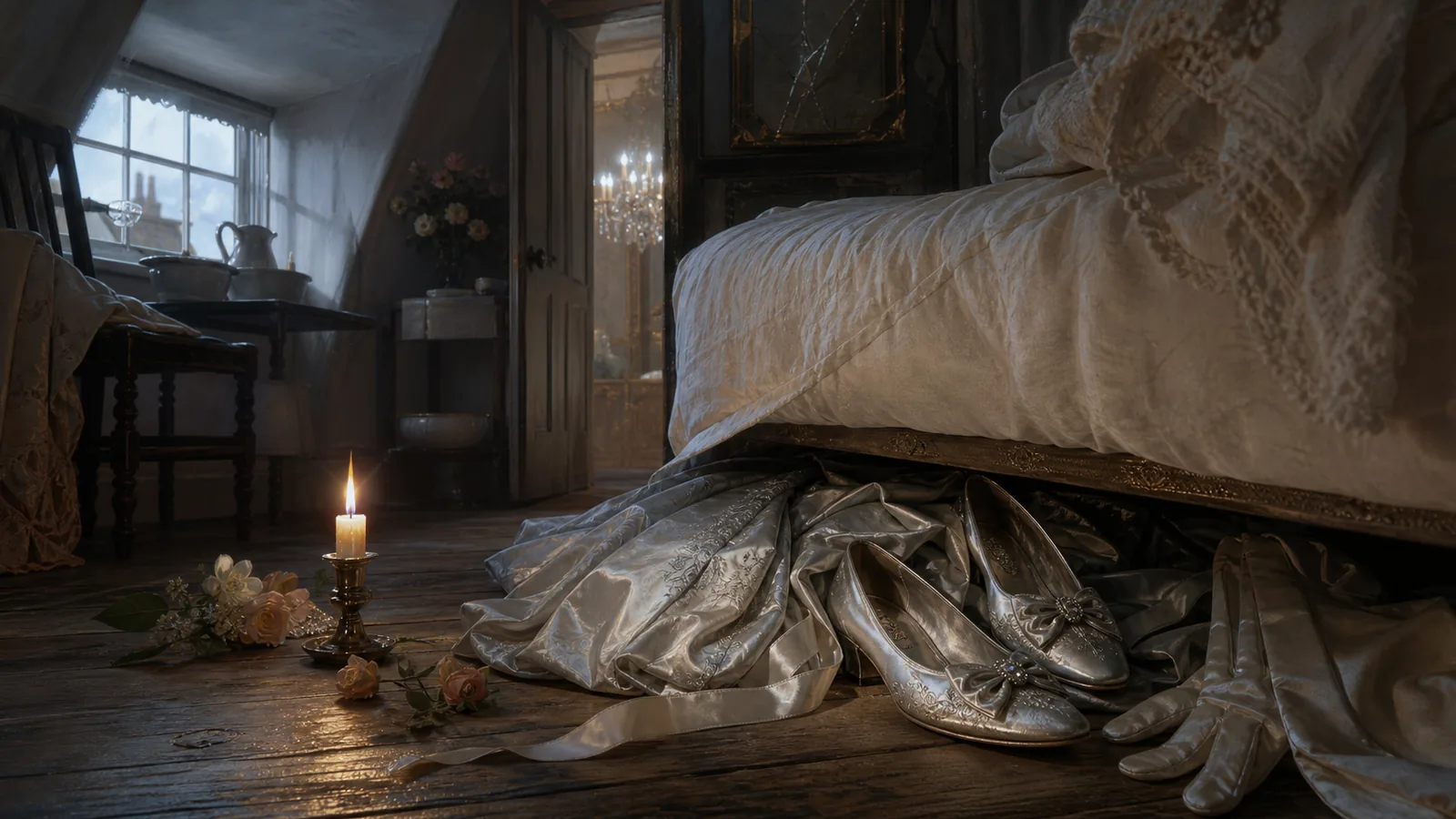
Lady Penwood dismisses Sophie from the only home she knows
Lady Penwood does not need a confession. She makes Sophie put on the silver shoes and watches them fit.
That is the end of pretending.
She has found the dress under Sophie’s mattress. She knows Sophie went to the masquerade. She names the crime as theft, deception, and impersonating nobility. Sophie is ready for hard labor, more polishing, more floors, any punishment that at least keeps the roof over her head.
Lady Penwood chooses exile.
The argument finally drags the old wound into the open. Sophie asks why Lady Penwood kept her in the house if she despised her so much. Lady Penwood answers with the ugliest version of the family truth: Sophie was Lord Penwood’s error, never his legitimate daughter in society’s eyes, never a person Lady Penwood intended to love.
The flashbacks sharpen that cruelty without making it simple.
As a child, Sophie wanted Lady Penwood to be a mother. Lord Penwood introduced her as his ward, not his daughter, and asked Sophie not to call him father in front of his new wife. Later, after his death, a sympathetic voice — not Lady Penwood — delivered the news from the solicitor: the late Lord Penwood had not included Sophie in his will. Sophie’s mother had been a maid and a mistress. Sophie, illegitimate and unprotected, would become a maid too.
Safety looks a great deal like servitude when someone else gets to define it.
Sophie leaves with a small collection from the servants and one quiet kindness from Posy. The shoe clips Posy slips to her are not real diamonds. A pawnbroker calls them paste. Still, the gift matters because Posy sees Sophie more clearly than anyone in that house is allowed to say.
It is not enough for a future.
It is enough for a mail coach.
Lady Danbury returns to Queen Charlotte’s chessboard
While Sophie loses her place in Mayfair, Lady Danbury and Queen Charlotte wage a colder battle over absence.
The queen wants gossip, company, chess, and obedience, though not necessarily in that order. Lady Baird asks to step away from service for her confinement, and Charlotte grants the leave by making it permanent. Lady Danbury hears the loneliness underneath and leaves the chess match unfinished anyway.
Brimsley knows what that unfinished game means.
He comes to Lady Danbury quietly, almost desperately, and asks her to return. Charlotte is not merely annoyed. She is adrift. She will not replace Lady Baird. The world around her has become smaller, and Lady Danbury is one of the few people who remembers why.
Lady Danbury returns with an apology she does not feel.
Charlotte accepts it, then makes her move. The conversation that follows strips the crown down to fear. Charlotte asks why Agatha wants to leave her. Agatha says friendship cannot be commanded. Charlotte reaches for rank and calls her a subject. Agatha accepts the wound and prepares to go.
That is when Charlotte breaks.
She apologizes. She is afraid of being left alone, and she is afraid of what happens when George dies. Lady Danbury stays. Not because she has been ordered. Because Charlotte finally asks like a friend.
For all the satin and ceremony around them, this is the same terror Sophie faces in another register: what becomes of a woman when the person who protected her is gone?
Benedict finds Sophie working at the Cavender estate
Benedict tries to laugh off his disappointment with Eloise, but the glove search has marked him too.
He admits he thought marriage might be possible with the woman from the ball. Then he retreats into every label the ton has ready for him: unserious, rake, free spirit. Eloise listens with more tenderness than she wants to show. She may resent losing their little unmarried clubhouse, but she does not want him wounded.
Benedict goes out anyway.
The country party he lands in is ugly beneath the revelry. Mr. Cavender — son of the estate’s absent Lord and Lady Cavender — and his friends harass a maid in the corridor. That maid is Sophie, now working wherever she can after Lady Penwood’s blacklist. She warns another servant to run, threatens to scream if touched, and refuses to be softened into silence.
Benedict steps in.
He does the necessary thing with a fury that cuts through the room. Cavender apologizes. Benedict warns him that any future abuse of a woman will cost him his place in society. Then Cavender answers with the petty cruelty of a man protected by his own house: Sophie no longer works there.
Benedict has saved her from one danger and knocked away the job she needed to survive.
That is why their final carriage ride carries so much tension. He offers to find her a safe position in London. Sophie does not trust the ease of that promise. She has tried London. She has learned how quickly protection can become another form of power.
He asks if they know one another.
Sophie denies it with the only shield she has left: she is only a maid.
Benedict still does not see the woman he has been searching for. Sophie sees him perfectly, and that may be worse. He wanted the glittering stranger from the masquerade. She is sitting beside him in plain clothes, poorer and far less protected than his fantasy allowed.
Time has not released them from that night.
It has simply removed the mask.
Verdict
“Time Transfixed” is a strong second chapter because it lets the Cinderella shape hurt. The masquerade is not treated as a harmless fantasy once Sophie returns home. Every borrowed object has a cost. Every look from Benedict has a consequence. The silver gown may have given her one beautiful evening, but the morning after belongs to rank, money, legitimacy, and reputation.
The Benedict-Sophie thread has real charge because the romance is already arguing with reality. His search is sincere, but it is also careless. Her refusal to reveal herself is painful, but it is not coy. Beside them, Queen Charlotte and Lady Danbury give the story a tender older echo about dependency, pride, and the terror of being left. A few of the promenade beats run long, but the final stretch lands with a carriage ride that knows exactly how much one sentence can hide.
Rating: 8.4/10
More episodes from Bridgerton — Season 4 — Benedict and Sophie's masked-ball romance, episode by episode. Jump to any episode in the season:
Where to go next
Reviewed by Mira Vance · QuizFandom Editor & Lead Reviewer. Every rating is an honest per-watch assessment from the desk that also writes the quizzes — not a press release rehash.