Bridgerton S04E5 Recap: "Yes or No" — A No Becomes Everything
What happens — the short version (spoilers)
- Sophie tells Alfie that Benedict asked her to be his mistress and asks about other work instead.
- Violet offers Sophie a letter, then has Mrs. Wilson investigate after Sophie lies about Aylesbury's ducks.
- Sophie tells Benedict no and says being his mistress is the last thing she would want.
- Miss Virginia confronts Penelope because Whistledown's unnamed gossip still ruined her plan for independence.
- Araminta's calling card arrives at Hyacinth's recital, and Sophie goes pale.
- Benedict tells Sophie he loves her, and Sophie chooses a night with him after he asks to go slowly.
Benedict wants an answer, Sophie wants a door, and Mayfair keeps proving that desire is never private once rank gets involved.
Bridgerton, Season 4, Episode 5 — “Yes or No” Netflix
Lady Whistledown begins the week with three dangerous words: “be my mistress.”
For the ton, the phrase is almost ordinary. Men keep wives in one house, women in another, and reputations balanced on whatever discretion can still be purchased. Penelope writes about one such arrangement without naming Mr. Hiscox or Miss Virginia. Half of Mayfair knows anyway.
That is the cruelty sitting under “Yes or No.” Benedict thinks he has asked Sophie one question. Mayfair keeps answering others for her.
Can a woman survive as the hidden part of a gentleman’s life? Can love excuse a life without name, standing, or security?
Sophie knows the answer before Benedict does.
No.
In Bridgerton, a no is never only a refusal. Sometimes it is the first honest sentence in the room.
Sophie tells Alfie that Benedict asked her to be his mistress
Sophie starts where she often has to start: looking for the next safe place before the present one disappears.
She meets Alfie because Araminta Gun has left Penwood House. Sophie does not yet know where Araminta has gone. She only knows that London feels smaller when her former stepmother can be anywhere.
Alfie asks how Sophie came to be in Bridgerton colors, and Sophie gives him the chain: Cavender House, the glass of water, Benedict’s fist, the downpour, the kiss, the job in Violet’s house, and now the offer that has made everything impossible.
Benedict has asked her to be his mistress.
Alfie, with the practical eye of someone who knows the servant world too well, does not gasp in the expected place. Lodging, an allowance, freedom from ordinary duties, and Benedict Bridgerton’s devoted attention do not sound like the worst bargain in London to him.
Sophie understands why he says it. She also understands the part he is missing. She has already lived inside another woman’s version of that bargain.
Her mother was a maid and a mistress. Sophie carries the surname that proves what society refused to give her: legitimacy, protection, a father who could name her without consequence. To become Benedict’s mistress would feel like walking back into the old arrangement with prettier rooms.
That is why she asks Alfie about other work instead. He mentions an opening under the new Lady Penwood, and Sophie reaches for the only tool she thinks can get her there: a letter from Violet Bridgerton.
Violet offers Sophie a letter while Mrs. Wilson investigates her past
Marcus slips out of Violet’s room in the morning after Mrs. Wilson fails, very uncharacteristically, to wake her in time. Violet is flustered, but Marcus is gentler than the scandal math around them. He thinks her children would enjoy seeing her happiness.
It is a lovely thought.
Hyacinth is treating her dance rehearsal like a debut ball. Eloise has annoyed Hyacinth badly enough that Violet threatens her with a return to the marriage mart. Into all of this, Sophie asks to leave.
She frames the request carefully. Violet created the position for her, and Sophie does not want to tax her generosity. There is work available at the house where she grew up, and a letter of introduction would help.
Violet agrees, but not before noticing the small wrong notes. Sophie says she grew up in Aylesbury. Violet mentions its famous owls. Sophie politely says she dislikes owls. Later, Violet tells Mrs. Wilson the point: Aylesbury is famous for ducks.
That tiny lie sends Mrs. Wilson asking questions, and the answers are not what Violet hoped.
Sophie has her mother’s name. Her mother was from London, not Aylesbury. Violet understands what that likely means. Sophie is illegitimate.
Violet had started to imagine some hidden noble origin that might make Sophie “suitable” for reasons society would accept.
Then Mayfair closes its fist.
Araminta has moved next door to the Bridgertons, bringing Rosamund, Posy, Mrs. Varley, and a new list of grievances. She believes Sophie stole her diamond French shoe clips. Mrs. Varley learns from the servants’ market that Sophie Baek is now working at Bridgerton House.
The refuge is now one wall away from the old prison.
Benedict arranges a walk and Sophie gives him her answer
Benedict knows Sophie will not speak to him at the house, so he uses an errand as cover. He sends Eloise and Francesca out to buy the feather while he stays behind with Sophie. Eloise suspects the idea is not his. She is right. Hatch asked Mrs. Wilson.
Sophie sees the trap at once. Benedict apologizes, but he still wants what he came for: an answer to whether she will be his mistress.
Sophie gives it plainly.
No.
Then she gives him the part he should have known before he asked. If he understood her, being his mistress would be the last thing she would ever want.
The painful thing is that Benedict is not cruel here. He is sincere, and sincerity only makes the gap more obvious.
When he later finds her alone at the house, the argument finally sharpens around his double standard: would he have kissed the lady he met at a ball the way he kissed Sophie?
Would he have kissed the lady from the ball by the lake or in the stairwell? Would he have asked her to be his mistress? Or would he have protected her from ruin?
Benedict has no easy answer because a kiss does not cost them equally. His desire can be treated as wildness. Hers can be treated as proof she was never respectable.
Sophie says it exactly. As a maid, she is respectable and necessary. Benedict’s offer would take that from her too.
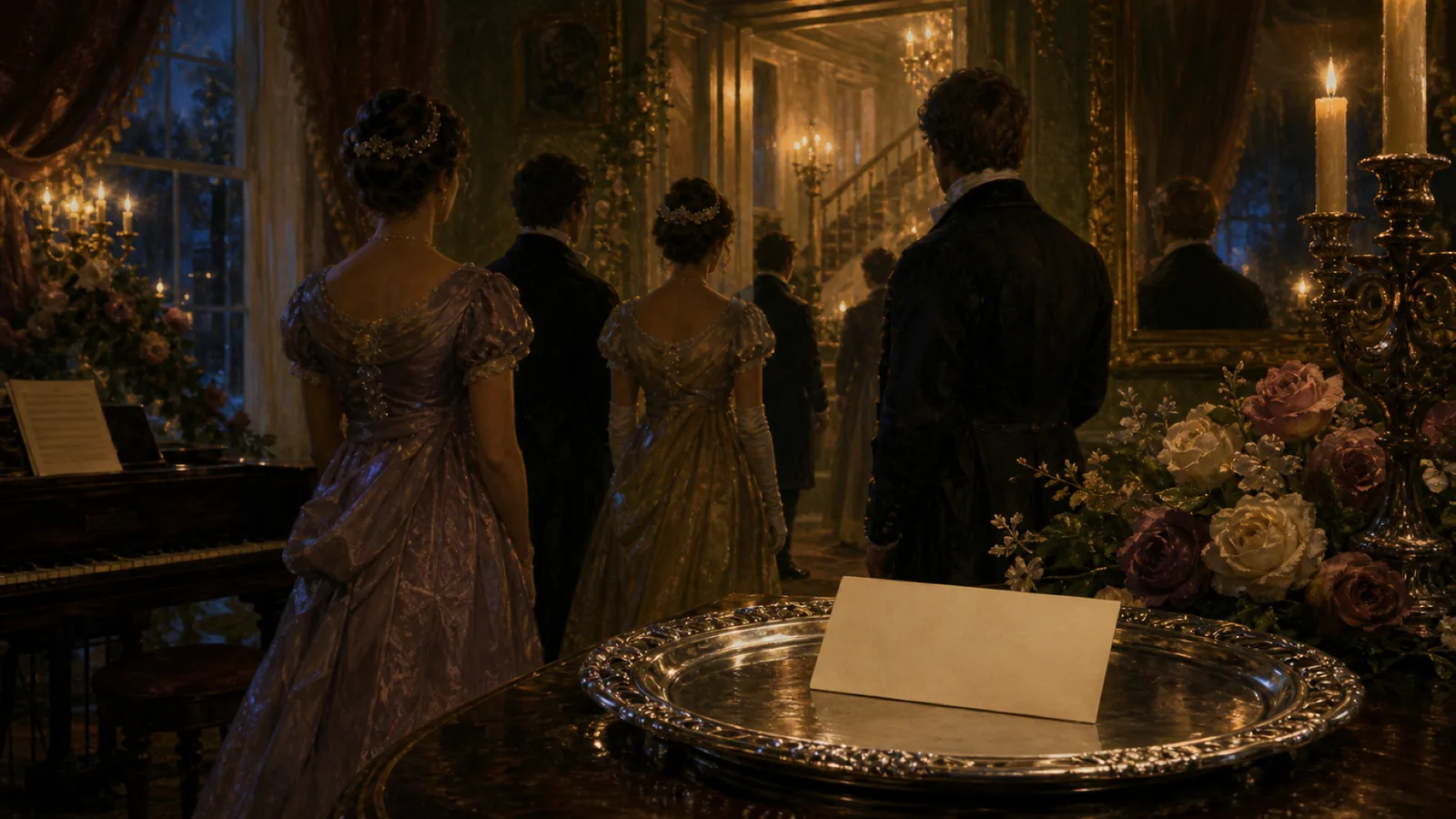
Penelope hears what Whistledown cost Miss Virginia
Penelope learns the same lesson from the other side of the quill.
Miss Virginia forces her way into the Bridgerton house because Whistledown’s unnamed gossip has named her in every way that matters. Penelope insists she did not print names. Miss Virginia knows the difference is cosmetic.
Before the column, speculation was still speculation. After Whistledown, it became real for the ton, real for Mr. Hiscox’s family, and ruinous for Miss Virginia’s plan to save enough money for independence.
Penelope wants to help, but a denial would only invite more scrutiny. The damage has already moved faster than mercy can follow.
At the palace, Queen Charlotte has the opposite complaint. She does not like Whistledown’s restraint. Why no names? Why no new report on Benedict? How are she and Lady Danbury meant to settle their bet if Penelope refuses to feed the game?
Penelope tries to explain that public authorship changed Whistledown. She is no longer a wallflower watching from the edge. She is a Bridgerton, privileged enough to be received by the Queen.
So she asks to rest it and pursue other writing.
Charlotte’s answer is immediate.
No.
Everyone wants Penelope’s power until she tries to make it responsible. Everyone wants Sophie to accept the protection available to her until she names the price.
Hyacinth’s recital brings Marcus, Gregory, and Araminta into view
Hyacinth’s rehearsal arrives with enough lemonade anxiety to fuel an entire season. Daphne told her that a young man who takes a fancy to a girl may offer to fetch lemonade, so Hyacinth wants plenty nearby.
Eloise brings the feather Benedict arranged, but Hyacinth rejects it because Sophie has already styled her hair and she does not wish to look like the silly girl Eloise thinks she is.
Gregory receives romantic advice from Colin, Mr. Finch, and Mr. Dankworth over imported cheese, then puts it to use almost immediately. After one dance and one lemonade exchange, he thinks he may be in love.
Violet uses the evening for courage of her own. She tells Hyacinth and Eloise that Lord Anderson will attend because he is her friend. The word is small, but Violet has to push it through years of widowhood and motherhood.
When Marcus arrives and the world does not fall apart, Violet knows the time is right.
Across town, Francesca tries to host Michaela into a more conventional future and nearly breaks the peace of her own house. John keeps blaming Parliament for his mood, but Francesca knows Michaela has changed their routine. She introduces Lord Taylor despite John’s warning, and Michaela retreats to another room.
Francesca wants badly to be a good wife. Michaela misses John, worries for him, and admits there are very few people with whom she feels secure. Francesca, a little drunk and more honest for it, admits she is envious of Michaela’s chaos.
They end as friends. Then Araminta’s calling card lands at the recital.
Sophie hears the name and goes pale.
The neighbor is not a rumor anymore.
Benedict follows Sophie upstairs and says he loves her
Sophie leaves the recital saying she feels poorly, and Benedict follows.
Violet stops him first. Whatever is happening between him and Sophie is not appropriate. Benedict, stung, turns the accusation back on her. She is with Marcus, a man who is not her husband, while her children sleep down the hall. He says her life is none of his business, but his is none of hers.
It is an ugly thing to say to his mother.
It is also the argument of a man who has found one example of adult desire outside the rules and wants it to absolve him of every consequence.
Upstairs, Sophie will not let him do that.
She tells him it would be easier to say what is right than what is wrong. She did not ask him to pursue her, touch her, kiss her, or show her a world that could never be hers. He hurts her.
Benedict finally stops defending the shape of his offer and says the thing beneath it. He thinks of her every moment. He wishes there were another way for them to be together. The thought of a day without her torments him. He loves her.
Sophie says he cannot.
Benedict agrees, and that is what makes the confession land. He cannot love a maid. He cannot be with a maid. He cannot spend every waking hour longing for a life beside her, and yet he does.
It is excessive. It is foolish. It is also the first time he gives Sophie more than an arrangement.
He tells her he would not marry anyone else and asks for the one answer he cannot buy.
Sophie has already said no to being hidden.
This time, she says yes to being loved.
By the final minutes, their bodies follow what their words have admitted. Benedict asks if it is all right. Sophie says she wants him and asks him to go slowly.
No title has changed. No protection has appeared. Araminta is next door, Violet knows too much, and society still has teeth.
Sophie has not been coaxed into a mistress’s bargain. She has chosen a moment after naming exactly what it costs her.
Verdict
This is a rich midseason turn because the swoon arrives only after the argument has done its work. Benedict and Sophie’s final scene has heat because Sophie says no first, often, and clearly. Her refusal is not coy. It is moral, practical, and personal.
The side plots also pull their weight. Penelope’s Whistledown crisis mirrors Sophie’s fear of becoming a disposable woman in a man’s story. Violet and Marcus give Benedict an imperfect adult mirror. Francesca and Michaela’s quarrel adds a softer note about insecurity inside marriage and friendship. If anything drags, it is the table-setting around the recital and the Kilmartin soiree, but the emotional throughline stays clear.
The result is longing with a bill attached. Benedict and Sophie are intoxicating here because the romance does not erase the danger. They walk straight into it, hand shaking, heart open.
Rating: 8.7/10
More episodes from Bridgerton — Season 4 — Benedict and Sophie's masked-ball romance, episode by episode. Jump to any episode in the season:
Where to go next
Reviewed by Mira Vance · QuizFandom Editor & Lead Reviewer. Every rating is an honest per-watch assessment from the desk that also writes the quizzes — not a press release rehash.