Bridgerton S04E7 Recap: "The Beyond" — Grief Crosses the Room
What happens — the short version (spoilers)
- Benedict speaks at John's funeral while Francesca tries to manage biscuits and condolences instead of grief.
- Sophie helps Francesca upstairs and shares a memory from her father's funeral.
- Francesca says she may be carrying John's child, then breaks after a physician's examination and succession talk.
- Violet tells Benedict that marrying Sophie would mean country life, social distance, and risks for Hyacinth.
- Posy warns Sophie that Araminta wants her arrested over the shoe clips.
- Francesca dances a Highland reel for John, while Araminta has Sophie arrested before Benedict can reach her.
John Kilmartin's funeral asks Francesca to mourn in public, while Benedict and Sophie learn how little time love leaves for polite hesitation.
Bridgerton, Season 4, Episode 7 — “The Beyond” Netflix
At the start of “The Beyond,” everyone is speaking softly around a wound no one can tidy.
John Kilmartin is gone. Benedict stands where Anthony might have stood and tries to give shape to a loss that has arrived too quickly for language. Francesca listens as her brother calls John a good man, devoted to his family, his Parliament seat, and most especially to his wife.
Then the service ends, and the work begins.
That is Francesca’s first instinct here: work. Biscuits must be managed. Guests must be thanked. Letters must be written. If grief cannot be stopped, perhaps it can at least be arranged on a tray with enough napkins and proper distance.
But death has no respect for a well-run reception.
Neither does love, which is very rude of it.
Benedict speaks for John at the funeral
Benedict begins the day apologizing for not being Anthony, then does exactly what the family needs. He does not pretend to understand the loss. He says he is at a loss too. That honesty suits the room better than a grand speech would have.
Francesca accepts his effort with quiet grace, but she cannot accept stillness. She refuses a private moment by the grave because there is too much to oversee at home. At the reception, she reaches for usefulness as if it might hold her together. When talk of John’s love for her begins to overwhelm her, she notices the biscuits instead.
Of course she does.
A Bridgerton woman may be breaking apart, but heaven help the household if the refreshments run low.
Sophie sees the panic under the composure. Her excuse is perfect: Francesca’s hair is coming undone. Upstairs, away from the condolences, Sophie gives Francesca the kind of permission society never does. She tells her about her father’s funeral, the pickled salmon he detested, and the fury she wanted to throw across the room.
It is a small story, but it gives Francesca a new way to think about memory. Everyone keeps a different version of the dead. All anyone can do is honor the version they loved.
Francesca does not know how to do that yet. She only knows how to return downstairs.
Michaela asks Francesca to celebrate John’s life
Michaela understands John through laughter as much as mourning, and that makes her suggestion both loving and impossible for Francesca to hear at first.
In Scotland, Michaela says, people eat, drink, cry, laugh, and tell stories of the dead. John would not want to be mourned by strangers in stiff silence. He would want family and friends to rejoice in his life. He would want dancing.
Francesca hears criticism where Michaela means tenderness.
The snap is instant. John does not want anything, Francesca says. He is dead. Gone. Turning his funeral into a circus will not change that.
It is unfair, and it is also grief talking with its teeth out. Michaela wants movement because standing still hurts. Francesca wants order because feeling anything larger might ruin her. They both loved John. They simply loved him from opposite sides of the same silence.
Violet sees the danger in that silence. So does Eloise. So does nearly everyone who tries, clumsily or gently, to approach Francesca. Yet Francesca keeps insisting she is steady, even when the word sounds less like truth than command.
Then she tells her family why.
Francesca tells her family she may be carrying John’s child
Francesca’s courses are late. She believes she is with child, and the news changes the rules of her grief at once.
She calls it John’s gift, a piece of himself left behind, the way Edmund left Violet with Hyacinth. If she must stay calm for the child and for the Kilmartin line, she will. In her mind, that makes composure a duty rather than a denial.
The family receives the news with care, but the ton is never content to let a woman’s word be enough.
Mr. Dundas arrives from the House of Lords to discuss the Kilmartin estate and succession. Francesca tells him she is with child before he can ask the question. He offers congratulations, then immediately calls for a physician’s examination. Benedict objects. Francesca does not want it. Dundas speaks of procedure, the Crown, the estate, the title, the Parliament seat.
There it is: grief turned into paperwork, the body of a young widow turned into evidence.
Benedict’s anger is sharp and welcome. He reminds Dundas that this is an honorable family and that Francesca has already endured a nightmare. It does not save her from the examination.
Afterward, Francesca finally breaks. She cannot sleep in her room. Violet tries to reach her through Edmund, and Francesca rejects the comparison in open anger. Violet has eight children, eight pieces of Edmund. Francesca believes she gave John nothing. She says she failed him, cursed it, failed to continue the Kilmartin line.
The calm is gone.
What remains is a daughter in her mother’s arms, saying she has nothing.
Benedict tells Violet he loves Sophie
Benedict spends the day doing what his family requires, but Sophie keeps pressing at the edge of every duty.
In the garden after the funeral, he thanks her for comforting Eloise and Hyacinth. She offers sympathy anyway, not because her employment demands it, but because her heart is breaking for him. He asks whether she still plans to leave. She does. At the end of the week.
He wishes her luck, which may be the cruelest polite sentence in Mayfair.
Benedict cannot keep pretending with Violet. When she mentions Sophie, he finally says what he has been circling: he loves her. More than he thought possible. Captivating, maddening, real. Then he turns Violet’s own gospel of love matches back on her. Would she have thrown Edmund aside if he had been lower class?
Violet cannot answer that quickly, and the delay tells Benedict plenty.
Later, after Francesca’s breakdown has left everyone raw, Violet and Benedict share a drink beneath Edmund’s portrait. Violet is more honest this time. She says marrying Sophie would mean a different life: the country, real distance from society, fewer family visits, missed birthdays, missed weddings, harm to Hyacinth’s prospects if the family stays too publicly close.
It is not a refusal. It is a bill.
Then Violet gives him the part he needed most. If Benedict has found love, he deserves to go after it before it is too late. If he marries Sophie, Violet will still love him.
That blessing does not make the choice easy. It makes the choice real.
Sophie loses her necklace and agrees to leave for the Americas
While Benedict weighs forever, Sophie’s life keeps shrinking with every conversation.
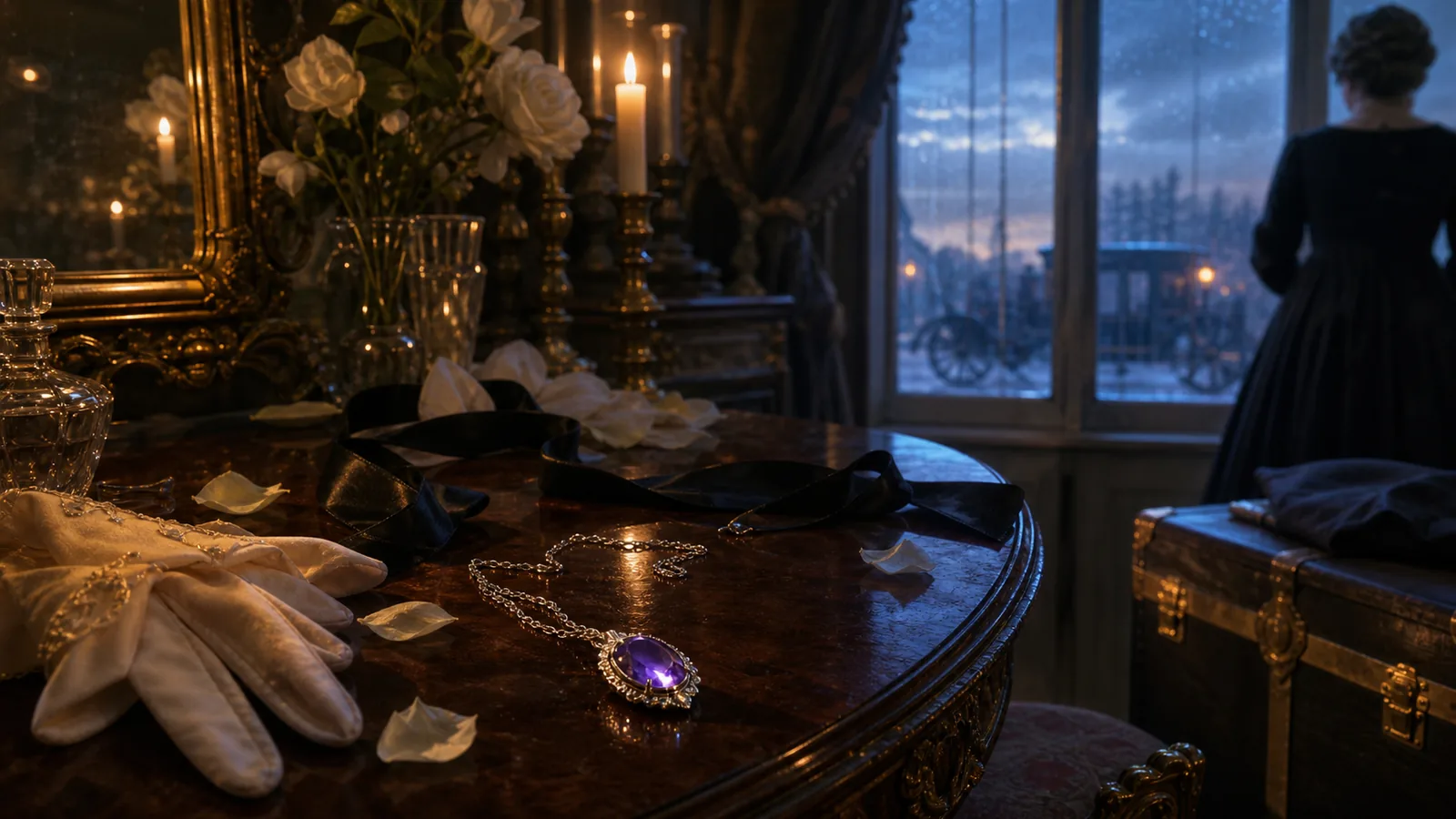
Her mother’s necklace is gone: a silver chain with an amethyst pendant, the only piece of her mother she has. She searches half the night and finds nothing. The loss arrives just as her planned escape collapses. Alfie tells her that Lady Penwood would not wait. The Penwood House position has been given to someone else.
Sophie cannot stay at Bridgerton House, not with Benedict there. She calls it torture. The Bruton Street opening is too close. Returning to the country feels like retreat. Then Alfie names the one position left: a family in Mayfair needs a lady’s maid to help them move.
They are moving to the Americas.
She would have to be on a ship in three days.
Posy then climbs out a drawing room window, slips into Bridgerton House, and gives Sophie the warning she deserves. Araminta has moved next door. She is looking for Sophie and means to have her arrested over the shoe clips. Posy admits the clips were her fault and says what she should have said long ago: the cruel things spoken about Sophie and her mother were untrue.
That apology matters. It also comes too late to keep Sophie safe.
By evening, Sophie has decided not to tell the Bridgerton servants where she is really going. Penwood House is easier to say than America. She also begins letting go of the necklace in her mind. Maybe she wore it to honor her mother. Maybe she wore it as a reminder of her mother’s mistakes. Either way, she is ready to leave the past behind.
Or she is trying very hard to sound ready.
Hyacinth delays her debut as Queen Charlotte misses Whistledown
Francesca’s loss sends little tremors through the whole ton.
Hyacinth suddenly wants no part of the marriage mart. She looks at John, Edmund, and Lord Featherington and decides love only brings hardship and sorrow. For a girl who has spent so long pressing her face against the ballroom window, the retreat is startling. Eloise, who has argued against marriage for years, finally hears her own logic coming back in a younger voice and does not look comforted by it.
Violet asks Marcus to keep their betrothal quiet for a while so their happiness will not overshadow Francesca’s grief. Marcus agrees without fuss. Lady Danbury prepares for her own departure and gently tells Violet that Francesca needs time.
Queen Charlotte, naturally, mourns in her own vocabulary.
She discusses funeral clothes, complains that her bonbons do not taste the same, requests Swiss replacements, considers importing a new animal, and finally admits the plain thing: she is sad. She has just bid farewell to Whistledown, and she misses her. A death, a friend’s impending absence, and the end of her favorite scandal sheet all sit together in one royal mood.
Francesca dances for John as Sophie is arrested
Francesca finally chooses Michaela’s way.
At Kilmartin House, family and friends gather again, this time to remember John as he lived. Michaela speaks first, calling him her greatest friend and partner in mischief since birth. Others follow: his kindness, his care, his rare words, his brandy-loosened surprises, his childhood tree climbing.
Then Francesca stands.
She says the thing everyone has been stepping around. It was only a headache. How could a headache take her husband away? She had planned their whole life. She thought she knew what the future held.
But she does not leave him there, trapped in the unfairness. Francesca remembers what it felt like to spend her whole life out of place and then meet someone who understood her before she said a word. John was her husband and her truest friend. The pain is present, but the love was worth it.
She would not change it.
For anything.
Michaela begins the Scottish Highland dance John knew as a child, and Francesca joins her. Soon everyone is pulled into it: stag, spin, arms, switch. It is messy, warm, ridiculous, and exactly the sort of remembrance Francesca could not bear to imagine earlier.
Benedict watches long enough to know what he has to do. He tells Violet he has waited long enough and leaves for Bridgerton House. Violet tells him she has left something in his desk, a keepsake from her grandmother, and lets him go.
He arrives too late.
Sophie has already left. The servants tell him she is not going to Penwood House. She has taken a post with a family sailing to the Americas at dawn, and she would not give their name.
Outside, Araminta gets there first. She hands Sophie to a constable, accuses her of thievery and impersonating nobility, and takes back what she wants. Sophie pleads with her, but Araminta does not soften.
Benedict calls Sophie’s name from behind the disaster.
This time, hearing her is not the same as reaching her.
Verdict
“The Beyond” is a strong penultimate entry, heavy with grief but never trapped under it. Francesca’s story gives the chapter its ache, and the move from funeral biscuits to a Highland dance keeps John’s absence human instead of ornamental. The conversations carry much of the force: Sophie with Francesca, Violet with Benedict, Benedict with Francesca, Posy with Sophie.
The Benedict-Sophie thread also gains urgency from how practical the barriers are: employment, class, false charges, family risk, and a ship leaving at dawn. The Queen’s Whistledown sadness and Hyacinth’s debut panic are smaller pleasures around the edges, but they fit the mood: everyone is learning what vanishes when love, gossip, or certainty leaves the room.
Rating: 8.7/10
More episodes from Bridgerton — Season 4 — Benedict and Sophie's masked-ball romance, episode by episode. Jump to any episode in the season:
Where to go next
Reviewed by Mira Vance · QuizFandom Editor & Lead Reviewer. Every rating is an honest per-watch assessment from the desk that also writes the quizzes — not a press release rehash.