Bridgerton S04E4 Recap: "An Offer From a Gentleman" — Every Kindness Has a Price
What happens — the short version (spoilers)
- Benedict brings Sophie to Bridgerton House after other households refuse to hire her.
- Violet hires Sophie for Eloise and Hyacinth after learning she can read, write, speak French, and knows Latin.
- Sophie bonds with Eloise and Hyacinth over books while the staff welcome Hazel into the household.
- Benedict questions Miss Hollis while Sophie pours tea and hears his search for the Lady in Silver continue.
- Francesca tells John the truth about not reaching a pinnacle, and John reassures her.
- Benedict confesses that Sophie consumes him and asks her to be his mistress.
Sophie Baek finds shelter in Bridgerton House, but shelter is a dangerous thing when the gentleman offering it cannot see the price she pays to accept.
Bridgerton, Season 4, Episode 4 — “An Offer From a Gentleman” Netflix
Everyone means well. Benedict offers Sophie work. Violet offers her a home. Lady Danbury offers Alice Mondrich a place near the Queen. John offers Francesca patience. Then Benedict makes the offer that turns the title from swoon to wound.
In Mayfair, good intentions still travel through rank, money, servants’ corridors, marriage prospects, and the awful little word “mistress.” Sophie knows that before Benedict does.
Sophie Baek arrives at Bridgerton House under Benedict’s protection
Sophie arrives asking all the practical questions.
Does Benedict know her new employers? Are they kind? Do they have children? The answer to all three is Bridgerton House, which is not the comfort Benedict seems to think it is.
He has brought her straight to his own family.
Sophie refuses at once. She thanks him for the ride and the offer, then tries to leave. Benedict has already written to friends, only to learn their wives have been warned not to hire her. The countryside is uncertain. Cavender House is worse. He lays out the logic, but Sophie hears the part he cannot: she has been moved from one man’s power into another’s.
Benedict insists she would work for his mother, not for him. The house is large, he says. They will hardly see one another. Then he adds, softly, “I know you, Sophie.”
The line wants to be romantic. It also frightens her.
Sophie has been fighting to control what people are allowed to know. Benedict knows her kindness, intelligence, courage, and face at the wrong distance from his, but he does not yet know the danger of knowing those things aloud.
Violet receives Sophie with gratitude and caution. Mrs. Wilson has heard rumors. Benedict answers with the simplest defense he has: Sophie saved his life, and he trusts her.
Sophie gives her qualifications. She can clean, mend, read, and write. Benedict adds French. Sophie adds Latin. Violet sees at once that this is not an ordinary ladies’ maid, then decides Eloise could use a push and Hyacinth could use a companion.
Just like that, Sophie has a room, a role, and a new problem: she is inside the family she once wished for, but only through the servants’ entrance.
Sophie meets the staff and finds common ground with Eloise
Bridgerton House is chaos in a very specific, very expensive key. Mrs. Wilson walks Sophie through the rooms. Miss Bridgerton reads and avoids society. Miss Hyacinth tries to sneak into balls. Laundry moves, kitchens hum, and John the footman offers Sophie a sweet before Celia decides she may have found someone immune to his charm.
Sophie arrives as someone who has done everything. At her last house, there were only eight of them, and she did all the cleaning, mending, washing, and brushing herself. When she reaches for a tray, Mrs. Wilson has to remind her that carrying it is not her job.
Hazel’s arrival gives the household a burst of relief. Benedict kept his promise and found her employment too. Sophie is grateful, but the moment sharpens what she already suspected. Benedict has been moving pieces around her life with a speed only a Bridgerton can afford.
Eloise has been ordered to observe Hyacinth’s dancing and treats it like punishment. Hyacinth wants to read to her about ballerinas or show her ribbons. Eloise is ready to despair over a future spent chaperoning younger relations.
Sophie quietly changes the weather.
Sophie asks Eloise how she knows she will not like the book; Hyacinth answers by explaining it is about Marie Sallé, a dancer famed for inventing her own steps. Eloise has read it. Sophie has read Miss Edgeworth. Eloise already knows Ennui — she asks Sophie whether she has read it, and Sophie has. Suddenly, the room has three girls talking about books instead of one older sister bracing for boredom.
Sophie reaches them by being exactly as bright as she is.
Violet offers Sophie a permanent place and Lady Danbury chooses Alice
Lady Danbury’s dinner keeps Benedict’s search alive in public. Violet has shown him miniatures from the masquerade guest list, and he is certain none are his unknown lady. Penelope wonders whether Whistledown has become a pawn for Queen Charlotte and every eager mama in the ton. Alice Mondrich volunteers to help search and welcomes the purpose.
Then Eloise and Hyacinth start praising Sophie: French, Latin, Korean, art, science, more than half the books in the library. The compliments sound sweet, but they also make Violet look again. Sophie’s education does not match the story society would like to tell about her station.
Violet invites Sophie to tea and asks gently but directly. Sophie says she grew up in Aylesbury. The lady she worked for allowed her to sit in on the children’s lessons. Cavender House was recent. The earlier household ended after a disagreement Sophie does not wish to discuss.
Violet does not force it. She gives Sophie a reason to breathe, asks about My Cottage, hears Sophie call it one of the happiest weeks of her life, and then offers something practical: if Sophie wants the position to become permanent, she should stay.
“My girls are fond of you,” Violet says. “Well, we all are.”
Sophie says she will consider it.
Lady Danbury prepares another offer. She tells Violet she has a gift for Alice, though it will benefit Agatha too. Violet answers the fear under that confession: wanting something for yourself is not selfish. Life is meant to be lived.
Agatha takes Alice to Queen Charlotte and secures the appointment before Alice has time to refuse. Alice is furious, and she has reason to be. Lady Danbury did not ask. But Agatha sees that Alice argues, does not shrink, and is not of the Queen’s world.
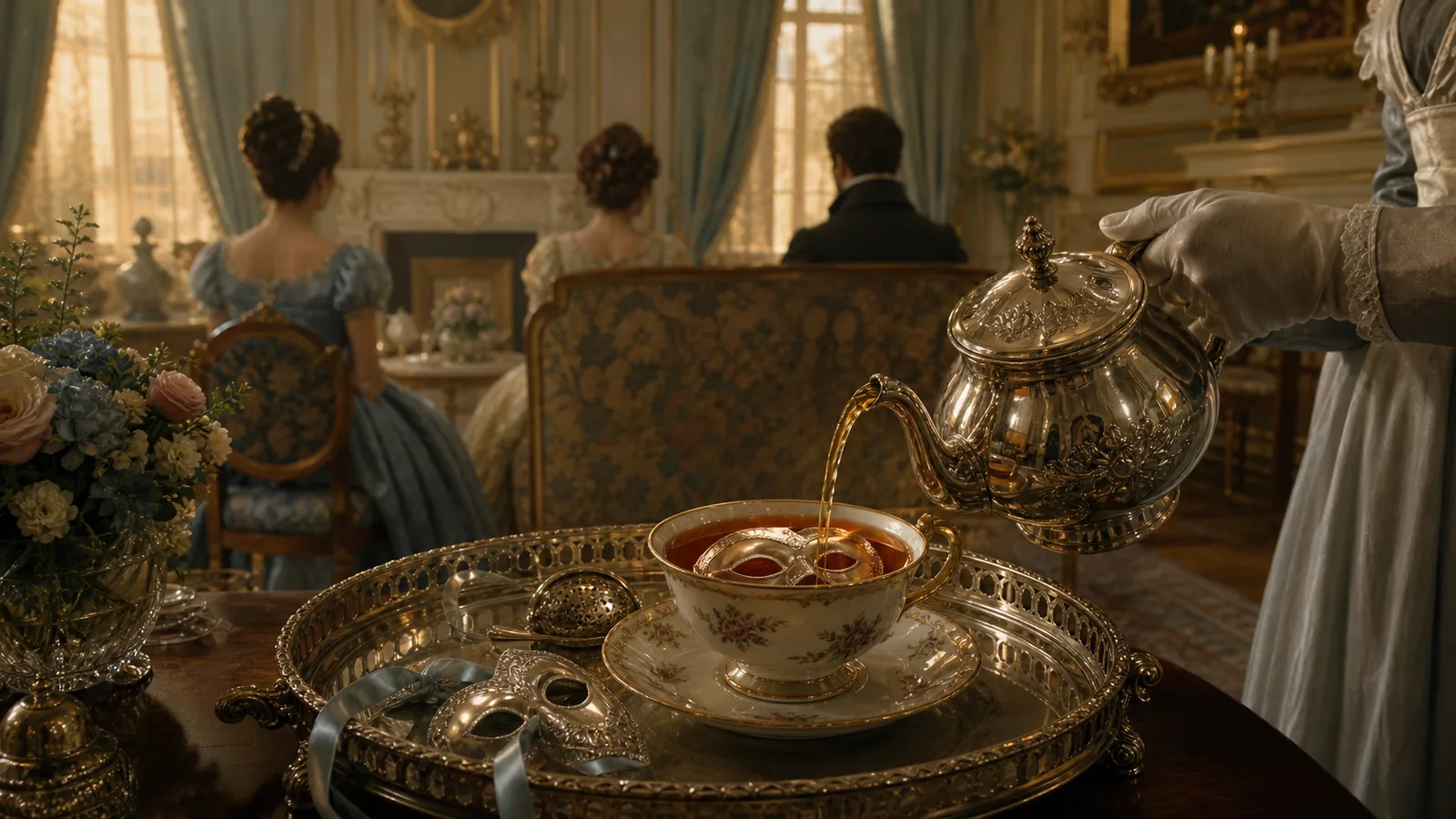
Benedict meets Miss Hollis while Sophie pours the tea
The search for the Lady in Silver narrows to Miss Hollis, a dark-haired neighbor who left town after the masquerade and has only just returned.
Violet arranges tea with Lady Hollis and her daughter. Benedict promises to be the epitome of charm and grace, which is always a dangerous sentence from a man who is about to interrogate a young lady about swimming.
At first, Miss Hollis seems plausible. She likes the country, freedom away from society’s watchful eye, swimming in the sea, and France.
Sophie pours the tea.
The pain is in how ordinary it looks to everyone else. Benedict is a gentleman speaking to an eligible young lady in his mother’s drawing room. Sophie is the maid with the pot, hearing questions that belong to her week with him.
Then Miss Hollis mentions that she was never at the masquerade. She fell ill and could not attend. The candidate collapses, but the damage is done.
Benedict finds Sophie afterward and apologizes. Sophie does not want the apology he is offering. She names the world as it is: he is a gentleman, gentlemen meet eligible young ladies, she is a maid, and she cleans up after them.
He says Miss Hollis can never compare.
Sophie asks, “Compare to what?”
That is the question Benedict keeps avoiding. If Sophie is not the Lady in Silver, then what is she allowed to be? If she is, what changes when she is standing there in a servant’s dress?
Sophie finally says the quiet part with force. This is the kindest position she has ever had, and he is ruining it by being everywhere. She asks why bachelors do not live in their bachelor lodgings.
Benedict agrees to stay away.
Before he goes, Sophie tells him it would be remiss not to pursue Miss Hollis. She seemed delightful, Sophie says. A perfect fantasy.
It is a cruel little mercy. She gives him permission to choose the easier dream because she cannot afford to be the real woman he wants.
Francesca tells John the truth while Violet keeps the house empty
Francesca kisses John without warning, then fumbles through an explanation about wanting to spontaneously enjoy tea together. Later, she asks Mrs. Wilson how one might arrange an evening tea with someone alone. Mrs. Wilson understands at once: send the servants away, move the family to dinner elsewhere, and keep the house quiet.
The language is all tea. The meaning is not.
Francesca wants desire to arrive correctly, privately, and without making too much noise. John notices the performance before she can hide inside it. After their night together, he asks whether she reached her pinnacle. Francesca says no, then admits she has not ever. She fears that is why they are not yet with child.
John answers with tenderness. There is nothing wrong with her. He wants to give her children and pinnacles, but she is right as she is, they are right as they are, and they have time.
Violet uses the same empty-house scheme for herself. With the family at Kilmartin House or otherwise occupied and the servants given the night off, her caller arrives. He says Mrs. Wilson told him she was serving tea somewhere new.
Violet answers, “I am the tea that you are having.”
By dinner, Francesca and John have arranged their home until everything is just right. Gregory wonders where Violet is. Someone suggests Benedict may have the same illness. Then Michaela arrives, driving herself because her coachman could not handle the journey, and Francesca looks as if she has seen a ghost.
Benedict follows Sophie back and asks her to be his mistress
Violet gives Benedict the advice he should have heard before he turned Sophie into a secret he could not name.
Miss Hollis is not the Lady in Silver, and Benedict says he may end the pursuit. Violet gently suggests that the woman may not exist in the way he imagined. Benedict has always chased the imagined. Violet still expects to see Edmund around every corner, but she knows reality is where love grows.
“Reality feeds your heart,” she tells him.
Sophie decides to stay at Bridgerton House. Mrs. Wilson tells her she is cherished there, truly. For one minute, it looks as if Sophie may get the humble, precious thing she wanted: work that does not degrade her, friends who call her to the tavern, a house where her intelligence is noticed as a gift.
Then she returns for her coin purse and finds Benedict.
He has stayed away because she consumes him, he says. His eyes search for her in every room. His heart beats when she is near. The reality of Sophie has become more tantalizing than any fantasy, and he cannot live without it.
Benedict says he meant it when he told her she deserved better. He says he is determined to give it to her.
Then he asks Sophie to be his mistress.
There it is: the offer from a gentleman.
Not marriage. Not public protection. Not a place at his side. A private arrangement that gives Benedict access to the woman he wants while leaving Sophie with the shame, the risk, and the proof that he still cannot imagine her fully in his world.
The interruption from the servants saves the scene from an answer, but not from the hurt. Sophie has been called to the tavern by people who know her as one of their own. Benedict has asked her into a life where she would belong nowhere.
Across Grosvenor Square, another warning arrives. A woman steps into the neighboring house and says she has always wanted to live there. A servant answers, “Welcome back, ma’am.”
Sophie has chosen to stay.
Her past has found the square.
Verdict
“An Offer From a Gentleman” is a rich, painful midseason turn because romance and rank collide without pretending good intentions solve the problem. Benedict is sincere. Sophie knows sincerity will not protect her. That tension gives the final proposal real sting, especially after so many people spend the chapter learning how to ask for what they want.
The ensemble material is strong too. Francesca and John get a gentle, grown-up intimacy thread. Violet’s private tea is playful and deserved. Lady Danbury’s push for Alice is messy in the right way, even when it moves quickly. A few transitions are crowded, but the Benedict-Sophie ending lands hard because the wrong offer comes wrapped in the right confession.
Rating: 8.5/10
More episodes from Bridgerton — Season 4 — Benedict and Sophie's masked-ball romance, episode by episode. Jump to any episode in the season:
Where to go next
Reviewed by Mira Vance · QuizFandom Editor & Lead Reviewer. Every rating is an honest per-watch assessment from the desk that also writes the quizzes — not a press release rehash.