For All Mankind S2E1 Review: A Decade Jump Lands on a Solar Storm
The premiere flashes through Reagan-era alt-history before a coronal mass ejection traveling at thirty percent of light speed forces Jamestown into a shelter it cannot fully provide.
For All Mankind has always treated the time jump as a thesis. Each season opens a decade later and asks what the alt-history premise cost the people who survived the last one. The second season picks up around 1983, after a Nixon voiceover insists there is no substitute for victory, after Reagan’s “city on the highest hill in the sky” speech has rebranded the moon as American real estate, and after Jamestown has grown from the three-cot bunker Gordo remembers into a base with its own commander, dosimeter protocols, and TV cameras pointed at the sunrise. The premiere uses a montage to set the table and a solar flare to flip it. By the time Molly Cobb is dragging an unconscious Wubbo Ockels across regolith with her own badge going red, the show has made it plain that the price of the new space race will be paid in millirems.
A montage redraws a decade of alt-history
The opening prologue is dense to the point of being a homework assignment. News clips compress ten years of drift into one sequence. Brezhnev refocuses Soviet resources away from Afghanistan and into the space race. The 1980 US Olympic hockey team fails to overcome the heavily favored Soviets. John Lennon survives a would-be assassin; John Paul II does not. Polanski is caught at the Canadian border. Charles marries Camilla, not Diana. Reagan refuses to bail out Chrysler. Jamestown reactor tech prevents a meltdown on Earth. Brezhnev dies; Andropov succeeds him. The shuttle Enterprise gets named after the Star Trek starship.
The detail that lands hardest is the smallest one. Jamestown’s reactor tech is patching civilian plants. Microgravity-grown silicon is a licensable revenue stream. NASA is not a budget item anymore. It is a sovereign enterprise that prints money, leases printers to its generals, and treats the Pentagon as a customer. The cold open is the show explaining, very quickly, that the city on the highest hill has been built and everyone is now arguing about who pays the property tax.
Jamestown has become a base, with everything that implies
The lunar sequences open on Jodi Balfour’s Ellen Wilson, base commander, declining another going-away party while two weeks of polar night thaw into a sunrise everyone outside is suited up to watch. She has seen the sunrise more times than she can remember. She wants the new commander to bond with the crew. She wants the base to herself for what will be the last time. The choice is staged as a small one and the show treats it as a major character beat. Ellen has stopped being a pilot. She has become an administrator.
Outside, Sonya Walger’s Molly Cobb has not. She and Wubbo are parked at the western rim of Shackleton crater, bickering over whether the rover is best positioned for a photograph or a moon. Molly has rechristened the twin peaks above the rim “Lenny and Squiggy.” Wubbo has a camera and a sense of awe. The premiere needs the audience to like both of them quickly, because by the end of the hour Molly will be dragging Wubbo across a kilometer of difficult terrain in an unsealed suit, and the second-season thesis depends on that drag mattering.
The sing-along of Bob Marley’s “Three Little Birds” between Jamestown and the rim crew is the kind of grace note this show has always been good at. The episode title is the lyric. The promise the song makes — every little thing is gonna be all right — is the promise the proton radiation will, an act later, violate.
NASA is now a Pentagon supplier and a private empire
Wrenn Schmidt’s Margo Madison runs her JSC morning like a corporate procedural. She negotiates with Nelson Bradford over polar shuttle launches from Vandenberg, trades Army-Air Force fifty-yard-line tickets for landing clearance at Edwards, and gets nowhere on launching unsecured civilian crews from a Pentagon pad. Berlin is referenced as the precipitating incident — a year on, still unresolved, still souring every shuttle conversation. The fleet has grown to a dozen named vehicles. The next-generation shuttle is Pathfinder, and the White House wants it armed on its maiden voyage.
That is the political spine of the hour. Administrator Tom Paine has dinner-pitched Margo on putting ordnance on Pathfinder to send a message to the Soviets, who are about to test their own shuttle. Once weapons go on, Pathfinder belongs to the Joint Chiefs. The civilian agency that has run the moon for a decade becomes a parts supplier. Joel Kinnaman’s Ed Baldwin, now Chief of the Astronaut Office, tells Paine that payload is outside his lane and that if Paine can turn Margo around over a bowl of chili, he is in. Read against the next forty minutes, it is a man telling his agency’s most powerful administrator that the political fight is not his.
The Ed we meet here is a different man than the one who walked away from Apollo 15. He has a putter, a Pebble Beach golf carpet, and a one-line management style — “I’ll let you know when you’re ready” — that he uses on young pilot Gary Piscotty with practiced cruelty. Gary has logged three years, five CAPCOM shifts, qualifications across every vehicle the agency flies, and a 95th-percentile evaluation. Ed lets him walk through the resume, says nothing, and tells him to take his foot off the golf ball. The show is not signaling Ed is wrong. It is signaling the position he has reached — the one that lets him grant or withhold flights — is the position he refused for a decade and now wields like a man who knows what it cost him to get there.
The Stevens household is the season’s emotional shipwreck
If Ed has become an executive, Michael Dorman’s Gordo Stevens has become a punchline he is not in on. The premiere puts him in front of a community-college lecture hall, fielding bathroom-in-space questions and telling a Texas audience that on the old Jamestown “we were the settlers, and the Russians, they were the Indians.” The room laughs. The episode does not. Dorman plays the line with a half-second of recognition that the joke is no longer working on him. When someone asks for the story of the girl who broke her arm on the moon, he tries to tell it and breaks. He says it all just falls apart on you, and the audience clears their throats waiting for him to finish.
That same evening, his ex-wife Sarah Jones’s Tracy is on Johnny Carson explaining that she just married Sam Cleveland in Vegas. Dorman lets Gordo absorb it without performing it. Jimmy, the younger Stevens son, says his mom left a message on the machine the night before, sounded loopy, and he did not think it was important. Gordo says he knew it was going to happen eventually, declines Ed’s offer to knock back a few, says he will be fine. The show has set up two parallel collapses — Gordo’s by inches, the storm’s by minutes.
A solar flare wrecks the entire chessboard
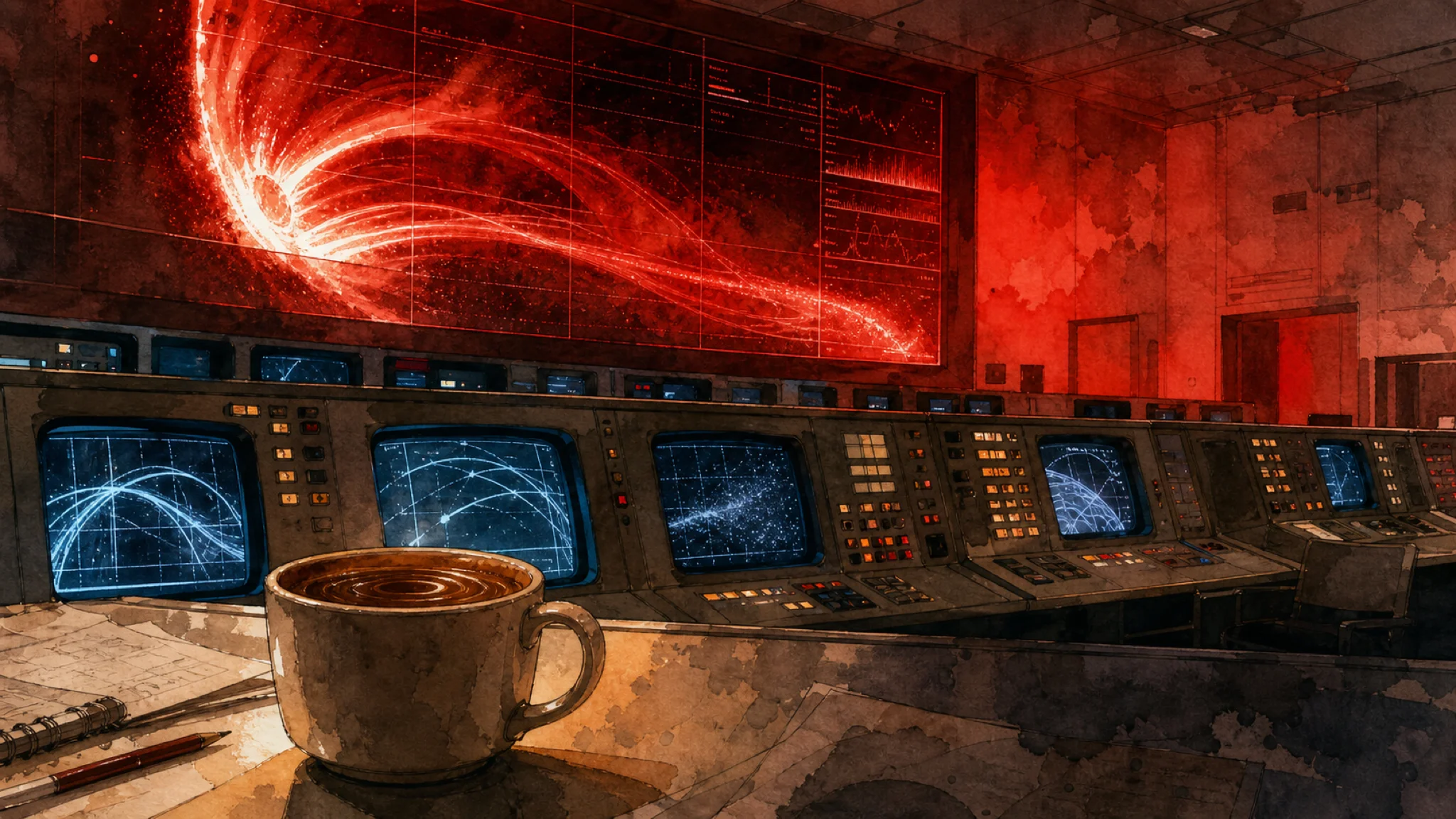
The back half is the same craft applied to a weather event. Bill the CAPCOM and Doreen Campbell the Skylab astronomer notice a major solar flare, then notice it is bigger than anything in recorded observation, then notice Mariner 14 has gone dark inside the orbit of Mercury too fast for the plasma to have reached it. Margo’s room realizes the proton radiation is moving at thirty percent of the speed of light. CMEs normally take days to travel from the sun to the moon. This one will reach Jamestown in under half an hour.
The premiere stages the response with the show’s signature procedural calm. Skylab shelters. Columbia, in lunar orbit, hunkers the crew on the mid-deck. Jamestown scrams the reactor, switches to reserve power, and gets every astronaut on the surface either back to base or into three meters of regolith. The closing montage cuts between Ellen running depressurization checks, the Joint Chiefs putting Reagan on Air Force One, Bradford recommending DEFCON 3 because the Soviets will lose eyes on North America and may interpret the blackout as cover for a first strike, and Margo explaining dosimeter color to Paine in a sentence the episode lets land twice. Badge is green, body is clean. Badge is red — Paine completes it, against his will. Margo says it is not good. The understatement is doing all the work.
The final sequence belongs to Molly. She reaches the lava tube at base camp, calls for Wubbo, gets static, and finds him collapsed short of the entrance with his suit torn from a fall. The premiere stretches her drag across five minutes of panting, regolith, and a woman who would not stop staring at the moon refusing to leave a man who would not stop pointing a camera at it. The storm has not yet hit the moon. The closing shot is her badge.
What this episode argues
The premiere is making two arguments at once. The first is structural. The decade jump did not arrive at peace. It arrived at a militarized standoff where space is the disputed border, NASA is a partial Pentagon supplier, and a solar weather event can push two superpowers two notches up the nuclear ladder because both now depend on satellites neither can quickly replace. The cold open’s archive of small alt-history changes was always going to compound, and the storm is the compounding. The second argument is about people. Ed has stopped flying and started gatekeeping. Ellen has stopped flying and started administering. Gordo has stopped flying and started drinking through community-college Q&As. Molly has not stopped, and the universe is about to punish her for it in roentgens.
Verdict
“Every Little Thing” is doing a lot of work in one hour and it shows in the seams. The cold open asks the audience to absorb ten years of alternate history without losing the thread, and the first thirty minutes are wall-to-wall table-setting — Pathfinder politics, Shantel VanSanten’s Karen Baldwin and the restaurant accounting, Kelly’s college catalogs, Gary’s flight ambitions, Tracy’s televised remarriage. A few new faces (Gary, Doreen, Bill, Sam Cleveland) are still sketches. But the show’s long-arc craft is unmistakable. The solar flare is procedurally clean, the escalation to DEFCON 3 is sharpened rather than spelled out, and the Marley sing-along earns the closing montage by setting the audience up to believe everything is going to be all right roughly forty minutes before it is not. Gordo’s lecture-hall collapse and Molly’s lava-tube drag give the hour two parallel emotional spines that will hold up the season.
A premiere this committed to scaffolding for ten episodes will live or die on the payoff. The closing image — a single dosimeter on a single wrist, the storm still seconds out — is a stronger hook than the season needed. The show has stopped pretending the moon is a frontier. It has started writing it as an exposed surface.
Rating: 8.6/10
More episodes from For All Mankind — Season 2 — Cold War escalates to the lunar surface, episode by episode. Jump to any episode in the season:
Where to go next
Reviewed by Mira Vance · QuizFandom Editor & Lead Reviewer. Every rating is an honest per-watch assessment from the desk that also writes the quizzes — not a press release rehash.