For All Mankind S2E10 Review: Two Astronauts, No Suits, and the Hour That Made the Show
Ron Moore's writers room closes 1983 the way a finale should — with a near-war averted by a handshake, a meltdown stopped by a duct-tape suit, and a love song scoring a death.
For nine episodes “The Grey” has threaded three fuses — a Soviet defector on Jamestown, a nuclear-armed Pathfinder crossing a blockade, an Apollo-Soyuz handshake nobody in either capital wants. The finale lights all three and refuses to let any resolve cleanly. By the end of the hour two astronauts are dead on the lunar surface, a third has been talked out of firing the first shot of World War III by a colleague with a sidearm, and the Soviet intelligence officer Margo Madison thinks is her friend is being congratulated for opening the door. Ronald D. Moore and writer Matt Wolpert deliver a finale that is loud where it needs to be and quiet where it counts.
Two reactors, forty-five minutes, and a roll of duct tape
The Jamestown crisis is the spine. Soviet marines breach Ops/Comm in the cold open, take Commander Rossi hostage, and demand cosmonaut Rolan Baranov in exchange. The American garrison fights back, loses Vance to a point-blank shot, and stalls. Then the lights start blinking in Houston. The primary coolant pump for the nuclear reactor has shut down, and General Bradford has to tell Margo Madison (Wrenn Schmidt) what the Pentagon never told JSC: there is a second reactor. It was smuggled up under last month’s Sea Dragon payload to produce weapons-grade plutonium, and because national-security timelines beat the safety schedule, it was brought online before the backup coolant loop was connected. No fail-safe. Forty-five minutes to a meltdown that would render Shackleton uninhabitable for a thousand years.
Margo’s reaction is the closest the show comes to letting a department director throw a chair. “Forget for a moment just how nonsensical it is to have nuclear weapons on the moon at all” — delivered to Ellen Wilson (Jodi Balfour) — is the show’s whole second-season argument in a sentence. The Pentagon turned the lunar base into a plutonium farm. The base is now hours from glassing itself because no one in the room was allowed to know enough to do their jobs. Schmidt plays the fury with her shoulders rather than her voice.
The fix is engineered as a kitchen-table problem. The cable connectors that would swap the backup computer to the primary loop are twenty-five meters outside the depressurized hub. There are no suits. Gordo Stevens (Michael Dorman) — who has spent the season visibly losing a battle with his own psyche — volunteers to run those twenty-five meters without one. Molly Cobb walks Houston through what it would take. Breathe out all the air in your lungs or they burst. Wrap every inch of exposed skin in duct tape, because anything uncovered balloons the second it hits vacuum. The adhesive will melt at two hundred degrees Fahrenheit. Fifteen seconds before he loses consciousness.
Tracy refuses to let him go alone
The scene that lifts the sequence from stunt to the show’s high-water mark is in the galley. Tracy Stevens (Sarah Jones) takes the second roll of tape. Gordo tries to talk her out of it. She cuts him off. “Don’t you dare make me tell our boys their daddy didn’t have to die.” Jones — who has played Tracy for two seasons as a woman performing celebrity to survive an industry that wanted her quiet — lets the line do its own work without a tear and without a swell on the soundtrack. The decision rhymes with everything the show has been telling us about the Stevens marriage: the fights, the affairs, the public divorce, the slow re-coupling on the moon over six tapes of Bob Newhart. They go through the air lock holding hands.
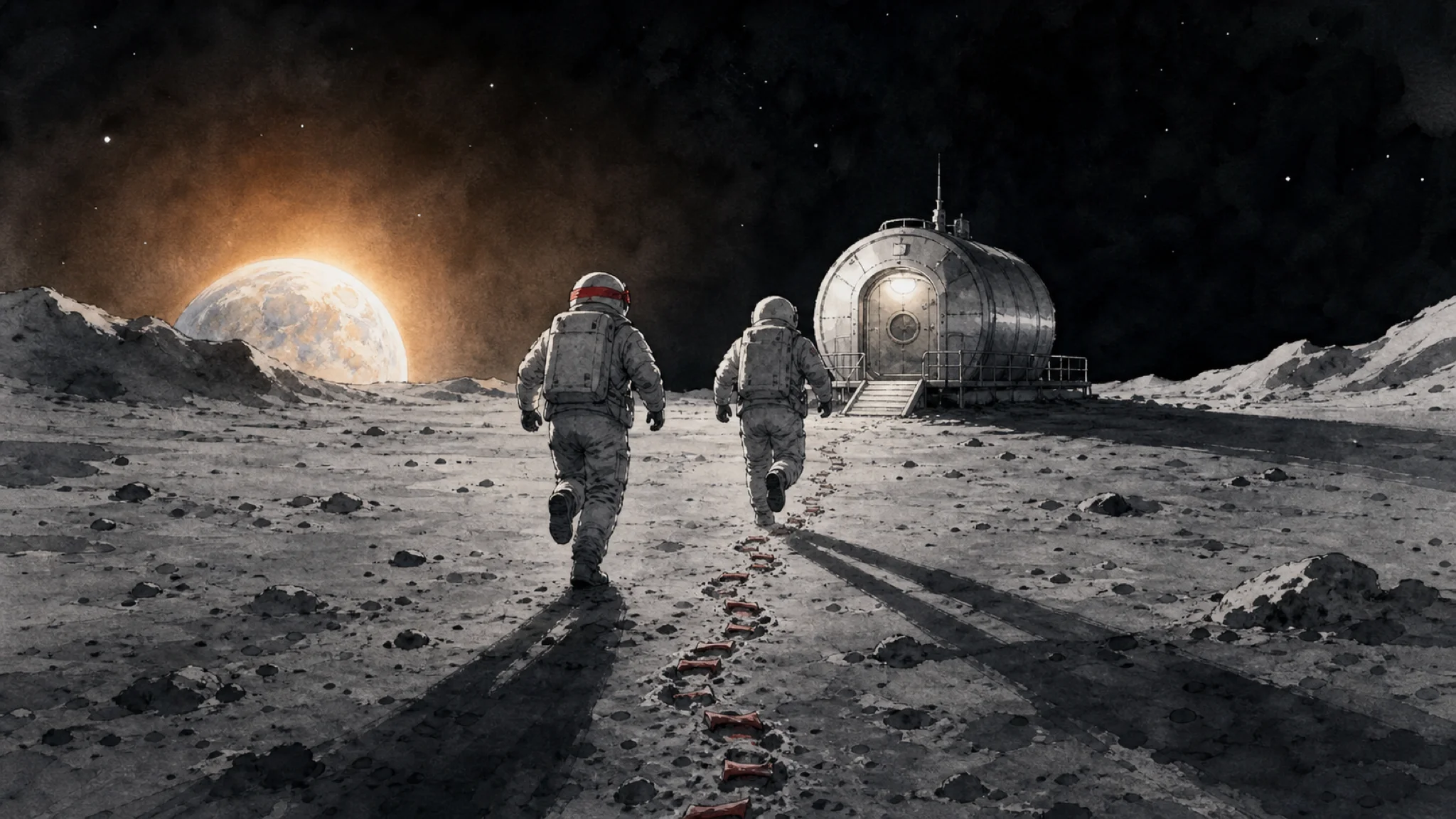
Director Sergio Mimica-Gezzan stages the run in long, almost dialogue-free takes. The duct-tape suits are absurd by design — Tracy tells Gordo he looks ridiculous; he says he makes the suit sing — and the absurdity is what makes the death watchable. They reach the cables. They reboot the computer. The reactor stabilizes. The air lock repressurizes. Houston cheers. Then the camera pulls back and lets you understand, without a line of dialogue, that they will not survive what they just absorbed. The funeral — three rifle volleys at a flag-draped grave — runs without undercut.
Dani Poole keeps Apollo-Soyuz alive on her own authority
The diplomatic spine of the hour is the handshake nobody is letting happen. The Soviets keep postponing the docking; Sergei eventually admits to Margo from a payphone that Soyuz has avionics issues Andropov will not let them confess. When the Gulf of Mexico standoff goes DEFCON 2 and air-raid sirens cut across Houston, the president cancels the mission. Danielle Poole (Krys Marshall) hears the recall order and refuses to take it. “And I am telling you it ain’t happening.” She tells Stepan on the Soyuz to begin docking procedures or they will crash into each other on national television.
What lifts the moment is Margo’s response in MOCC. Bradford is incandescent. Margo overrules him — “I speak for the president in this room, and I think one good thing should happen on this shitty day” — and tells Bill Strausser to clear Apollo for docking. The season has built Margo as the one administrator who refuses to be intimidated by the Pentagon, the Soviets, or Tom Paine’s ghost. She gives Aleida the headset to make the call. Marshall sells Poole’s defiance as exhaustion rather than heroism, which is what makes it heroic. John Lennon’s “Well Well Well” comes up under the handshake and the show finally allows itself a swing of unguarded joy. Reagan, on Air Force One, watches the footage and reroutes to Moscow.
Sally Ride pulls a gun on Ed Baldwin
The Pathfinder confrontation is the season’s other great two-hander. With Buran in missile-lock range of Sea Dragon and Houston out of comms behind the moon, Ed Baldwin (Joel Kinnaman) orders Sally Ride to lock weapons on the Soviet ship. Ride refuses. Ed relieves her, takes the station himself. Ride retrieves the sidearm from the locker and points it at his back. “Step away from the console.”
The argument that follows is the show’s sharpest statement of its politics to date. Ed runs the Korea analogy — strength is the only language these people understand. Ride runs the math — Sea Dragon is unmanned, Buran is not, and a hot kill on the moon starts a war that ends millions. Sally Ride — written here as the conscience of the program — does not pretend she is comfortable with the gun. She is shaking. Ed dares her to fire it inside a pressurized spacecraft and pivots back to the console. The standoff breaks because Houston returns to comm range with news that Reagan has re-routed to Moscow and ordered a mutual pullback. The console reboots in time. The fire-control sequence aborts. Kinnaman plays Ed afterward as a man who has just discovered he was about to do something he could not have walked back, and the show is honest enough not to give him a redemption beat. He exhales.
Karen sells the Outpost; Kelly applies to Annapolis
The civilian beats are the finale’s quietest gambit. Karen Baldwin (Shantel VanSanten) sells the Outpost to Sam Cleveland in a transaction that takes one morning and one signature, then tells Kelly over a final drink that she does not know what she is going to do next. The conversation drifts to William & Mary, to India, to elephants. Kelly asks if her parents are getting a divorce. Karen does not answer. The air-raid siren cuts the scene short.
The closing monologue belongs to Kelly, narrating her Naval Academy application essay over the epilogue. Operation Babylift, 1972 — a C-5A Galaxy out of Saigon, 243 children, a crash one minute and twenty-three seconds into the flight, forty-seven survivors. She was one of them. The essay reckons with whether the moments that shape a life have a design or whether people invent one to feel better. She lands on a John Lennon line about how everything will be okay, and if it is not, that just means there is more story coming. She signs both names. Hanh Nguyen, born in Saigon. Kelly Ann Baldwin, raised in Houston. A child of the space program.
What this episode argues
Every storyline in the finale pivots on the same question. Who gets to make the call when the chain of command produces a worse outcome than the people in the room? Dani Poole disobeys a presidential recall and saves the handshake. Sally Ride pulls a sidearm on her commander and stops a war. Margo Madison clears a docking the White House just cancelled. Gordo and Tracy run a duct-tape sprint NASA’s official manuals do not contain. The finale’s thesis is that institutions on autopilot pick the worst available option roughly every time, and the only check on that is the individual willing to be insubordinate for the right reason.
The closing kicker is the only beat that refuses to honor that thesis. Sergei calls Margo to pay his respects after the funeral and floats a drink at the ICSE conference in the UK that summer. Margo, fragile and grieving and a little flattered, says she will see what she can do. The camera cuts to Sergei in a Moscow office handing the phone to a handler. “By the time she realizes she is working for us, it will be too late.” The conscience of MOCC has just unknowingly volunteered to be the asset, and the show plants it as the season’s last image before the time jump.
Verdict
This is one of the great hours of prestige television built in the last decade and the closest the show ever gets to the platonic version of itself. The Gordo and Tracy sequence has been quoted, parodied, and ranked on every “best of” list since it aired, and re-watching it the staging holds. Mimica-Gezzan and DP Stephen McNutt build the run on long takes, restrained score, and the duct-tape suits’ actual silhouettes. Tracy and Gordo play the galley scene without a single false note. The Pathfinder standoff is the rare Cold War set piece where both characters’ positions are coherent enough that the show does not need to pick a side. Marshall, Schmidt, and Balfour run a parallel three-hander in MOCC that would carry a lesser finale on its own.
What keeps it from a flat ten is structural. The Sergei coda is the show’s first overt move into spy-thriller plumbing, and while it lands it also leans heavier than the season has earned — Sergei has been written as a sincere counterpart for so long that the betrayal reads as a writers-room decision more than a character one. The Pathfinder bridge resolves on a deus ex Moscow that the script needs more than it earns. None of which dents the central achievement. This is what a season finale looks like when a show knows exactly which threads to braid, which to snap, and which to leave hanging.
Rating: 9.4/10
More episodes from For All Mankind — Season 2 — Cold War escalates to the lunar surface, episode by episode. Jump to any episode in the season:
Where to go next
Reviewed by Mira Vance · QuizFandom Editor & Lead Reviewer. Every rating is an honest per-watch assessment from the desk that also writes the quizzes — not a press release rehash.